The Ultimate Guide to Fidelity Stock Trading Fees

What Does It Actually Cost to Trade Stocks at Fidelity?
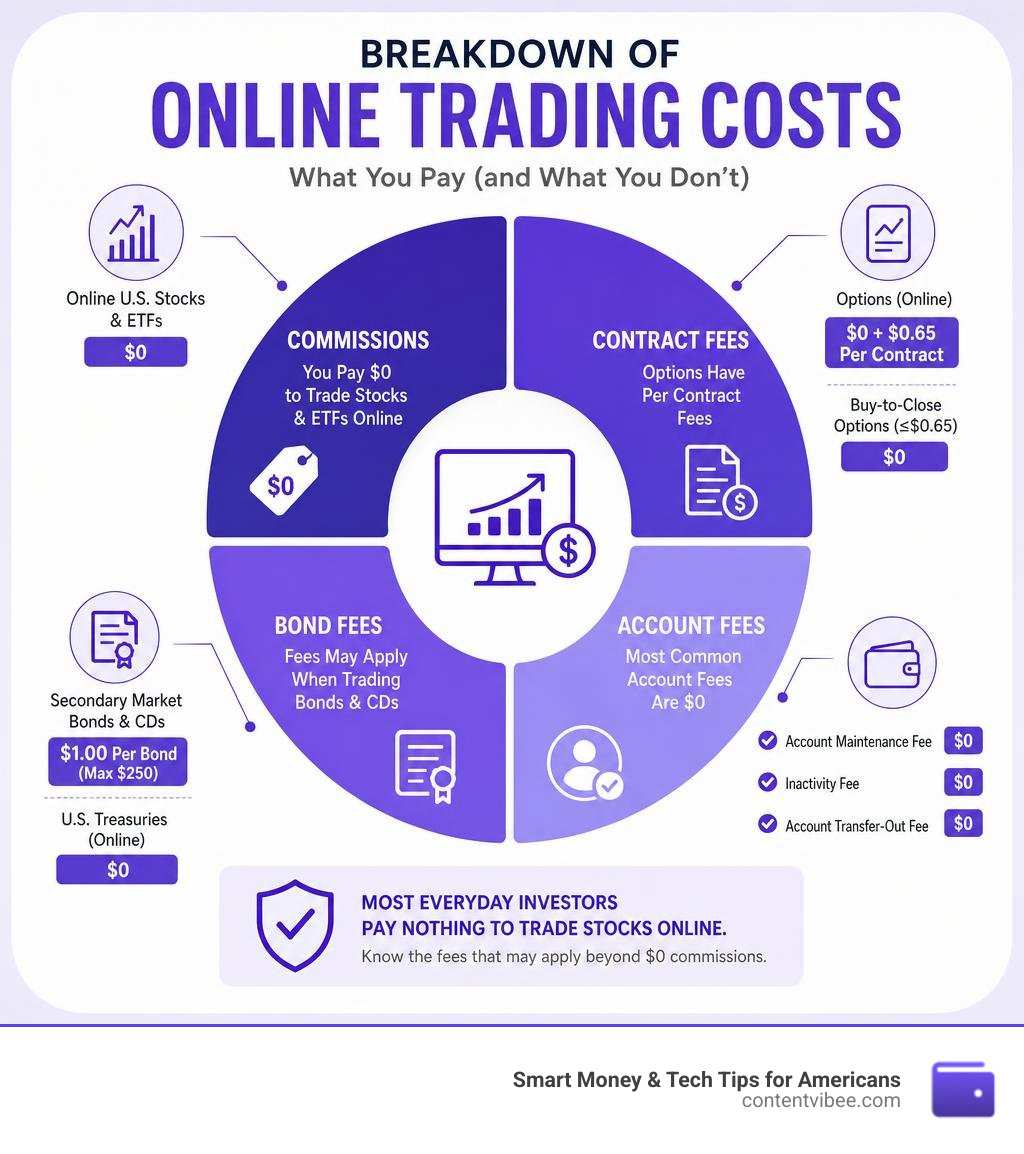
Fidelity stock trade cost for online U.S. stocks and ETFs is $0 commission. That’s the short answer.
Here’s a quick breakdown of the key fees you’ll encounter:
| Trade Type | Cost |
|---|---|
| Online U.S. stocks & ETFs | $0 |
| Options (online) | $0 + $0.65 per contract |
| Buy-to-close options (≤$0.65) | $0 |
| Secondary market bonds & CDs | $1.00 per bond (max $250) |
| U.S. Treasuries (online) | $0 |
| Non-Fidelity mutual funds (transaction-fee) | $49.95 |
| Broker-assisted trades | $32.95 |
| Account maintenance fee | $0 |
| Inactivity fee | $0 |
| Account transfer-out fee | $0 |
So yes — most everyday investors pay nothing to trade stocks online at Fidelity.
But “zero commission” doesn’t mean zero cost. There are contract fees, regulatory assessments, margin interest rates, and situational charges that can add up — especially for retirees managing bonds, mutual funds, or options alongside their stock portfolio.
This guide walks you through every layer of Fidelity’s fee structure in plain language, so you know exactly what you’re paying (and what you’re not).
Understanding the Core Fidelity Stock Trade Cost
When we talk about the core fidelity stock trade cost, we are looking at the standard retail brokerage account transactions. For the vast majority of self-directed investors in July 2026, the cost to buy and sell standard equities online is completely free.
Whether you are executing trades through the web portal, the mobile app, or Active Trader Pro, online U.S. stock and ETF trades carry a flat $0 commission. If you are curious about how this compares to other platforms, you can check out our deep dive on Are Fidelity Stock Trading Fees Really Zero.
But how does this work in practice? Let’s break down the mechanics of “free” trades:
Fractional Shares (Stock Slices)
If you do not have enough cash to buy a full share of a high-priced stock, you can buy fractional shares (which Fidelity refers to as “Stocks Slices”). You can invest in more than 7,000 U.S. stocks and ETFs with as little as $1. The great news is that there are no extra fees for this service. To learn more about how this works, read our guide on Does Buying Stock Slices Cost Extra Fidelity Fractional Fees Explained.
Trade Execution and Price Improvement
Even when commissions are $0, the quality of your trade execution matters. When you place a market order, your broker routes it to market centers. Fidelity is known for its excellent price execution. On average, they save investors $24.50 on a 1,000-share equity order compared to the industry average of $4.34. This is because they actively seek price improvements (getting you a slightly lower buy price or a slightly higher sell price than the public quote).
For more detailed information on their execution standards, check out the official Trading Commissions and Margin Rates | Fidelity page.
The “No-Commission” Catch
Is there a catch to these free trades? Generally, no. However, you must be aware of the “Additional Assessment” fee. This is a tiny regulatory fee charged on sell orders (typically $0.01 to $0.03 per $1,000 of principal) to offset fees charged to brokerages by the SEC and self-regulatory organizations. It is not a markup by the broker, but rather a pass-through fee.
To understand how these tiny fractions affect your bottom line, take a look at our analysis of Are Fidelity Trades Really Free Demystifying The Fees and read How Much Does Fidelity Actually Charge To Trade Stocks to see real-world math.
Beyond the Basics: Options, Bonds, and Mutual Fund Fees
While standard stock trades are free, your fidelity stock trade cost changes when you venture into other asset classes.

Mutual Funds and Transaction Fees
Fidelity offers over 10,000 mutual funds. Many of these are part of their “No Transaction Fee” (NTF) network, meaning you can buy and sell them for $0. However, if you purchase a transaction-fee fund from an outside fund family, you will pay a steep $49.95 per purchase online.
Furthermore, if you sell an NTF fund that you have held for less than 60 days, you will be hit with an early redemption fee of $49.95. We explain these nuances in detail in our article Fidelity Mutual Fund Trade Fee When Is Free Not Actually Free.
Fixed Income and Bonds
If you are building a retirement portfolio with fixed income, online purchases of new-issue U.S. Treasuries are completely free. For secondary market bonds and CDs, there is a markup of $1.00 per bond (with a maximum of $250 per trade, or $50 for bonds maturing in one year or less). If you require broker assistance to place these bond trades, an additional fee of $19.95 applies.
For the complete, unedited breakdown of these asset classes, you can download the official Fidelity Brokerage and Commission Fee Schedule | Trading information or view the summaries on Commissions, Margin Rates, and Fees .
How Options Impact Your Overall Fidelity Stock Trade Cost
Options trading at Fidelity is highly competitive, but it is not entirely free. While the base commission is $0, you must pay a $0.65 per-contract fee.
Let’s look at how this impacts your trading math:
- Buying 1 contract: Your fee is $0.65.
- Buying 10 contracts: Your fee is $6.50.
- Buying 100 contracts: Your fee is $65.00.
There is, however, an investor-friendly exception: Buy-to-close orders for low-priced options (valued at $0.65 or less) are completely free. If you are trying to exit a position that has lost most of its value or is close to expiring worthless, you can close it online without paying the contract fee.
Be aware that options trades are also subject to the Options Regulatory Fee (ORF), which is a regulatory pass-through fee ranging from $0.02 to $0.04 per contract. For a deeper dive into these contract calculations, read Fidelity Fee Per Trade.
Hidden Costs and the True Fidelity Stock Trade Cost for Alternative Assets
If you step outside of standard U.S. equities, you may encounter situational fees that can catch you off guard.
- OTC Penny Stocks: While many over-the-counter (OTC) trades are free, certain micro-cap or penny stocks may carry specific settlement or transaction fees. You can read our complete guide on Fidelity Penny Stocks Fees The Ultimate Guide To Otc Trading to learn how to avoid these.
- Foreign Ordinary Shares: Trading international stocks directly on foreign exchanges carries higher costs. You will face country-specific taxes, local exchange fees, and currency conversion fees.
- Currency Conversion Fees: If you trade in foreign currencies, a conversion fee of up to 1% of the principal value applies for transactions under $100,000 (decreasing for larger volumes).
- Physical Precious Metals: Buying gold or silver through your brokerage account incurs a transaction fee of up to 2.90% of the purchase amount, plus a quarterly storage fee (typically 0.125% of the asset value, with a $3.75 quarterly minimum).
Margin Rates and Account Maintenance Costs
If you trade on margin (borrowing money from the broker to purchase securities), you must pay close attention to margin interest rates. These rates are tiered based on your debit balance.
As of their latest rate adjustments (with the base rate set at 10.575% effective December 12, 2025), the tiered margin interest rates are structured as follows:
| Margin Debit Balance | Margin Interest Rate |
|---|---|
| Under $25,000 | 11.825% |
| $25,000 – $49,999 | 11.325% |
| $50,000 – $99,999 | 10.075% |
| $100,000 – $249,999 | 9.575% |
| $250,000 – $499,999 | 9.075% |
| $500,000 – $999,999 | 8.500% |
| $1,000,000+ | 7.500% |
Because margin rates for smaller balances are relatively high, we recommend margin trading primarily for experienced investors who understand the risks of leverage.
On the bright side, their non-trading fees are incredibly low. They charge $0 for account maintenance, $0 for inactivity, and $0 for account transfers.
Let’s see how this compares to other major brokerages:
| Fee Type | Fidelity | Competitor A | Competitor B |
|---|---|---|---|
| Annual Account Fee | $0 | $20 | $0 |
| Outgoing Account Transfer (ACAT) | $0 | $50 | $75 |
| Bank Wire Fee (Online) | $0 | $15 | $25 |
| Insufficient Funds Fee | $0 | $25 | $20 |
For a comprehensive review of these non-trading costs, check out our guide on Fidelity Brokerage Account Fees Review What You Need To Know. You can also read about the standard account features on the Fidelity Brokerage Account from Fidelity Investments page.
Zero-Expense Ratio Funds and Low-Cost Investing Options
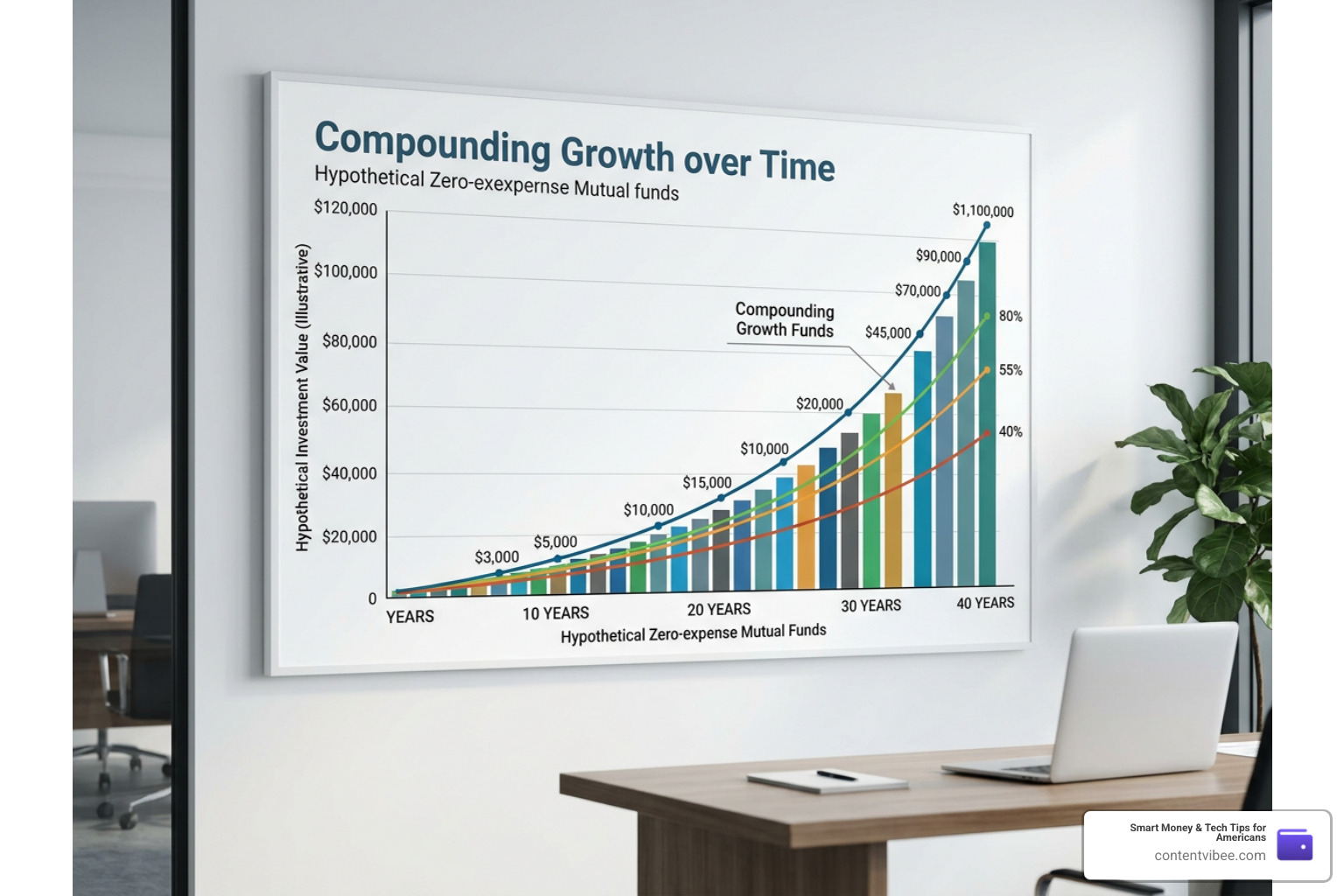
One of the best ways to keep your overall investment costs low is to take advantage of zero-expense-ratio mutual funds.
Fidelity was the first in the industry to introduce ZERO index mutual funds with no minimums to invest. These funds charge an absolute 0.00% expense ratio:
- Fidelity ZERO Large Cap Index Fund (FNILX)
- Fidelity ZERO Extended Market Index Fund (FZIPX)
- Fidelity ZERO Total Market Index Fund (FZROX)
- Fidelity ZERO International Index Fund (FZILX)
If you prefer standard index funds, their flagship products are also incredibly cheap. For example, the Fidelity 500 Index Fund (FXAIX), which tracks the S&P 500, has an ultra-low expense ratio of just 0.015%.
What About Robo-Advisors?
If you want hands-off management, Fidelity Go (their robo-advisor service) is highly competitive:
- Balances under $25,000: $0 advisory fee.
- Balances $25,000 and above: 0.35% annual advisory fee.
This makes it an excellent starting point for younger investors or those with smaller accounts. For a complete look at these advisory services and fund costs without the fine print, read our guide on Fidelity Fees And Commissions Explained Without The Fine Print or visit their official Straightforward and Transparent Pricing page.
Frequently Asked Questions About Fidelity Trading Fees
Does Fidelity charge any monthly or annual account maintenance fees?
No. Standard retail brokerage accounts, Traditional IRAs, Roth IRAs, and Rollover IRAs have $0 annual account maintenance fees and $0 inactivity fees. There are no minimum balance requirements to keep your account open, making it highly accessible for beginners.
What are the cash account trading restrictions and violations to avoid?
When trading in a cash account, you must follow federal settlement rules (Regulation T). Because stock and option trades take one business day to settle, you can run into three main violations if you aren’t careful:
- Good Faith Violation: This occurs when you buy a stock with unsettled funds and then sell that stock before those funding proceeds have settled.
- Free Riding Violation: This occurs when you buy a stock and then pay for that purchase by selling the exact same stock before paying for it in full with cash.
- Cash Liquidation Violation: This occurs when you buy a stock and fund the purchase by selling another stock after the purchase date, rather than before or on the same day.
Accumulating three good faith violations within a 12-month period results in your account being restricted to using settled cash only for 90 days. For more detailed instructions on how to avoid these restrictions, refer to the Trading FAQs: Trading Restrictions – Fidelity page.
Is there a fee for transferring an account out of Fidelity?
No. Unlike almost all major brokerages that charge between $50 and $75 for outgoing Automated Customer Account Transfers (ACATs), Fidelity charges $0 for outgoing full or partial transfers. This means you can move your money or securities to another institution at any time without facing a financial penalty.
Conclusion
At the end of the day, managing your fidelity stock trade cost is incredibly straightforward. For online stock, ETF, and fractional share trades, your cost is $0. If you avoid broker-assisted trades ($32.95), short-term mutual fund redemptions, and high margin balances, you can run a highly sophisticated portfolio with virtually zero drag on your long-term returns.
Here at Smart Money & Tech Tips for Americans, we advocate for keeping your investment friction as low as possible. By taking advantage of commission-free trading, zero-expense index funds, and fee-free account transfers, you can let the power of compounding do the heavy lifting.
Ready to optimize your portfolio and save more on fees? Check out The Ultimate Guide To Fidelity Trading Fees And Savings for our step-by-step strategies on minimizing your investment friction.