The Cost of Calling: Fidelity Representative Trade Fees Explained

The $32.95 Fee That Catches Fidelity Investors Off Guard
The broker assisted trade fee at Fidelity is $32.95 per trade — a flat charge applied any time you place a stock or ETF order through a live representative by phone, instead of using Fidelity’s website or mobile app.
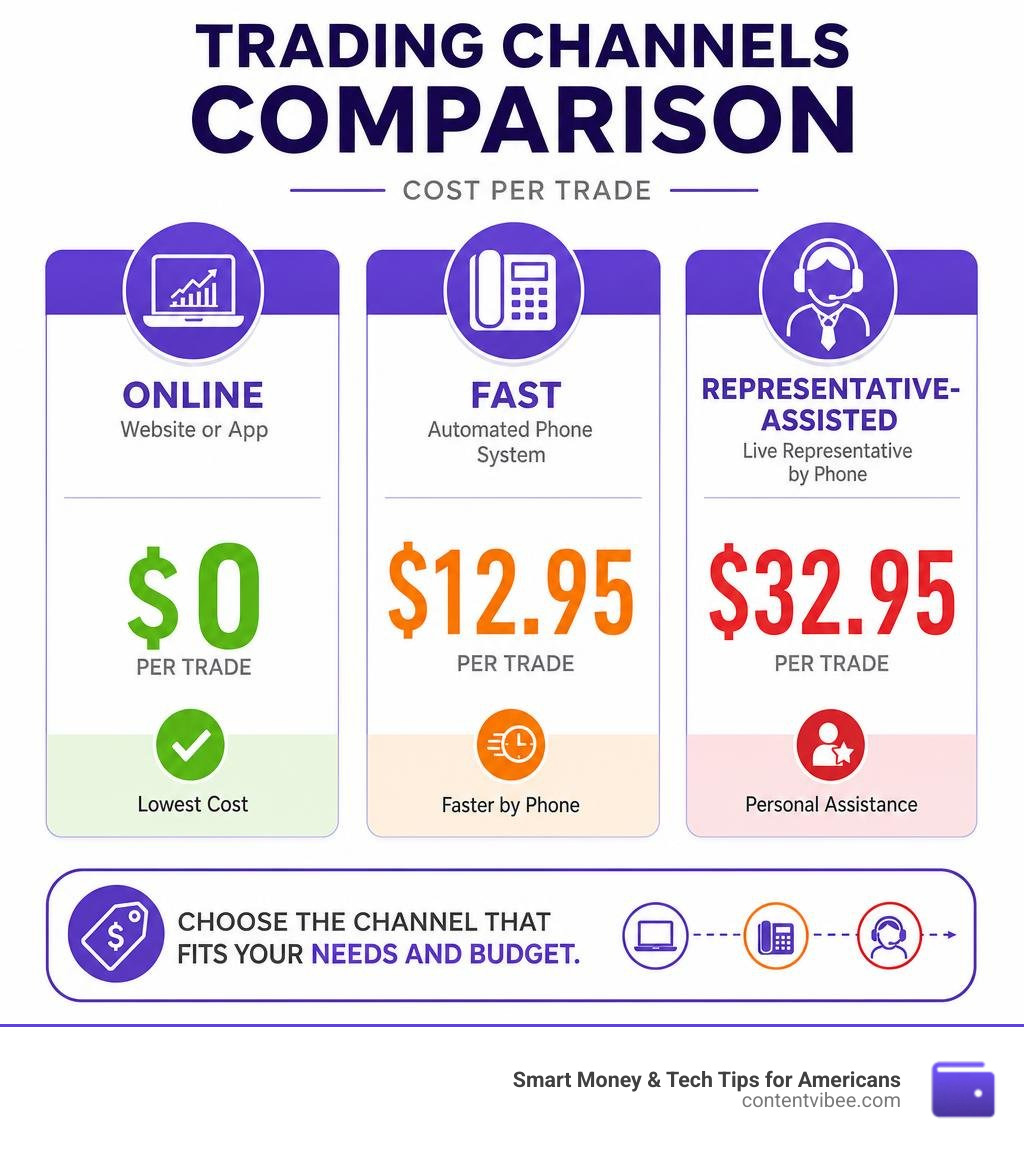
Here’s a quick breakdown of what you’ll pay depending on how you place your trade:
| Trading Method | Stocks & ETFs | Options (per contract) |
|---|---|---|
| Online (website or app) | $0.00 | $0.00 + $0.65/contract |
| FAST (automated phone) | $12.95 | $12.95 + $0.65/contract |
| Representative-assisted | $32.95 | $32.95 + $0.65/contract |
Most investors today expect to pay nothing to trade. And at Fidelity, that’s true — if you trade online. But the moment you pick up the phone and ask a live person to place that order for you, the fee clock starts.
That gap between $0 and $32.95 catches a lot of people off guard. Especially retirees who are more comfortable calling in than navigating an app.
And the cost adds up fast. Buy and then sell a single stock through a representative? That’s $65.90 in total fees — on a trade that would have cost you absolutely nothing online.
This guide explains exactly how the fee works, when it applies, and when it might actually be worth paying.
What is a Broker-Assisted Trade and How Does It Work?

To understand why the broker assisted trade fee at Fidelity exists, we have to look at how order execution works behind the scenes.
A broker-assisted trade is any transaction where a live Fidelity representative manually enters a trade order on your behalf. This differs significantly from standard online trading, where you act as your own broker. When you trade online via Fidelity’s website or mobile app, you use their automated self-service infrastructure. The process is completely digital, requiring zero human intervention from Fidelity’s staff. Because automated systems are incredibly cheap to scale, Fidelity can easily offer these online trades for $0.
But when you pick up the phone to place a trade, you are occupying the time and expertise of a licensed financial professional. This live representative must:
- Verify your identity and account security.
- Confirm the exact ticker symbol, share quantity, and order type (such as a market or limit order).
- Read you required regulatory disclosures.
- Manually input the order into their institutional trading terminal.
- Confirm the execution details back to you in real time.
This high-touch process takes time and resources. Even in our modern, automated world, human labor remains a premium service.
Some investors wonder if they are paying hidden costs when they trade on their own. If you have ever asked yourself, are fidelity stock trading fees really zero, the answer is yes—provided you stay within the self-service digital channels. The moment a human broker gets involved, the free ride ends, and the standard representative-assisted rate applies.
Understanding the Broker Assisted Trade Fee Fidelity Structure
To navigate these expenses without hurting your portfolio’s growth, we need to look closely at the current pricing models. As of July 2026, Fidelity utilizes a channel-based pricing structure. This means the fee you pay is determined entirely by how you place the trade, rather than what you are trading.
If we consult the official Fidelity Brokerage and Commission Fee Schedule, we see three primary trading channels:
- Online/Mobile App: $0.00 commission. This is the self-service route that the vast majority of retail investors use daily.
- FAST (Fidelity Automated Service Telephone): $12.95 per trade. This is an automated interactive voice-response system. You speak to a computer, not a human, which is why it serves as a cheaper middle ground.
- Representative-Assisted: $32.95 per trade. This is the flat rate charged when you speak directly to a live associate to execute your order.
To see how these channels impact your overall costs, you can read our deep dive into the fidelity fee per trade structure, which details how small charges can silently erode your compounding returns over time.
How the Broker Assisted Trade Fee Fidelity Applies to Stocks and ETFs
For standard domestic stocks and Exchange-Traded Funds (ETFs), the broker assisted trade fee at Fidelity is a flat $32.95 per trade.
It is vital to understand that this fee is charged per execution, not per day or per account. If you call a representative and ask them to buy shares of three different ETFs, you will be charged $32.95 for each individual ticket, resulting in a total of $98.85 in fees.
Furthermore, this fee applies regardless of the size of your order. Whether you are buying 5 shares of a utility stock or 5,000 shares of an index ETF, the live phone order will cost you $32.95. For smaller investors, this flat rate can be devastating.
For instance, if you purchase $1,000 worth of stock over the phone, that $32.95 fee represents an immediate 3.3% loss on your investment principal. You would need the stock to rise by 3.3% just to break even on the purchase fee—and that is before factoring in another $32.95 fee when you eventually call back to sell. For a comprehensive look at how these equity costs stack up, check out our guide on how much does fidelity actually charge to trade stocks.
How the Broker Assisted Trade Fee Fidelity Applies to Options and Mutual Funds
If you are trading options or mutual funds, the representative-assisted pricing becomes slightly more complex.
For options, Fidelity charges a base representative-assisted fee of $32.95 plus a $0.65 per-contract fee. If you were to call a broker to execute a 10-contract option order, your total fee would be $39.45 ($32.95 base + $6.50 contract fees). By comparison, doing this exact same trade online would cost you only $6.50 ($0 base + $6.50 contract fees). For a complete breakdown of contract pricing and assignment costs, refer to the ultimate guide to fidelity option commissions.
When it comes to mutual funds, the fees depend on the fund’s classification:
- Fidelity Funds: There are no transaction fees across any channel (online, FAST, or live representative).
- FundsNetwork No-Transaction-Fee (NTF) Funds: These are third-party funds that are free to trade online. However, if you purchase them through a representative, you may be subject to transaction charges.
- Short-Term Trading Fees: If you sell a No-Transaction-Fee (NTF) fund held for less than 60 days, Fidelity charges a short-term redemption fee. While this is a flat $49.95 online, executing this short-term sale via a live representative will cost you 0.75% of the transaction’s principal (with a minimum charge of $100 and a maximum of $250).
Additional Fees and Regulatory Assessments Beyond the Flat Commission
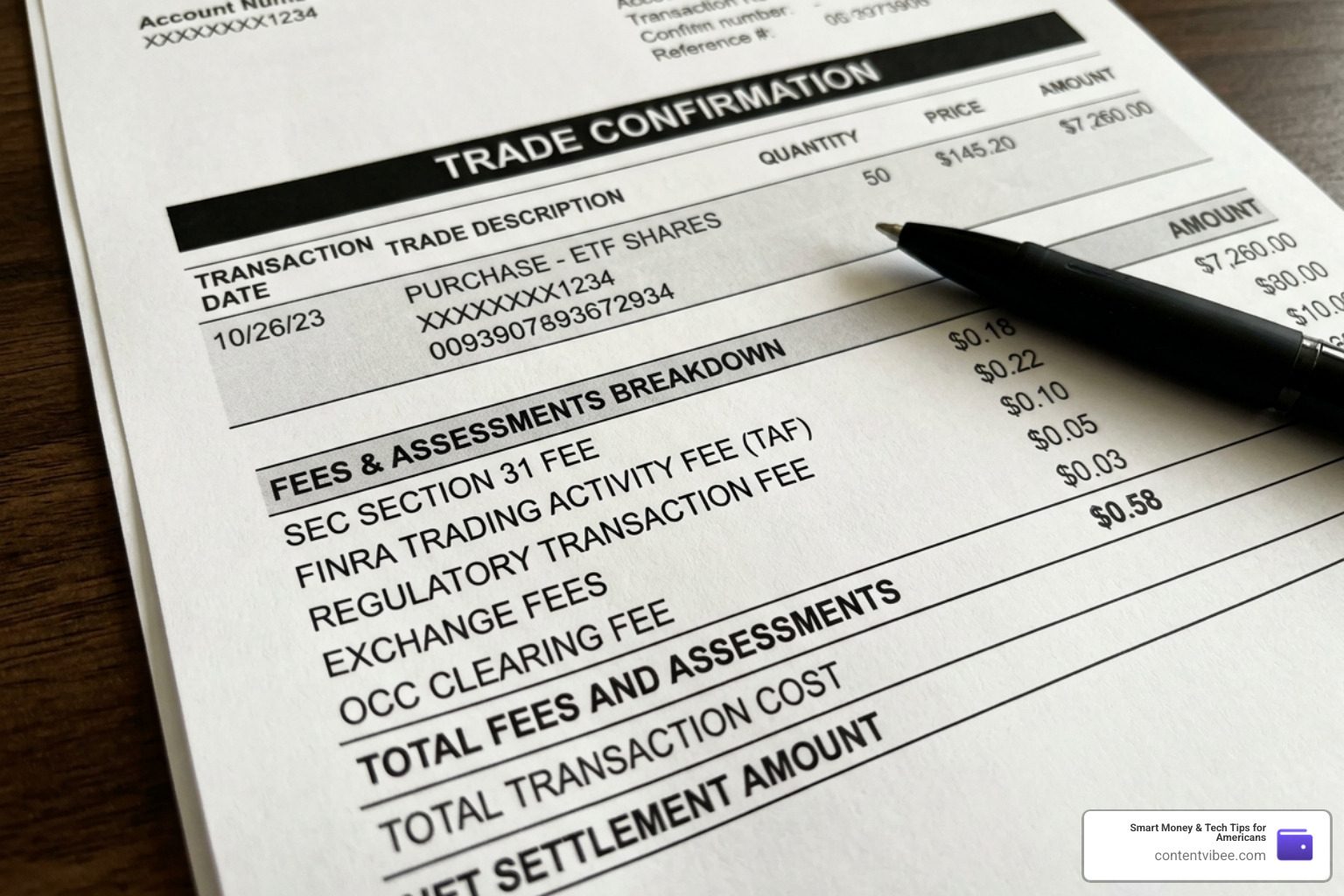
Many investors assume that the $32.95 flat commission is the only fee they will pay on a phone trade. However, there are several regulatory assessments and pass-through fees that are automatically tacked onto your trade confirmations.
These fees do not go into Fidelity’s pockets; instead, they are collected to offset fees charged to Fidelity by self-regulatory organizations (SROs) and government agencies like the Securities and Exchange Commission (SEC).
- Additional Assessment Fee: Charged on all sell orders (both online and representative-assisted). This fee typically ranges from $0.01 to $0.03 per $1,000 of principal to offset charges imposed by national securities exchanges and clearing agencies.
- Options Regulatory Fee (ORF): This is a pass-through fee charged by systemic options exchanges to cover regulatory oversight costs. It generally ranges from $0.02 to $0.04 per contract and is charged on all options transactions.
- Fixed-Income Markups: If you call a representative to buy bonds or CDs in the secondary market, you won’t pay the standard $32.95 stock fee. Instead, you will pay a markup of $1.00 per bond, with a representative-assisted minimum fee of $19.95 and a maximum of $250. (Treasury auction purchases, which are free online, carry a flat $19.95 fee when placed through a representative).
To see how these regulatory fees are calculated on your monthly statements, you can read our guide on what does it really cost to trade on fidelity, which strips away the confusing legal jargon. For additional information on rates and margin tiers, you can also review Fidelity’s official resources on Trading Commissions and Margin Rates.
When is a Representative-Assisted Trade Worth the Cost?
Given how expensive a $32.95 fee is compared to free online trading, why would anyone choose to call a broker?
While we always recommend using online tools whenever possible, there are specific, highly complex scenarios where paying the representative fee acts as a form of financial insurance.
- Complex Estate or Trust Accounts: If you are managing an estate or a complex trust account after the passing of a family member, executing trades can be legally stressful. A licensed representative can help ensure that assets are liquidated or transferred in strict accordance with the estate’s legal guidelines, preventing costly tax or legal mistakes.
- Physical Stock Certificates: If you hold old, physical paper stock certificates, you cannot simply trade them via a mobile app. A representative must manually verify, deposit, and execute the sale of these physical shares.
- Extreme Market Volatility or System Outages: During rare moments of systemic market panic, retail trading apps can occasionally experience technical outages. If you need to exit a highly leveraged position immediately to prevent catastrophic losses, calling the trade desk and paying the $32.95 fee is a small price to pay for immediate execution.
- Large, Multi-Leg, or Illiquid Orders: If you are executing a massive block trade or a highly complex multi-leg options strategy on an illiquid security, a professional broker can manually route the order to specific market makers to ensure you receive the best possible execution price (price improvement), which can easily save you more than the $32.95 fee.
For a thorough breakdown of how these specific situations are handled under the hood, read our comprehensive overview of fidelity fees and commissions explained without the fine print.
How to Avoid the Representative Fee: Self-Service Alternatives
For 99% of everyday trades, there is absolutely no reason to pay the representative fee. You can easily keep your hard-earned money in your portfolio by mastering Fidelity’s self-service tools.
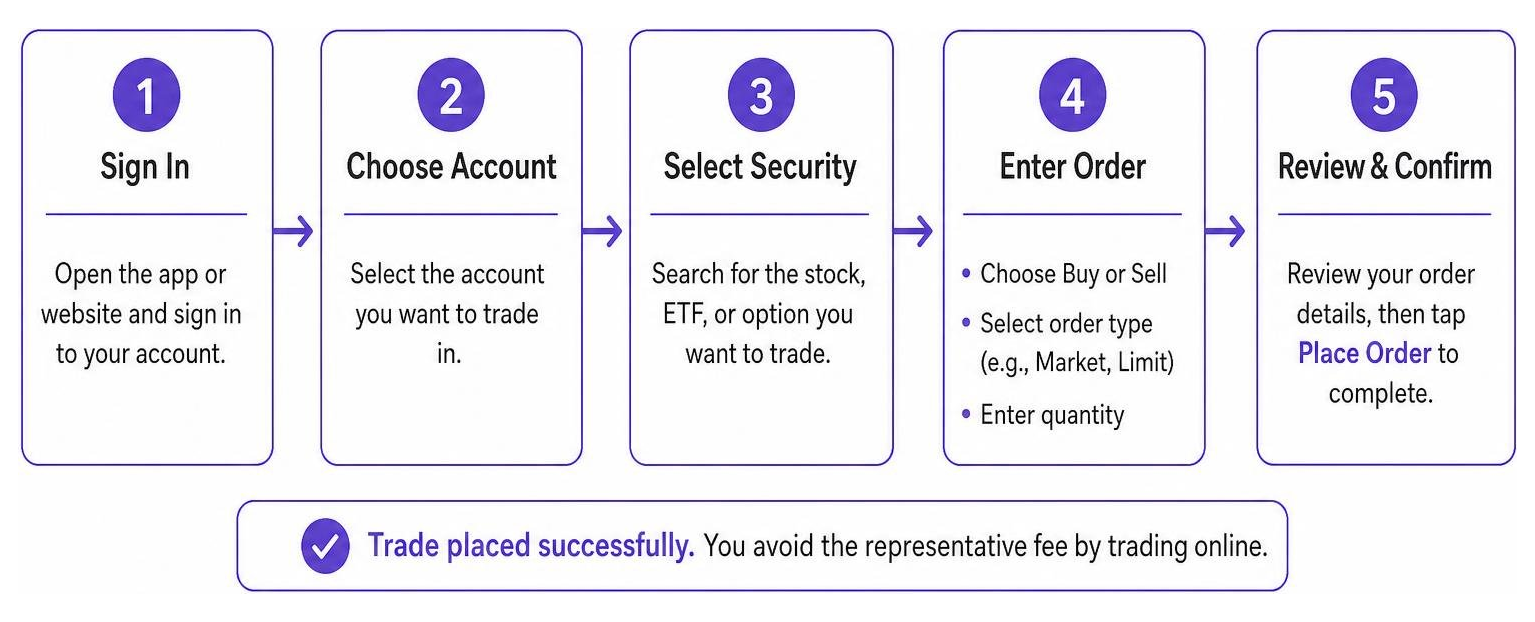
To bypass the representative fee entirely, we recommend using these three primary methods:
- The Fidelity Mobile App or Online Portal: Placing trades through the mobile app or website is completely free for U.S. stocks, ETFs, and online options. The interfaces are highly intuitive, offering step-by-step prompts to guide you through entering your order.
- The FAST Phone System: If you do not have internet access but still need to place a trade over the phone, do not wait for a live representative. Instead, use the FAST automated system by calling Fidelity’s main line and saying “trade.” This automated voice system only charges $12.95 per trade, saving you $20 instantly compared to a live broker.
- Leveraging Chat Support for Guidance: If you are hesitant to place a trade because you are confused by the online platform, you can use Fidelity’s free online chat or virtual assistant. A live support agent can walk you through the navigation steps in real time. As long as you click the final “Place Order” button on your screen, you will pay $0 in commissions.
If you want to make sure you are taking full advantage of all of Fidelity’s zero-fee structures, take a look at our guide on are fidelity trades really free demystifying the fees.
Frequently Asked Questions About Fidelity Representative Fees
Are there situations where broker-assisted fees are waived?
Yes. Fidelity does waive or reduce representative-assisted fees for certain high-net-worth clients and specific account types.
Fidelity determines fee waiver eligibility through household grouping, where they aggregate the total assets of all eligible accounts registered to the same home address over a rolling 12-month period. Clients enrolled in premium wealth management tiers or those with millions of dollars in assets under management (AUM) often receive complimentary representative-assisted trades as part of their relationship package.
Additionally, if you are trading within a workplace retirement plan like a BrokerageLink account, the plan sponsor may have negotiated a custom fee schedule that waives or discounts representative-assisted fees. Always check your specific plan’s BrokerageLink Commission Schedule for details.
How do Fidelity’s phone trading fees compare to other major brokers?
Fidelity’s $32.95 fee is highly competitive and sits right in line with the industry standard for traditional brokerages.
While almost all major brokers have moved to a $0 commission model for online trades, they all continue to charge a premium for live human assistance. For example, Charles Schwab charges $25.00 per broker-assisted trade, while Vanguard charges $25.00 (though Vanguard waives this fee for clients with over $1 million in assets).
Across the entire brokerage industry, live phone support is treated as a premium, specialized service rather than a standard convenience.
Can I get help with a trade without paying the $32.95 fee?
Absolutely. You can call Fidelity’s customer service line at any time to ask general questions about market concepts, account balances, or platform navigation without triggering a fee.
The broker assisted trade fee at Fidelity is only assessed if the representative actually inputs and executes the trade for you. If you call them, ask how a limit order works, have them explain the quote on a stock, and then hang up and place the trade yourself on your phone, you will pay $0.
Conclusion
At Smart Money & Tech Tips for Americans, our mission is to help you cut through the financial noise so you can keep more of your money working for you. In an era of commission-free trading, paying a $32.95 fee to place a routine stock or ETF trade is an unnecessary leak in your retirement bucket.
By taking a few minutes to familiarize yourself with Fidelity’s online portal or mobile app, you can avoid these fees entirely, ensuring that every dollar of your principal goes toward long-term portfolio growth.
To learn more about optimizing your brokerage accounts and discovering hidden ways to maximize your investment returns, read the ultimate guide to fidelity trading fees and savings.