Fidelity Options Fees Explained: From Covered Calls to Iron Condors

What You’re Actually Paying When You Trade Options at Fidelity
If you’ve been wondering does Fidelity charge fees for options, here’s the short answer: yes, but not in the way most people expect.
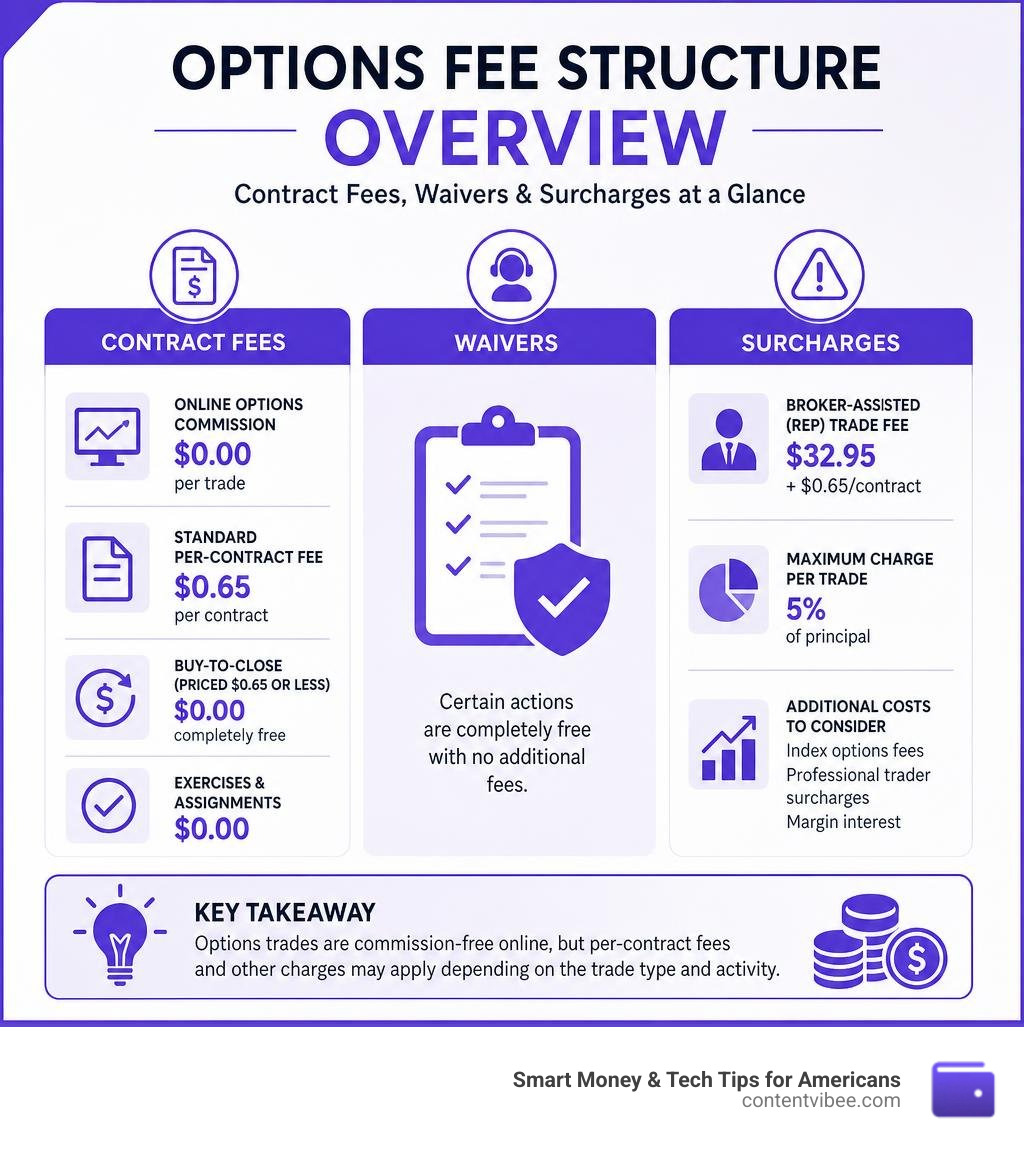
Fidelity charges $0 commission per options trade online — but a per-contract fee still applies. Here’s a quick summary of what you’ll pay in 2026:
| Fee Type | Amount |
|---|---|
| Online options commission | $0.00 per trade |
| Standard per-contract fee | $0.65 per contract |
| Buy-to-close (priced $0.65 or less) | $0.00 (completely free) |
| Exercises and assignments | $0.00 |
| Broker-assisted (rep) trade fee | $32.95 + $0.65/contract |
| Maximum charge per trade | 5% of principal |
So if you buy 10 options contracts online, you pay $6.50 total in contract fees — and nothing else in commissions.
That said, there are additional costs that catch many traders off guard — especially retirees using options strategies like covered calls or iron condors. Index options, professional trader surcharges, and margin interest can add up fast if you don’t know where to look.
This guide breaks it all down in plain language, so you know exactly what you’re paying before you place a single trade.
Does Fidelity Charge Fees for Options Trades?
When you trade options online through Fidelity, you are entering a world of commission-free trading. But wait, what does “commission-free” actually mean?
In 2026, the retail brokerage landscape separates “commissions” (the flat fee charged just to execute a trade) from “contract fees” (the variable fee charged per options contract). So, does fidelity charge fees for options? Yes, they do. While they charge a $0.00 commission to place the trade, they still assess a $0.65 per-contract fee.
However, there is a built-in safety net for smaller trades: Fidelity caps its options transaction fees at a maximum of 5% of the trade’s total principal. This means if you are trading low-priced options where the standard contract fee would eat up a massive chunk of your investment, the fee is capped to keep your trading cost-efficient.
To understand how these costs fit into the broader picture of trading on the platform, you can check out our detailed analysis in Are Fidelity Trades Really Free? Demystifying the Fees. For the full legal breakdown of these rules, you can also review the official Fidelity Brokerage and Commission Fee Schedule.
Understanding the Standard Per-Contract Fee
The standard fee of sixty-five cents ($0.65) per contract is the baseline for almost every online equity option trade you make at Fidelity.
Let’s look at how this plays out in real-world transaction costs. If you buy 5 call options on a stock, your contract fee is:
5 contracts x $0.65 = $3.25
If you scale up your volume trading and buy 50 contracts, the fee becomes:
50 contracts x $0.65 = $32.50
For active traders who run multi-leg strategies like iron condors, each “leg” counts as a separate contract. An iron condor consists of four separate contracts (two puts and two calls). Opening just one iron condor position means you are trading 4 contracts, which will cost you $2.60 in contract fees. If you trade 10 iron condors at a time, you are opening 40 contracts, resulting in a $26.00 fee.
To keep these transaction costs from chipping away at your portfolio management returns, we have compiled some excellent cost-reduction strategies in The Ultimate Guide to Fidelity Trading Fees and Savings.
When Does Fidelity Charge Fees for Options Buy-to-Close Orders?
Here is some of the best news for options traders: Fidelity offers a complete fee waiver for buy-to-close orders on low-priced options.
If you write (sell) an option contract to open a position and the option’s price subsequently drops to $0.65 or less, you can buy to close that contract for $0.00—meaning no commission and no per-contract fee.
This is an incredibly powerful tool for risk management. Many experienced traders like to “lock in” 80% to 90% of their profits on a short option rather than holding it all the way to expiration. Because Fidelity waives the fee to close these low-priced options, you can eliminate your expiration risk for free.
For a complete look at how this buy-to-close exception fits into your broader tax and trading strategy, take a look at Fidelity Fees and Commissions Explained Without the Fine Print.
Hidden and Situational Costs of Options Trading

While the $0.65 per-contract fee is straightforward, the financial fine print contains several other potential costs that could impact your bottom line. These include regulatory fees, proprietary exchange index surcharges, and penalties for placing trades through older or manual channels.
Before diving into complex multi-leg options strategies, we always recommend reviewing the official Options Agreement to ensure you fully understand your contractual obligations and risks.
Proprietary Index Options and Professional Surcharges
Not all options contracts are created equal. If you trade proprietary index options—such as those tracking the S&P 500 (.SPX), the Nasdaq 100 (.NDX), or the Cboe Volatility Index (.VIX)—you will pay an additional exchange fee on top of Fidelity’s standard $0.65 rate.
These indexes are proprietary products owned by the exchanges themselves, and the exchanges pass their licensing fees down to the broker, who then passes them to you.
Here is what you can expect to pay in additional per-contract fees for popular index products in 2026:
- S&P 500 Index (.SPX): $0.50 additional fee per contract
- Nasdaq 100 Index (.NDX): $0.45 additional fee per contract
- Cboe Volatility Index (.VIX): $0.30 additional fee per contract
- S&P 100 Index (.XEO): $0.35 additional fee per contract
- S&P 100 Index (.OEX): $0.30 additional fee per contract
- Russell 2000 Index (.RUT): $0.15 additional fee per contract
- Dow Jones Industrial Average (.DJX): $0.14 additional fee per contract
Furthermore, if you are designated as a Professional Options Trader by the exchanges (which happens if you average 390 or more options orders daily across any calendar month in a quarter), Fidelity is required to add an extra $0.50 per-contract surcharge to all of your executions.
Broker-Assisted Trades and Exercise/Assignment Fees
If you prefer to place your trades over the phone with a live representative, prepare to pay a premium.
Fidelity charges a hefty $32.95 flat fee for representative-assisted options trades, plus the standard $0.65 per-contract fee. If you use their automated phone system (FAST), the flat fee is lowered to $12.95, plus the $0.65 per-contract fee. To keep your costs as close to zero as possible, always use Fidelity’s online platforms or mobile apps to execute your trades. You can read more about these representative-assisted policies in our guide on Broker Assisted Trade Fee Fidelity.
On the bright side, if your options contracts are exercised or assigned, Fidelity does not charge a fee. Physical delivery of the underlying stock is handled commission-free.
However, keep in mind that Fidelity may automatically exercise any in-the-money options on expiration day if they are $0.01 or more in the money, unless you explicitly instruct them otherwise by 4:20 p.m. ET.
Margin Rates and Account Requirements for Options

To trade advanced options strategies—such as spreads, straddles, and iron condors—you will need to apply for margin approval. When you carry a debit balance in a margin account, you are subject to margin interest rates.
Fidelity utilizes a tiered margin interest rate structure. The larger your debit balance, the lower your interest rate. In 2026, Fidelity’s margin rates start as low as 7.50% for debit balances of $1,000,000 or more, while smaller balances under $25,000 are subject to a higher rate of 11.825% (based on a base margin rate of 10.575%).
Margin Interest Rate Tiers
| Margin Debit Balance | Interest Rate (Effective 2026) |
|---|---|
| $0 – $24,999.99 | 11.825% |
| $25,000 – $49,999.99 | 11.325% |
| $50,000 – $99,999.99 | 10.125% |
| $100,000 – $249,999.99 | 9.825% |
| $250,000 – $499,999.99 | 9.325% |
| $500,000 – $999,999.99 | 8.325% |
| $1,000,000+ | 7.500% |
To understand how these margin requirements affect your overall account cash flow, take a look at our Fidelity Brokerage Account Fees Review: What You Need to Know. You can also cross-reference these rates on the official Trading Commissions and Margin Rates – Fidelity Investments page.
Additionally, if you want to trade options spreads in a retirement account like an IRA, Fidelity requires you to maintain a minimum $2,000 cash spread reserve to cover potential risks.
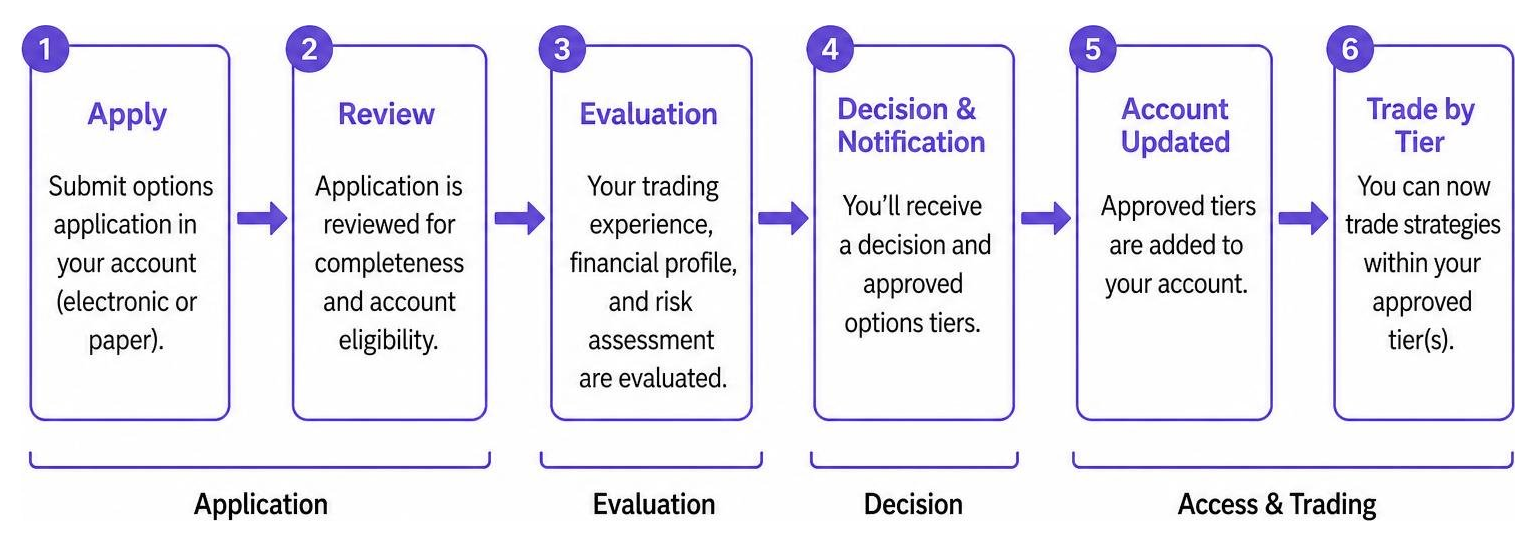
To help you visualize how to get approved for these options tiers, we have mapped out the approval sequence below:
Frequently Asked Questions About Options Fees
Does Fidelity charge fees for options exercises or assignments?
No. Unlike some older brokerage firms, Fidelity charges $0.00 for options exercises and assignments. If your call option is exercised and you take physical delivery of 100 shares of stock, or if your written put option is assigned and you are forced to buy the shares, you will not pay a commission or a contract fee for the stock transaction.
Are there any account minimums or maintenance fees for options?
Fidelity does not charge any annual or monthly account maintenance fees, nor do they charge inactivity fees. There is also a $0 minimum requirement to open a standard retail brokerage account. However, to trade options spreads (Tier 2 approval), you must maintain a minimum account equity of $2,000.
Can you negotiate lower options contract fees?
Yes. If you are a high-volume trader or maintain a substantial account equity threshold (typically $1,000,000 or more in assets), you can contact a Fidelity representative to negotiate a lower per-contract rate. Some active traders have successfully negotiated their contract fees down to $0.40 or $0.50 per contract.
Conclusion
Understanding how and when Fidelity charges fees for options is key to optimizing your portfolio’s performance. By placing your trades online, closing out short positions when they drop below $0.65, and avoiding costly broker-assisted phone trades, you can keep your transaction costs incredibly low.
At Suppremo, we want to help you make smart money decisions that protect your hard-earned wealth. If you are ready to take your options knowledge to the next level and learn advanced ways to minimize your trading friction, dive into our comprehensive resource: The Ultimate Guide to Fidelity Option Commissions.