Fidelity Options Cost Guide: What You’ll Actually Pay
What Are Fidelity Options Fees? Here’s What You’ll Actually Pay
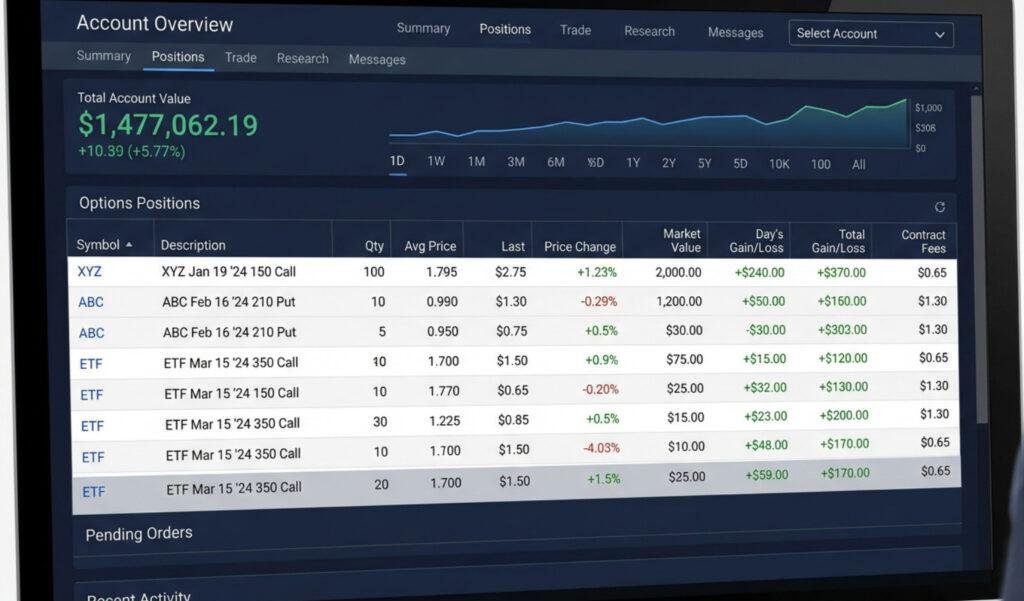
What are fidelity options fees is one of the most common questions from investors who want to trade options without getting hit by surprise costs. The short answer is straightforward:
| Fee Type | Amount |
|---|---|
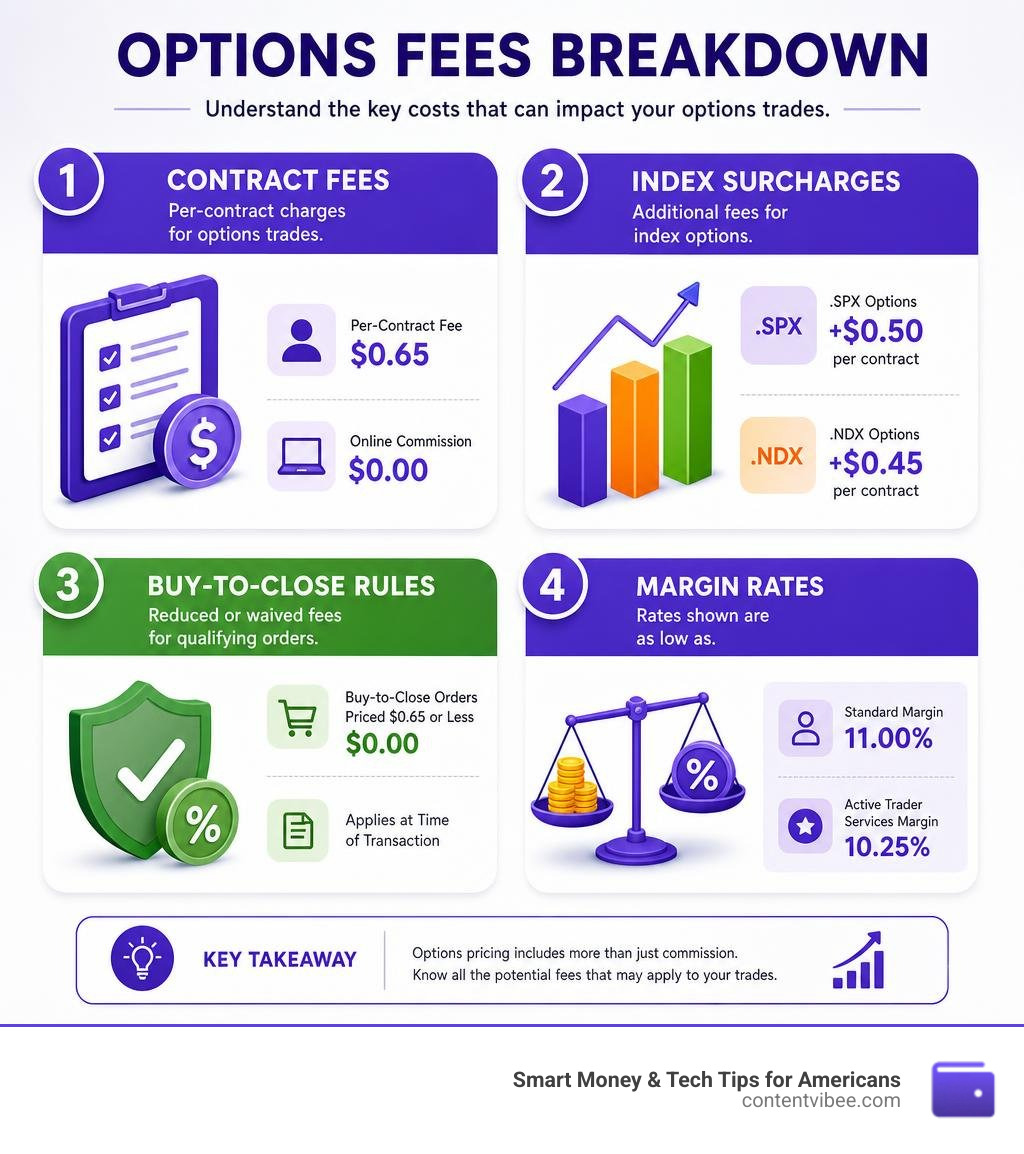
| Commission per options trade (online) | $0.00 |
| Per-contract fee | $0.65 |
| Buy-to-close orders priced $0.65 or less | $0.00 |
| Index options (.SPX) additional fee | $0.50 per contract |
| Index options (.NDX) additional fee | $0.45 per contract |
| FAST (automated phone) base fee | $12.95 per trade |
| Representative-assisted base fee | $32.95 per trade |
| Professional trader surcharge | $0.50 per contract |
So if you buy 10 standard equity options contracts online, your total fee is $6.50 — no base commission, just the per-contract charge.
But there’s more to the full picture. Index options, professional trader designations, regulatory fees, and margin costs can all quietly add up. This guide breaks down every layer of Fidelity’s options pricing so you know exactly what you’re paying — and when.
Understanding What Are Fidelity Options Fees: The Standard Pricing Structure

When we look at the broader landscape of modern retail investing, the concept of “commission-free trading” has become the industry standard. However, as many options traders quickly realize, “no commission” does not mean “completely free.”
At Fidelity, standard online options trades are structured with a $0 base commission. This means you will not pay a flat transaction fee simply for hitting the “place order” button. Instead, your primary trading cost is determined by a per-contract fee. To understand this distinction fully, we can review the official Fidelity Brokerage and Commission Fee Schedule | Trading information . It outlines how modern brokerage accounts balance zero-dollar base fees with specialized contract pricing.
For a deeper look into the general cost structures across the platform, you can check out our guide on Fidelity Fees and Commissions Explained Without the Fine Print. It helps demystify the fee landscape for retail investors.
What Are Fidelity Options Fees for Standard Contracts?
For standard equity and exchange-traded fund (ETF) options, Fidelity charges a flat $0.65 per contract. Because there is no base commission, your trading fee scales in a linear fashion based on the volume of contracts you trade.
For example, if you decide to buy a single call option on your favorite stock, your total transaction cost will be exactly $0.65. If you scale that trade up to 5 contracts, your fee is $3.25. For 10 contracts, you will pay $6.50.
But what happens when you decide to trade more complex multi-leg options strategies, such as vertical spreads, iron condors, or straddles? At Fidelity, multi-leg options orders are still charged on a per-contract basis for the total number of contracts executed. If you place a 4-leg iron condor using 1 contract per leg (totaling 4 contracts), your entry fee will be $2.60 (4 contracts multiplied by $0.65).
To explore how these contract costs impact different trading styles and strategic approaches over time, read through The Ultimate Guide to Fidelity Option Commissions.
What Are Fidelity Options Fees for Index and Proprietary Products?
If you prefer trading highly liquid, cash-settled index options rather than standard stock or ETF options, you need to budget for additional exchange fees. Index options are proprietary products owned by specific exchanges (like the Cboe), and these exchanges charge licensing and transaction fees to the brokerages. Fidelity passes these costs directly to the consumer.
When you trade these proprietary index options, Fidelity adds an additional per-contract surcharge on top of the standard $0.65 fee. Here is how these surcharges break down for the most popular index products:
- .SPX (S&P 500 Index Options): Additional $0.50 per contract (Total: $1.15 per contract)
- .NDX (Nasdaq 100 Index Options): Additional $0.45 per contract (Total: $1.10 per contract)
- .XEO (S&P 100 Index Options – European Style): Additional $0.35 per contract (Total: $1.00 per contract)
- .OEX (S&P 100 Index Options): Additional $0.30 per contract (Total: $0.95 per contract)
- .VIX (Cboe Volatility Index Options): Additional $0.30 per contract (Total: $0.95 per contract)
- .RUT (Russell 2000 Index Options): Additional $0.15 per contract (Total: $0.80 per contract)
- .DJX (Dow Jones Industrial Average Index Options): Additional $0.14 per contract (Total: $0.79 per contract)
If you are planning to build a strategy around index trading, keep these extra surcharges in mind. For more details on these specific rules, check out the Options Trading | FAQs | Fidelity page.
Hidden and Situational Costs in Options Trading

Beyond the standard contract rates, there are several situational fees and regulatory costs that can impact your net returns. Understanding these hidden charges is essential for accurate cost management.
When you sell an options contract, you will notice a tiny transaction fee that does not appear when you buy. This is the Options Regulatory Fee (ORF), which is assessed by the Options Clearing Corporation (OCC) and the various options exchanges. To offset this industry-wide charge, Fidelity passes down an “Options Fee” that typically ranges from $0.02 to $0.04 per contract. This fee can fluctuate slightly depending on the rates established by the OCC.
Additionally, sell orders are subject to a minor SEC assessment fee (often referred to as the Section 31 fee), which is calculated as a tiny percentage of the total dollar value of the sale. While these regulatory fees are only fractions of a cent or a few pennies per trade, they are technically part of what are fidelity options fees for sellers.
Before signing your paperwork, it is always wise to review the official Options Agreement to understand your legal responsibilities. For a broader analysis of how “free” trading platforms actually cover their operational costs, take a look at our breakdown in Are Fidelity Trades Really Free Demystifying the Fees.
Buy-to-Close and Exercise/Assignment Rules
One of the most investor-friendly features of Fidelity’s options fee structure is its rule regarding buy-to-close orders.
If you write (sell to open) an options contract to collect premium, you may want to buy back that contract later to lock in your profits or mitigate further risk. If the option contract’s premium has decayed to $0.65 or less, Fidelity allows you to place an online buy-to-close order completely commission-free and fee-free. You will not pay the $0.65 contract charge to close out these low-value positions. This is a massive advantage for premium sellers who like to “manage winners” early rather than waiting for contracts to expire worthless.
Furthermore, if your options positions expire in-the-money and result in an exercise or assignment, Fidelity does not charge any transaction fees. Whether you are assigned on a short option or choose to exercise a long option, the actual conversion into the underlying shares of stock is executed at $0.00 commission, without any per-contract fees.
Broker-Assisted and FAST Trading Fees
While online trades are highly cost-efficient, utilizing alternative trading channels at Fidelity will trigger substantial base fees:
- FAST® (Fidelity Automated Service Telephone): If you place your options trade through Fidelity’s automated interactive voice response system, you will be charged a base fee of $12.95 per trade plus the standard $0.65 per-contract fee.
- Representative-Assisted Trades: If you call and have a live Fidelity broker place your options trade for you, you will incur a hefty $32.95 base fee plus the $0.65 per-contract fee.
To avoid these unnecessary costs, it is highly recommended to stick to Fidelity’s online platforms, such as their website, mobile app, or Active Trader Pro. You can read more about avoiding these representative-guided expenses in our dedicated article on the Broker Assisted Trade Fee Fidelity.
How Margin Rates and Account Tiers Impact Your Costs
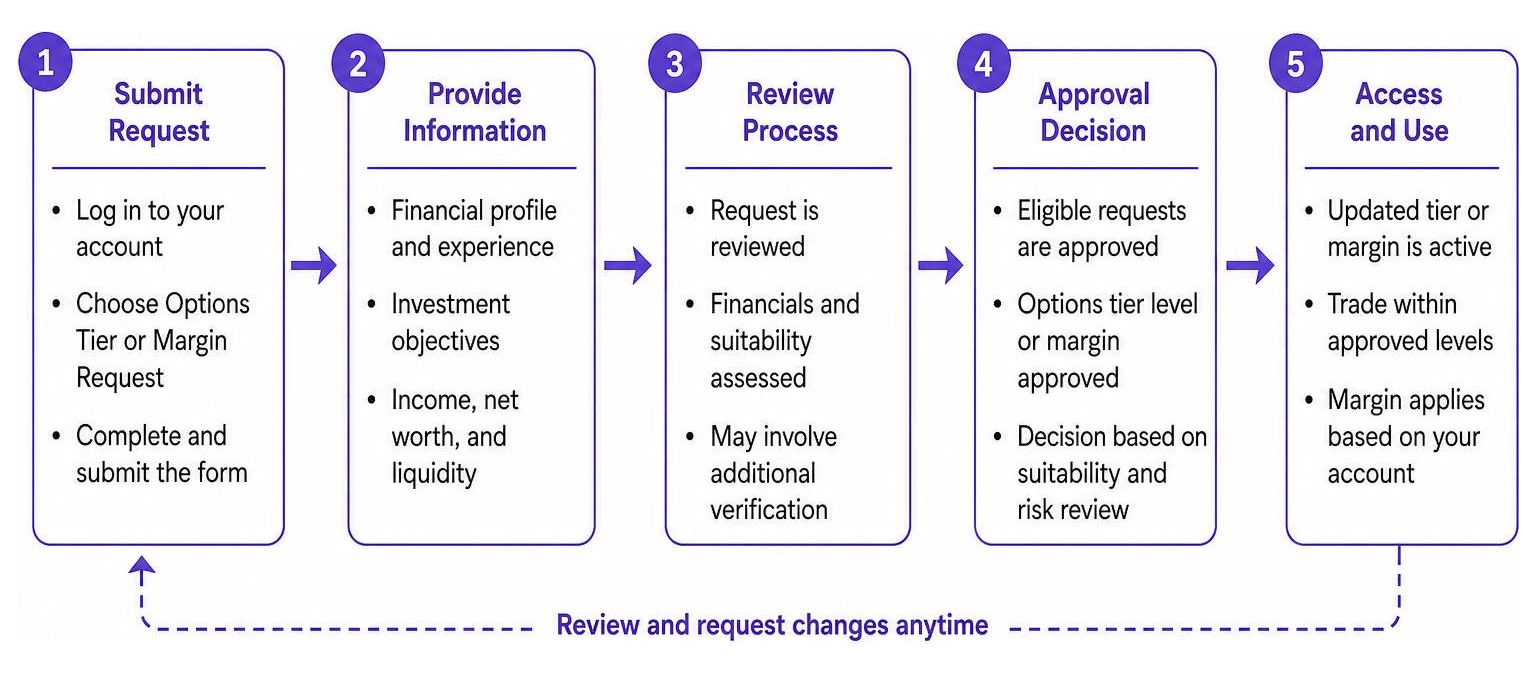
If you trade advanced options strategies (like spreads or uncovered writing), you will need a margin account. The cost of borrowing funds on margin can directly affect your options trading profitability, especially if you hold leveraged positions over time.
Fidelity’s margin interest rates are tiered based on your account’s average daily debit balance. The larger your debit balance, the lower your interest rate.
To help you visualize these borrowing costs, here is the tiered margin interest rate structure at Fidelity:
| Margin Debit Balance | Interest Rate (Effective July 2026) |
|---|---|
| $0 to $24,999 | 11.825% |
| $25,000 to $49,999 | 11.325% |
| $50,000 to $99,999 | 10.375% |
| $100,000 to $249,999 | 10.325% |
| $250,000 to $499,999 | 10.075% |
| $500,000 to $999,999 | 7.750% |
| $1,000,000+ | 7.500% |
To see how these margin rates compare to the overall cost of running an active retail portfolio, you can read our deep-dive analysis on What Does It Really Cost to Trade on Fidelity. You can also cross-reference current rate details on Fidelity’s official Commissions, Margin Rates, and Fees page.
Tiered Margin Interest Rates
As shown in the table above, trading on margin can become expensive for smaller accounts. If you carry a debit balance of under $25,000, your interest rate is 11.825%.
For active options traders who utilize margin to execute complex, multi-leg spreads, managing these interest expenses is just as important as keeping track of contract fees. If you plan to carry significant debit balances, scaling your account or maintaining a higher equity balance can help you qualify for the lower tiers, such as the 7.75% or 7.50% rates reserved for larger balances.
Options Trading Tiers and Approval Levels
To manage risk, Fidelity groups options strategies into three distinct approval tiers. Depending on your trading experience, financial situation, and account equity, you will be approved for one of the following levels:
- Tier 1 (Basic Hedging and Income): This tier allows you to write covered calls, buy protective puts, and write cash-covered puts. It is the lowest-risk tier and is widely accessible, even in retirement accounts (IRAs).
- Tier 2 (Spreads and Basic Leverage): This tier unlocks the ability to buy calls and puts, and trade multi-leg spreads (such as vertical spreads, iron condors, and butterflies). If you trade spreads within a Fidelity IRA, note that Fidelity requires a minimum $2,000 Cash Spread Reserve to cover potential risks.
- Tier 3 (Advanced Leverage and Uncovered Writing): This is the highest approval tier, allowing you to write uncovered (naked) equity and index options, as well as uncovered straddles and strangles. It requires a margin account and significant capital and experience.
While moving up these tiers does not change your standard $0.65 per-contract fee, it does change your capital requirements and margin rules. Higher tiers require careful risk management to avoid forced liquidations, which can carry unexpected liquidation fees.
Frequently Asked Questions About Fidelity Options Fees
Can you negotiate lower options fees at Fidelity?
Yes. While the standard rate is $0.65 per contract, high-volume traders can negotiate lower rates. If you trade hundreds or thousands of contracts per month, or if you maintain a substantial balance (such as $1,000,000+ in household assets), you can contact a Fidelity representative to request a customized rate.
Many active traders have successfully negotiated their contract fees down to $0.40, $0.35, or even lower depending on their volume. For strategic advice on how to approach your broker for these discounts, check out our guide on The Ultimate Guide to Fidelity Trading Fees and Savings.
Are there any inactivity or account maintenance fees?
No. Fidelity does not charge any monthly account maintenance fees, annual fees, or inactivity fees on standard retail brokerage accounts or IRAs. You can leave your account funded or unfunded without worrying about passive charges eating into your capital.
Additionally, Fidelity is one of the few major brokerages that charges $0 for outgoing ACAT transfers, meaning you can move your assets to another institution without facing a transfer-out penalty. To learn more about standard account costs, you can read our Fidelity Brokerage Account Fees Review What You Need to Know.
What is the professional options trader fee?
Under exchange rules, a retail investor is designated as a “Professional Options Trader” if they average 390 or more placed options orders per day during any calendar month in a quarter.
If your account receives this professional designation, Fidelity is required to apply an additional $0.50 per-contract charge to all of your executions. This surcharge is designed to cover the higher exchange fees associated with high-frequency professional trading.
Conclusion
Understanding what are fidelity options fees is key to managing your trading performance. With $0 base commissions and a standard $0.65 per-contract fee, Fidelity offers a highly competitive and transparent pricing structure for retail options traders. By taking advantage of money-saving rules—like free buy-to-close orders on contracts under $0.65 and commission-free exercises—you can keep your trading friction remarkably low.
Here at Suppremo, we are dedicated to providing smart money tips to help you build and protect your wealth. For more actionable strategies on optimizing your options portfolio and keeping your transactional costs to an absolute minimum, make sure to read The Ultimate Guide to Fidelity Option Commissions.