Applying for Spousal Disability Benefits: A Complete Guide to VA and SSA Options

What You Need to Know Before Applying for Spousal Disability Benefits
Applying for spousal disability benefits is one of the most important financial steps a spouse can take when their partner becomes disabled or retires under Social Security.
Here is a quick answer if you need it fast:
How to apply for spousal disability benefits (SSA):
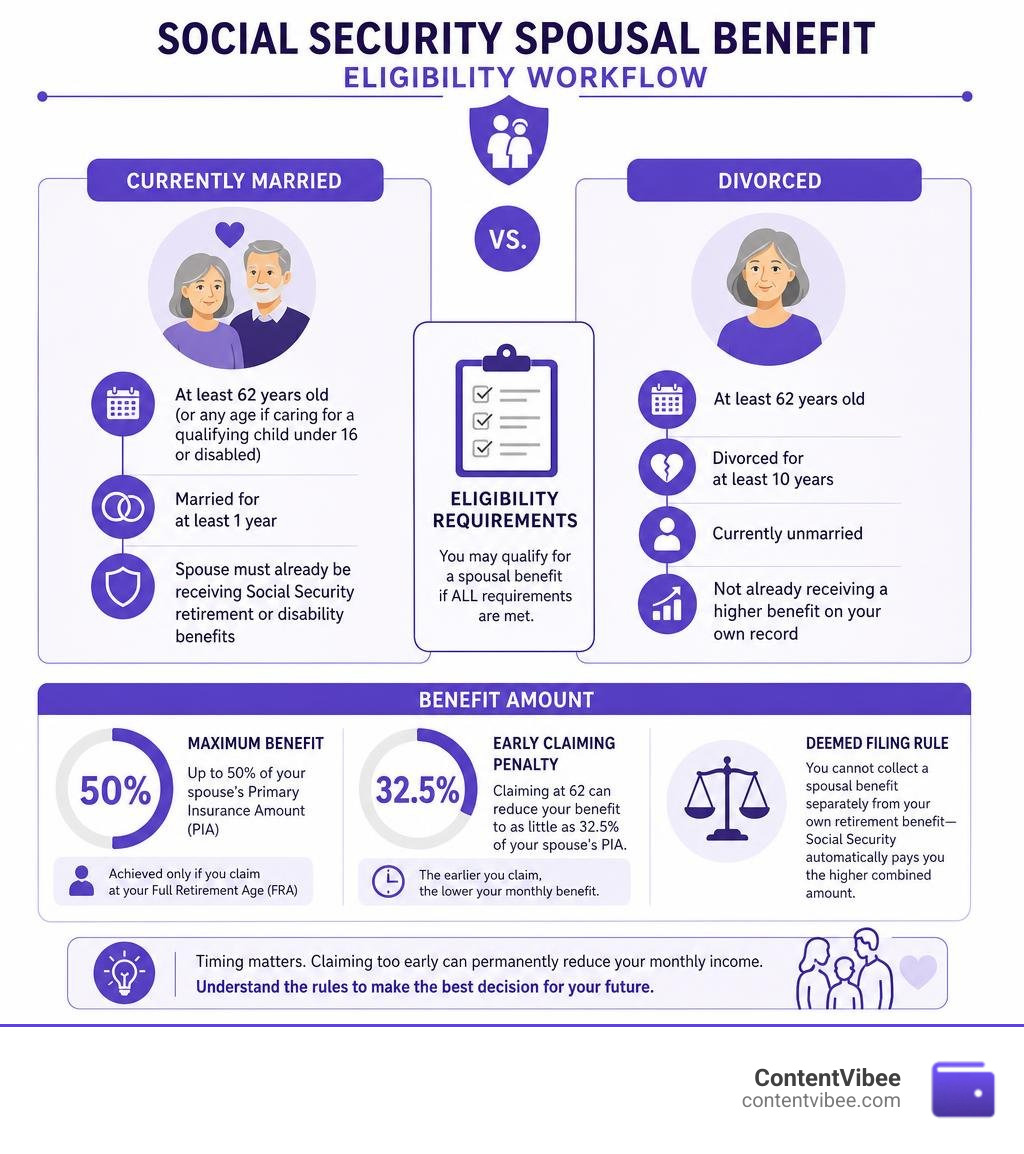
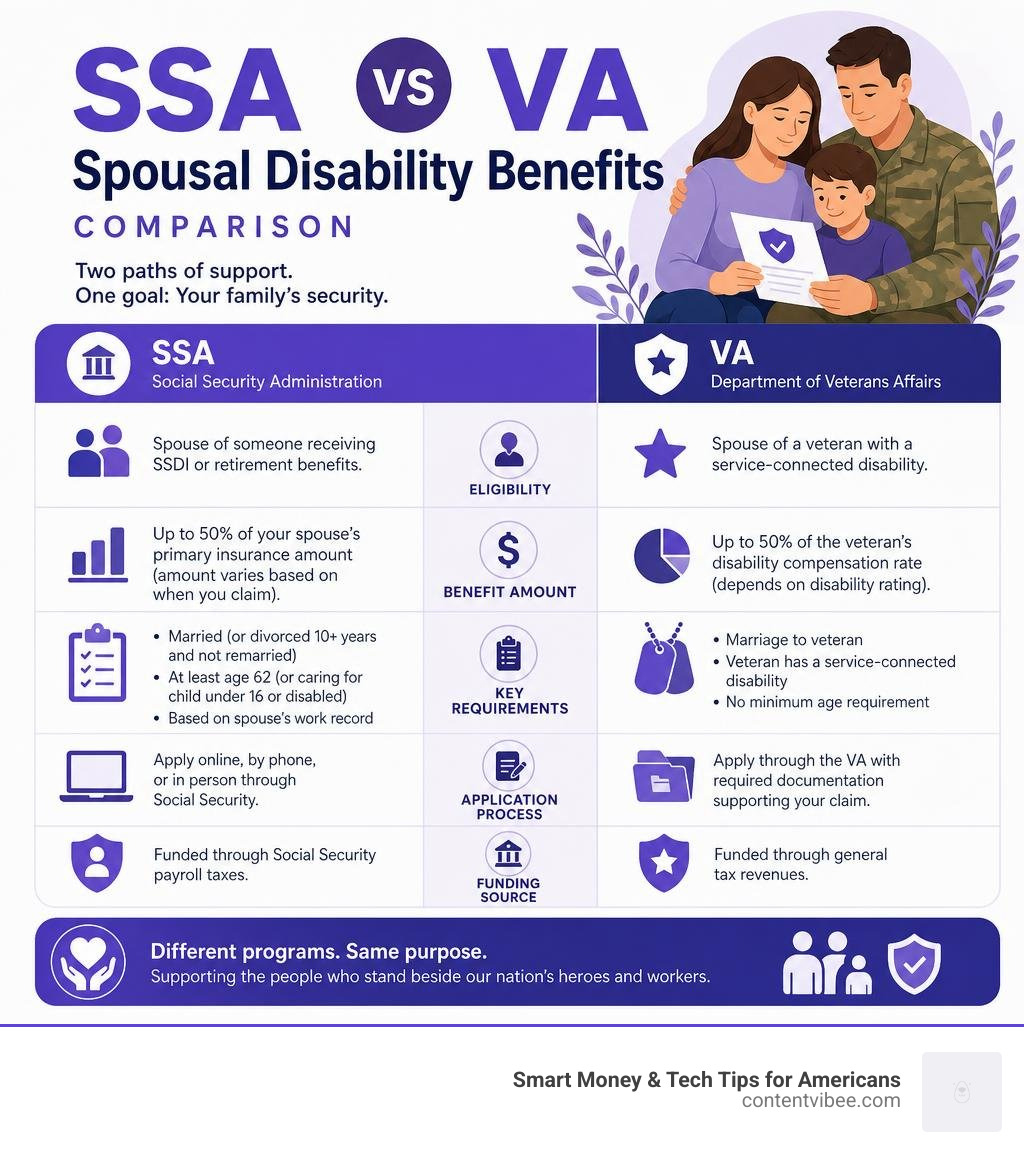
- Check eligibility — You must be married to someone receiving SSDI or retirement benefits, and be at least age 62 (or caring for a qualifying child under 16 or disabled).
- Gather documents — Birth certificate, marriage certificate, Social Security numbers, and W-2 forms.
- Apply online at ssa.gov, call (800) 772-1213, or visit your local Social Security office.
- Know your benefit range — You can receive between 32.5% and 50% of your spouse’s primary insurance amount, depending on when you claim.
- Divorced? You may still qualify if your marriage lasted at least 10 years and you have not remarried.
Many people don’t realize they may be leaving real money on the table. If your spouse receives Social Security Disability Insurance (SSDI), you could be entitled to a monthly benefit based on their earnings record — even if you have little or no work history of your own.
The rules can feel confusing at first. There are age requirements, marriage duration rules, benefit reduction formulas, and separate options through the VA if your spouse is a veteran. But once you understand the basics, the path forward becomes much clearer.
This guide breaks it all down in plain language — eligibility, documents, how benefits are calculated, and when to get professional help.
Understanding SSA Spousal Disability Benefits and Eligibility
When it comes to navigating government systems, we know that reading policy manuals can feel like trying to translate ancient hieroglyphics. Fortunately, we have done the heavy lifting for you.
Under the Social Security Administration (SSA), spousal benefits are designed to provide financial support to the husband or wife of a worker who is entitled to retirement or disability benefits. If your partner is currently receiving Social Security Disability Insurance (SSDI), you may qualify for a monthly payment on their record.
To learn more about the foundational rules of who qualifies, you can read The Ultimate Guide to Spousal Social Security Eligibility.
The SSA relies on strict legal definitions to determine who counts as a spouse. According to the official policy manual, SSA – POMS: RS 00202.001 – Definitions and Requirements for Spouse Benefits – 07/24/2017, a claimant must have a legally recognized marriage under the laws of the state where the worker lives, or have the same inheritance rights as a spouse under state intestate law.
What about same-sex couples? The SSA fully recognizes same-sex marriages and non-marital legal relationships (NMLRs) for the purpose of claiming benefits. As detailed in SSA – POMS: GN 00210.100 – Same-Sex Relationships – Spouse’s Benefits – 09/29/2016, the SSA uses the actual date of the marriage or relationship establishment—not the dates of historical court rulings—to calculate how long you have been married.
Generally, you must be married for at least one continuous year before you can file a claim based on your living spouse’s record. However, this one-year rule can be waived if you are the natural parent of your spouse’s biological child.
Core Eligibility Requirements for Spouses
To qualify for spousal benefits when your partner is on disability, you must meet several core requirements:
- The Worker’s Status: Your spouse must already be entitled to and receiving SSDI or retirement benefits.
- Your Age: You must be at least 62 years old, unless you qualify under the child-in-care exception.
- The Marriage Rule: You must meet the legal definition of a spouse. This includes a “deemed spouse”—someone who entered into a marriage ceremony in good faith, even if a legal technicality or impediment (like an administrative oversight in a prior divorce) made the marriage technically invalid.
- Your Own Earnings Record: If you are eligible for your own Social Security retirement or disability benefit, the SSA will compare the two. You cannot collect a full spousal benefit on top of your own full benefit; instead, you receive the higher of the two amounts.
How Caring for a Qualifying Child Affects Your Claim
If you are caring for a qualifying child, the typical age-62 rule is waived. This is a massive relief for younger families dealing with a parent’s disability.
A qualifying child must be:
- Under the age of 16, OR
- Disabled (with a disability that began before age 22).
If you have a qualifying child in your care, you can apply for spousal benefits at any age. Better yet, your spousal benefit will not be reduced for early retirement, even if you are far younger than 62.
However, keep in mind that the “Family Maximum” rule applies. The SSA limits the total amount of money that can be paid to a single family on one worker’s earnings record. If multiple children and a spouse are all claiming benefits on the same disabled worker’s record, the individual payments may be scaled back to fit within this family cap.
Step-by-Step Process for Applying for Spousal Disability Benefits
Once you have verified your eligibility, the next step is actually applying for spousal disability benefits. While dealing with government forms might not be your idea of a fun Saturday afternoon, taking a systematic approach will prevent delays and keep your stress levels down.

To make sure you do not miss a single step, we recommend checking out The Ultimate Checklist for Your Application for Spousal Benefits.
Gathering Required Documents for Applying for Spousal Disability Benefits
Before you contact the SSA, you should gather your paperwork. Having these documents ready will prevent you from having to pause mid-application to hunt through old filing cabinets.
According to SSA – POMS: RS 00202.050 – Spouse’s Benefits – Evidence and Forms Requirements – 02/16/2006, the SSA requires specific proofs to verify your identity and relationship. You should gather:
- Your Birth Certificate: To verify your age (always required if you are 62 or older).
- Proof of U.S. Citizenship or Lawful Status: If you were born outside the United States.
- Your Marriage Certificate: Original copy to prove your relationship.
- Divorce Decrees: If you are applying as a divorced spouse, you must provide proof that your prior marriage was dissolved.
- W-2 Forms or Self-Employment Tax Returns: For the most recent tax year.
- U.S. Military Discharge Papers (DD-214): If you or your spouse served in the military before 1968.
- Bank Account Information: For setting up direct deposit (routing and account numbers).
Note: While the SSA accepts photocopies of tax documents, they generally require original certificates or certified copies for birth and marriage records. Do not delay your application if you are missing a document! File anyway, and the SSA will help you obtain the necessary verifications.
Submitting Your Application Online, by Phone, or In Person
You have three main options to submit your application to the SSA:
- Online: This is the fastest and most convenient method. You can apply online through the SSA’s official portal if you are at least 62 years old and within three months of when you want your benefits to start.
- By Phone: You can call the SSA’s national toll-free number at (800) 772-1213 (TTY 1-800-325-0778) between 8:00 AM and 7:00 PM, Monday through Friday, to schedule an appointment or complete the application over the phone.
- In Person: You can visit your local Social Security field office. We highly recommend calling ahead to schedule an appointment to avoid waiting in long lines.
During the application process, you will complete Form SSA-2 (or the digital equivalent). You will be asked questions about your personal details, marriage history, employment, and any children in your care. Once approved, the SSA strongly encourages signing up for direct deposit so your monthly funds are deposited directly into your checking or savings account without mail delays.
How Benefit Amounts Are Calculated and Reduced
A common question we hear is: “How much will I actually get?”
The maximum spousal benefit you can receive is 50% of your disabled spouse’s Primary Insurance Amount (PIA). The PIA is the base amount your spouse is eligible to receive at their own Full Retirement Age (FRA).
Crucially, claiming a spousal benefit does not reduce your disabled partner’s monthly check. They will still receive 100% of their entitled SSDI amount; your spousal benefit is paid in addition to theirs.
However, your monthly payment depends heavily on when you claim it. If you decide to claim spousal benefits before you reach your own Full Retirement Age, the SSA will apply a permanent reduction to your monthly check.
Here is a breakdown of how claiming early affects your spousal benefit percentage:
| Claiming Age | Percentage of Spouse’s PIA |
|---|---|
| Full Retirement Age (67 for those born 1960+) | 50.0% |
| 1 Year Early (Age 66) | ~45.8% |
| 2 Years Early (Age 65) | ~41.7% |
| 3 Years Early (Age 64) | ~37.5% |
| 4 Years Early (Age 63) | ~35.0% |
| 5 Years Early (Age 62) | 32.5% |
The Impact of Early Claiming and Own Retirement Benefits
As you can see from the table, claiming as early as age 62 reduces your benefit to just 32.5% of your spouse’s PIA. The SSA calculates this reduction using a monthly formula: your benefit is reduced by 25/36 of 1% for each of the first 36 months before your FRA, and an additional 5/12 of 1% for each month beyond that.
Another critical rule to keep in mind is the higher own benefit rule. Under “deemed filing” rules, when you apply for spousal benefits, the SSA automatically checks if your own retirement benefit (based on your own work history) is higher. If your own retirement benefit is higher than the spousal benefit, the SSA will pay your own benefit instead. If the spousal benefit is higher, you will receive a combination of payments that equals the higher spousal amount. You cannot “double dip” and receive full amounts of both.
Special Rules for Divorced Spouses Applying for Spousal Disability Benefits
What happens if you are divorced from the disabled worker? You might still be in luck! The SSA allows divorced spouses to claim benefits on their ex-partner’s record, provided you meet the following conditions:
- Your marriage lasted for at least 10 consecutive years.
- You are currently unmarried. (If you remarried, you generally cannot claim on your ex-spouse’s record unless your subsequent marriage ended by death, divorce, or annulment).
- You are at least 62 years old.
- Your ex-spouse is entitled to SSDI or retirement benefits.
- Your own retirement or disability benefit is less than the spousal benefit.
If you have been divorced for at least two continuous years, you can apply for spousal benefits even if your ex-spouse has not yet filed for their own benefits, as long as they are eligible for them. Best of all, any benefits paid to you as a divorced spouse will not affect the benefit amount your ex-spouse or their current husband or wife receives.
VA Spousal Disability Options: Pension and DIC
If your spouse is a veteran who became disabled or passed away due to service-related circumstances, the Department of Veterans Affairs (VA) offers separate benefits that work differently than the SSA.

The VA focuses heavily on military service history, disability ratings, and whether the disability was connected to active duty service.
VA Disability Pension vs. Dependency and Indemnity Compensation (DIC)
The VA provides two primary financial programs that can support spouses:
- VA Survivors Pension (or Death Pension): This is an income-based benefit paid to the active-duty veteran’s surviving spouse who has not remarried. To qualify, the deceased veteran must have met specific active-duty service requirements (typically at least 90 days of active service, with at least one day during an official wartime period). Because this is a needs-based program, your annual family income and net worth must fall below limits set by Congress.
- Dependency and Indemnity Compensation (DIC): This is a tax-free, monthly monetary benefit paid to eligible survivors of military service members who died in the line of duty, or veterans whose death resulted from a service-related injury or disease. Unlike the pension, DIC is not based on your income.
Additionally, if your veteran spouse is still living but is highly disabled, they may qualify for a higher VA monthly payment because they have a spouse (you). The VA increases a veteran’s monthly disability compensation if they have a disability rating of 30% or higher and have eligible dependents, including a spouse.
Frequently Asked Questions about Spousal Disability Benefits
How long does it take to get a decision on a spousal disability benefits application?
Because a spousal benefit is tied to a worker who is already approved for SSDI or retirement benefits, the non-medical processing time is relatively quick. If all of your documentation is in order, the SSA can process a straightforward spousal claim in a matter of weeks to a few months.
However, if you are applying for Disabled Widow(er)’s Benefits (DWB) where you must prove your own disability, the process takes much longer. In those cases, your claim is sent to your state’s Disability Determination Services (DDS). To get a real-time estimate of wait times in your state, you can use the interactive tools on the official SSA website to check current processing backlogs.
Are there waiting periods for receiving cash and Medicare benefits?
Yes, waiting periods depend on the specific type of benefit you are claiming:
- SSDI Cash Benefits: There is a standard 5-month waiting period from the established onset date of disability before cash payments can begin.
- Medicare Eligibility: Typically, individuals on SSDI must wait 24 months after receiving their first cash benefit before Medicare coverage begins.
- The ALS Exception: Under SSA – POMS: DI 10110.001 – Requirements for Disabled Widow(er)’s Benefits (DWB) – 12/09/2022, individuals diagnosed with Amyotrophic Lateral Sclerosis (ALS) have their 24-month Medicare waiting period waived entirely.
- Disabled Widow(er) Claims: As outlined in SSA – POMS: DI 11015.005 – Field Office (FO) Processing of an Initial Disabled Widow(er)’s Benefits (DWB) Claim – 03/25/2020, prior eligibility for Supplemental Security Income (SSI) or state supplemental payments can sometimes be credited toward these waiting periods.
When should I consult a lawyer or seek professional help?
While many people successfully apply for spousal benefits on their own, there are times when seeking professional help is a smart move. You should consider consulting a Social Security disability lawyer or a veterans service officer (VSO) if:
- Your initial application was denied due to relationship status issues or complex marital histories.
- You are trying to claim benefits as a disabled widow or widower and need help proving your medical condition to the DDS.
- You have a complex divorce case with multiple marriages and need help obtaining necessary legal records.
- You are appealing a decision. Having legal representation during the appeals process significantly increases your chances of a successful outcome.
Conclusion
At Smart Money & Tech Tips for Americans, we believe that staying informed is the best way to protect your family’s financial future. Whether you are planning your retirement in June 2026 or managing the sudden onset of a spouse’s medical condition, securing the benefits you are legally entitled to is a vital piece of the puzzle.
By understanding the eligibility rules, gathering your paperwork ahead of time, and knowing how early claiming affects your monthly check, you can navigate the application process with confidence.
For a deeper dive into how these rules work, check out our resource on What is a Social Security Spousal Benefit? to make sure you are maximizing your household’s income. Keep your paperwork organized, don’t hesitate to ask the SSA for help, and take charge of your financial security today!