How to Check Your Eligibility for Spousal Social Security Benefits

Why Understanding Spousal Social Security Benefits Eligibility Can Change Your Retirement
Spousal Social Security benefits eligibility is something millions of Americans qualify for — but many never claim, simply because they don’t know the rules.
Here’s a quick summary of who qualifies:
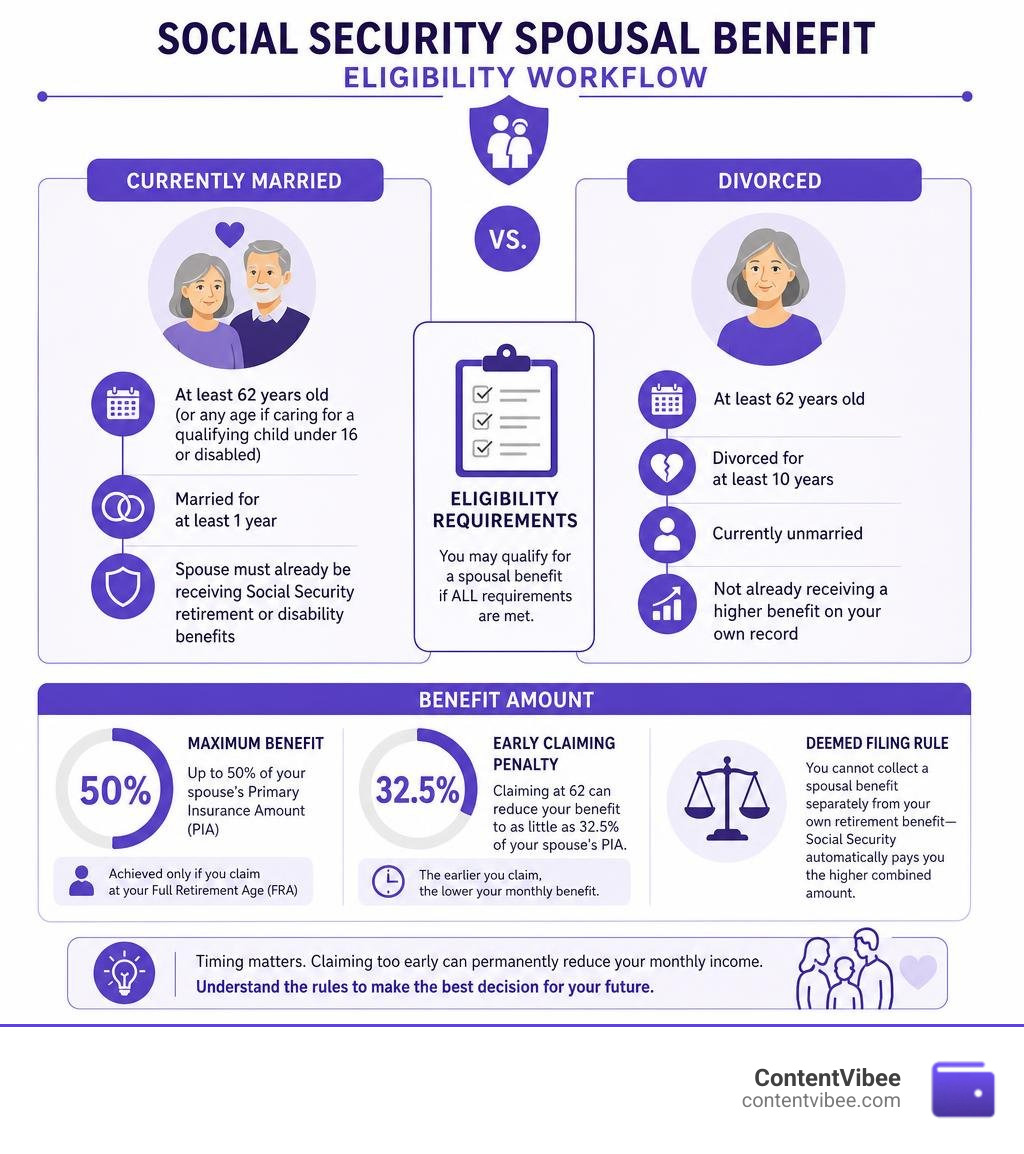
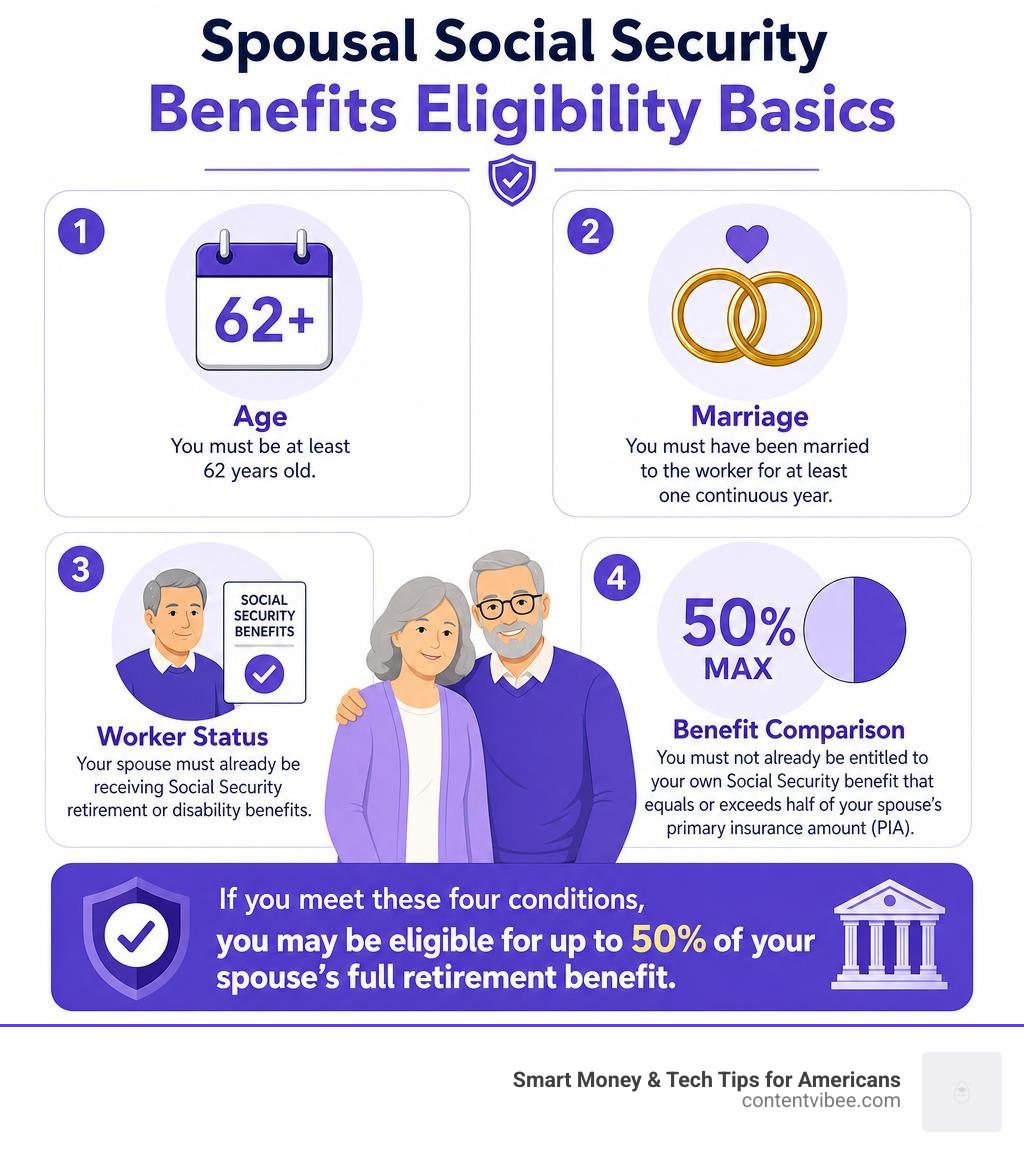
- Age: You must be at least 62 years old (or any age if caring for a qualifying child under 16 or a disabled child)
- Marriage: You must have been married to the worker for at least one continuous year
- Worker status: Your spouse must already be receiving Social Security retirement or disability benefits
- Benefit comparison: You must not already be entitled to your own Social Security benefit that equals or exceeds half of your spouse’s primary insurance amount (PIA)
If you meet those four conditions, you may be eligible for up to 50% of your spouse’s full retirement benefit — even if you never worked a day in your life.
That’s a significant amount of money. And yet, it’s one of the most overlooked parts of Social Security planning.
Nearly 97% of Americans aged 60 to 89 currently receive or will receive Social Security in some form. Spousal benefits are a core part of that system — designed to support partners who took time away from the workforce, worked fewer years, or simply earned less than their spouse.
This guide will walk you through exactly how to check your eligibility, understand how your benefit is calculated, and avoid costly mistakes when claiming.
Basic Requirements for Spousal Social Security Benefits Eligibility

To qualify for spousal benefits, you must navigate a specific set of rules established by the Social Security Administration (SSA). These criteria ensure that benefits are distributed to legally recognized partners who rely on the primary worker’s earnings record.
Under the official guidelines outlined in the SSA Handbook § 305, a spouse is eligible for insurance benefits on a worker’s record only if the worker is already entitled to either retirement (RIB) or disability (DIB) insurance benefits. This means you cannot claim a spousal benefit until your partner has officially filed and started receiving their own payments.
The SSA also recognizes same-sex marriages and non-marital legal relationships (such as civil unions or domestic partnerships) for spousal benefits. According to SSA – POMS: GN 00210.100, the SSA determines marital status based on the laws of the state where the primary worker is domiciled when you apply. If the relationship is recognized as a valid marriage or grants inheritance rights under state intestacy laws, it meets the requirement. The duration of the marriage is calculated from the actual date the marriage or relationship was legally established, rather than the dates of landmark court rulings.
Age and Marriage Rules for Spousal Social Security Benefits Eligibility
To establish spousal social security benefits eligibility, you must meet strict timeline and age requirements. Under standard rules, you must have been married to the primary worker for at least one continuous year prior to filing your application.
However, as detailed in SSA – POMS: RS 00202.001, there are a few important exceptions to this one-year rule:
- You are the natural biological parent of the primary worker’s child.
- You were entitled (or potentially entitled) to certain Social Security auxiliary benefits (such as survivor, parent, or disabled adult child benefits) in the month immediately before your marriage.
- You are considered a “deemed spouse.” A deemed spouse is someone who entered into a marriage ceremony in good faith, but a legal impediment (such as an administrative error or an incomplete prior divorce) technically invalidated the marriage.
Additionally, you must have reached at least age 62 to claim a spousal benefit, unless you qualify under the child-in-care exception.
Special Rules for Spouses Caring for a Child
If you are caring for a child who is entitled to benefits on your spouse’s record, the standard age requirements do not apply. You can receive spousal benefits at any age if you have a qualifying child in your care.
As specified in SSA – POMS: NL 00711.025, a qualifying child must be:
- Under the age of 16, or
- Disabled (with the disability beginning before age 22).
Once the child turns 16, your spousal benefits will stop unless the child is disabled and remains in your care. It is important to note that if you claim spousal benefits early solely because you are caring for a qualifying child, your benefit is not reduced for early retirement.
How Spousal Benefits Are Calculated and Reduced

Understanding how the SSA calculates your monthly check is essential for maximizing your retirement income. The foundation of this calculation is the primary worker’s Primary Insurance Amount (PIA). The PIA is the monthly benefit amount a worker is entitled to receive if they claim at their exact Full Retirement Age (FRA).
The maximum spousal benefit you can receive is 50% of your spouse’s PIA. For example, if your spouse’s PIA is $2,000 per month, your maximum spousal benefit at your own Full Retirement Age will be $1,000.
It is a common misconception that delaying your claim past your FRA will increase your spousal benefit. While primary workers can earn Delayed Retirement Credits (DRCs) that increase their personal benefit by 8% for every year they delay claiming up to age 70, these credits do not apply to spousal benefits. The spousal benefit is strictly capped at 50% of the worker’s PIA.
To learn more about how these limits coordinate with your household budget, read The Ultimate Guide to Spousal Social Security Eligibility.
The Impact of Claiming Before Full Retirement Age
If you choose to claim your spousal benefit before reaching your own Full Retirement Age, the SSA will permanently reduce your monthly payment. The reduction is determined by a monthly fractional formula based on how many months early you claim:
- For the first 36 months early: The benefit is reduced by 25/36 of 1 percent for each month.
- For any additional months beyond 36 months: The benefit is reduced by 5/12 of 1 percent for each month.
If your Full Retirement Age is 67 (which applies to anyone born in 1960 or later) and you claim at the earliest possible age of 62, you are claiming 60 months early. This results in a total reduction of 35%, meaning you will receive only 32.5% of your spouse’s PIA instead of the full 50%.
The table below illustrates how claiming early reduces your spousal benefit based on a primary worker’s PIA of $2,000 (which yields a maximum spousal benefit of $1,000 at FRA):
| Claiming Age | Months Before FRA (Age 67) | Spousal Benefit Percentage of PIA | Monthly Spousal Benefit |
|---|---|---|---|
| 67 (FRA) | 0 | 50.0% | $1,000 |
| 66 | 12 | 45.8% | $917 |
| 65 | 24 | 41.7% | $833 |
| 64 | 36 | 37.5% | $750 |
| 63 | 48 | 35.0% | $700 |
| 62 | 60 | 32.5% | $650 |
Note: Percentages are rounded to the nearest tenth of a percent. Claiming early permanently locks in this lower rate for the rest of your life.
Simultaneous Entitlement and Deemed Filing
If you have worked and earned your own Social Security credits, you might be eligible for both your own retirement benefit and a spousal benefit. Under the SSA’s simultaneous entitlement rules, you cannot “double dip” or collect the full amount of both benefits. Instead, the SSA will pay your own retirement benefit first. If your spousal benefit is higher than your own retirement benefit, you will receive an additional spousal supplement to make up the difference.
For example, let’s look at the case of Sandy, who is eligible for:
- Her own retirement benefit: $1,000
- A spousal benefit based on her husband’s record: $1,250
When Sandy files, the SSA will pay her own $1,000 retirement benefit. Then, they will add a spousal supplement of $250, bringing her total monthly payment to $1,250.
This process is governed by deemed filing. As explained in Do You Qualify for Social Security Spouse’s Benefits?, when you apply for retirement or spousal benefits, you are “deemed” to be filing for both simultaneously if you are eligible for both. You cannot choose to claim only one to let the other grow. The SSA automatically calculates the combination that provides you with the highest possible monthly payout.
Special Rules for Divorced Spouses and Survivors
The Social Security system provides essential safety nets for individuals who are divorced or widowed. These benefits ensure that a former partner’s work history can still support you in your retirement years.
Divorced Spousal Social Security Benefits Eligibility Requirements
If you are divorced, you can still establish spousal social security benefits eligibility on your ex-spouse’s record. To qualify, you must meet the following criteria:
- Your marriage lasted for at least 10 consecutive years before the divorce was finalized.
- You are currently unmarried. (If you remarried, you generally cannot claim benefits on your ex-spouse’s record unless your subsequent marriage ended by death, divorce, or annulment).
- You are at least 62 years old.
- Your ex-spouse is eligible for retirement or disability benefits (even if they have not yet applied for them).
If your ex-spouse is eligible for benefits but has not yet filed, you can still claim divorced spousal benefits if you have been divorced for at least two continuous years.
Crucially, claiming benefits on an ex-spouse’s record has absolutely no impact on their own benefit amount, nor does it affect the benefits of their current spouse if they have remarried. It is a completely private transaction between you and the SSA.
How Survivor Benefits Differ from Regular Spousal Benefits
Survivor benefits are designed for widows, widowers, and surviving divorced spouses, and they operate under a completely different set of rules than regular spousal benefits:
- Marriage Duration: The marriage must have lasted at least nine months (compared to one year for living spouses), with exceptions for accidental deaths or military service.
- Claiming Age: You can claim survivor benefits as early as age 60 (or age 50 if you have a disability that started before or within seven years of the worker’s death).
- Benefit Amount: A surviving spouse who has reached their Full Retirement Age can receive 100% of the deceased worker’s benefit (including any delayed retirement credits the worker earned), rather than the 50% cap placed on living spousal benefits.
- Child Care: If you are caring for the deceased worker’s child who is under age 16 or disabled, you can receive survivor benefits at any age, typically valued at 75% of the deceased’s benefit.
Like spousal benefits, if you choose to claim survivor benefits before your Full Retirement Age, the monthly amount will be reduced. However, the reduction range is different, starting at 71.5% of the deceased worker’s benefit if claimed at age 60.
How to Apply and Required Documentation
Ready to submit your application? The process is straightforward, but success depends on submitting the correct documentation to avoid processing delays.
You can apply online through the official SSA portal if you are at least 61 years and 9 months old and plan to start benefits within the next four months. Alternatively, you can schedule an appointment by calling 1-800-772-1213 or visiting your local Social Security office.
To make sure you don’t miss a step, we recommend using The Ultimate Checklist for Your Application for Spousal Benefits to organize your filing process.
Required Evidence and Forms for Your Application
The SSA requires official, certified evidence to verify your identity, age, and relationship status. According to SSA – POMS: RS 00202.050, you must prepare to submit the following items:
- Proof of Age: Your original birth certificate or other certified public records of birth.
- Proof of Marriage: A certified marriage certificate to establish your relationship with the primary worker.
- Proof of Divorce: If applying as a divorced spouse, you must provide your final divorce decree to prove the marriage lasted at least 10 years.
- Proof of Termination of Previous Marriages: If either you or your spouse were previously married, you must provide divorce decrees, annulment papers, or death certificates for those prior marriages.
- U.S. Citizenship or lawful alien status documentation.
- Tax Records: Your recent W-2 forms or self-employment tax returns.
Tip: Always submit original documents or certified copies issued by the custodian of the original records. The SSA cannot accept photocopies or notarized copies.
Recent Claiming Strategy Changes to Keep in Mind
If you are researching Social Security strategies online, you might run across articles discussing advanced claiming tactics like “file-and-suspend” or “restricted applications.” It is important to know that these strategies have been phased out:
- File-and-Suspend: Historically, a primary worker could file for benefits to allow their spouse to claim a spousal benefit, and then immediately suspend their own payments to earn delayed retirement credits. This loophole was completely closed for anyone suspending benefits after April 29, 2016.
- Restricted Application: This strategy allowed a spouse who had reached FRA to file a “restricted application” for spousal benefits only, allowing their own retirement benefit to grow by 8% per year until age 70. Under the Bipartisan Budget Act of 2015, this option was phased out. It is now only available to individuals who were born on or before January 1, 1954. If you were born after that date, you are subject to the expanded deemed filing rules, meaning you must claim all eligible benefits at once.
Frequently Asked Questions about Spousal Benefits
Navigating Social Security rules can feel like learning a new language. Here are answers to some of the most common questions we receive.
Can I collect spousal benefits if I never worked?
Yes! You do not need any work history or Social Security credits of your own to qualify for spousal benefits. As long as you meet the age and marriage requirements, and your spouse is actively receiving retirement or disability benefits, you can collect up to 50% of their Primary Insurance Amount.
Does my spousal benefit increase if my spouse delays retirement?
No. Spousal benefits are calculated strictly on your partner’s PIA (their benefit at Full Retirement Age). If your spouse delays claiming their retirement benefits up to age 70 to earn Delayed Retirement Credits, those credits will increase their monthly check, but they will not increase your spousal benefit.
How do government pensions affect my spousal benefits?
If you receive a pension from a federal, state, or local government job where you did not pay Social Security taxes, your spousal benefit may be significantly reduced under the Government Pension Offset (GPO).
The GPO reduces your spousal or survivor benefit by two-thirds of the amount of your government pension. For example, if you receive a monthly civil service pension of $1,200, two-thirds of that is $800. If you were eligible for an $900 spousal Social Security benefit, the GPO offset would reduce your final Social Security check to $100 ($900 – $800 = $100). If two-thirds of your pension is larger than your spousal benefit, your Social Security spousal payment will be reduced to zero.
Conclusion
At Smart Money & Tech Tips for Americans, we believe that understanding your financial options is the key to building a secure, stress-free retirement. Your Social Security strategy shouldn’t be left to guesswork. By checking your eligibility, understanding the timing of your claim, and gathering the right documentation, you can secure every dollar you and your partner are entitled to receive.
Are you ready to explore how these rules apply to your household retirement plan? Learn more about what is a social security spousal benefit and take control of your financial future today.