Average Settlement Offers in Mediation and What to Expect

What to Expect From Average Settlement Offers During Mediation
Average settlement offers during mediation typically fall between 20% and 60% of the damages you originally claimed — though the exact number depends heavily on your specific situation.
Here’s a quick snapshot of typical ranges by injury or dispute type:
| Case Type | Typical Settlement Range |
|---|---|
| Consumer disputes | $3,000 – $25,000 |
| Minor injuries (soft tissue, whiplash) | $5,000 – $25,000 |
| Moderate injuries (fractures, concussions) | $25,000 – $100,000 |
| Severe injuries (surgery, permanent damage) | $100,000 – $500,000 |
| Catastrophic injuries / wrongful death | $500,000 and above |
A few things to know upfront:
- The first offer is almost never the final offer. Insurance companies routinely open 30–50% below where they expect to end up.
- Most mediations succeed. Industry data shows 80–92% of mediation cases reach a settlement — far more than go to trial.
- There is no single “average.” Two people with the same injury can walk away with very different numbers based on evidence, liability, and other factors.
Here’s the honest truth: mediation is a negotiation, not a formula. The number you settle for reflects a compromise — you accept less than you demanded, and the other side pays more than they wanted. That middle ground is exactly what mediation is designed to find.
In this guide, we’ll walk you through how these numbers are set, what moves them up or down, and how to walk into mediation prepared.
Understanding the Reality of Average Settlement Offers During Mediation
When we dive into legal disputes, one of the most common questions we hear is: “What is the average settlement offer during mediation?” It is a completely natural question to ask. You want to know if the deal on the table is fair, or if you are leaving money on the table.
But as we look closer at the data, we quickly realize that searching for a single “average” is a bit of a wild goose chase.

Why? Because mediation is not an algorithm. It is a highly customized, private negotiation facilitated by a neutral third party. Every single case brings its own unique set of facts, emotional dynamics, and legal hurdles to the table. As discussed in detail by the Wetherington Law Firm in their guide on What is the Average Settlement Offer During Mediation?, trying to average out thousands of completely different disputes—ranging from a minor fender-bender to a massive corporate contract breach—doesn’t give you a helpful benchmark. It just gives you a distorted number.
To put this in perspective, let’s look at some macro-level data. According to the comprehensive dataset compiled by Personal Injury Settlement Statistics & Data 2026 | FairSettlement.org, the national median settlement for personal injury cases sits around $31,000, while the statistical mean (average) is closer to $52,900.
Why is there such a massive gap between the median (the middle case) and the mean (the mathematical average)? It is because a small handful of multi-million-dollar catastrophic cases pull the mathematical average way up, even though the vast majority of everyday cases settle for much less.
At its core, mediation is built on the concept of mutual compromise. Both sides are trying to avoid the inherent “trial risk”—the terrifying reality that if you leave the decision to a judge or jury, you could walk away with absolutely nothing. In mediation, the plaintiff typically accepts a bit less than their absolute best-day-in-court scenario, and the defendant pays a bit more than they initially wanted to. This compromise is the price of certainty, speed, and peace of mind.
Typical Ranges for Average Settlement Offers During Mediation
While a single universal average doesn’t exist, we can look at historical data within specific categories to establish realistic boundaries.
For everyday consumer disputes—such as billing issues, credit reporting errors, or minor contract disagreements—the typical range is much tighter. According to research on consumer claims, including the analysis of $3,000 to $25,000+: Average Settlement Offers During Mediation for Consumer Disputes — BMA Law, the typical settlement range for these matters falls between $3,000 and $25,000. In these cases, the final settlement offers usually represent anywhere from 20% to 60% of the claimed damages.
When we pivot to personal injury cases, the ranges are heavily dictated by injury severity and the corresponding medical treatment. To help you visualize what this looks like in practice, let’s break down the ranges as outlined by Average Pain and Suffering Settlements in 2026 (By Injury) | ClaimCalc:
- Minor Injuries (Whiplash, Soft Tissue): These claims typically settle between $5,000 and $25,000. They usually involve conservative treatment like chiropractic care or physical therapy without any positive findings on MRIs or X-rays.
- Moderate Injuries (Fractures, Concussions): Settling between $25,000 and $100,000, these cases involve clear, objective medical evidence such as broken bones or documented traumatic brain injuries that require specialized medical care but don’t result in permanent disability.
- Severe Injuries (Spinal Fusion, Major Surgery): These cases frequently land between $100,000 and $500,000. They involve invasive surgeries, long periods of missed work, and significant ongoing pain and suffering.
- Catastrophic Injuries / Wrongful Death: These life-altering disputes routinely settle for $500,000 to multiple millions of dollars. They represent permanent disability, the need for lifetime medical care, or the tragic loss of a loved one.
Key Factors That Influence Average Settlement Offers During Mediation
So, what actually pushes a settlement offer toward the higher or lower end of these ranges? It usually boils down to seven critical variables:
- Liability Strength: Is fault crystal clear? If a commercial truck rear-ended you while the driver was texting, liability is clear-cut, which pushes settlement offers up. If it is a slip-and-fall where you might have been distracted by your phone, liability is muddy, which drags offers down.
- Economic Losses: This is the hard math. Your past medical bills, projected future medical care, and lost wages form the baseline of your claim. The higher the objective financial losses, the higher the starting point for negotiations.
- Insurance Policy Limits: This is a harsh reality of the legal system. If the negligent party only has a $25,000 state-minimum auto policy and no personal assets, your settlement will almost certainly be capped at $25,000, regardless of how severe your injuries are.
- Evidence Quality: Do you have clear photos of the scene, consistent medical records with no gaps in treatment, and expert witness statements? Strong, organized evidence acts as leverage to demand a higher settlement.
- Venue Effects: Where would the trial take place if mediation fails? Some counties are notoriously “plaintiff-friendly,” where juries regularly hand out massive verdicts. Insurance companies know this and will offer more to avoid going to trial in those jurisdictions.
- Contributory Negligence Rules: State laws play a massive role. In states with strict contributory negligence laws, if you are found even 1% at fault for an accident, you are barred from recovering any compensation. This legal hurdle heavily depresses settlement offers if there is any doubt about who caused the incident.
- Party Motivation: Sometimes, one side is simply exhausted. A plaintiff facing mounting medical bills might be willing to take a lower offer just to get the cash quickly. Conversely, a corporation facing a public relations nightmare might pay a premium to settle quietly and quickly.
How Mediation Compares to Trial Outcomes
To truly understand the value of average settlement offers during mediation, we have to compare the process to the alternative: taking the case all the way to a jury verdict.
Fewer than 1% of civil cases filed in federal courts actually end in a trial. The remaining 99% are either dismissed or settled out of court. There is a very good reason for this. Let’s look at how these two paths stack up against each other:
| Feature | Mediation | Trial |
|---|---|---|
| Success Rate | Very High (80% – 92% settle) | Unpredictable (50/50 coin flip) |
| Duration | Quick (resolved in a single day or weeks) | Slow (can drag on for months or years) |
| Financial Cost | Low (shared mediator fee + attorney hours) | Extremely High (expert fees, court costs, trial prep) |
| Privacy | Completely Confidential | Fully Public Record |
| Control | You decide whether to accept or reject | A jury or judge decides your fate |
| Outcome Nature | Collaborative compromise | Winner-take-all |
As the negotiation experts at Edwards Mediation Academy point out in their guide on Average Settlement Offers in Mediation: What to Expect, the primary benefit of mediation is control. In a courtroom, you hand all your power over to twelve strangers who may not understand the technical nuances of your case, or who might simply have a bad day.
Furthermore, trials are incredibly expensive. By the time you pay for expert medical testimony, accident reconstruction specialists, court reporters, and thousands of hours of attorney time, a “win” at trial can sometimes net you less money than a modest, early settlement in mediation.
The Role of the Mediator and Negotiation Strategies
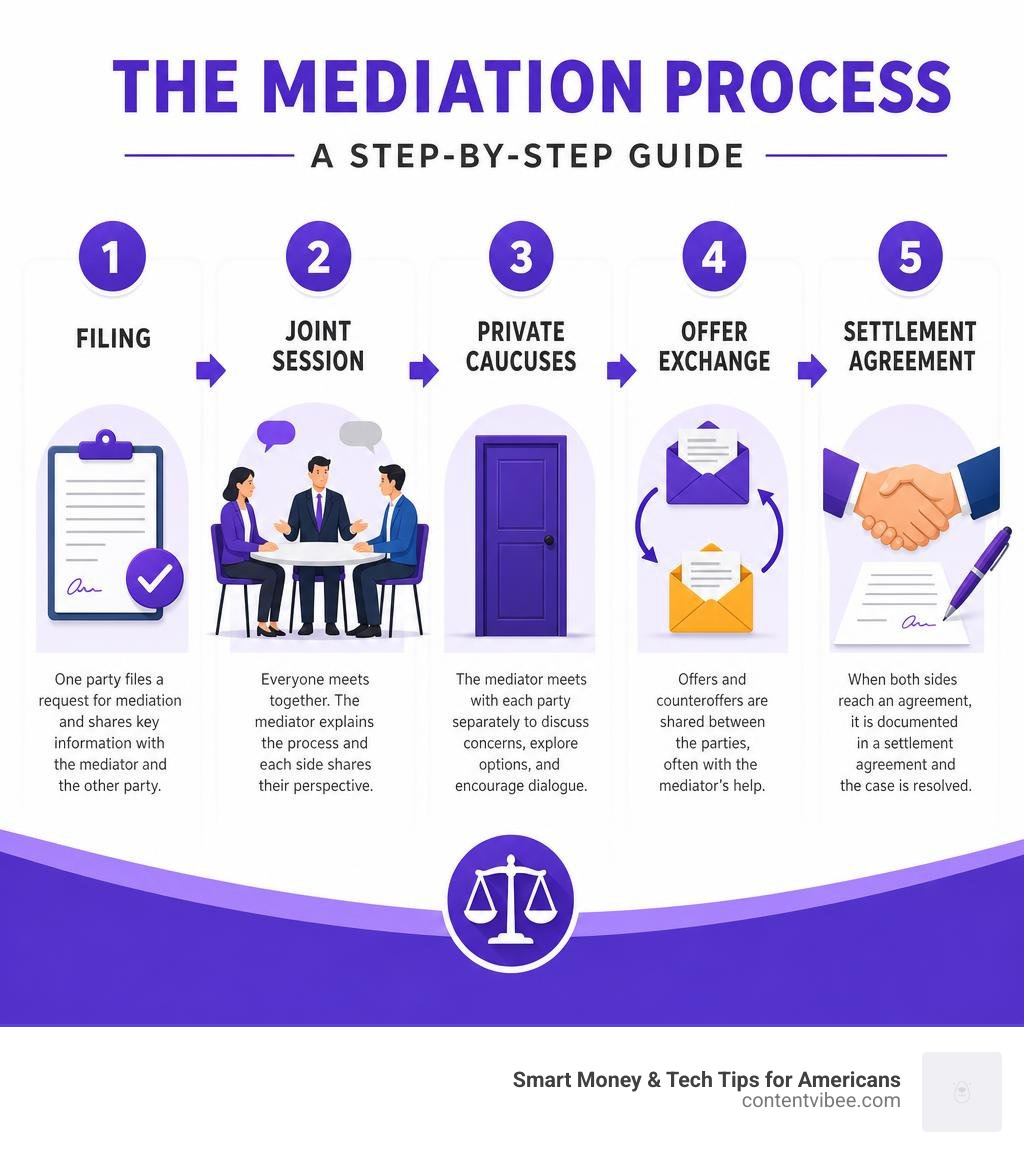
It is a common misconception that a mediator is like a private judge who will listen to both sides and declare a winner. In reality, a mediator has zero authority to force anyone to agree to anything.

Instead, the mediator acts as a neutral diplomatic bridge. The process usually begins with a brief joint session where everyone sits in the same room. After that, the parties split up into separate rooms—a process called “caucusing.” The mediator then spends the day walking back and forth between the rooms, carrying offers, clarifying facts, and delivering reality checks.
If negotiations stall near the end of the day, the mediator might issue a “Mediator’s Proposal.” This is a single settlement number that the mediator believes is fair based on the day’s discussions. Both sides must vote “yes” or “no” in secret. If both say yes, the case is settled. If either says no, the deal falls through, and no one is told who rejected it.
To get the most out of this process, professional negotiators rely on a few proven strategies:
- The First Offer Dynamics: Expect the initial offer from the insurance company or defendant to be incredibly low—often so low that it feels like an insult. Do not pack your bags and leave. This is a standard opening gambit designed to test your resolve and lower your expectations.
- The GRIT Strategy (Graduated and Reciprocated Initiative in Tension-Reduction): This strategy involves making a small, unilateral concession to signal goodwill, inviting the other side to match your concession. It helps break deadlocks when both parties are dug into their positions.
- Logrolling: This is the art of trading off issues of different values. For example, a plaintiff might agree to take a slightly lower monetary settlement in exchange for a structured payout schedule, or a consumer might drop a minor claim if the company agrees to completely delete negative remarks from their credit report.
As highlighted by The Mediation Group in their article, What Is the Average Settlement Offer During Mediation?, successful negotiation requires moving away from rigid “positions” (e.g., “I demand $100,000 or else!”) and focusing instead on “interests” (e.g., “I need enough money to cover my outstanding medical bills and secure my lost wages”).
How to Prepare for Mediation to Maximize Your Offer
If you want to walk away from mediation with a favorable settlement, you cannot just show up and wing it. You need to prepare with the same level of detail as if you were walking into a courtroom.
Here is our checklist for maximizing your settlement offer:
- Validate Your Evidence: Gather every scrap of paper that supports your claim. This includes medical bills, diagnostic imaging (MRIs/X-rays), tax returns to prove lost income, and physical evidence like photos of the accident scene or defective products.
- Draft a Powerful Demand Letter: Before mediation begins, your attorney should send a comprehensive demand letter outlining the facts, liability, and damages. This sets a serious tone and establishes your starting anchor point.
- Know Your Numbers: Before you walk through the door, establish three numbers in your head:
- The Dream Number: Your ideal, best-case scenario.
- The Target Number: A realistic, fair settlement based on the evidence.
- The Walk-Away Number: The absolute minimum you will accept before walking out and taking your chances in court.
- Embrace Patience: Mediation is a slow, methodical process. As the legal team at Schmidt & Clark notes in their Average Settlement Offers During Mediation (2026 Update), very little progress is made in the morning. The defense will spend hours trying to poke holes in your case. Real movement almost always happens after lunch, as the clock starts ticking and both sides feel the pressure of the day wrapping up. Stay calm, pack some snacks, and trust the process.
Frequently Asked Questions about Mediation Settlements
What happens if we cannot reach an agreement during mediation?
If you cannot reach an agreement, the mediator will declare an “impasse.” Because mediation is entirely voluntary and non-binding, you are free to walk away.
An impasse does not mean your case is over. In fact, many cases that “fail” at mediation end up settling a few weeks or months later. The mediation session often acts as a catalyst, forcing both sides to see the weaknesses in their arguments and recalibrate their expectations. If a post-mediation settlement still cannot be reached, your next steps typically involve escalating the dispute to binding arbitration or proceeding to a formal trial.
What are the most common misconceptions about mediation offers?
- Misconception 1: “The mediator decides who wins.” As we mentioned earlier, the mediator is a facilitator, not a judge. They cannot force a settlement.
- Misconception 2: “The first offer is their best offer.” The first offer is simply a starting point. Accepting it immediately is almost always a financial mistake.
- Misconception 3: “There is a standard formula for my injury.” Every case is evaluated on its unique merits. Two people with the exact same herniated disc can receive wildly different settlements based on their age, occupation, state laws, and the quality of their legal representation.
Is a settlement agreement reached in mediation legally binding?
Yes, but only after it is reduced to writing and signed by both parties.
During the mediation session, once you agree on the core terms, the attorneys will draft a “Term Sheet” or a formal settlement agreement. According to the legal insights provided by Osterbind Law in their guide on Average Settlement Offers During Mediation, once this document is signed, it becomes a legally binding and enforceable contract.
This agreement will almost always include a “Release of Liability” clause. This means that in exchange for the settlement money, you permanently waive your right to pursue any future legal claims related to this incident. If your injuries worsen down the road, you cannot go back and ask for more money.
Conclusion
Navigating a legal dispute can feel like walking through a financial minefield. Whether you are dealing with a personal injury, a consumer dispute, or a business disagreement, understanding the mechanics of mediation is a vital part of smart financial planning.
At Smart Money & Tech Tips for Americans, we believe that being armed with the right data is your greatest asset. While there is no magic formula to calculate your exact outcome, knowing the typical ranges, preparing your evidence, and understanding the psychology of negotiation will put you in the best possible position to secure a favorable deal.
Before you sit down at the negotiating table, it helps to run the numbers yourself. You can Calculate your potential settlement using online interactive tools to get a clearer picture of your economic damages, pain and suffering multipliers, and realistic negotiation targets. Use this data, stay patient, and approach your mediation with confidence!