A Complete Breakdown of Fidelity Advisor Directed Fees

Why Fidelity Advisor Directed Fees Matter Before You Invest
Fidelity advisor directed fees can range from $0 to over 1.85% per year depending on the service tier you choose — and that difference can cost you tens of thousands of dollars over time.
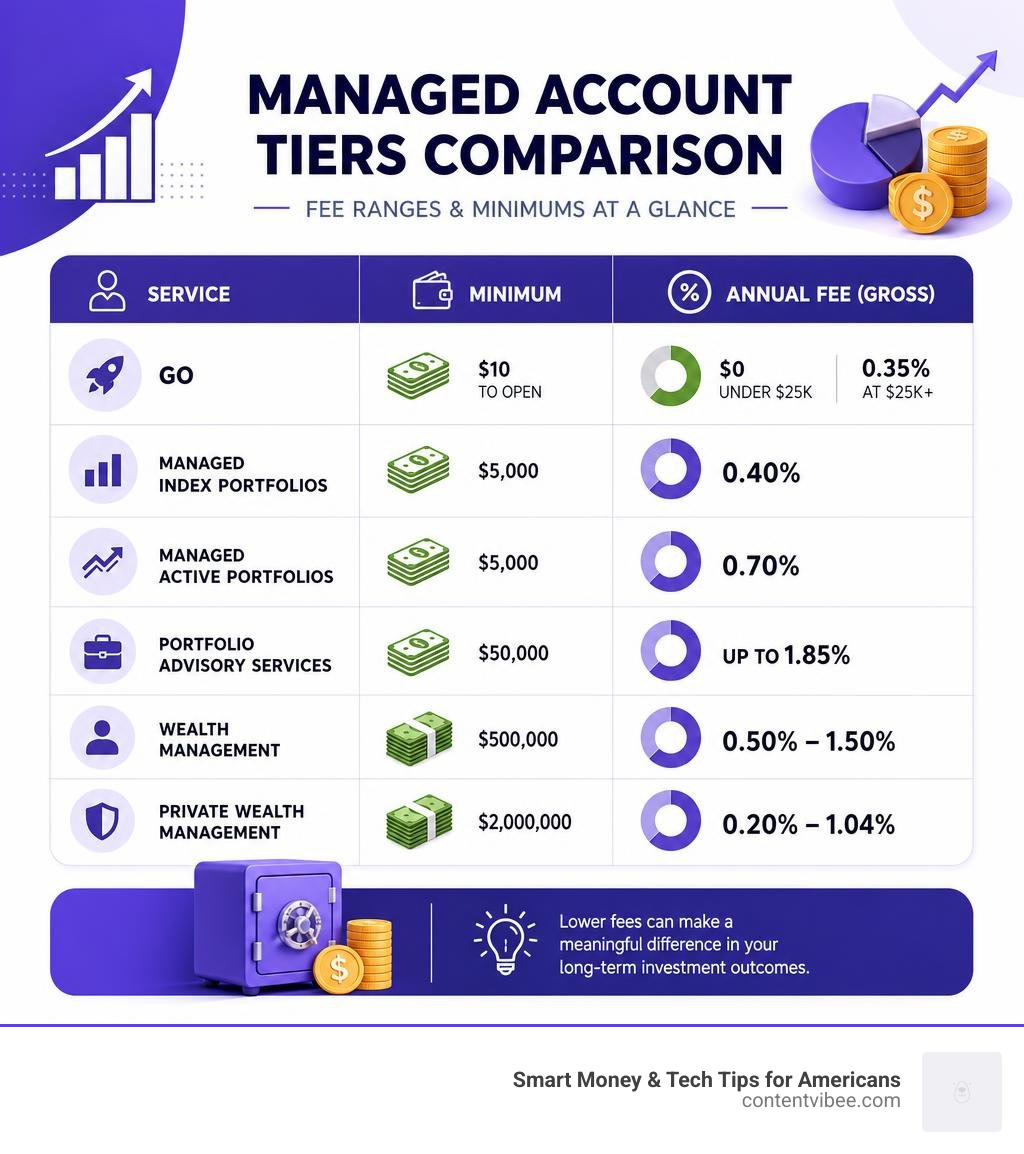
Here’s a quick comparison of Fidelity’s main managed account options:
| Service | Minimum | Annual Fee (Gross) |
|---|---|---|
| Fidelity Go | $10 to open | $0 under $25K; 0.35% at $25K+ |
| Managed FidFolios (Index) | $5,000 | 0.40% |
| Managed FidFolios (Active) | $5,000 | 0.70% |
| Portfolio Advisory Services | $50,000 | Up to 1.85% |
| Fidelity Wealth Management | $500,000 | 0.50%–1.50% |
| Private Wealth Management | $2,000,000 | 0.20%–1.04% |
Choosing the wrong tier — or not understanding what you’re actually paying — is a common and costly mistake.
The difference between a 0.25% and a 1.00% annual fee on a $100,000 portfolio can add up to nearly $30,000 in lost returns over 20 years, even at a modest 4% annual return. That’s not a small rounding error. That’s a car, a down payment, or years of retirement income.
This guide breaks down every Fidelity managed account tier, how fees are calculated, what’s actually included, and where the hidden costs can sneak up on you.
Understanding Fidelity Advisor Directed Fees and Managed Accounts
When you transition from managing your own investments to having a professional handle them, you enter managed accounts. At Fidelity, these services are referred to as “advisor-directed” or “professionally managed” accounts.
Instead of paying a commission for every stock or mutual fund you buy, you typically pay an ongoing, asset-based fee. This fee structure is usually organized as a “wrap fee program.” Under a wrap fee program, a single fee covers your investment advice, portfolio management, trade executions, custody, and administrative services.

When you enroll in an advisor-directed service, Fidelity’s advisory arm, Strategic Advisers LLC, acts as a fiduciary. This means they are legally obligated to act in your best interest and put your financial well-being ahead of their own. They manage your portfolio using discretionary authority, meaning they make the daily buy and sell decisions based on your financial goals, risk tolerance, and time horizon.
To understand the core differences between self-directed brokerage accounts and managed accounts, you can review the official Guide to Brokerage and Investment Advisory Services.
Core Tiers of Fidelity Advisor Directed Fees
Fidelity structures its managed services into distinct tiers based on your account size and the level of human interaction you require.
- Robo-Advising (Fidelity Go): This is the entry-level digital advisory service. It is designed for hands-off investors who want a automated portfolio built with low-cost funds. For a deeper dive into this specific tier, check out The No-Nonsense Guide to Fidelity Robo Advisor Fees.
- Portfolio Advisory Services: A step up from the pure robo-advisor, this tier offers professional portfolio management with a slightly lower entry barrier than full wealth management.
- Fidelity Wealth Management: Designed for investors with at least $500,000, this tier pairs you with a dedicated financial advisor to build a customized plan that covers retirement, tax strategies, and estate planning.
- Private Wealth Management: For high-net-worth individuals with $2 million or more in assets, this service provides a dedicated team of specialists to manage complex financial needs, including trust services and advanced tax-smart strategies.
How Fidelity Advisor Directed Fees Compare to Industry Standards
To evaluate whether Fidelity’s fees are reasonable, we must look at industry averages. Historically, the traditional fee for a human financial advisor has hovered around 1.00% of assets under management (AUM) per year.
Fidelity’s pricing is highly competitive, especially as your account balance grows. According to industry research, the average asset-weighted expense ratio for all mutual funds and ETFs dropped to 0.34% in 2024, which is less than half of what it was 20 years ago. This downward pressure on fees has also impacted advisory services. For comparison, equity mutual funds carry an asset-weighted average expense ratio of 0.40%, while index mutual funds average just 0.05%.
Fidelity’s managed services often use proprietary, zero-expense-ratio funds (such as Fidelity Flex funds) to keep the underlying costs of their robo-adviser portfolios at zero, meaning the advisory fee is the only cost you pay. You can view their full breakdown of standard brokerage and advisory costs on the Straightforward and Transparent Pricing page.
Fee Structures and Minimums Across Fidelity Managed Services
Let’s explore the specifics of each tier, examining the minimum investments, gross fees, and what you actually get for your money.
Digital and Hybrid Managed Accounts
If you are just starting out, Fidelity Go is the primary robo-advisory option.
- Minimum Investment: $0 to open an account, $10 to start investing.
- Advisory Fee:
- Under $25,000: $0 annual advisory fee.
- $25,000 and above: 0.35% annual advisory fee.
Once your balance crosses the $25,000 threshold, you unlock access to unlimited 30-minute coaching calls with human financial advisors. These advisors can help you with budgeting, retirement planning, and managing debt.
Furthermore, taxable accounts at the $25,000+ level automatically receive tax-loss harvesting. To keep underlying fund fees at zero, Fidelity Go invests your money exclusively in Fidelity Flex mutual funds, which carry a 0.00% expense ratio. For more details on how these portfolios are constructed, visit the Fidelity Go Overview.
Wealth Management and Private Wealth Services
For larger portfolios, Fidelity transitions you to personalized, advisor-led relationships.
-
Fidelity Wealth Management:
- Minimum Investment: $500,000.
- Gross Advisory Fee Range: 0.50% to 1.50% per year.
- What’s included: A dedicated financial advisor, customized portfolio construction, ongoing tax-smart investing strategies, and comprehensive financial planning.
-
Fidelity Private Wealth Management:
- Minimum Investment: $2,000,000.
- Gross Advisory Fee Range: 0.20% to 1.04% per year.
- What’s included: A dedicated wealth management team, advanced estate and legacy planning, specialized tax strategies, and coordination with external professionals like CPAs and attorneys.
You can read the exact legal disclosures and service definitions in the official Client Relationship Summary.
Portfolio Advisory and Private Portfolio Services
Fidelity also offers specialized discretionary management under different brand names, depending on how your assets are held (e.g., individual accounts vs. trust accounts).
-
Portfolio Advisory Services:
- Minimum Investment: $50,000.
- Gross Advisory Fee: This service typically charges a gross advisory fee of around 1.10%, but the maximum gross advisory fee can be up to 1.85% for smaller accounts ($300,000 to $500,000) and reduces gradually down to 1.05% for accounts over $3 million.
-
Fidelity Private Portfolio Service (for accounts of $3 million or more):
- This service has a tiered fee schedule that rewards higher balances with lower net fees.
- $3M to $4M Tier: 1.40% gross advisory fee, which drops to a 0.65% net advisory fee after applying the Credit Amount.
- $8M+ Tier: 1.05% gross advisory fee, which drops to a 0.30% net advisory fee after the Credit Amount.
The “Credit Amount” is a critical feature of these higher-tier services. It acts as a rebate to offset any underlying fund fees or revenue-sharing payments that Fidelity’s affiliates receive, ensuring you aren’t double-charged for the mutual funds held in your portfolio.
Custom Stock Portfolios and Direct Indexing Fees
If you want the benefits of professional management but prefer holding individual stocks rather than mutual funds or ETFs, Fidelity offers Managed FidFolios. This is a digital separately managed account (SMA) that allows for direct indexing and personalization.
Actively Managed vs. Direct Indexing FidFolios
Managed FidFolios require a $5,000 minimum investment and use fractional shares to build diversified portfolios of individual stocks. There are two primary strategies:
-
Direct Indexing Strategies:
- Annual Advisory Fee: 0.40% (or $20 per year for every $5,000 invested).
- How it works: Your portfolio mirrors a major index (like the S&P 500 or an international index), but you own the individual stocks directly. This allows you to exclude up to five individual stocks or two entire industries (for example, if you want to avoid oil or tobacco companies).
-
Actively Managed Strategies:
- Annual Advisory Fee: 0.70% (or $35 per year for every $5,000 invested).
- How it works: Professional managers actively select stocks to beat the market or target specific outcomes, such as high dividend income. This includes specialized strategies like the Environmental Focus strategy, which targets sustainable companies.
Because you own the underlying stocks directly, the system can perform daily tax-loss harvesting by selling individual losing stocks to offset capital gains. Fidelity notes that over 94% of Managed FidFolios clients have had their advisory fees completely covered by the tax savings generated by these strategies. You can read the fine print in the Fidelity Managed FidFolios Brochure.
Hidden Costs, Fee Calculations, and Tax Implications
While Fidelity is highly transparent about its pricing, no investment program is entirely free of secondary costs. To keep your overall costs low, you must learn to identify and Beat hidden investment fees.
How Advisory Fees Are Calculated and Billed
Fidelity’s advisor-directed fees are calculated daily and billed quarterly in arrears. This means the fee is based on the average daily balance of your assets during the quarter, and it is automatically deducted from your account.
To prevent double-billing, Fidelity uses a Credit Amount system. Many mutual funds pay “distribution fees” (12b-1 fees) or administrative fees to the brokerage platform that hosts them. If Fidelity holds a fund in your managed account that pays these fees to a Fidelity affiliate, Fidelity calculates that amount and credits it back to your account, reducing your net advisory fee.
Tax-Smart Investing and Tax Implications
Paying an advisory fee has distinct tax implications that you should discuss with a CPA:
- Fee Deductibility: Under current U.S. tax law, personal investment advisory fees are generally not deductible on your federal income tax return.
- Tax-Loss Harvesting: Managed accounts (especially Managed FidFolios and taxable Fidelity Go accounts over $25,000) actively look for opportunities to sell losing securities to offset capital gains. This can lower your current-year tax bill.
- Capital Gains Deferral: When transitioning an existing portfolio into a managed service, selling your old mutual funds to buy the advisor’s recommended portfolio can trigger a massive capital gains tax bill. Fidelity’s advisors can work to transition your low-cost basis shares slowly over time to minimize this tax hit.
Frequently Asked Questions about Fidelity Advisor Directed Fees
What is the difference between gross and net advisory fees at Fidelity?
The gross advisory fee is the maximum percentage fee charged by Fidelity for managing your account before any offsets are applied. The net advisory fee is the actual out-of-pocket percentage you pay after Fidelity subtracts the “Credit Amount.” This credit represents rebates for underlying fund expenses or revenue-sharing payments that Fidelity’s affiliates received from the funds in your portfolio.
Are there any hidden transaction fees in Fidelity’s wrap programs?
No. Because Fidelity’s advisor-directed accounts operate as wrap fee programs, you do not pay individual commissions or transaction fees when the advisor buys or sells stocks, ETFs, or mutual funds within the managed account. However, you are still responsible for the internal operating expense ratios of any non-Fidelity mutual funds held in the account.
How does the Credit Amount reduce my overall advisory fees?
Fidelity calculates the Credit Amount daily based on the actual fees and revenue-sharing payments received by its affiliates from the mutual funds held in your portfolio. This credit is then automatically applied to your quarterly billing cycle, lowering your gross advisory fee down to the lower net advisory fee.
Conclusion
Understanding Fidelity advisor directed fees is essential to keeping your wealth-building plan on track. Whether you are using a simple robo-advisor like Fidelity Go or working with a dedicated team in Private Wealth Management, knowing what you pay — and how those fees affect your long-term returns — ensures you make informed decisions.
At Smart Money & Tech Tips for Americans, we believe that fee transparency is the cornerstone of successful financial planning. To see how these costs compare across different brokerage setups, Explore our Fidelity Cost Transparency Review.