Claiming Spousal Benefits Without the Government Red Tape

Why Claiming Social Security Spousal Benefits Is Worth Your Attention Right Now
Claiming Social Security spousal benefits is one of the most valuable — and most misunderstood — moves a married (or formerly married) person can make in retirement.
Here’s a quick answer if you just need the basics:
How to claim Social Security spousal benefits:
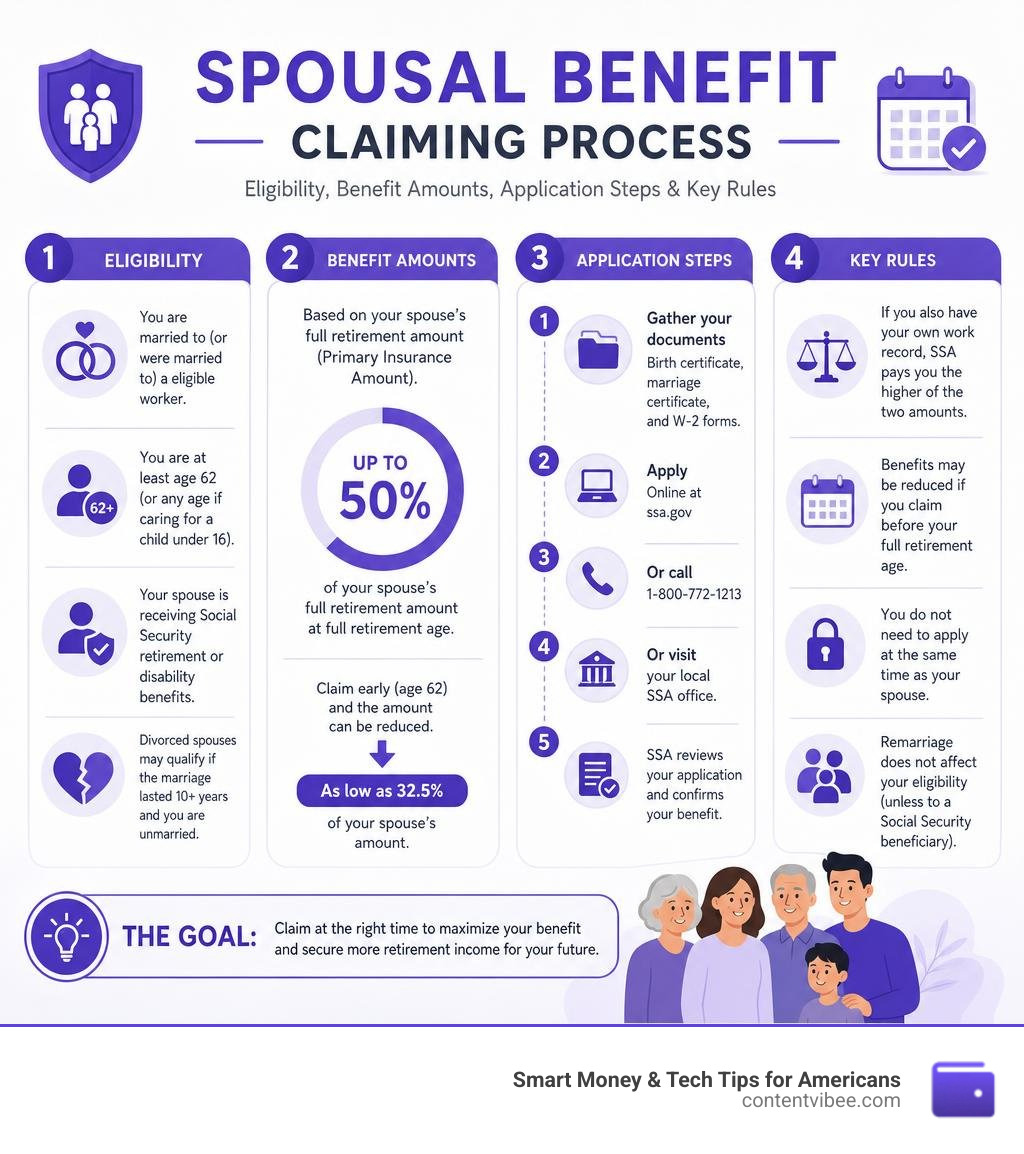
- Make sure your spouse is already receiving their Social Security retirement or disability benefit
- Confirm you are at least age 62 (or any age if caring for a qualifying child under 16)
- Gather your documents: birth certificate, marriage certificate, and W-2 forms
- Apply online at ssa.gov, call 1-800-772-1213, or visit your local SSA office
- If you also have your own work record, SSA will automatically pay you the higher of the two amounts
That’s the short version. But the details matter — a lot.
The benefit can be worth up to 50% of your spouse’s full retirement amount. Claim too early, and that number can drop to as little as 32.5%. Claim at the wrong time with your own earnings record, and you could leave money on the table without realizing it.
For divorced spouses, the rules are different but still generous — you may qualify even if your ex has remarried.
This guide walks you through everything: who qualifies, how the math works, what documents you need, and how to avoid the most common mistakes people make when applying.
What Are Spousal Benefits and Who Qualifies?
Social Security is often viewed as an individual safety net, but it is actually designed to support entire families. Spousal benefits exist to provide retirement security for husbands, wives, and ex-spouses who may have earned less over their careers—or who stepped away from the workforce entirely to raise children or manage a household.
At its core, a spousal benefit allows you to receive a monthly payment based on your husband’s or wife’s earnings record rather than your own. To determine how much you qualify for, the Social Security Administration (SSA) looks at your spouse’s Primary Insurance Amount (PIA). The PIA is the monthly benefit your spouse is eligible to receive when they reach their Full Retirement Age (FRA).
We often see couples assume that if one partner didn’t pay enough into the Social Security system to qualify for retirement benefits, they are left out in the cold. Fortunately, that is not the case. Even if you have a limited work history (or no work history at all), you can still receive a spousal benefit worth up to 50% of your partner’s PIA.
To help you figure out if you meet the baseline criteria, we recommend checking out the official SSA blog post, Do You Qualify for Social Security Spouse’s Benefits?. For a deeper dive into how marital status and work history intersect with these rules, our Detailed Guide to Spousal Benefits Eligibility offers a comprehensive breakdown of the fine print.
Basic Eligibility Requirements
To qualify for spousal benefits, the federal government has established several strict rules. First and foremost, you must currently be married to the worker on whose record you are claiming. Additionally, your marriage must have lasted for at least one continuous year before you file your application.
Age is another critical factor. Generally, you must be at least 62 years old to claim spousal benefits. However, there is a major exception to this rule: if you are caring for a child who is under the age of 16, or a child of any age who became disabled before age 22, you can claim spousal benefits at any age. In these cases, the age requirement is waived, and the benefit is not reduced for early claiming.
According to the official SSA Handbook § 305, you must also meet specific marital and prior entitlement conditions. Furthermore, the primary worker (your spouse) must already be entitled to and receiving either retirement or disability benefits for you to collect on their record. If they have not filed yet, you cannot receive spousal benefits, unless you fall under specific divorced spouse rules.
For a deeper look at how these qualifications play out in real life for married partners, check out our guide on How Social Security Spousal Benefits Work for Married Couples.
Rules for Divorced Spouses Claiming Social Security Spousal Benefits
If you are divorced, you might think your ex-spouse’s Social Security record is completely off-limits. However, the SSA is surprisingly accommodating here. You can receive benefits as a divorced spouse on your ex-spouse’s Social Security record, and doing so will not impact their benefit amount or the benefits of their current spouse if they have remarried.
To qualify as a divorced spouse, you must meet the following criteria:
- Your marriage to your ex-spouse must have lasted for at least 10 consecutive years.
- You must be at least 62 years old.
- You must currently be unmarried. (If you remarry, you generally lose the right to claim on your ex’s record, unless your subsequent marriage ends by death, divorce, or annulment).
- Your ex-spouse must be eligible for retirement or disability benefits.
One major advantage for divorced spouses is that if you have been divorced for at least two consecutive years, you can claim benefits on your ex-spouse’s record even if they have not yet applied for their own retirement benefits. As long as they are at least 62 and qualify for them, you can file independently.
For a full breakdown of how to navigate these sensitive rules and coordinate your retirement, read our post, Double the Fun: Understanding Your Spousal Social Security Benefits.
How Spousal Benefit Amounts Are Calculated
The maximum spousal benefit you can receive is exactly 50% of your spouse’s Primary Insurance Amount (PIA). It is highly important to note that this 50% cap is based on what your spouse is entitled to receive at their full retirement age, not what they actually receive if they delayed retirement to earn extra credits.
For example, if your spouse’s PIA is $2,000 per month, your maximum spousal benefit is $1,000 per month. If your spouse decides to delay claiming their own benefit until age 70 to earn delayed retirement credits, their personal check will increase, but your maximum spousal benefit remains anchored to their FRA amount ($1,000).
To get a clear handle on how these numbers are calculated, we highly recommend reading our article on Determining Your Spousal Social Security Benefit Amount.
The table below outlines how your claiming age permanently impacts the percentage of your spouse’s benefit you will receive:
| Claiming Age | Percentage of Spouse’s PIA Received (Assuming FRA is 67) |
|---|---|
| 67 (Full Retirement Age) | 50.0% |
| 66 | 45.8% |
| 65 | 41.7% |
| 64 | 37.5% |
| 63 | 35.0% |
| 62 | 32.5% |
How Age Affects Claiming Social Security Spousal Benefits
As the table shows, timing is everything. If you wait until you reach your own full retirement age (which is 67 for anyone born in 1960 or later), you will receive your full 50% spousal benefit. However, you can choose to retire and claim spousal benefits as early as age 62, though doing so results in a permanent reduction of your monthly check.
The reduction math is structured as follows:
- The benefit is reduced by 25/36 of 1% for each month before your FRA, up to 36 months.
- If you claim more than 36 months early, the benefit is reduced by an additional 5/12 of 1% for each remaining month.
If your FRA is 67 and you claim at age 62 (60 months early), this formula reduces your spousal benefit by a total of 35%, leaving you with just 32.5% of your spouse’s PIA. This reduction is permanent, meaning you will receive this lower amount for the rest of your life.
To run your own numbers and explore the impact of early retirement, you can use the official Benefits for Spouses calculator. For more strategic advice on timing, check out our article, At What Age Can I Claim My Spouse’s Social Security?.
The Impact of Having Your Own Earnings Record
If you have your own work history, you might be eligible for both your own retirement benefit and a spousal benefit. However, you cannot “double dip” and receive the full amount of both.
Under the “deemed filing” rules, when you apply for either retirement or spousal benefits, you are automatically deemed to be applying for both. The SSA will calculate both benefit amounts and pay your own retirement benefit first. If your spousal benefit is higher than your own retirement benefit, they will add an extra amount to your check to bring the total up to the higher spousal benefit amount.
For example, let’s say your own retirement benefit at FRA is $800, and your spousal benefit is $1,200. The SSA will pay you your $800 retirement benefit plus a $400 spousal top-off, giving you a combined total of $1,200. If your own retirement benefit is higher than the spousal benefit (say, $1,500), you will simply receive your own higher benefit, and no spousal benefit will be paid.
Understanding this interaction is crucial to planning your retirement timeline. Learn more about how to optimize your filing schedule by reading Social Security Spousal Benefits Timing Is Everything.
Step-by-Step Guide to Claiming Social Security Spousal Benefits

Now that you understand the rules and the math, let’s look at the actual application process. Claiming your benefits doesn’t have to be an administrative nightmare if you know what to expect and have your files in order. To keep your stress levels low, we suggest reading our guide, How to Claim Spousal Retirement Benefits Without Losing Your Mind.
Gathering Your Required Documents
Before you contact the SSA, you should compile all the necessary paperwork. Having these documents ready will prevent delays in processing your application.
For a standard spousal benefit application, you will need:
- Your Social Security number and your spouse’s Social Security number.
- Your original birth certificate (or a certified copy).
- Your marriage certificate (original or certified copy).
- Your W-2 forms or self-employment tax returns for the prior year.
- Your bank account information (routing and account numbers) to set up direct deposit.
- If you are a divorced spouse, your final divorce decree showing that your marriage lasted at least 10 years.
- Proof of U.S. citizenship or lawful alien status if you were not born in the United States.
While the SSA will accept photocopies of W-2 forms, they require original documents or certified copies for birth, marriage, and divorce certificates. Do not mail your only copy of these vital records if you can avoid it; instead, consider bringing them to a local office in person. For more detailed checklist tips, see our post on Applying for Spousal Benefits.
Submitting Your Application Online or In-Person
Once your paperwork is organized, you have three primary ways to submit your application:
- Online (The Fastest Method): You can apply online at the official SSA website if you are within three months of turning 62 or older. This is highly convenient because you can save your progress and complete the form at your own pace.
- By Phone: You can call the SSA’s national toll-free service at 1-800-772-1213 (TTY 1-800-325-0778) to schedule an appointment to apply over the phone.
- In-Person: You can visit your local Social Security office. We highly recommend calling ahead to schedule an appointment so you don’t end up waiting in a long line.
To get started with your application today, check out our step-by-step walkthrough on how to Claim Spousal Benefits.
Modern Claiming Strategies and Rules to Know in 2026
The landscape of Social Security claiming has shifted dramatically over the past decade. If you are reading older retirement guides, you might run into strategies that are no longer legal. In 2026, couples need to design their strategies around the current rules to ensure they aren’t leaving money on the table.
For a comprehensive strategic overview, we recommend reading Maximizing Spousal Benefits Without Leaving Money on the Table.
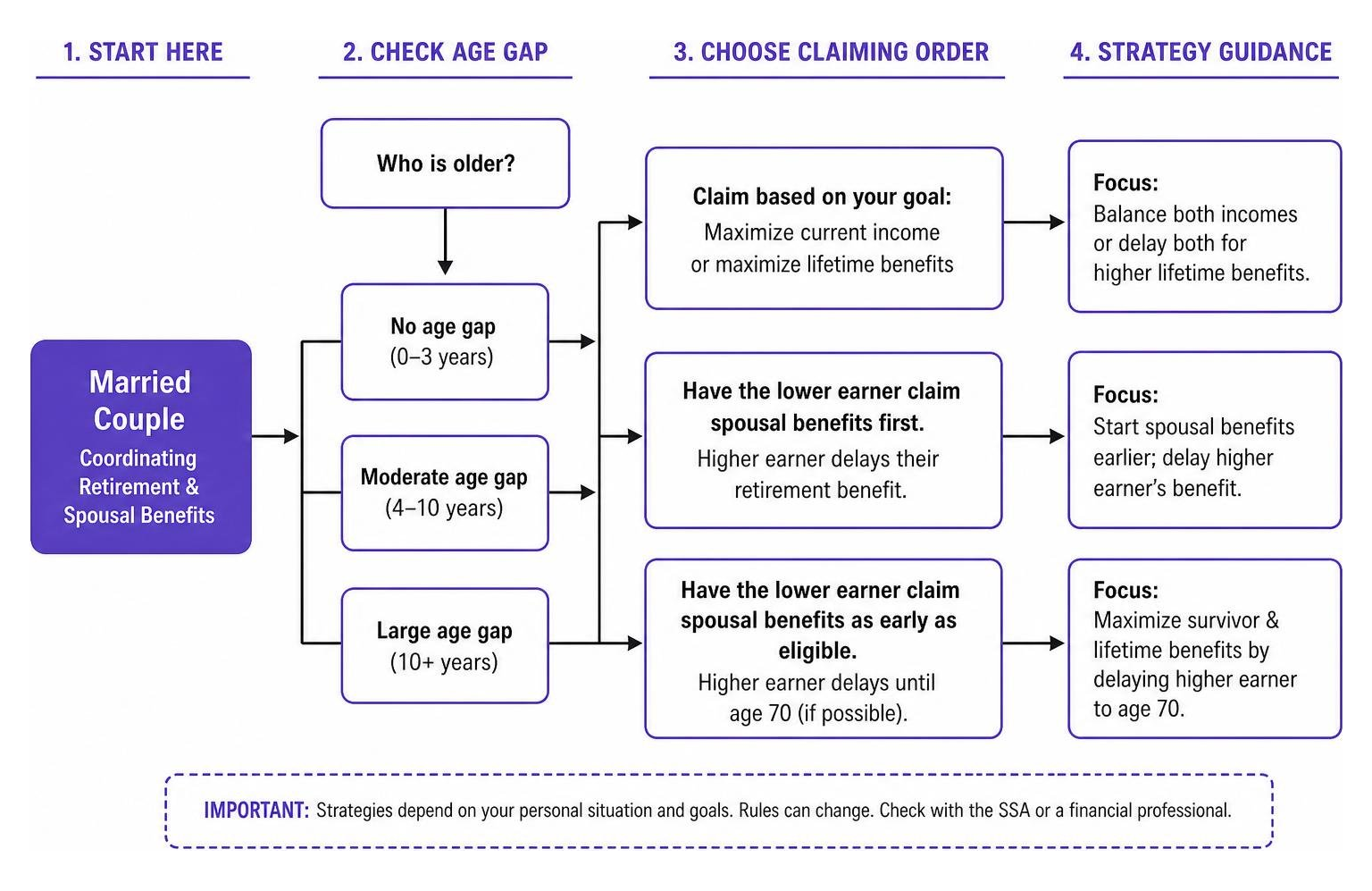
To visualize how age differences and claiming timelines interact for married couples, review the strategic decision path below:
The Death of File-and-Suspend and Restricted Applications
The Bipartisan Budget Act of 2015 permanently closed two of the most popular loophole strategies used by couples: “File-and-Suspend” and “Restricted Applications.”
Under the old rules, a higher-earning spouse could file for retirement benefits at FRA and immediately suspend them. This allowed the lower-earning spouse to claim a spousal benefit while the higher-earning spouse’s personal benefit continued to grow by 8% per year until age 70. Today, if a worker suspends their benefits, all spousal and family benefits on their record are suspended as well.
Similarly, the “Restricted Application” strategy allowed individuals at FRA to file exclusively for spousal benefits while letting their own retirement benefits grow. Today, deemed filing applies at all ages. If you are eligible for both benefits, you must file for both, and you will receive the higher amount. There are no exceptions to this rule for anyone reaching age 62 after January 2, 2016.
To read the official regulatory explanation of these updated rules, visit the SSA’s Filing Rules for Retirement and Spouses Benefits page.
Coordinating Survivor Benefits vs. Spousal Benefits
It is vital to distinguish between spousal benefits (paid while your spouse is alive) and survivor benefits (paid after your spouse passes away).
While spousal benefits are capped at 50% of the worker’s PIA, survivor benefits can be worth up to 100% of the deceased worker’s benefit. If your spouse delayed claiming their retirement benefit until age 70, your survivor benefit will include those delayed retirement credits.
Crucially, deemed filing does not apply to survivor benefits. This means a surviving spouse can choose to claim a survivor benefit as early as age 60 (at a reduced rate of 71.5%) while letting their own retirement benefit grow unhindered until age 70, at which point they can switch to their own higher benefit.
To learn how to coordinate these two distinct types of benefits for maximum family security, check out Double the Fun: A Guide to Social Security Spousal Benefits for Couples.
Frequently Asked Questions About Spousal Benefits
To help you calculate your potential payouts and plan your household budget, we encourage you to use our interactive Tools: Social Security Spousal Benefit Calculator.
Can I claim spousal benefits if my spouse hasn’t retired yet?
For married couples, the answer is generally no. Your spouse must be actively receiving their own retirement or disability benefits for you to collect a spousal benefit on their record.
However, there is an exception for divorced spouses. If you have been divorced for at least two consecutive years, you can claim spousal benefits on your ex-spouse’s record even if they haven’t retired yet, provided they are at least 62 and qualify for benefits.
Will claiming spousal benefits reduce my partner’s monthly check?
No. Claiming spousal benefits has absolutely zero impact on your partner’s monthly retirement check. Their benefit is protected, and they will continue to receive the full amount they are entitled to. Furthermore, if you are a divorced spouse claiming on an ex-partner’s record, your claim will not reduce the benefits paid to your ex-spouse or their new partner.
What happens to my spousal benefit if I work?
If you claim spousal benefits before reaching your full retirement age and continue to work, your benefits may be subject to the Social Security Earnings Test.
If your earnings exceed the annual limit, the SSA will temporarily withhold a portion of your benefits. Once you reach your full retirement age, the earnings limit no longer applies, and the SSA will recalculate your monthly benefit upward to account for the months your benefits were withheld.
Conclusion

Claiming your Social Security spousal benefits does not have to be an overwhelming process. By understanding the basic eligibility rules, keeping an eye on how early claiming reduces your monthly check, and preparing your documentation in advance, you can secure the maximum benefit you are legally owed.
At Suppremo, we are dedicated to helping you make smart, highly informed decisions about your financial future. To take the next step in planning your retirement income, use our free tool to Calculate Your Spousal Benefits the Easy Way and ensure you are keeping every dollar you deserve.