The Best Offshore Injury Lawyers Compared
Why Hiring an Offshore Injury Lawyer Could Be the Most Important Decision You Make
If you were hurt working offshore, you need to act fast. Here’s what you need to know right now:
Quick Answer: What Does an Offshore Injury Lawyer Do?
| Question | Answer |
|---|---|
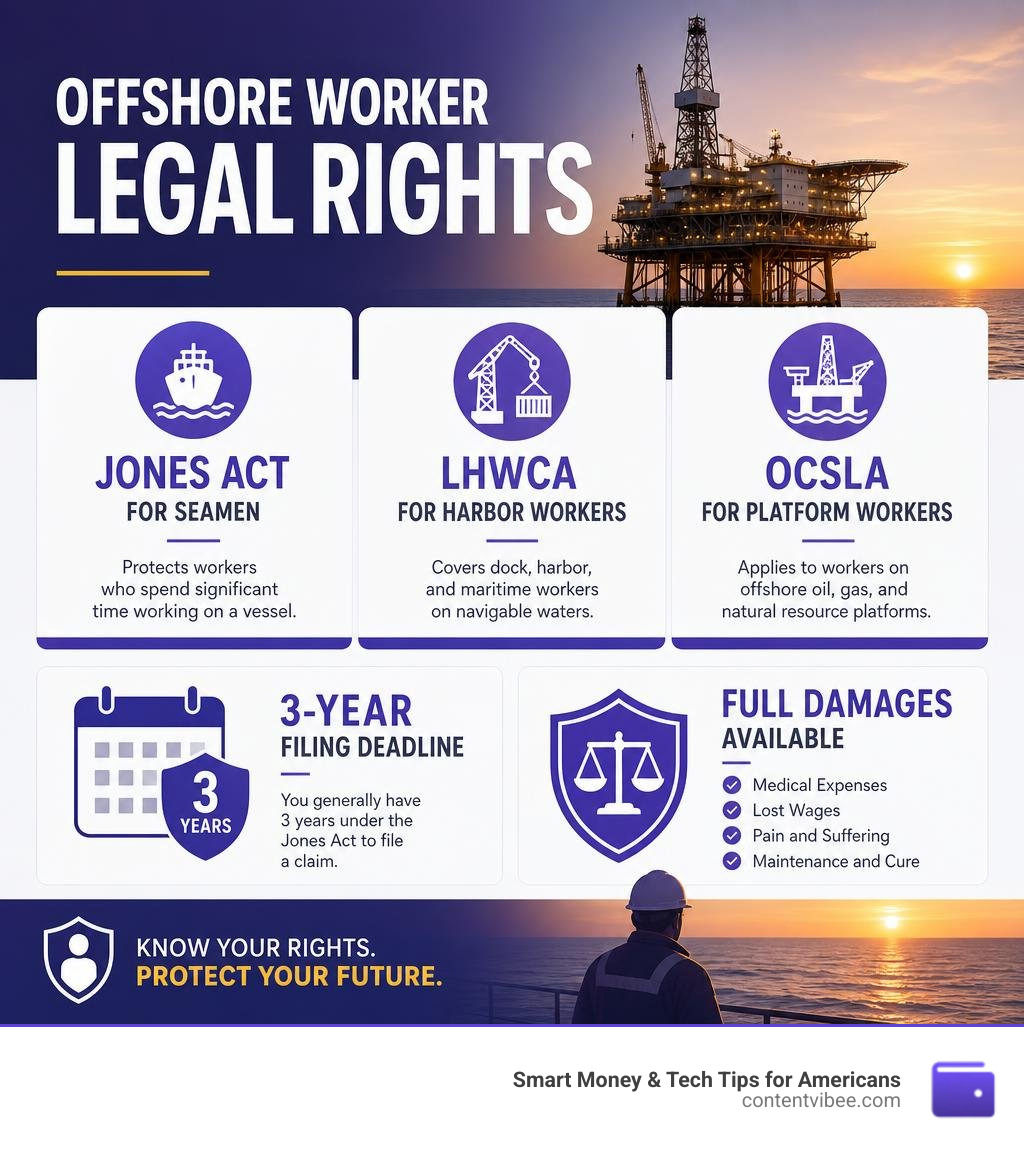
| What law protects you? | The Jones Act (seamen), LHWCA (dock/harbor workers), or OCSLA (platform workers) |
| What can you recover? | Medical bills, lost wages, pain and suffering, daily living expenses (maintenance and cure) |
| How long do you have? | 3 years under the Jones Act; some claims have shorter deadlines |
| Does it cost money upfront? | No — most offshore injury lawyers work on contingency (no fee unless you win) |
| First step? | Report your injury, get medical care, and contact a maritime lawyer before talking to your employer’s insurance adjuster |
Working offshore is one of the most dangerous jobs in America. Offshore oil and gas workers face a fatality rate of 18 per 100,000 workers — far above the national average. Commercial fishermen face an even grimmer picture, with a fatality rate of 75 per 100,000 workers. Overall, maritime workers get injured at rates up to three times higher than the typical U.S. worker.
When something goes wrong out on the water, the rules are completely different from a land-based workplace accident. You can’t just file a standard workers’ comp claim and call it a day. Federal maritime law — including the Jones Act — gives injured offshore workers far stronger rights, including the ability to sue for full damages like pain and suffering.
But here’s the catch: your employer’s legal team starts building their defense the moment your accident happens. Evidence disappears. Witnesses scatter. Quick settlement offers arrive — often worth a fraction of what your case is actually worth.
That’s exactly why understanding your rights, and finding the right offshore injury lawyer, matters so much.
Key terms for offshore injury lawyer:
Understanding Maritime Law: The Jones Act, LHWCA, and OCSLA
When you are injured on land, you are generally restricted to standard state workers’ compensation programs. These programs pay for your medical bills and a portion of your lost wages, but they forbid you from suing your employer for pain and suffering.
Offshore, the legal landscape shifts dramatically. Depending on where you were working, what your job duties were, and what type of structure you were on, your injury will fall under one of three major federal frameworks. To help navigate this legal maze, injured workers rely on a specialized offshore injury lawyer to identify the correct jurisdiction and maximize their financial recovery.
| Legal Framework | Who It Covers | Key Benefits & Rights |
|---|---|---|
| The Jones Act | “Seamen” (crew members on vessels in navigation) | Right to sue employer for negligence; full damages (pain and suffering); maintenance and cure benefits. |
| LHWCA (Longshore & Harbor Workers’ Compensation Act) | Land-based maritime workers (dockworkers, harbor workers, shipbuilders) | No-fault workers’ compensation benefits; medical coverage; vocational rehabilitation. |
| OCSLA (Outer Continental Shelf Lands Act) | Workers on fixed offshore platforms (oil rigs attached to the seabed) | Extends LHWCA benefits to the outer continental shelf; incorporates adjacent state laws for third-party lawsuits. |
Choosing the wrong path can delay your medical benefits or even cause your case to be dismissed entirely. That is why consulting a legal professional is critical. For a broader look at how personal injury claims operate across different industries, check out our Personal Injury Lawyers Complete Guide.
If you qualify as a seaman, your primary path to recovery is filing a claim under the Merchant Marine Act of 1920, commonly known as the Jones Act. You can read more about this specialized process in this guide on Jones Act Claims.
Who Qualifies as a Seaman Under the Jones Act?
The term “seaman” has a highly specific legal definition. You do not qualify as a seaman simply because your job involves water. Under federal maritime law, you must satisfy a two-part test to earn seaman status:
- The 30% Rule: You must spend a significant amount of your working time — generally at least 30% — aboard a vessel or a fleet of vessels under common ownership.
- Contribution to the Vessel’s Mission: Your employment duties must actively contribute to the function of the vessel or the accomplishment of its mission.
This definition covers deckhands, captains, engineers, cooks, commercial fishermen, and even divers. It also includes workers on mobile drilling rigs (like jack-up rigs or semi-submersibles) when those structures are in navigation. If you are a specialist or service hand who travels from vessel to vessel, establishing your seaman status can be complex, and a skilled offshore injury lawyer will be needed to analyze your logbooks and employment contracts.
Recoverable Damages with an Offshore Injury Lawyer
If you qualify as a seaman and your employer’s negligence contributed to your injury, you are entitled to seek “full damages.” Unlike standard workers’ compensation, which places strict caps on what you can recover, Jones Act damages can include:
- Pain and Suffering: Compensation for the physical agony and mental anguish caused by the accident.
- Past and Future Lost Wages: Recovery of the income you lost while healing, plus the loss of your future earning capacity if you can no longer return to offshore work.
- Past and Future Medical Expenses: Every dollar spent on surgeries, physical therapy, medication, and long-term medical care.
- Unseaworthiness Damages: If your injury was caused by a defective vessel or unsafe equipment, you can file an independent unseaworthiness claim against the vessel owner.
Because the financial stakes are so high, maritime employers and their insurance carriers will aggressively fight to limit these payouts. Securing proper legal representation from specialized Accident And Injury Lawyers is often the only way to ensure these powerful corporate entities pay what they truly owe.
Key Differences Between the Jones Act, LHWCA, and OCSLA
The primary dividing line between these three laws is the type of structure you were working on when the accident occurred.
If you work on a fixed platform (an oil rig permanently bolted to the ocean floor), you are not on a “vessel in navigation.” Therefore, you do not qualify as a seaman under the Jones Act. Instead, your injuries are governed by the Outer Continental Shelf Lands Act (OCSLA), which extends LHWCA benefits to offshore workers.
For dockworkers, harbor workers, and shipbuilders working on or near the water, the Longshore and Harbor Workers’ Compensation Act (LHWCA) provides structured, no-fault benefits. While you cannot sue your employer for negligence under the LHWCA, you can still file third-party lawsuits if a contractor or equipment manufacturer caused your injury.
Because Louisiana and the Gulf Coast host a massive portion of the nation’s offshore workforce, local legal nuances play a major role in these cases. To see how these federal laws interact with local jurisdictions, review this resource on the Louisiana Offshore Injury Lawyer framework.
Common Causes of Offshore Accidents and Post-Incident Steps
Offshore work environments are inherently hostile. You are operating heavy machinery on slick, moving steel decks, often in extreme weather conditions, thousands of miles from the nearest hospital.

Some of the most common causes of offshore accidents include:
- Equipment Failure: Corroded cables, defective cranes, and poorly maintained winches.
- Employer Negligence: Inadequate crew training, forcing workers to pull double shifts without rest, and failing to provide proper personal protective equipment (PPE).
- Slip and Falls: Decks covered in oil, grease, or ocean water without non-skid surfaces.
- Fires and Explosions: Highly pressurized gas leaks on drilling platforms or vessels.
In maritime law, the principle of comparative fault applies. This means that even if you were partially to blame for your own accident, you can still recover damages. However, your total financial award will be reduced by your percentage of fault. Employers will use this rule to try to pin 100% of the blame on you. For similar industrial injury insights, you can read our Oilfield Injury Lawyer Texas Detailed Guide.
Proving Employer Negligence in Maritime Claims
Under the Jones Act, proving negligence is significantly easier than in a standard personal injury case. The law utilizes what is known as a “featherweight” burden of proof.
To win a standard personal injury lawsuit, you must prove that the defendant’s negligence was the primary cause of your injury. Under the Jones Act, you only have to prove that your employer’s negligence played the slightest part—even a fraction of a percent—in causing your injury.
If an employer failed to fix a flickering light bulb, failed to enforce a strict cell phone distraction policy, or asked you to lift something too heavy without help, and that contributed to your slip or strain, they can be held legally liable. Additionally, vessel owners have an absolute duty to provide a “seaworthy” vessel, meaning the ship, its crew, and its equipment must be reasonably fit for their intended use.
What to Do Immediately After an Offshore Accident
The hours and days following an offshore accident are critical. What you do—and what you don’t do—can make or break your potential legal claim.

If you are injured, follow these steps immediately to protect your health and your legal rights:
- Seek Immediate Medical Attention: Your health is the absolute priority. Accept evacuation via helicopter if your injuries are severe.
- Report the Injury in Writing: Report the incident to your supervisor immediately. Ensure it is logged in the vessel’s official daily log. Demand a copy of the incident report.
- Document the Scene: If you are physically able, take photos of the unsafe condition, the equipment involved, and your injuries.
- Gather Witness Contacts: Collect the names, phone numbers, and email addresses of co-workers who saw the accident. Crew members transfer frequently, and finding them later can be incredibly difficult.
- Preserve Physical Evidence: Keep your damaged safety gear, torn clothing, or any tools involved in the accident.
- Be Cautious with Company Representatives: Do not give recorded statements to insurance adjusters or company lawyers. They are trained to twist your words to minimize their liability.
- Consult an Independent Doctor: You have the legal right to choose your own treating physician. Do not let your employer force you to see a “company doctor” whose primary goal may be to downplay your injuries and rush you back to work.
How to Choose the Best Offshore Injury Lawyer
Offshore injury claims are incredibly complex. They involve overlapping federal statutes, international maritime treaties, and technical engineering concepts. A general personal injury lawyer who handles car accidents is simply not equipped to go toe-to-toe with multi-billion-dollar maritime defense firms.
When vetting attorneys, you should look for the following criteria:
- Actual Maritime Experience: Ask how many Jones Act cases they have actually taken to trial.
- Financial Resources: Maritime litigation is expensive. Your lawyer must have the financial backing to hire marine engineers, vocational experts, and forensic economists to build your case.
- Contingency Fee Structure: You should never pay a dime upfront. The best offshore injury lawyers work on a contingency basis, meaning they only get paid if they successfully recover money for you.
To understand how to evaluate local attorneys and find the right fit for your specific geographical area, consult our guide on Injury Lawyer Near Me How To Find The Right One.
Why You Need a Specialized Offshore Injury Lawyer
Large oil and gas companies, shipping conglomerates, and marine insurers have a highly sophisticated “defense playbook.” The moment an accident occurs, they deploy investigators to the scene to gather evidence that protects their bottom line.
A specialized offshore injury lawyer knows this playbook inside and out. Many top-tier plaintiff attorneys actually began their careers representing maritime defense firms, giving them insider knowledge of how these companies attempt to suppress evidence or deny valid claims.
Furthermore, preparing a maritime case for trial requires a massive allocation of resources. Your legal team must be prepared to subpoena vessel maintenance logs, analyze black box data, and depose corporate executives. For a transparent breakdown of how legal fees work in these complex scenarios, read our detailed article: How Much Do Lawyers Charge For Accident Claims.
Frequently Asked Questions About Offshore Injuries
How long do I have to file a Jones Act claim?
Under federal maritime law, the statute of limitations for a Jones Act claim is three years from the date of the injury. If you fail to file a lawsuit within this three-year window, you will lose your right to seek compensation forever.
However, you should never wait this long. Evidence on vessels and offshore platforms can be painted over, repaired, or lost entirely within weeks of an accident. Additionally, other types of maritime claims (such as those against third-party contractors or claims under specific state laws via OCSLA) may have much shorter deadlines—sometimes as short as one year.
What is the difference between maintenance and cure and standard workers’ compensation?
“Maintenance and cure” is an ancient maritime right designed to protect injured seamen. It is a no-fault benefit, meaning you are entitled to it regardless of who caused your accident.
- Maintenance is a daily living allowance meant to cover your basic shelter and food expenses on land (equivalent to what you would have received aboard the vessel).
- Cure is the obligation of your employer to pay for all necessary medical care, rehabilitation, and prescriptions related to your injury.
These benefits must be paid until you reach Maximum Medical Improvement (MMI)—the point at which your condition cannot improve any further. Unlike standard workers’ compensation, there are no statutory caps on the duration of these benefits, and your employer cannot legally stop paying them simply because they disagree with your independent doctor.
Can I be fired or blacklisted for filing an offshore injury claim?
It is absolutely illegal for a maritime employer to retaliate against you, fire you, or blacklist you within the industry for filing a legitimate Jones Act or maritime injury claim. Federal maritime law provides strong wrongful termination protections for injured workers.
Despite these laws, the fear of being blacklisted prevents many offshore workers from seeking the compensation they deserve. A skilled offshore injury lawyer will act as a shield between you and your employer, ensuring your rights are protected throughout the legal process.
Conclusion
At Smart Money & Tech Tips for Americans, we know that a sudden workplace injury can throw your entire financial future into chaos. If you are an offshore worker recovering from a severe accident, securing full and fair financial compensation is not just about paying off immediate medical bills—it is about protecting your family’s long-term livelihood.
The maritime industry is backed by massive legal teams and deep financial pockets. To level the playing field, you need an advocate who understands the complexities of the Jones Act, LHWCA, and OCSLA.
If you are ready to take the next step toward financial recovery, read our comprehensive analysis on how much does a personal injury lawyer cost to understand how contingency fees protect your wallet while you fight for justice.