First Offer Blues: Navigating Auto Accident Settlement Averages

What the Insurance Company Won’t Tell You About Your First Settlement Offer
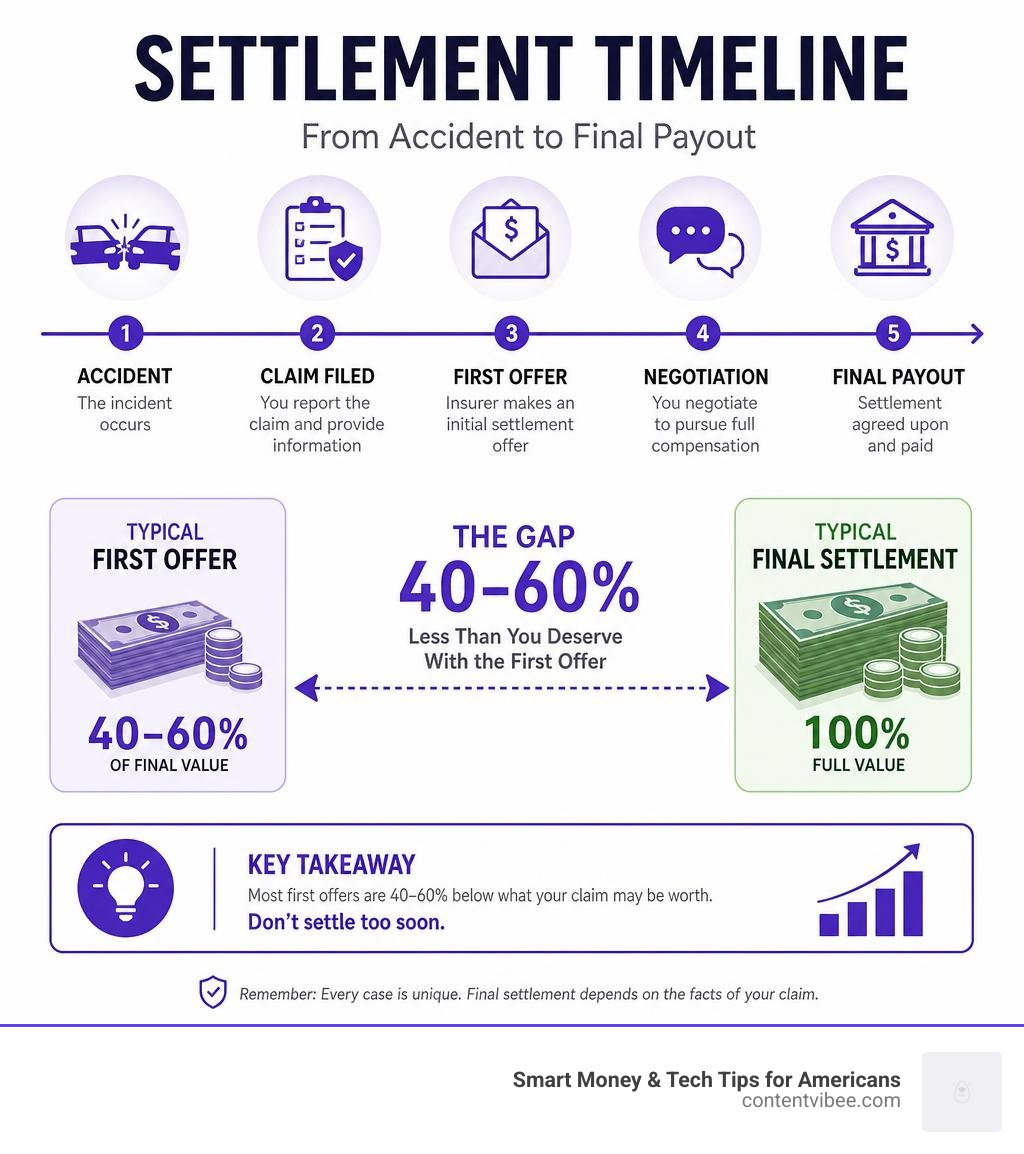
The average first settlement offer amount for auto accident claims is typically 40 to 60 percent below what you could realistically receive after negotiation. That’s not a small gap — it can mean tens of thousands of dollars left on the table.
Here’s a quick snapshot of where first offers and final settlements tend to land in 2026:
| Scenario | Typical First Offer | Typical Final Settlement |
|---|---|---|
| Minor injury (soft tissue/whiplash) | $3,000 – $8,000 | $10,000 – $25,000 |
| Moderate injury (fractures, surgery) | $15,000 – $40,000 | $50,000 – $150,000 |
| Severe injury (TBI, spinal) | $60,000 – $120,000 | $200,000 – $1,500,000+ |
| National average (all injury claims) | ~$12,000 – $18,000 | ~$26,500 – $31,000 |
Sources: Insurance Information Institute, Insurance Research Council, FairSettlement.org (2023-2026 data)
So why does this gap exist? Insurance companies are businesses. Their adjusters are trained to open low — using anchoring psychology and automated valuation software — to see if you’ll accept quickly. Most unrepresented claimants do: 73% accept the insurer’s first offer, according to Insurance Research Council data.
You don’t have to be one of them.
This guide breaks down exactly how first offers are calculated, what they leave out, and what steps you can take to push back — whether you hire a lawyer or not.
What Is the Average First Settlement Offer Amount for Auto Accident Claims?

When we look at the numbers across the United States in 2026, the data shows a clear picture. The national average final settlement for a car accident involving bodily injury is approximately $30,416. However, the median settlement—which is often a more realistic benchmark for everyday fender-benders with minor injuries—sits closer to $20,000 to $30,000.
But here is the catch: your initial offer will not look like those final numbers.
If your case has a true fair value of $30,000, the average first settlement offer amount for auto accident injuries will often arrive as a lowball figure of $12,000 to $15,000. For minor injuries like whiplash, where final settlements average around $12,000 to $18,950, initial offers can be as shockingly low as $1,500 to $5,000.
To understand how these numbers shift based on your location and specific injury details, you can look at the latest 2026 settlement averages and dive deeper into the broader personal injury statistics. The reality is that the initial offer is rarely a reflection of what your case is actually worth; it is simply the starting line of a financial tug-of-war.
Why the Average First Settlement Offer Amount for Auto Accident Injuries Is Systematically Low
It is tempting to think of insurance adjusters as friendly neighbors who want to help us get back on our feet. In reality, insurance companies are massive, profit-driven corporations. Keeping their payouts low is a core business strategy.
To achieve this, insurers rely on three main tactics:
- Anchoring Psychology: By throwing out a very low number first, the adjuster sets a psychological “anchor.” Even if you negotiate them up, you are subconsciously negotiating relative to that low starting point rather than the actual value of your medical bills and pain.
- Computer Claims Software: Most major insurance companies use specialized software programs like Colossus or Claim IQ. These algorithms are programmed to systematically undervalue claims by 12% to 20% right out of the gate by strictly minimizing non-economic damages.
- Adjuster Incentives: Claims adjusters are evaluated on how quickly they close files and how much money they save the company. Offering a fast, low settlement to an unrepresented, stressed victim is the easiest way for them to meet their corporate metrics.
To learn more about how these corporate mechanics operate behind closed doors, check out this detailed report on how insurers lowball claims.
How Insurers Calculate the Average First Settlement Offer Amount for Auto Accident Damages
To understand why the first offer is so low, we have to look at how insurers construct their math. When evaluating a claim, damages are split into two primary categories:
- Economic Damages: These are your objective, verifiable financial losses. They include your current medical bills, pharmacy receipts, and documented lost wages from missed work.
- Non-Economic Damages: This is the subjective “human cost” of the accident, commonly referred to as pain and suffering. It covers physical pain, emotional distress, loss of enjoyment of life, and sleep disruption.
Historically, insurers used a straightforward multiplier method to calculate pain and suffering. They would take your economic damages (say, $10,000 in medical bills) and multiply them by a number between 1.5 and 5 depending on the severity of the injury.
Today, however, insurers rely heavily on software to assign strict financial values to specific “injury codes.” If you have a soft-tissue neck strain, the computer spits out a rigid, conservative bracket. Because the software cannot feel your pain or understand how a back injury prevents you from lifting your toddler, the initial calculation is almost always missing the human element. For a breakdown of how these formulas translate into real-world court cases, explore these lawsuit settlement averages.
Key Factors That Influence Your Initial Settlement Offer

Every car accident is unique, meaning your initial offer will be heavily influenced by the specific facts of your case. Insurance adjusters look at several key pillars to determine how much risk your claim poses to their bottom line:
- Injury Severity: A documented fracture or a herniated disc requiring surgery will always command a higher initial offer than soft-tissue injuries or whiplash, which insurers try to dismiss as temporary.
- Medical Treatment Consistency: Gaps in medical care are a claim’s worst enemy. If you waited ten days after the crash to see a doctor, the insurer will assume you weren’t actually hurt and drop their offer accordingly.
- Clear Liability: If there is any doubt about who caused the crash, the adjuster will discount the offer to reflect your potential share of the blame.
- Available Policy Limits: An insurance company will never offer more than the maximum limit of the policy. If the at-fault driver carries a state-minimum liability policy, your initial and final offers may be strictly capped by those limits.
State-Specific Rules and Negligence Laws
Where your accident occurs plays a massive role in the initial settlement offer you receive. Different states use different legal frameworks to handle shared fault:
- Pure Comparative Negligence (e.g., California): In California, you can recover compensation even if you were 90% at fault for the crash, though your payout is reduced by your percentage of blame. Because of this flexible rule, insurers in California must negotiate carefully. If you are dealing with a crash in Southern California, you may want to review how these rules apply to Los Angeles car accident claims.
- Modified Comparative Negligence (e.g., Texas, Wisconsin): In Texas and Wisconsin, you can recover damages as long as you are not more than 50% (or 51%, depending on the state) at fault. If you cross that threshold, you get nothing. Insurers in these states will aggressively look for ways to pin the blame on you to avoid paying entirely. For Texas residents, understanding this dynamic is crucial when navigating Houston injury claims.
- Contributory Negligence (e.g., Maryland): Maryland is one of the few harsh jurisdictions where if you are even 1% at fault for the accident, you are legally barred from recovering any compensation. In Maryland, insurers will use the slightest hint of comparative fault to make an initial offer of zero.
The Role of Policy Limits and Accident Types
The type of vehicle that hit you can dramatically alter the financial ceiling of your claim. In a standard passenger car accident, you are often dealing with individual policy limits, which can be as low as $15,000 to $30,000 depending on the state.
However, if you are struck by a commercial vehicle or a semi-truck, the landscape changes completely. Commercial trucks are backed by massive corporate insurance policies that frequently carry limits of $1 million or more. Because the financial stakes are so high and the injuries are often catastrophic, the initial offers in truck accident cases require a highly specialized approach. To understand how these high-policy negotiations unfold, consult our comprehensive Florida truck accident guide.
First Offer vs. Final Payout: The Power of Negotiation
To see just how much of a difference negotiation makes, let’s look at the numbers. Data from the Insurance Research Council (IRC) consistently reveals a staggering gap between claimants who accept the first offer and those who negotiate, particularly with the help of an attorney.
| Claim Metric | Unrepresented Claimant (Accepts First Offer) | Represented Claimant (Negotiates Final Settlement) |
|---|---|---|
| Average Settlement Payout | $17,600 | $77,600 |
| First Offer Acceptance Rate | 73% | <10% |
| Average Net Payout (After Fees) | $17,600 | ~$52,000 (after 33% fee) |
| Average Timeline to Settle | 3 to 6 months | 11 to 17 months |
Sources: Insurance Research Council, FairSettlement.org
The data shows that represented claimants receive settlements that are, on average, 3.5 times higher than those who go it alone. Even after deducting a standard 33% contingency fee, injury victims who negotiate with legal backing take home more than double the net recovery of those who accepted the insurer’s initial lowball offer.
Rejecting that first offer and holding out through the negotiation process can feel exhausting, but patience alone is statistically shown to add an average of $30,000 to a final settlement. If you are staring at an initial check in your inbox, take a deep breath and read this guide on deciding on first offers before you sign anything. For a realistic look at whether you should handle this yourself or seek help, we have broken down when a lawyer is worth it.
Step-by-Step Guide to Rejecting and Countering a Low Offer
If you have decided to reject the insurance company’s first offer, you need a systematic, professional approach to make them take you seriously. Here is how we recommend handling the process:
- Wait for Maximum Medical Improvement (MMI): Never settle your claim until your doctor declares you have reached MMI. This is the point where your injuries have healed as much as they realistically will. If you settle before reaching MMI, you cannot go back and ask for more money if you discover you need a $50,000 surgery down the road.
- Request a Written Breakdown: Ask the claims adjuster to provide a written explanation of how they calculated their offer. Ask them specifically how much they allocated for medical bills, lost wages, and pain and suffering.
- Draft a Formal Written Counter-Demand: Do not negotiate over the phone. Send a formal, written letter via certified mail. Point out the specific expenses the adjuster ignored, such as future physical therapy or missed bonuses at work.
- Establish a Strong Anchor: Your counter-offer should be a realistic, documented number that is higher than what you expect to settle for, leaving you room to negotiate downward.
For more strategic tips on how to structure your response, read this guide on should you accept the first offer and learn the art of evaluating settlement offers like a professional.
Frequently Asked Questions About Auto Accident Settlements
How long does it take to receive the first settlement offer?
In most straightforward car accident claims, you can expect to receive an initial settlement offer within 30 to 60 days after you submit your completed demand package to the insurance company.
However, if the insurance adjuster contacts you within days of the accident—before you have even finished seeing a doctor—be highly skeptical. This is a common tactic designed to get you to sign away your rights for a tiny fraction of your claim’s true value before you realize the full extent of your injuries. For a complete look at how the timeline unfolds, check out our settlement process guide.
What damages are typically excluded from an initial insurance offer?
In their rush to close your file cheaply, insurance adjusters will routinely exclude or heavily discount several critical categories of damages in their first offer:
- Future Medical Expenses: If you need ongoing chiropractic care, physical therapy, or future surgeries, the first offer will almost certainly ignore these costs.
- Pain and Suffering: Insurers rely on software that assigns minimal, baseline values to your physical pain and emotional distress.
- Lost Earning Capacity: If your injuries mean you can no longer work the same hours or perform the same job duties as before the crash, this long-term financial loss is rarely factored into an initial check.
To see what a fully loaded compensation package should look like, you can explore these average settlement payouts.
How do I know if I need a lawyer to negotiate my settlement?
While you can technically negotiate minor property-damage-only claims or very small injury claims (with under $2,000 in medical bills) on your own, you should strongly consider hiring a professional if:
- Your medical bills exceed $5,000.
- You suffered fractures, head trauma, or injuries requiring surgery.
- The insurance company is disputing who was at fault for the crash.
- You have pre-existing medical conditions that the insurer is trying to blame for your current pain.
Most personal injury attorneys offer free initial consultations and work on a contingency fee basis, meaning they only get paid if they win your case. If you are preparing to speak with a professional, make sure to read our list of questions to ask an injury lawyer to ensure you find the right fit for your needs.
Conclusion
At Smart Money & Tech Tips for Americans, we believe that securing your financial recovery after an auto accident shouldn’t feel like a second job. The insurance company’s first offer is almost never their best offer—it is simply a business proposal designed to save them money. By understanding how these calculations work, staying patient, and refusing to settle before you have fully healed, you can protect your wallet and secure the compensation you truly deserve.
If you are currently holding an initial offer and want to see how it stacks up against realistic historical data, take 60 seconds to run your numbers through our free, AI-powered settlement calculator tool. Knowledge is power, and when it comes to dealing with insurance companies, being prepared is the best way to turn those first offer blues into a fair financial victory.