How Long Do You Have to Sue? Personal Injury Statute of Limitations Explained

Why the Personal Injury Lawsuit Statute of Limitations Could Make or Break Your Case
The personal injury lawsuit statute of limitations is the legal deadline by which you must file your claim — miss it, and you almost certainly lose your right to any compensation, no matter how strong your case is.
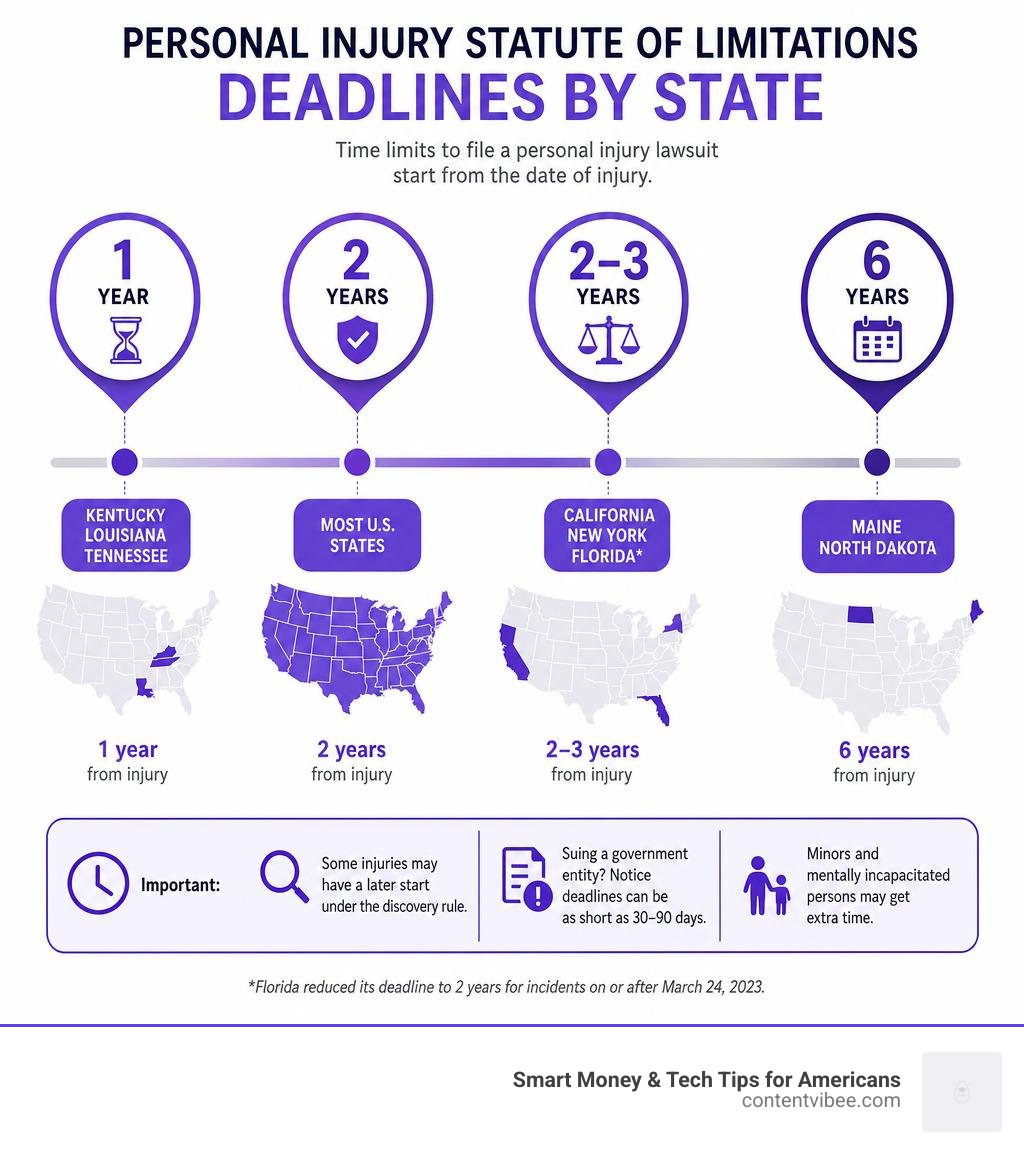
Here’s a quick answer based on where you live:
| State(s) | Standard Personal Injury Deadline |
|---|---|
| Kentucky, Louisiana, Tennessee | 1 year from injury |
| Most U.S. states | 2 years from injury |
| California, New York, Florida* | 2–3 years (varies) |
| Maine, North Dakota | 6 years from injury |
*Florida reduced its deadline to 2 years for incidents on or after March 24, 2023.
Key facts to know right now:
- The clock usually starts on the date of the accident
- Some injuries trigger a later start date under the discovery rule
- Suing a government entity? You may have as little as 30–90 days to file a notice of claim
- Minors and mentally incapacitated persons may get extra time
Imagine this: you’re in a car accident, you focus on recovering, and months later you finally call a lawyer — only to find out your deadline already passed. It happens more often than you’d think.
This guide breaks down exactly how these deadlines work, which exceptions might apply to you, and what to do to protect your right to sue.
Relevant articles related to personal injury lawsuit statute of limitations:
Understanding the Personal Injury Lawsuit Statute of Limitations

When we talk about civil law, the term “statute of limitations” refers to a strict legislative deadline for filing a lawsuit. If you have been harmed by another party’s negligence, you do not have an infinite amount of time to seek justice through the court system. This boundary is not meant to punish victims; rather, it is designed to keep the legal system fair, orderly, and reliable.
But why do these limits exist in the first place? There are two primary reasons: evidence preservation and the reliability of witness memory.
As time passes, physical evidence degrades. Skid marks on a road fade, video surveillance footage is routinely overwritten, and vehicles involved in a crash are scrapped or repaired. Furthermore, human memory is notoriously fragile. A witness who can vividly describe an accident today may struggle to recall basic details five years from now. By enforcing a reasonable deadline, the law ensures that cases are tried when the evidence is fresh and the facts can be determined with a higher degree of accuracy.
For a lawsuit to begin, the legal “cause of action” must accrue. In legal terms, accrual represents the exact point in time when a victim suffers a compensable harm, giving them the right to initiate a lawsuit. While this is straightforward in a sudden slip-and-fall incident, it can get highly complex when injuries develop slowly or remain hidden for months.
When Does the Clock Start Ticking?
In the vast majority of personal injury cases, the statute of limitations clock starts ticking on the exact date of the accident. If you are involved in a car crash on June 15, 2026, the calendar starts counting down the very next day.
However, what happens if you do not realize you have been injured right away? This is where the discovery rule comes into play. Under this legal doctrine, the statute of limitations clock is paused—or its start date is delayed—until the date the injured party actually discovers, or reasonably should have discovered, that they were harmed by someone else’s actions.
Consider latent injuries. A classic example is a patient who undergoes an abdominal surgery. Years later, they suffer from chronic pain, only for a routine X-ray to reveal that the surgeon left a surgical sponge inside their body. In states that recognize the discovery rule, the timeline to file a claim would start when the sponge was discovered, not on the date of the original surgery.
To explore how these rules apply in specific jurisdictions, you can read more about the New York Statute of Limitations for Personal Injury, which details how different injuries trigger different starting lines.
State-by-State Deadlines and Key Variations
Because personal injury laws are established at the state level, the deadline to file your claim depends entirely on where your injury occurred. There is no single federal deadline for state-level civil torts.
To help you visualize these differences, we have compiled a comprehensive list of standard personal injury filing deadlines across the United States for 2026.
| State | Standard Personal Injury Deadline |
|---|---|
| Alabama | 2 Years |
| Alaska | 2 Years |
| Arizona | 2 Years |
| Arkansas | 3 Years |
| California | 2 Years |
| Colorado | 2 Years (3 Years for motor vehicle accidents) |
| Connecticut | 2 Years |
| Delaware | 2 Years |
| District of Columbia | 3 Years |
| Florida | 2 Years (for incidents on or after March 24, 2023) |
| Georgia | 2 Years |
| Hawaii | 2 Years |
| Idaho | 2 Years |
| Illinois | 2 Years |
| Indiana | 2 Years |
| Iowa | 2 Years |
| Kansas | 2 Years |
| Kentucky | 1 Year |
| Louisiana | 1 Year |
| Maine | 6 Years |
| Maryland | 3 Years |
| Massachusetts | 3 Years |
| Michigan | 3 Years |
| Minnesota | 2 Years |
| Mississippi | 3 Years |
| Missouri | 5 Years |
| Montana | 3 Years |
| Nebraska | 4 Years |
| Nevada | 2 Years |
| New Hampshire | 3 Years |
| New Jersey | 2 Years |
| New Mexico | 3 Years |
| New York | 3 Years |
| North Carolina | 3 Years |
| North Dakota | 6 Years |
| Ohio | 2 Years |
| Oklahoma | 2 Years |
| Oregon | 2 Years |
| Pennsylvania | 2 Years |
| Rhode Island | 3 Years |
| South Carolina | 3 Years |
| South Dakota | 3 Years |
| Tennessee | 1 Year |
| Texas | 2 Years |
| Utah | 4 Years |
| Vermont | 3 Years |
| Virginia | 2 Years |
| Washington | 3 Years |
| West Virginia | 2 Years |
| Wisconsin | 3 Years |
| Wyoming | 4 Years |
To stay updated on recent legal shifts and state-specific code updates, check out the comprehensive State by State Personal Injury Statute of Limitations for 2026 reference page.
How the Personal Injury Lawsuit Statute of Limitations Varies by State
Let’s take a closer look at a few of the most highly populated states to see how their rules differ.
- California: Under California Code of Civil Procedure section 335.1, you generally have 2 years from the date of the injury to file a lawsuit. If you are dealing with a local case, speaking with a personal injury lawyer los angeles can help you navigate local court procedures and ensure your paperwork is processed accurately.
- Texas: Texas also enforces a strict 2-year deadline for personal injury claims. Because Texas courts are highly distributed, consulting an experienced personal injury lawyer houston is invaluable for managing local filing requirements.
- Florida: Florida represents one of the most significant recent legal shifts. For accidents occurring on or after March 24, 2023, the state slashed its statute of limitations from 4 years down to 2 years. If you are researching old legal guides, be careful—relying on the outdated 4-year rule will result in your case being thrown out.
- New York: New York maintains a standard 3-year statute of limitations for general negligence claims, such as slip-and-falls and car crashes, though malpractice and wrongful death claims have shorter timelines.
Shortest vs. Longest State Deadlines
If you are injured in Kentucky, Tennessee, or Louisiana, you have the absolute shortest window in the country: just 1 year from the date of the accident to file your lawsuit. This incredibly tight turnaround means you must act immediately to gather evidence and consult with a legal professional.
On the other end of the spectrum, Maine and North Dakota are the most generous, offering a massive 6-year window to file a claim. Missouri sits close behind with a 5-year limit. While having half a decade to sue sounds comfortable, we highly advise against waiting. The sooner you file, the stronger your evidence will be.
To review how these variations stack up across other civil categories, take a look at the comprehensive guide on Statute of Limitations by State 2026.
Critical Exceptions and Tolling Rules

While the deadlines we’ve discussed are generally firm, the legal system recognizes that certain circumstances make it impossible or highly unfair to expect a victim to file a lawsuit on time. In these rare scenarios, the court may “toll” the statute of limitations.
“Tolling” is a legal term that means temporarily pausing or extending the countdown clock. When an event tolls the statute, the clock stops running until that event ends, at which point the countdown resumes.
For example, if a defendant enters active-duty military service, federal and state laws—such as those outlined in Wisconsin Legislature: 893.24—often toll civil deadlines. This ensures that service members are not sued while deployed, and conversely, that injured victims are not barred from suing a negligent party who is currently serving overseas.
Exceptions That Pause the Personal Injury Lawsuit Statute of Limitations
Beyond military service, there are three primary categories where tolling is commonly applied:
- Minors: Children under the age of 18 do not have the legal capacity to file a lawsuit on their own. Consequently, states almost always toll the statute of limitations for minors. The clock typically does not start ticking until the minor reaches their 18th birthday. For instance, if a 10-year-old is injured in a state with a 2-year limit, they usually have until their 20th birthday to file a lawsuit.
- Mental Incapacity: If an individual is mentally incapacitated, comatose, or declared legally insane at the time of their injury, they cannot reasonably be expected to understand their legal rights. The statute of limitations is paused until their legal disability is removed (i.e., they regain cognitive function) or a legal guardian is appointed to represent them.
- Out-of-State Defendants: If the person who caused your injury flees the state, hides, or lives outside the jurisdiction to avoid being served with a lawsuit, many states pause the clock. The time they spend outside the state’s borders does not count toward your filing deadline.
These protections are codified in detailed statutory frameworks, such as North Carolina General Statutes Article 3, which outlines precise criteria for how infancy, insanity, and defendant absence pause the legal clock.
Special Deadlines for Government Entities
If your injury was caused by a government employee or occurred on public property—such as slipping on a wet floor in a post office, getting hit by a city bus, or tripping on a broken municipal sidewalk—the standard rules are completely thrown out the window.
Government entities enjoy a legal protection known as “sovereign immunity.” While you can sue the government, you must follow highly strict, accelerated procedures. Instead of filing a lawsuit directly in court, you must first file a formal “Notice of Claim” with the responsible administrative agency.
The deadlines for these notices are incredibly short. For example, under the Statute of Limitations For Personal Injury in New York, you must file a notice of claim within just 90 days of the injury. Other states and local municipalities enforce deadlines ranging from 30 to 180 days. If you miss this initial notice window, you will be permanently barred from suing the government agency, even if your state’s general personal injury deadline is years away.
Deadlines for Related Civil Claims
While personal injury claims focus on physical and emotional harm, accidents often cause other types of damage. It is critical to understand that different civil claims carry entirely different deadlines, even if they stem from the exact same incident.
For example, if you are in a car crash, you might have a personal injury claim for your whiplash and a separate property damage claim for your wrecked vehicle. In Virginia, under Code of Virginia § 8.01-243, you have 2 years to sue for your bodily injuries, but a generous 5 years to file a lawsuit for the damage to your personal property.
Similarly, contract breaches, fraud, and other civil actions carry their own distinct timelines, which can range from 2 to 15 years depending on whether the agreement was written or oral.
Medical Malpractice and Product Liability Deadlines
Medical malpractice and product liability claims are highly specialized subsets of personal injury law, and they are governed by unique, often stricter rules.
- Medical Malpractice: Because medical errors are not always immediately obvious, these claims rely heavily on the discovery rule. However, to prevent doctors from being sued decades after a procedure, states implement a “statute of repose.” This is an absolute maximum cutoff date that overrides the discovery rule. In California, for example, you must file within 3 years of the injury or 1 year of discovering it—whichever comes first. Special extensions may apply if a foreign object (like a surgical clamp) was left inside you, or if the provider committed fraud to conceal the mistake.
- Product Liability: If a defective product—like a failing car airbag or a toxic consumer good—causes you harm, you can sue the manufacturer. However, like medical malpractice, product liability claims are subject to statutes of repose. If a state has a 10-year statute of repose on products, you cannot sue the manufacturer if the product was first sold to the public more than 10 years ago, even if it just injured you yesterday.
For practical steps on managing these complex timelines, check out our personal injury lawyer tips guide.
Wrongful Death and Defamation Claims
Two other civil claims with highly specific timelines are wrongful death and defamation:
- Wrongful Death: When a person dies due to someone else’s negligence, their surviving family members can file a wrongful death lawsuit. In almost every state, the statute of limitations clock starts on the date of death, not the date of the underlying accident. (An exception is Tennessee, where the clock runs from the date of injury). Wrongful death deadlines are often shorter than standard injury deadlines, frequently capped at 2 years.
- Defamation (Libel and Slander): If someone ruins your reputation through false written statements (libel) or spoken words (slander), you can sue for civil damages. However, because reputation claims degrade quickly, defamation carries some of the shortest deadlines in civil law—often just 1 year from the date the statement was first published or spoken.
If you are trying to figure out if your situation warrants a lawsuit, our guide on x ways to know for sure if you need a personal injury lawyer atlanta provides excellent diagnostic questions to help you evaluate your case.
Frequently Asked Questions About Lawsuit Deadlines
What happens if I miss the statute of limitations deadline?
If you miss the deadline, your case is effectively over. If you attempt to file a lawsuit after the statute of limitations has expired, the defendant’s attorney will immediately file a “Motion to Dismiss” your case.
Because the deadline is a matter of strict statutory law, the judge will have no choice but to grant the motion and dismiss your case with prejudice. This means you lose your legal right to seek compensation forever, regardless of how severe your injuries are or how obviously negligent the other party was. To see how strictly this is enforced across different jurisdictions, read about the Personal Injury Statute of Limitations by State.
Can ongoing settlement negotiations pause the filing deadline?
No! This is one of the most common and costly mistakes injury victims make. Many people assume that if they are actively negotiating a settlement with an insurance adjuster, the deadline is paused.
Insurance adjusters are well aware of your state’s filing deadlines. Occasionally, they may intentionally drag out negotiations, hoping you will let the statute of limitations expire. Once that date passes, their legal liability vanishes, and they will immediately stop returning your calls.
The only way to pause a deadline during negotiations is through a formal, written tolling agreement. This is a legally binding contract signed by both parties where the defendant agrees to waive the statute of limitations defense for a specified period. Never rely on a verbal promise; if it isn’t in writing, it doesn’t exist. For more insights on dealing with insurance companies, read our list of x questions to ask when you need an injury lawyer.
How do I calculate my exact filing deadline?
To calculate your deadline accurately, follow these steps:
- Identify the Trigger Date: This is usually the date of the accident or the date of discovery.
- Consult State Statutes: Identify the exact number of years your state allows for your specific claim type.
- Count the Days: When counting, exclude the first day (the day of the accident) and include the final day. If the final day falls on a Saturday, Sunday, or official legal holiday when the courts are closed, the deadline is typically extended to the next business day.
- Consult an Attorney: Because calculating deadlines is highly fact-specific and subject to complex tolling rules, you should always have a licensed attorney verify your calculations.
Conclusion
When it comes to protecting your financial and physical well-being after an accident, time is your most precious resource. The personal injury lawsuit statute of limitations is a strict, unforgiving boundary. Whether you have 1 year in Kentucky or 6 years in Maine, letting the clock run out means losing your right to justice forever.
At Smart Money & Tech Tips for Americans, we believe that staying informed is the first step toward securing your financial future. If you or a loved one has been injured, do not wait until the last minute to explore your options.
If you are worried about the financial side of hiring representation, we encourage you to read our detailed breakdown on How much does a personal injury lawyer cost? to understand contingency fees and how you can secure legal help with zero upfront costs. Take action today, document your claim, and protect your rights before your legal window closes for good.