The Complete Guide to Social Security Spousal Benefit Eligibility
What You Need to Know About Social Security Spousal Benefits
A social security spousal benefit is one of the most valuable — and most overlooked — income sources available to married and divorced Americans in retirement. If your spouse has a stronger earnings record than you, you may be able to collect up to 50% of their full retirement benefit, even if you worked very little or not at all.
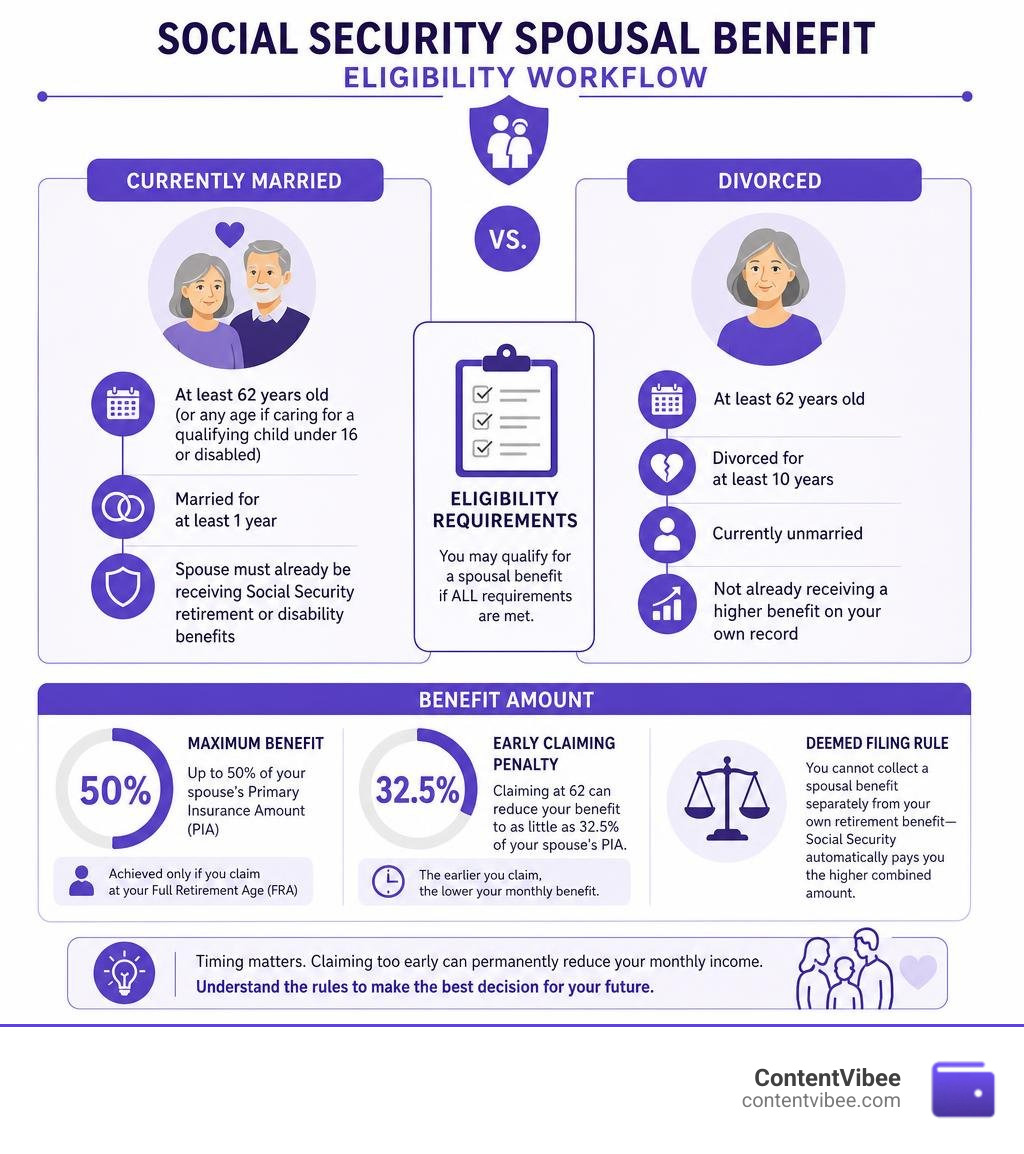
Here’s a quick overview of who qualifies:
- Currently married: You must be at least 62 years old (or any age if caring for a qualifying child under 16 or disabled), married for at least 1 year, and your spouse must already be receiving Social Security retirement or disability benefits.
- Divorced: You must have been married for at least 10 years, be at least 62, currently unmarried, and not already receiving a higher benefit on your own record.
- Maximum benefit: Up to 50% of your spouse’s Primary Insurance Amount (PIA) — but only if you claim at your full retirement age (FRA).
- Early claiming penalty: Claiming at 62 can reduce your benefit to as little as 32.5% of your spouse’s PIA.
- Deemed filing rule: You cannot collect a spousal benefit separately from your own retirement benefit — Social Security automatically pays you the higher combined amount.
These rules affect millions of households, and getting the timing wrong can permanently reduce your monthly income. This guide breaks down every rule clearly so you can make the best decision for your situation.
What Is a Social Security Spousal Benefit and Who Qualifies?
A social security spousal benefit is designed to provide retirement income security for a spouse who either did not work outside the home, took years off to care for family, or earned significantly less than their partner over their working lifetime. Instead of relying solely on your own work history, the Social Security Administration (SSA) allows you to claim a monthly check based on your spouse’s earnings record.
To understand how this works, we first need to look at the term Primary Insurance Amount (PIA). Your spouse’s PIA is the monthly payment they are entitled to receive if they wait until their exact Full Retirement Age (FRA) to claim retirement. A standard spousal benefit can equal up to 50% of that primary earner’s PIA.
To qualify under general rules, you must meet key criteria outlined in SSA Handbook § 305:
- Marriage Duration: As a current spouse, you must generally be validly married for at least 1 continuous year immediately before filing your claim.
- Age Threshold: You must be at least 62 years old, unless an important exception applies.
- Primary Worker Status: Your spouse must already be entitled to and receiving their own Social Security retirement or disability benefits.
- Child-in-Care Exemption: If you are caring for a child who is under age 16 or disabled (and entitled to benefits on your spouse’s record), the age 62 requirement is waived completely.
If you are just starting to explore these rules, our guide on Spousal Benefits 101: How to Get Your Fair Share breaks down the fundamentals of how these checks fit into a comprehensive retirement plan.
Qualification Requirements for a Social Security Spousal Benefit
Let’s dive deeper into administrative policy guidelines. Under federal standards set in SSA – POMS: RS 00202.001, eligibility depends on several strict factors:
- Age 62 Baseline: Unless you qualify under the child-in-care exception, 62 is the absolute minimum age to submit an application.
- Worker Entitlement: You cannot claim a spousal benefit on a living spouse’s record until that spouse actually files for their own retirement or disability insurance benefits.
- Primary Insurance Amount (PIA) Limit: You are only entitled to a spousal supplement if 50% of your spouse’s PIA is larger than 100% of your own personal PIA. If your earned benefit is higher than half of theirs, you simply receive your own benefit.
- Child-in-Care Exception Details: If you care for your spouse’s biological or adopted child who is under age 16—or who became disabled before age 22—you can collect spousal benefits at any age, and your payment will not be reduced for early retirement!
Rules for Current Spouses vs. Divorced Spouses
The qualification rules shift significantly if you are divorced. While current spouses must be married for 1 year, ex-spouses must satisfy stricter federal mandates:
- 10-Year Marriage Rule: You and your ex-spouse must have been legally married for at least 10 continuous years prior to your divorce becoming final.
- Remarriage Restrictions: If you remarry before age 60, you generally lose eligibility to collect spousal benefits on your former spouse’s earnings record (unless that subsequent marriage ends by death, divorce, or annulment).
- The 2-Year Divorce Rule (Independently Entitled Divorced Spouse): For current spouses, the primary worker MUST file for retirement first. However, if you have been divorced for at least 2 consecutive years, you are considered an “independently entitled divorced spouse.” This means you can claim spousal benefits on your ex’s record even if your ex has NOT yet filed for their own retirement, provided you are both at least age 62.
- Privacy and Non-Interference: Your ex-spouse will never be notified when you file, nor will your claim reduce their payout or any benefits payable to their current family.
For a complete breakdown of ex-spouse claiming scenarios, check out our Detailed Guide to Spousal Benefits Eligibility.
How to Calculate Your Social Security Benefit Payout
Calculating your potential payout starts with identifying your spouse’s Primary Insurance Amount (PIA). The maximum social security spousal benefit you can receive is exactly 50% of your spouse’s PIA.
It is crucial to note that this 50% maximum assumes you wait until your own Full Retirement Age (FRA) to claim. For anyone born in 1960 or later, FRA is 67. If you were born between 1955 and 1959, your FRA is somewhere between 66 and 6 months and 66 and 10 months.

To see how the formula works in practice, review the official calculation guidelines at Benefits for Spouses. You can also run your own customized numbers instantly using our interactive Social Security Spousal Benefit Calculator.
Early Claiming Penalties and Reduction Rates
If you choose to file for spousal benefits before reaching your full retirement age, your monthly check takes a permanent haircut. Social Security calculates early filing reductions using two exact monthly reduction fractions:
- First 36 Months Early: Your benefit is reduced by 25/36 of 1% for each month you claim ahead of your FRA (which equals about 6.67% per year, or 25% total over 3 full years).
- Additional Months Early (Beyond 36 Months): If you claim more than 36 months before FRA (for instance, filing at 62 when your FRA is 67, which is 60 months early), the reduction rate drops to 5/12 of 1% per additional month (which equals 5% per year).
Here is how those reduction fractions play out for someone whose Full Retirement Age is 67 and whose spouse has a $2,000 PIA:
| Age at Claiming | Months Prior to FRA | Spousal Percentage of Primary Earner’s PIA | Monthly Payout (Spouse PIA = $2,000) |
|---|---|---|---|
| 67 (FRA) | 0 months | 50.0% | $1,000 |
| 66 | 12 months | 45.8% | $916 |
| 65 | 24 months | 41.7% | $833 |
| 64 | 36 months | 37.5% | $750 |
| 63 | 48 months | 35.0% | $700 |
| 62 | 60 months | 32.5% | $650 |
As you can see, filing right at age 62 yields the lowest possible payout of 32.5% of the worker’s PIA—a 35% total reduction off the maximum spousal benefit.
To explore how age impacts your personal timeline, read our in-depth analysis on How Age Affects Your Social Security Spousal Benefits.
Impact of Delayed Retirement Credits on Benefits
When high-earning workers delay claiming their retirement benefits past their Full Retirement Age, they earn Delayed Retirement Credits (DRCs) at a rate of 8% per year up to age 70. This can boost their personal payout to 124% or 132% of their baseline PIA.
However, here is a critical trap: Delayed retirement credits DO NOT increase spousal benefits.
Spousal payouts are permanently capped at 50% of the worker’s Full Retirement Age benefit (their base PIA). Whether your spouse claims their check at age 67 or waits until age 70, your maximum spousal benefit remains exactly the same.
As explained in Do You Qualify for Social Security Spouse’s Benefits?, because spousal benefits stop growing once you reach your own FRA, there is zero financial advantage for a lower-earning spouse to delay filing for a spousal benefit past their own Full Retirement Age.
Understanding Deemed Filing and Dual Entitlement Rules
In the past, retirees could use clever filing hacks like “restricted applications” or “file and suspend” to collect a spousal check while letting their own retirement benefit accumulate delayed credits. However, congress effectively eliminated these loopholes under the Bipartisan Budget Act of 2015.
Today, the rule of the land is deemed filing.
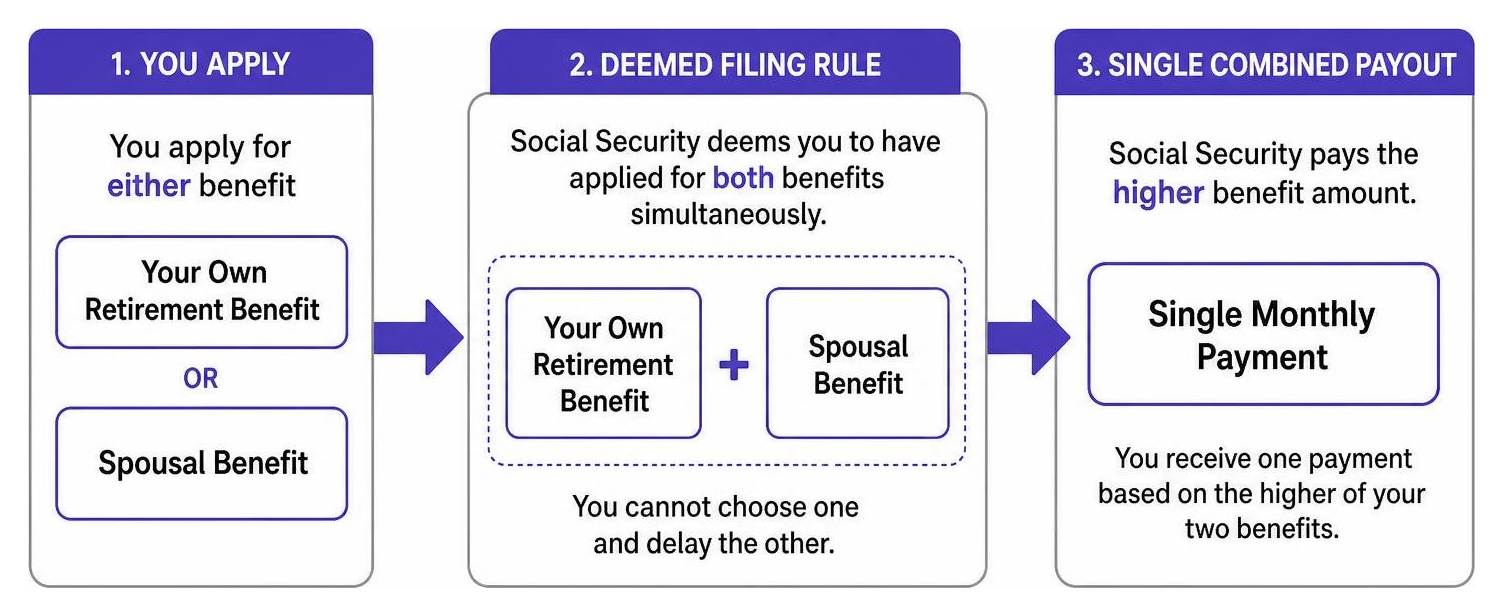
Under deemed filing, when you apply for either your own retirement benefit or a spousal benefit, Social Security deems you to have applied for both benefits simultaneously (assuming you meet age eligibility requirements). You cannot choose to receive only the spousal check while freezing your own record.
To learn how couples navigate these restrictions smoothly, visit our guide on How Social Security Spousal Benefits Work for Married Couples.
How Deemed Filing Affects Your Social Security Spousal Benefit Claim
Deemed filing operates under a framework called dual entitlement. You don’t get to “double dip” by adding a full 50% spousal check on top of your full personal retirement check.
Instead, Social Security calculates your payout using a two-step formula:
- Step 1: SSA pays your own earned retirement benefit first.
- Step 2: If 50% of your spouse’s PIA is higher than your personal benefit, SSA adds a “spousal supplement” to top off your check so your total monthly payout equals the higher spousal amount.
For example, let’s say Sarah’s own retirement benefit at FRA is $800, while her husband Tom’s PIA is $2,200 (making his 50% spousal cap $1,100). When Sarah applies at FRA, Social Security pays her $800 personal retirement benefit, plus a $300 spousal supplement. Her final combined check is $1,100 per month.
If Sarah’s own benefit had been $1,200, it would exceed half of Tom’s check ($1,100), meaning her spousal supplement would be $0.
Our resource on Double the Fun: Understanding Your Spousal Social Security Benefits walks through additional real-world case studies of dual entitlement in action.
Social Security Spousal Benefits vs. Survivor Benefits
Many people confuse spousal benefits with survivor benefits, but they are governed by very different legal standards under SSA – POMS: RS 00202.020.
A spousal benefit is paid while both spouses are living and caps out at 50% of the earner’s baseline PIA. A survivor benefit is paid after a spouse passes away and can be worth up to 100% of the deceased spouse’s actual benefit—including any delayed retirement credits the earner accumulated!
Here is a side-by-side comparison of how these two benefit types operate:
| Feature | Spousal Benefit | Survivor Benefit |
|---|---|---|
| Status of Primary Worker | Alive and receiving benefits | Deceased |
| Maximum Payment Cap | Up to 50% of worker’s FRA benefit (PIA) | Up to 100% of deceased worker’s actual check |
| Minimum Eligibility Age | Age 62 (unless caring for child < 16) | Age 60 (Age 50 if disabled) |
| Effect of Primary Worker’s DRCs | None (capped at worker PIA) | Full benefit (includes earner’s delayed credits up to 70) |
| Marriage Duration Rule | 1 year (10 years if divorced) | 9 months (10 years if divorced) |
| Impact of Remarriage | Disqualifies ex-spouses if before 60 | Allowed after age 60 without losing benefit |
| Deemed Filing Rules Apply? | Yes (forced dual filing) | No (can claim survivor check and delay own benefit) |
Notice that crucial bottom row: deemed filing does NOT apply to survivor benefits! A surviving spouse can choose to claim a survivor benefit early while allowing their own personal retirement benefit to grow until age 70, or vice versa.
Maximizing Household Income with Spousal Benefits
To get the absolute most out of your joint Social Security strategy, married couples should coordinate their claiming timelines.

Here are key strategies to keep in mind:
- Let the Primary Earner Delay to Age 70: Because survivor benefits can reach 100% of the deceased worker’s payout, having the higher earner wait until age 70 creates a maximum safety net for the surviving spouse, even though it won’t boost the living spousal benefit beyond 50%.
- Lower Earner Claims Spousal Benefit at FRA: Since spousal benefits stop earning growth credits at Full Retirement Age, the lower-earning spouse should never wait past their FRA to claim a spousal supplement.
- Coordinate Early vs. Late Filing: If the higher earner delays filing, the lower earner cannot collect a spousal benefit until the primary earner files. In these cases, the lower earner may want to claim their own retirement benefit at 62 first, and then add the spousal supplement later when the primary earner eventually claims Social Security.
To learn how small timing shifts can yield tens of thousands of extra dollars over a joint retirement, review our guide on Social Security Spousal Benefits: Timing Is Everything.
Frequently Asked Questions About Spousal Benefits
Does claiming a spousal benefit reduce my spouse’s monthly check?
No! This is one of the most common misconceptions about Social Security. Claiming a spousal benefit on your partner’s record has zero impact on their monthly check amount. They will continue to receive their full earned benefit regardless of whether you claim a spousal check. Furthermore, spousal benefits paid to a divorced ex-spouse do not reduce payments for the primary worker’s current legal spouse.
Does my ex-spouse get notified if I claim benefits on their record?
No. The Social Security Administration maintains strict privacy protocols. If you qualify and apply for an ex-spousal benefit based on a former marriage that lasted 10+ years, the SSA will not contact or notify your former partner. Your claim will remain completely confidential, and your ex’s benefit check will not be reduced by a single penny.
Can I receive spousal benefits if I get a public sector pension?
If you receive a pension from non-covered work (such as a state, local, or federal government job where you did not pay Social Security payroll taxes), your spousal benefit may be reduced under the Government Pension Offset (GPO).
The GPO rule reduces your Social Security spousal or survivor benefit by two-thirds of the monthly amount of your government pension. For example, if you collect a $1,500 monthly public pension, two-thirds of that ($1,000) is deducted from your spousal benefit. If your potential spousal check was $900, the GPO reduces it to $0.
Conclusion
At ContentVibee, we believe that understanding your social security spousal benefit options is essential for a stress-free retirement. Whether you are currently married, divorced, or caring for a family member, knowing how Full Retirement Age, deemed filing rules, and percentage reductions interact empowers you to make smart financial moves.
Don’t leave guaranteed retirement dollars on the table! Make sure to coordinate with your partner, evaluate your earnings records, and check out Social Security Spousal Benefits: Timing Is Everything to ensure you claim at the exact right moment.