Navigating Your Car Accident Claim Without Losing Your Mind
What Car Accident Claim Help Actually Looks Like — and Where to Start
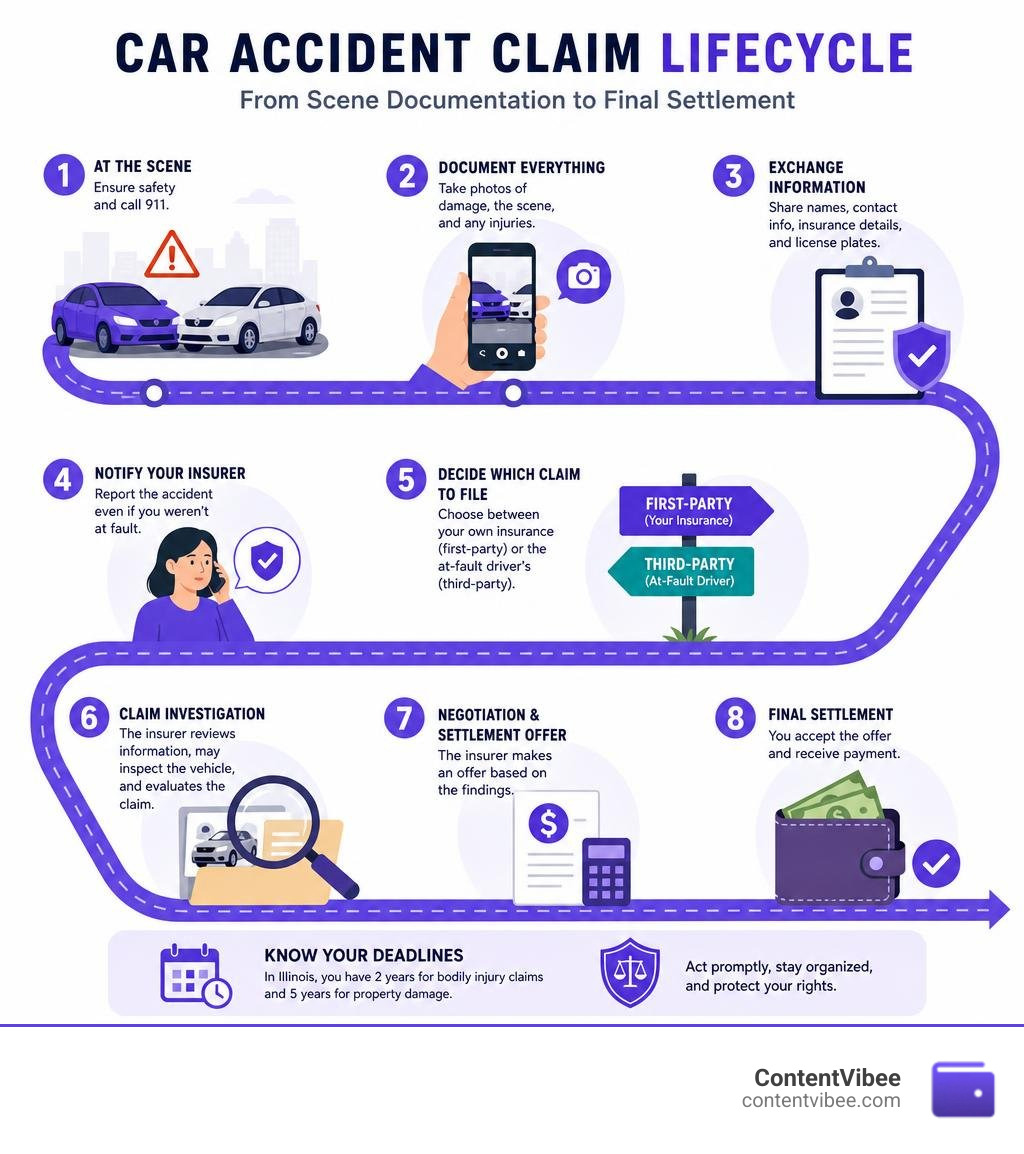
Getting car accident claim help starts with knowing the right moves — fast. Here’s a quick overview of what to do:
- Call 911 — report the accident and get a police report number
- Document everything — photos of damage, the scene, and any injuries
- Exchange information — names, insurance details, license plates
- Notify your insurer — even if you weren’t at fault
- Decide which claim to file — your own insurance (first-party) or the at-fault driver’s (third-party)
- Know your deadlines — in Illinois, you have 2 years for bodily injury claims and 5 years for property damage
Car accidents are stressful. One minute everything is fine, the next you’re standing on the side of the road wondering what happens next.
The insurance side of things makes it worse. Adjusters to call. Estimates to get. Deadlines you didn’t know existed. And a settlement offer that may be far lower than what you actually deserve.
Here’s the reality: most people don’t know their rights after an accident — and insurance companies know that. That gap costs accident victims real money.
This guide cuts through the confusion. Whether you’re dealing with a minor fender-bender or a serious collision, you’ll find clear, practical steps for filing your claim, understanding Illinois-specific rules, handling repairs, and pushing back if an insurer lowballs you.
Immediate Steps and First-Party vs. Third-Party Car Accident Claim Help
When a collision happens, adrenaline spikes, hearts race, and logical thinking often takes a backseat. However, the choices we make in the first sixty minutes after a crash set the foundation for our entire insurance claim. Knowing how to secure actionable car accident claim help right at the scene saves months of administrative heartburn later.
Essential On-Scene Actions and Evidence Gathering
Safety always comes first. Before reaching for your phone to snap photos, move vehicles to the shoulder if they are drivable and clear of traffic. Turn on hazard lights, check yourself and your passengers for severe injuries, and dial 911 immediately.
Once emergency services are dispatched, shift your focus to documentation. Insurance claims live or die on evidence. Do not rely on memory or verbal promises made by the other driver. Instead, take these critical steps:
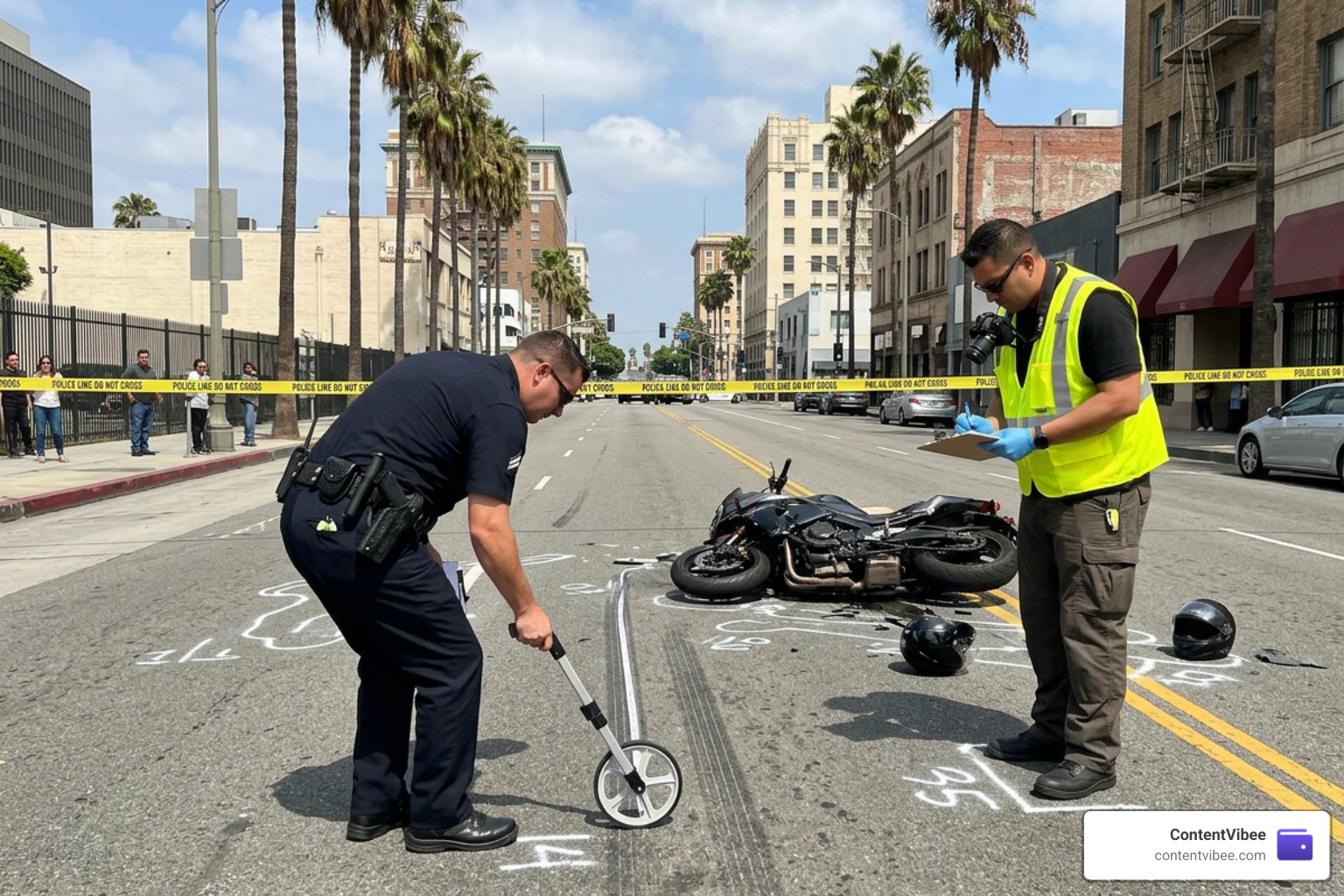
- Obtain an Official Police Report Number: Always request an officer on scene. The investigating officer writes an objective police report, logs initial statements, and issues traffic citations. Record the responding officer’s name, badge number, and police report ID.
- Photograph the Entire Crash Environment: Capture wide-angle photos of the entire crash scene, weather conditions, traffic signals, skid marks, and visual obstacles. Take close-up shots of all property damage, vehicle registration tags, and visible physical injuries.
- Exchange Complete Driver Information: Collect full legal names, contact numbers, street addresses, driver’s license numbers, vehicle identification numbers (VINs), and auto policy details from every driver involved.
- Gather Neutral Eyewitness Statements: Look for bystanders, shop owners, or neighboring motorists who witnessed the collision. Obtain their names and contact information before they leave. Neutral witness testimony carries tremendous weight during liability disputes.
- Avoid Discussing Fault or Saying “I’m Sorry”: Never apologize or speculate on liability at the crash scene. Even a polite “I’m sorry, I didn’t see you” can be recorded by the adjuster as an admission of fault. Let the objective facts speak for themselves.
If you suspect complex liability issues, severe injuries, or aggressive tactics from the other driver’s insurer, reviewing A Comprehensive Guide to Finding a Car Accident Lawyer can clarify whether immediate legal protection is necessary.
Filing First-Party vs. Third-Party Claims
Once the dust settles, you face a major decision: should you file a claim through your own insurance provider or pursue the at-fault driver’s insurance carrier? Understanding the mechanical difference between first-party and third-party claims is vital to getting effective car accident claim help.
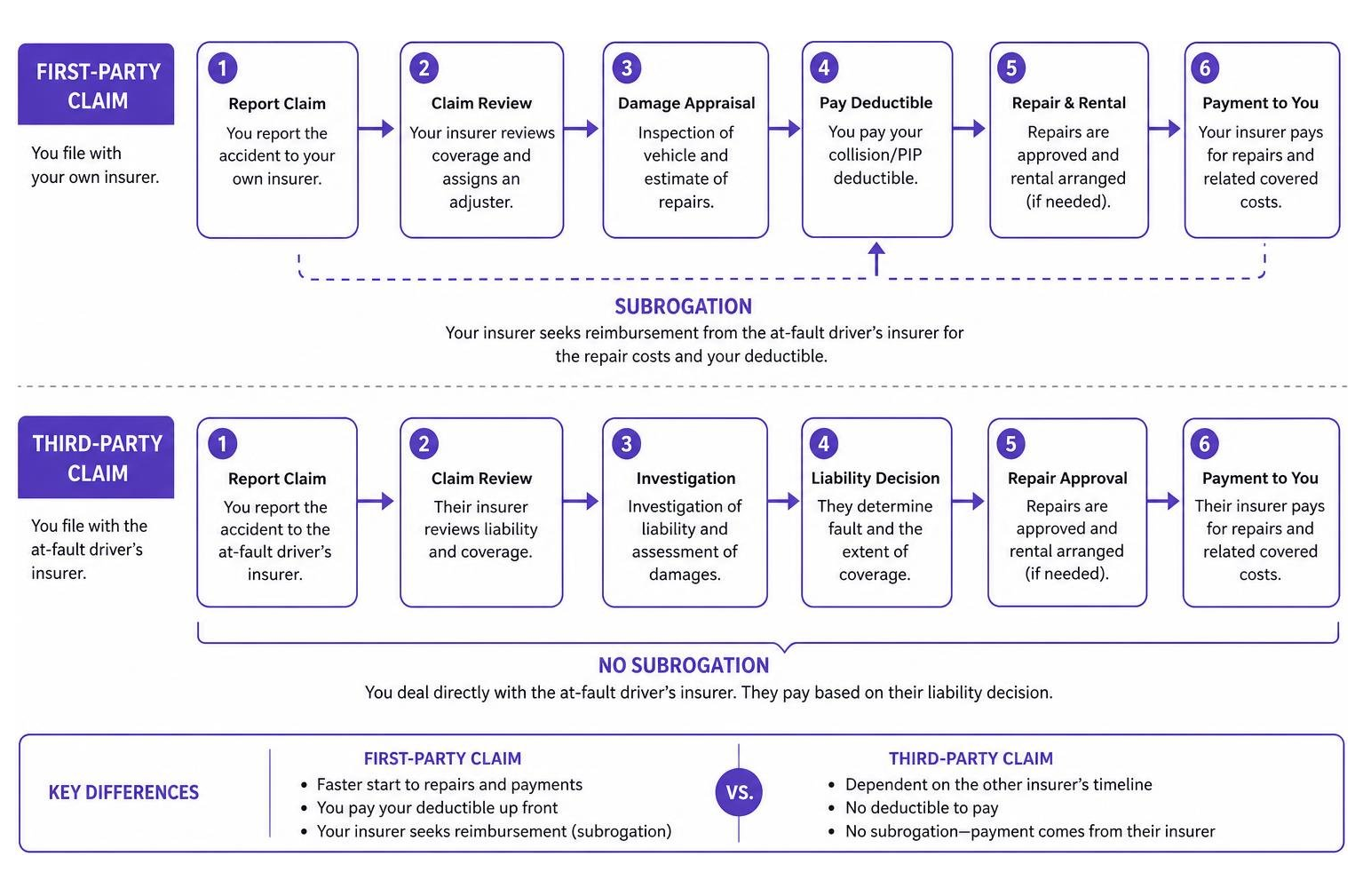
First-Party Claims (Filing with Your Own Insurer)
A first-party claim is submitted directly to your auto insurance policy under your collision or personal injury protection (PIP) coverage.
- The Pros: Processing speed is generally much faster. Your carrier owes you a direct contractual obligation to handle claims in good faith. Resources like Car Accident Claims Help | State Farm® – State Farm® make it easy to upload damage photos, track adjusters, and arrange rental vehicles online. Premium carriers detailed in guides like How Auto Claims Work | Chubb often assign dedicated examiners within six hours and release approved payments within 48 hours.
- The Cons: You must pay your collision policy deductible out of pocket before repairs begin. Your insurer will subsequently enter subrogation — a months-long legal recovery process — to claw back that repair cost and your deductible from the at-fault driver’s company.
Third-Party Claims (Filing with the At-Fault Driver’s Insurer)
A third-party claim is submitted against the other driver’s liability insurance policy.
- The Pros: You pay zero deductible. The liability carrier covers vehicle repairs, towing costs, rental car expenses, and medical expenses directly up to their policyholder’s coverage limit.
- The Cons: The third-party insurer has no contractual contract with you. Their primary legal duty is to protect their own policyholder and limit their financial payout. They will rigorously investigate fault before approving any payment, which can take weeks.
Understanding Illinois Claim Rules, Fault, and Deadlines
State auto insurance regulations govern how liability is split, how fast adjusters must respond, and how long you have to pursue legal recovery. Illinois operates as a fault-based auto insurance state with specific statutory protections for consumers.
How Comparative Negligence Impacts Your Car Accident Claim Help
In Illinois, financial recovery follows a modified comparative negligence system governed by a 50 percent bar rule. You can recover monetary damages following an accident as long as you were 50% or less at fault for the collision. However, if your share of fault exceeds 50%, you are legally barred from collecting any compensation from the other party.
When you are partially at fault (50% or less), your total financial recovery is reduced proportionally by your percentage of blame:
- Example A: Suppose your total property damage and medical bills equal $10,000. An investigation reveals the other driver ran a red light, but you were traveling 5 mph over the posted speed limit. The insurance adjuster determines you were 10% at fault and the other driver was 90% at fault. Under Illinois law, your payout is reduced by 10% ($1,000), leaving you with a net recovery of $9,000.
- Example B: If total damages equal $50,000 and you are found 20% at fault, your final check is reduced by $10,000, leaving you with $40,000.
Insurance adjusters frequently manipulate comparative fault percentages to cut their payout amounts. Knowing how adjusters apply formulas allows you to challenge biased fault assignments early. For a deeper breakdown of how settlement algorithms calculate these fractions, explore The Car Accident Settlement Formula and How to Beat It.
Statutory Time Limits and Insurance Regulations
Illinois state laws impose strict procedural rules and deadlines on both policyholders and insurance adjusters:
Illinois Minimum Mandatory Liability Limits
Every driver operating a vehicle in Illinois must maintain minimum liability policy limits of 25/50/20:
- $25,000 for bodily injury or death of one person per accident
- $50,000 total for bodily injury or death of two or more persons per accident
- $20,000 for property damage per accident
Statutory Time Limits (Statute of Limitations)
If you cannot settle your claim out of court, you must file a formal lawsuit within strict legal timelines:
- Bodily Injury Claims: 2 years from the date of the accident (or 2 years from the victim’s 18th birthday if the injured party was a minor).
- Property Damage Claims: 5 years from the date of the crash.
Consumer Response Rules for Insurers
Illinois insurance regulations enforce mandatory administrative timelines on insurance carriers:
- Claim Form Response: Insurance companies must provide necessary claim forms within 15 working days of your request.
- Delay Notifications: If a property damage liability claim remains unresolved after 60 days, the insurance company must send you a written explanation detailing the exact reasons for the delay.
Managing Vehicle Repairs, Rental Cars, and Diminished Value

Getting your car back on the road safely without taking a financial loss on its market value requires knowing your consumer rights during the repair estimate process.
Repair Shop Rights and Low Settlement Estimates
When an adjuster inspects your wrecked vehicle, their initial repair estimate is almost always conservative. Here are the core legal protections you hold:
- Freedom of Repair Shop Selection: You have the absolute right to choose any licensed auto body repair shop. Insurers cannot force you to use their preferred network facilities. However, if your preferred body shop charges higher hourly labor rates than local market standards, you may be responsible for paying the difference.
- Original Equipment Manufacturer (OEM) Parts Choices: Insurance estimates often specify aftermarket or reconditioned “crash parts.” You have the final say on whether to accept non-OEM components or insist on original manufacturer parts. If you insist on OEM parts when non-OEM parts meet quality standards, you may need to cover the price differential.
- Child Safety Seat Replacements: Under Illinois law, auto insurance policies must cover the full cost of replacing child safety seats that were installed and in use during a crash, regardless of whether visible damage is present.
- Illinois Total Loss Retention Rules: If repair costs approach or exceed the actual cash value (ACV) of your car, the insurer will declare it a total loss. In Illinois, you can only keep a totaled car if it is 9 years old or older and the insurer consents. Newer totaled vehicles (8 years old or less) cannot be retained by the owner and must be surrendered to the carrier with a salvage title. Insurers may deduct up to $500 maximum for pre-existing wear, tear, missing parts, or rust.
To clarify your repair choices, here is how first-party and third-party property damage coverage options compare:
| Property Damage Feature | First-Party Claim (Your Insurer) | Third-Party Claim (At-Fault Insurer) |
|---|---|---|
| Deductible Required? | Yes (Collision deductible applies) | No (Zero out-of-pocket deductible) |
| Repair Shop Choice | Freedom to select any shop | Freedom to select any shop |
| Rental Car Coverage | Depends on policy endorsement (“R” code) | Covered while vehicle is undergoing repairs |
| Diminished Value Claims | Typically excluded by standard policy language | Recoverable from at-fault carrier |
| Initial Processing Speed | Rapid (often days) | Moderate to slow (requires liability approval) |
Rental Costs and Claiming Diminished Value
When your primary vehicle is sitting in a repair shop or totaled on an impound lot, transportation costs add up quickly.
Rental Car Costs and Loss of Use
If you file a third-party claim, the at-fault driver’s insurance company is required to provide you with a comparable rental vehicle or pay you for “loss of use” during the entire period your car is un-drivable or undergoing active repairs. If filing first-party, check your insurance card: if the letter “R” appears under your active coverage endorsements, rental reimbursement is included up to your policy’s daily limits.
Claiming Inherent Diminished Value
Even after a certified body shop restores your vehicle to perfect structural and cosmetic condition, its permanent market resale value drops simply because it now carries an accident history on vehicle history reports (such as Carfax). This post-repair loss in market value is called diminished value.
Inherent diminished value claims can yield $2,000 to $15,000+ in additional compensation from the at-fault driver’s insurer, depending on your vehicle’s make, mileage, year, and pre-accident condition. First-party claims rarely pay diminished value due to standard policy exclusions, but third-party claims legally permit full recovery for this loss.
Automated claims tools such as myClaimAssist | File Your Auto Claim Free help identify hidden coverage layers like loss of use and diminished value. To gauge potential payouts for your vehicle and injury expenses, test your figures using our free Car Accident Settlement Calculator.
Resolving Claim Disputes, Uninsured Drivers, and Legal Next Steps

What happens when an insurance company denies your third-party claim, claims their policyholder is not at fault, or offers a lowball settlement check that doesn’t cover your medical bills?
Escalating Lowball Offers and Uninsured Motorist Claims
When negotiations stall, you do not have to accept an unfair settlement offer. Use these proven escalation avenues to assert your rights:
- Send a Formal Written Demand Letter: Outline the facts of the crash, reference attached police reports and medical bills, detail total economic losses, and state a specific settlement figure.
- Invoke the Policy Appraisal Clause: If you are disputing total loss vehicle valuations on a first-party claim, invoke your policy’s appraisal clause. You and the insurer each retain an independent appraiser, and a neutral umpire resolves the valuation difference.
- Submit an Insurance Commissioner Complaint: If an adjuster engages in bad-faith tactics, unreasonable delays beyond statutory timelines (such as exceeding 60 days without written explanation), or unfair valuation cuts, file a formal grievance with the Illinois Department of Insurance.
- Uninsured Motorists and Hit-and-Run Protocol: If the driver who caused your crash flees the scene or carries no auto insurance, file an immediate police report. In Illinois, mandatory Uninsured Motorist (UM) coverage on your own auto policy steps into the shoes of the missing driver to pay for your bodily injuries up to your policy limits.
Victims navigating complex liability disputes or non-responsive carriers can find guidance through established advice centers like Car Accident Lawyers | No Win No Fee Car Crash Solicitors | National Accident Helpline, which illustrate how legal specialists step in to enforce claim deadlines.
Seeking Professional Car Accident Claim Help and Legal Support
Handling minor fender-benders independently is straightforward. However, when an accident involves severe personal injuries, missed work, permanent disability, or contested liability, securing professional legal assistance is essential.
Personal injury attorneys operate on a contingency fee structure. This means you pay zero upfront costs or hourly retainer fees. The attorney’s legal fee is calculated as an agreed percentage (typically 33.3% to 40%) of the final settlement or verdict amount recovered on your behalf. If the attorney recovers nothing, you owe no legal fees.
If you are unsure whether your claim requires legal representation or if you can handle negotiations yourself, read DIY vs Attorney Can You Handle Your Car Accident Settlement Alone. To review how legal costs, litigation expenses, and net payouts are calculated, see our guide on Demystifying Personal Injury Lawyer Fees and Contingency Percentages.
Frequently Asked Questions about Car Accident Claims
Do I have to pay a deductible when filing through the at-fault driver’s insurance?
No. Deductibles only apply to first-party claims filed under your own collision policy. When you file a third-party claim against the at-fault driver’s insurance policy, you pay zero deductible. The third-party carrier pays the auto repair shop directly for all approved estimate costs and provides a rental vehicle at no out-of-pocket expense to you.
What happens if the other driver flees or has no insurance?
If you are hit by a hit-and-run driver or an uninsured motorist, report the incident to the police immediately. Next, file an uninsured motorist (UM) claim under your own auto policy. Illinois law requires all liability policies to include UM coverage matching state minimums ($25,000/$50,000). Your own insurance policy will cover your medical expenses and bodily injuries as if it were the at-fault driver’s policy.
Can I keep my car if the insurance company declares it a total loss?
In Illinois, you can only retain a totaled vehicle if it is 9 years old or older and your insurance company consents to the salvage retention. The insurer will deduct the vehicle’s salvage scrap value from your total loss settlement check. If your vehicle is 8 years old or newer and declared a total loss, state law strictly prohibits you from keeping it; the car must be surrendered to the insurer with a clear salvage title.
Conclusion
Navigating an auto accident claim doesn’t have to strain your mental health or financial security. By taking immediate control at the crash scene, gathering solid evidence, understanding state comparative fault thresholds, and enforcing statutory claim response rules, you level the playing field against insurance adjusters.
Remember these core takeaways:
- Act fast at the scene: Secure police reports, document witness statements, and photograph all vehicle damage.
- Choose the right claim path: Use first-party collision coverage for quick repairs, or third-party liability claims to avoid paying out-of-pocket deductibles.
- Know your rights: Protect your freedom to choose repair shops, claim diminished value, and enforce the 2-year bodily injury statute of limitations.
- Escalate unfair denials: Don’t hesitate to file state insurance complaints or consult an attorney when adjusters present lowball offers.
Take advantage of ContentVibee’s comprehensive calculators and legal resources to estimate your claim value and protect your rights every step of the way. If your case involves severe injuries or complex disputes, explore our Car Accident Attorneys Los Angeles Guide 2026 to connect with skilled legal advocates near you.