How Age Affects Your Social Security Spousal Benefits
Eligibility Requirements for Spousal Social Security Benefits at 62
Spousal social security benefits at 62 can put money in your pocket years before full retirement age — but claiming early comes with a permanent price tag most couples don’t fully understand until it’s too late.
Here’s a quick answer to the most common questions:
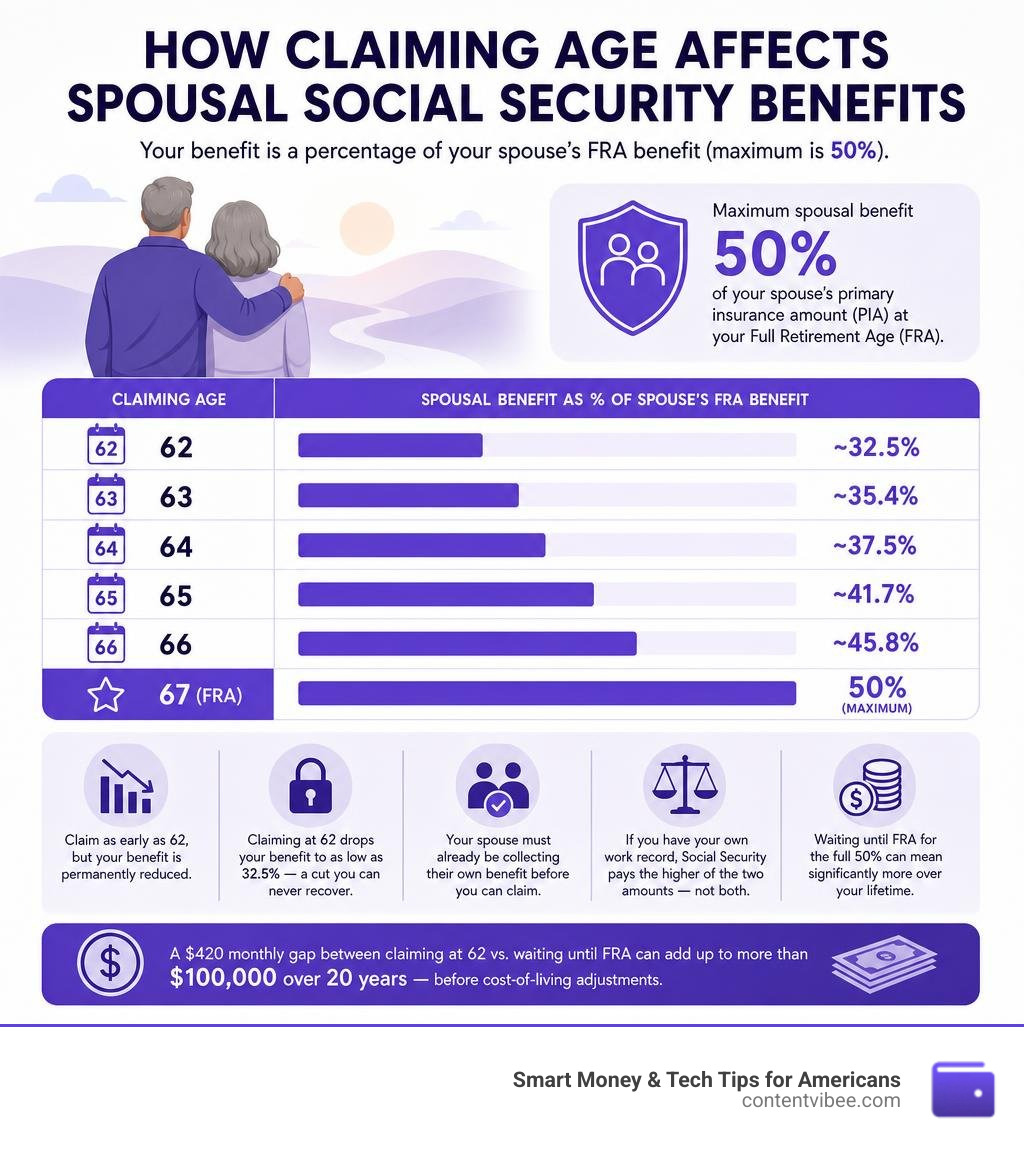
| Claiming Age | Spousal Benefit as % of Spouse’s FRA Benefit |
|---|---|
| 62 | ~32.5% |
| 63 | ~35.4% |
| 64 | ~37.5% |
| 65 | ~41.7% |
| 66 | ~45.8% |
| 67 (FRA) | 50% (maximum) |
Key facts at a glance:
- You can claim as early as age 62, but your benefit is permanently reduced.
- The maximum spousal benefit is 50% of your spouse’s primary insurance amount (PIA) — only available at your full retirement age.
- Claiming at 62 drops that to as low as 32.5%, a cut you can never recover.
- Your spouse must already be collecting their own benefit before you can claim a spousal benefit.
- If you have your own work record, Social Security will pay the higher of the two amounts — not both.
The decision of when to claim is one of the most financially consequential choices you’ll make in retirement. A $420 monthly gap between claiming at 62 versus waiting until full retirement age can add up to more than $100,000 over 20 years — before cost-of-living adjustments.
This guide breaks down everything you need to know: eligibility rules, the math behind the reductions, special rules for divorced and non-working spouses, and how couples can coordinate their claiming ages to protect lifetime income.
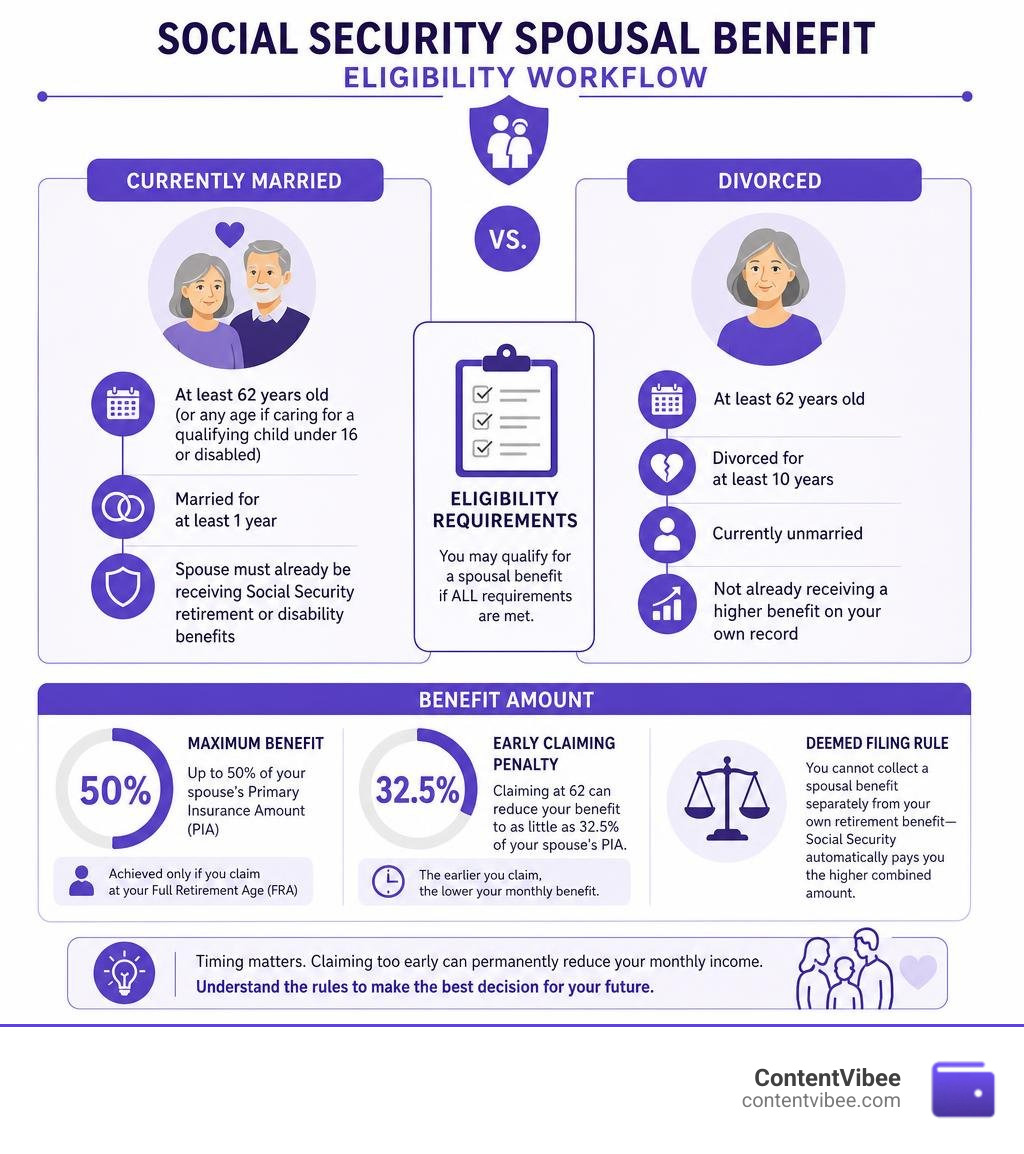
Before you run to the Social Security Administration (SSA) website to file your claim, we need to talk about the gatekeepers. To qualify for spousal social security benefits at 62, you must meet several strict statutory requirements.
First and foremost is the marriage duration requirement. You must be legally married to your spouse for at least one continuous year immediately before filing your application. The SSA relies on state laws to define a legal marriage, which also fully applies to same-sex marriages. There are a few rare exceptions to the one-year rule—such as if you are the parent of your spouse’s biological child or if you were entitled to auxiliary benefits on someone else’s record before marrying—but for 99% of couples, the 12-month mark is the magic number.
Second, your spouse must already be receiving their own retirement or disability benefits for you to claim a spousal benefit. This is a common point of confusion. If your husband or wife is still working and delaying their own Social Security claim to build up delayed retirement credits, you cannot collect a spousal benefit on their record. The primary worker must have pushed the “start” button on their own benefits before you can piggyback on their earnings history.
Third, your own work record plays a massive role. To receive a spousal benefit, your spouse’s Primary Insurance Amount (PIA)—the benefit they are entitled to at their Full Retirement Age (FRA)—must be more than double your own PIA. If you had a highly successful career and your own retirement benefit is larger than half of your spouse’s FRA benefit, the SSA will pay you your own benefit instead.
To explore this in greater depth, you can read our Detailed Guide To Spousal Benefits Eligibility or check out the official SSA guidance on Do You Qualify for Social Security Spouse’s Benefits? | Social Security Matters | SSA .
How Deemed Filing Affects Spousal Social Security Benefits at 62
Once upon a time, couples could use creative claiming strategies like the “restricted application.” A spouse could apply only for spousal benefits at their full retirement age, allowing their own retirement benefit to grow by 8% per year until age 70.
But the Bipartisan Budget Act of 2015 permanently closed this playbook for anyone turning 62 on or after January 2, 2016. Today, in July 2026, those old strategies are history.
Under current rules, we must navigate deemed filing. When you apply for either your own retirement benefit or a spousal benefit, you are legally “deemed” to have applied for both simultaneously. You do not get to choose which account to draw from. The SSA will calculate both your own retirement benefit and your spousal benefit, and they will pay you the higher of the two amounts.
This is known as dual entitlement. If your own retirement benefit is smaller than the spousal benefit, the SSA doesn’t just hand you the full spousal benefit. Instead, they pay your own retirement benefit first, and then “top off” your check with an excess spousal benefit to bring your total monthly deposit up to the spousal benefit level.
To learn more about how this timing works, see our guide on At What Age Can I Claim My Spouses Social Security.
Rules for Divorced Spouses and Non-Working Partners
What if you never worked, took decades off to raise a family, or are currently divorced? The system is designed to protect you, but the rules have very specific boundaries.
For non-working partners with little or no earnings history, the path is straightforward. If you have fewer than 40 work credits (roughly 10 years of work), you won’t qualify for your own retirement benefit. However, you can still collect a full spousal benefit based entirely on your husband’s or wife’s work record. The exact same age reductions apply, meaning if you claim at 62, your benefit will be reduced to 32.5% of their FRA benefit.
For divorced spouses, you can claim spousal benefits on your ex-spouse’s record if you meet the following criteria:
- Your marriage to your ex-spouse lasted for at least 10 consecutive years.
- You are currently unmarried. (If you remarry, you generally lose the right to claim on your ex-spouse’s record unless your subsequent marriage ends).
- Your ex-spouse is at least 62 years old.
- The benefit you would receive based on your own work is less than what you would receive based on your ex-spouse’s record.
There is a massive planning advantage for divorced couples: you do not have to wait for your ex-spouse to claim their own benefit. As long as you have been divorced for at least two consecutive years and your ex is at least 62, you can file for divorced spousal benefits even if they are still working and delaying their own claim. Best of all, claiming on an ex-spouse’s record has absolutely zero impact on their monthly benefit, nor does it affect their current spouse’s benefits.
For the official legal definitions of legal versus deemed spouses, you can consult the SSA – POMS: RS 00202.001 – Definitions and Requirements for Spouse Benefits – 07/24/2017 .
How Early Claiming Permanently Reduces Your Monthly Payout
If you decide to claim spousal social security benefits at 62, you must accept a permanent financial haircut.
Many people mistakenly believe that if they claim early at 62, their monthly check will automatically bump up to the full 50% amount once they reach their Full Retirement Age. This is a myth. Any reduction applied to your spousal benefit because of early claiming is permanent. It locks in for the rest of your life, with the only future increases coming from annual Cost-of-Living Adjustments (COLA).

Your Full Retirement Age (FRA) depends entirely on the year you were born. For anyone born in 1960 or later, your FRA is 67. Because we are writing this in July 2026, anyone turning 62 this year was born in 1964, meaning their FRA is indeed 67. Claiming at 62 means you are filing exactly 60 months (5 years) before your FRA.
To find your exact FRA and see how your birth year affects your timeline, check out our guide on How To Calculate Your Spousal Retirement Age Easily.
The Math Behind Spousal Social Security Benefits at 62
So, how does the SSA calculate this reduction? They use a strict mathematical formula based on the number of months you claim prior to your FRA.
For a spousal benefit, the reduction is:
- 25/36 of 1% for each of the first 36 months before your FRA.
- 5/12 of 1% for each additional month beyond 36 months.
Let’s do the math for someone whose FRA is 67 and who wants to claim spousal social security benefits at 62 (exactly 60 months early):
- For the first 36 months: $36 \times (25/36 \times 1\%) = 25\%$ reduction.
- For the remaining 24 months (60 – 36): $24 \times (5/12 \times 1\%) = 10\%$ reduction.
- Total reduction: $25\% + 10\% = 35\%$ reduction.
Because the maximum spousal benefit at FRA is 50% of the worker’s PIA, a 35% reduction means you will receive only 65% of that 50%.
$$50\% \times (1 – 0.35) = 32.5\%$$
Thus, at age 62, your spousal benefit is slashed to 32.5% of your spouse’s PIA.
Let’s put this in real dollars. Imagine your spouse’s PIA at their FRA is $2,400.
- If you wait until your own FRA (67) to claim, your spousal benefit is $1,200 (50%).
- If you claim early at age 62, your spousal benefit is reduced by 35%, leaving you with just $780 per month (32.5%).
That is a monthly difference of $420. Over a 20-year retirement, that gap costs your household $100,800 in lost purchasing power—and that’s before factoring in compounding COLAs!
For exact calculations, you can use the official Benefits for Spouses tool or read our guide on how to Calculate Spousal Benefits How Much Will You Get.
Comparing Spousal Reductions to Worker Retirement Reductions
It is vital to realize that the SSA punishes early claiming much more severely for spousal benefits than it does for a worker’s own retirement benefits.
If you claim your own retirement benefit early, the reduction is 5/9 of 1% per month for the first 36 months, and 5/12 of 1% for additional months. This results in a maximum reduction of 30% at age 62 (if your FRA is 67).
However, as we just calculated, the spousal benefit reduction at age 62 is 35%.
The table below highlights this discrepancy:
| Age | Months Early | Worker’s Own Benefit Reduction | Spousal Benefit Reduction | Spousal Benefit % of Partner’s PIA |
|---|---|---|---|---|
| 67 (FRA) | 0 | 0.00% | 0.00% | 50.0% |
| 66 | 12 | 6.67% | 8.33% | 45.8% |
| 65 | 24 | 13.33% | 16.67% | 41.7% |
| 64 | 36 | 20.00% | 25.00% | 37.5% |
| 63 | 48 | 25.00% | 29.17% | 35.4% |
| 62 | 60 | 30.00% | 35.00% | 32.5% |

As the diagram shows, the penalty slope is steeper for spouses. If you are trying to decide whether to claim your own small benefit or a spousal benefit early, understanding these differing reduction rates is critical to keeping more money in your household.
Maximizing Combined Income: Smart Claiming Strategies for Couples
When it comes to Social Security, couples shouldn’t plan in isolation. You have to look at your combined lifetime benefits as a single financial puzzle.

Coordinating your claiming ages requires analyzing your age differences, health statuses, and retirement savings. If there is a significant age gap, or if the higher earner is in poor health, your strategy must pivot to protect the surviving spouse.
For comprehensive strategies, we highly recommend reading The Smart Couples Guide To Social Security Strategies and our companion article, Double The Fun A Guide To Social Security Spousal Benefits For Couples.
Why Delayed Retirement Credits Don’t Boost Spousal Benefits
If you are the higher earner, delaying your Social Security claim past your Full Retirement Age is a fantastic move. For every year you delay claiming between your FRA and age 70, your retirement benefit increases by 8% per year due to delayed retirement credits. At age 70, your monthly check will be 124% of your original PIA.
However, this increase does not carry over to your spouse’s spousal benefit.
The spousal benefit is strictly capped at 50% of your PIA at your Full Retirement Age. It does not matter if you wait until age 70 to claim and boost your own check to $3,000; your spouse’s maximum spousal benefit is still based entirely on your FRA benefit amount (e.g., $2,400).
Because of this rule, there is absolutely no financial benefit for the lower-earning spouse to delay claiming a spousal benefit past their own Full Retirement Age. Once the lower-earning spouse reaches FRA, their spousal benefit hits its 50% ceiling. Waiting until age 70 to claim a spousal benefit will not result in a higher check—it only means leaving free money on the table.
For a deeper dive into avoiding these costly mistakes, read Maximizing Spousal Benefits Without Leaving Money On The Table.
Coordinating Claiming Ages to Protect Survivor Benefits
While delaying past FRA does not increase a living spouse’s spousal benefit, it has a massive impact on survivor benefits.
If you are married and the higher-earning spouse passes away, the surviving spouse is entitled to a survivor benefit of up to 100% of the deceased spouse’s actual benefit at the time of death. This includes any delayed retirement credits the higher earner accumulated by waiting until age 70 to claim.
This leads to a highly effective coordination strategy for many couples:
- The higher earner delays claiming until age 70 to secure the largest possible retirement benefit and, consequently, the largest possible survivor benefit to protect their partner.
- The lower-earning spouse claims their own retirement benefit early (perhaps at 62) to bring some income into the household immediately.
- Once the higher earner finally files at age 70, the lower-earning spouse can then transition to their spousal benefit top-off (though this top-off will still be reduced because they claimed their own retirement benefit early).
Even if the lower-earning spouse permanently reduced their spousal benefit by claiming early, their future survivor benefit is unaffected by their early spousal claim. If the higher earner dies, the survivor can step up to 100% of the higher earner’s actual benefit, completely replacing their own smaller, reduced benefit.
Frequently Asked Questions about Spousal Benefits
Does claiming a spousal benefit reduce my partner’s own Social Security check?
No. This is one of the most common anxieties couples face, but we can put your mind at ease. Receiving a spousal benefit on your partner’s work record does not reduce their monthly retirement or disability check by a single penny.
Your partner earned their benefit through their own lifetime of hard work, and the SSA calculates their payment independently. Spousal benefits are considered “auxiliary benefits” and are paid out of the Social Security Trust Funds as an additional entitlement.
The only time auxiliary benefits are capped is if multiple family members (such as a spouse and dependent children) claim on a single worker’s record, which might trigger the family maximum benefit limit. However, for a standard retired couple, both of you can collect your respective benefits concurrently without any penalties or clawbacks to the primary earner’s check.
Can I work while receiving spousal benefits before full retirement age?
Yes, you can work, but you must keep a close eye on the Social Security earnings test limit.
If you claim any type of Social Security benefit (retirement or spousal) before your Full Retirement Age and continue to earn income, the SSA will temporarily withhold a portion of your benefits if your earnings exceed certain annual thresholds.
In 2026, the earnings test limits are as follows:
- If you are under FRA for the entire year: The limit is $24,480. The SSA will withhold $1 in benefits for every $2 you earn above this limit.
- In the year you reach FRA: The limit is much higher—$65,160 (for 2026). The SSA will withhold $1 in benefits for every $3 you earn above this limit, up until the actual month you reach FRA.
- Once you reach FRA: The earnings test disappears completely. You can earn millions of dollars a year, and your benefits will never be withheld.
It is important to note that any money withheld under the earnings test isn’t gone forever. Once you reach your FRA, the SSA recalculates your monthly benefit upward to credit you for the months your benefits were withheld. However, if you are planning to work full-time, claiming spousal social security benefits at 62 might result in your entire monthly benefit being withheld until you stop working or reach FRA.
How do the 2015 Bipartisan Budget Act rules impact my filing options today?
As we are now in July 2026, the Bipartisan Budget Act of 2015 is fully implemented, and its transition windows have closed.
To put it simply:
- Restricted Applications are gone for virtually everyone filing today. The ability to file a restricted application to claim only spousal benefits while letting your own retirement benefit grow was grandfathered only for individuals born on or before January 1, 1954. Anyone turning 62 today was born in 1964 and must comply with deemed filing.
- “File and Suspend” is dead. Under the old rules, a worker could file for retirement benefits at FRA and immediately suspend them, allowing their spouse to claim spousal benefits while the worker’s own benefit continued to grow. Today, if a worker suspends their retirement benefit, all auxiliary benefits on their record (including your spousal benefit) are also suspended.
Conclusion
Deciding whether to claim spousal social security benefits at 62 is a delicate balancing act. While the appeal of securing early retirement income is strong, the permanent 35% reduction can significantly impact your household’s long-term financial security.
Before making your decision, we encourage you to look at the numbers for your specific situation. At Suppremo, we want to help you make these decisions with total confidence.
To make the math simple, you can use our Tools/Finance Calculator/Social Security Spousal Benefit Calculator to run your own scenarios, or read our step-by-step guide: https://suppremo.in/calculate-your-spousal-benefits-the-easy-way/.
Take the time to coordinate your ages, understand the rules of deemed filing, and make a plan that protects both of you for the decades of retirement ahead.