Ex-Spouse Social Security Eligibility and Rules
What Divorced People Need to Know About Social Security Benefits in 2026
Are ex spouses entitled to Social Security benefits? Yes — and more than 4 in 10 Americans nearing retirement age don’t even know it’s possible.
Here’s the short answer:
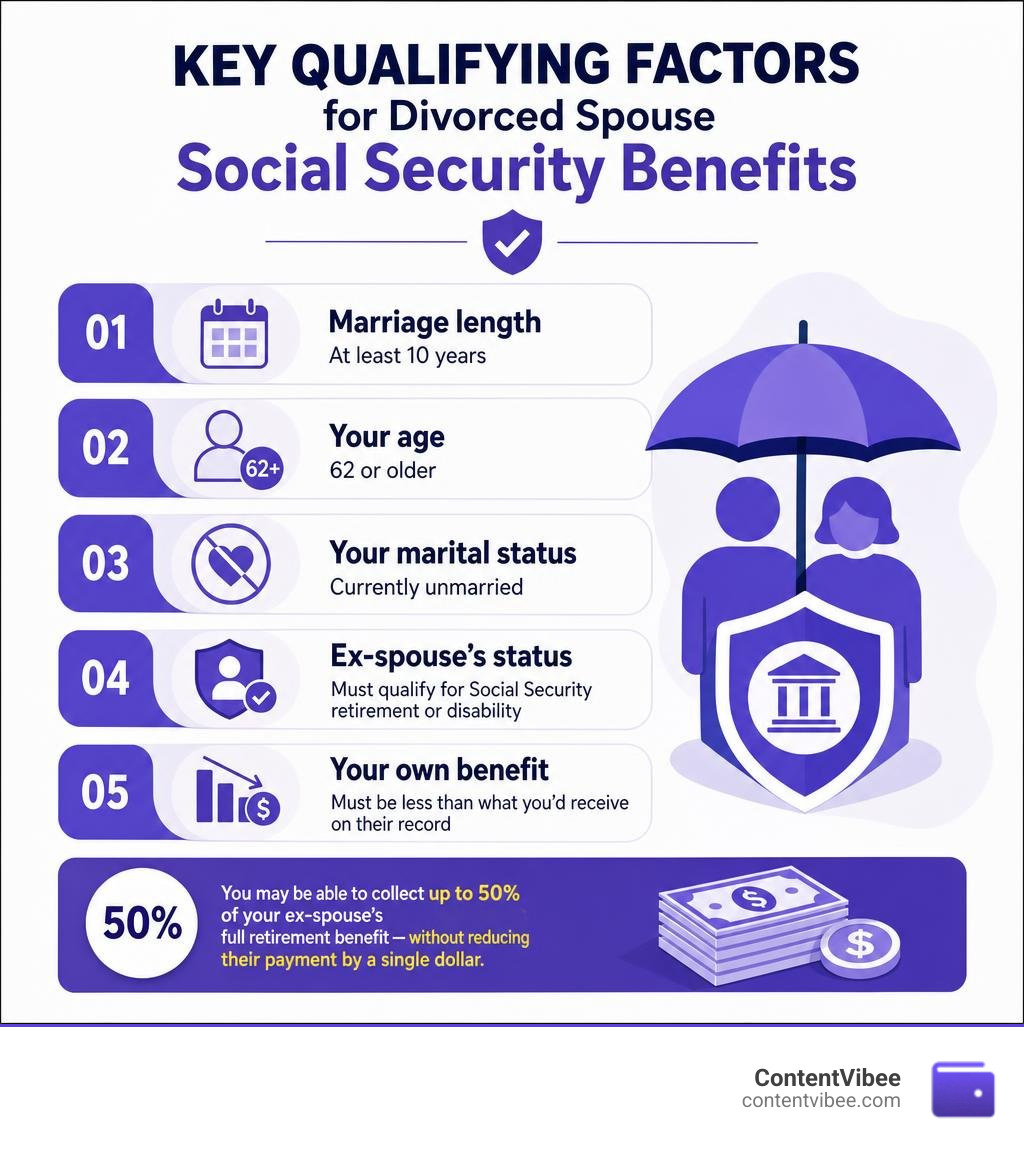
| Requirement | Rule |
|---|---|
| Marriage length | At least 10 years |
| Your age | 62 or older |
| Your marital status | Currently unmarried |
| Ex-spouse’s status | Must qualify for Social Security retirement or disability |
| Your own benefit | Must be less than what you’d receive on their record |
If you check all those boxes, you may be able to collect up to 50% of your ex-spouse’s full retirement benefit — without reducing their payment by a single dollar.
This applies whether your ex has remarried, whether they’ve filed for benefits yet, and even if your divorce decree included language trying to sign away these rights. That language is legally worthless. The Social Security Administration (SSA) does not enforce it.
As of December 2023, roughly 591,000 people were receiving Social Security benefits on a former spouse’s record — and 95% of them were women. The average monthly benefit for a divorced spouse of a retired worker was $960, while surviving divorced spouses received an average of $1,866 per month.
These are real dollars that many people leave on the table simply because they don’t know the rules.
This guide breaks down every major rule — eligibility, benefit amounts, privacy, remarriage, survivor benefits, and how to apply — so you can make a fully informed decision about your retirement income.
Are Ex Spouses Entitled to Social Security Benefits? Key Eligibility Rules
When couples split up, dividing tangible assets like bank accounts, real estate, and retirement plans usually dominates the divorce proceedings. But federal benefits operate under federal law, independent of state divorce courts. Under the Social Security Act, former spouses maintain financial protections designed to safeguard partners who earned lower lifelong incomes during a long-term marriage.
To answer the core question — are ex spouses entitled to social security benefits — the Social Security Administration evaluates five core criteria when you submit an application:
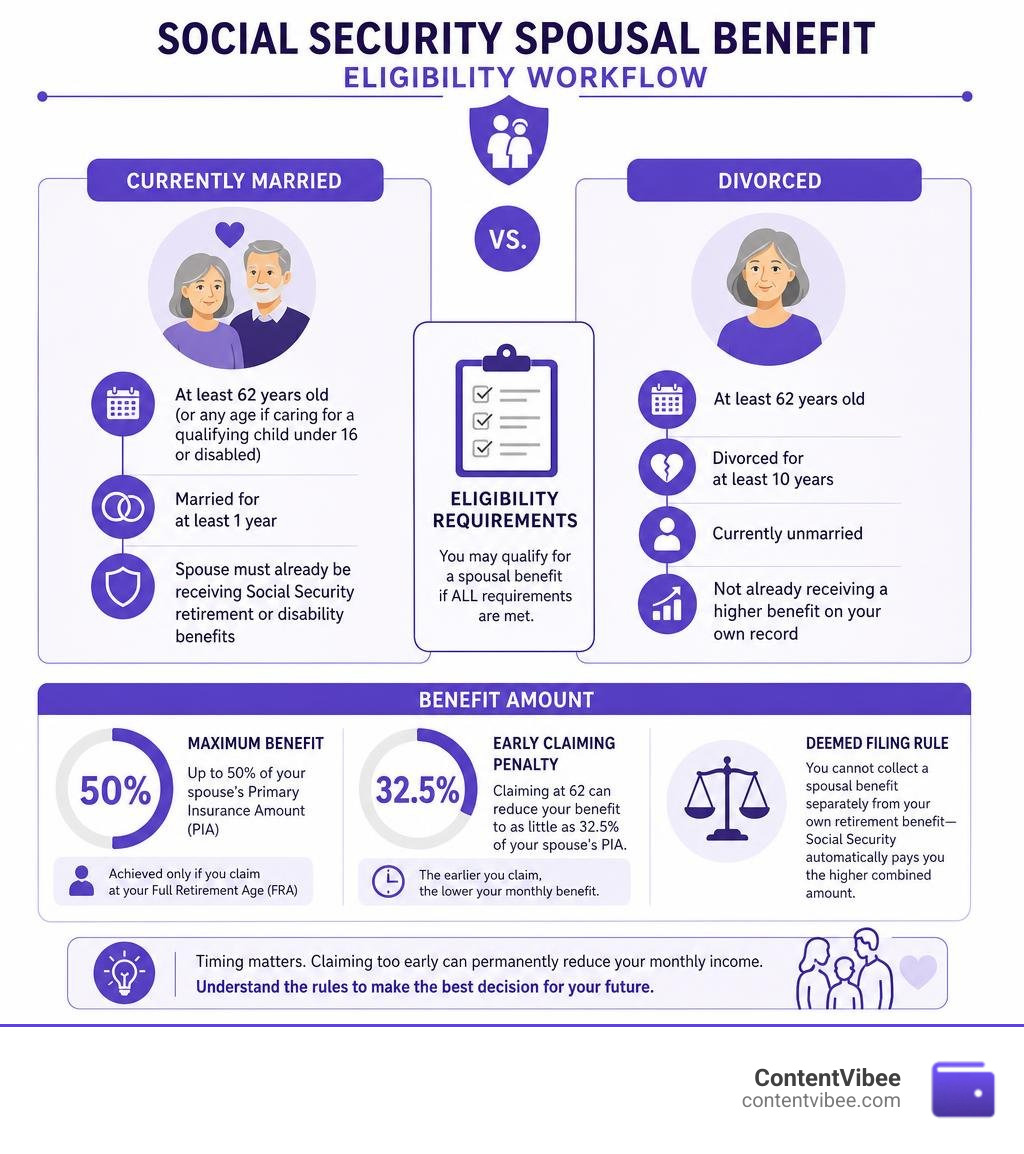
- Duration of Marriage: Your marriage must have lasted for at least 10 continuous years before the divorce became final.
- Minimum Age Requirement: You must be at least 62 years old to claim retirement-based spousal benefits (or age 60 if claiming survivor benefits after an ex-spouse’s death).
- Current Marital Status: You must currently be unmarried. If you remarried prior to age 60, you generally forfeit eligibility on your former partner’s record unless that subsequent marriage ended.
- Primary Insured Status: Your former partner must be entitled to Social Security retirement or disability benefits (meaning they have accumulated at least 40 work credits).
- Benefit Threshold Comparison: The benefit you are entitled to receive on your own work record must be less than the amount you would receive based on your ex-spouse’s earnings history.
If you fulfill these baseline criteria, we encourage you to explore our comprehensive breakdown on whether a can divorced spouse get social security benefits in specialized situations.

How the 10-Year Marriage Rule Operates
The 10-year marriage duration rule is strictly enforced by the SSA. Federal regulations measure this period from the exact calendar date of your legal marriage up to the final date of legal dissolution or divorce decree issuance.
If your marriage lasted 9 years, 11 months, and 25 days before the divorce decree was stamped final by the court clerk, the SSA will deny the spousal benefit claim. There are no discretionary waivers, equitable exceptions, or hardship exemptions for missing the 10-year mark by even a few days.
To prove continuous marriage, you must provide official state-issued marriage certificates and official final divorce decrees. If your marriage experienced temporary legal separations during those 10 years, the clock does not stop running, provided the marriage was not legally dissolved and reinstated during that time frame. For a deeper look into how marriage timing impacts your long-term retirement check, read our guide on how the ten year marriage rule affects your divorced spousal benefits.
Are Ex Spouses Entitled to Social Security Benefits If Their Ex Has Not Claimed Yet?
A common point of confusion is whether you have to wait for your ex-husband or ex-wife to file for their own retirement check before you can receive your portion.
The short answer is no — provided you meet the criteria for an independently entitled divorced spouse.
Under Social Security rules, if your ex-spouse is eligible for Social Security retirement benefits (age 62 or older with 40 work credits) but has not yet applied, you can still claim benefits on their work record if:
- You meet all general eligibility standards (married 10+ years, age 62+, currently unmarried).
- You have been legally divorced from your ex-spouse for at least two continuous years.
This two-year rule ensures that an uncooperative or financially delayed ex-spouse cannot block you from accessing your earned benefits. If your former partner is already receiving Social Security disability benefits or retirement benefits, the two-year post-divorce waiting period is waived completely. For step-by-step strategies following a separation, see our article on divorced spouse benefits what you need to know after the split.
Calculating Divorced Spousal Benefits and Payment Amounts
The maximum benefit a living divorced spouse can receive is 50% of the primary earner’s Primary Insurance Amount (PIA). The PIA represents the monthly benefit the primary worker is entitled to receive at their exact Full Retirement Age (FRA).
However, collecting the full 50% depends entirely on when you choose to begin receiving benefits. If you claim before your own Full Retirement Age, your monthly check will be permanently reduced.
Here is how claiming age impacts your monthly spousal payout assuming a Full Retirement Age of 67 (for anyone born in 1960 or later):
| Claiming Age | Percentage of Ex-Spouse’s PIA Received | Example Monthly Payout (If Ex’s PIA is $2,400) |
|---|---|---|
| 62 | 32.5% | $780 |
| 63 | 35.0% | $840 |
| 64 | 37.5% | $900 |
| 65 | 41.7% | $1,000 |
| 66 | 45.8% | $1,100 |
| 67 (FRA) | 50.0% | $1,200 |
Note: Unlike individual retirement benefits, spousal benefits do NOT earn Delayed Retirement Credits past your Full Retirement Age. There is zero financial incentive to wait past age 67 to claim an ex-spouse spousal benefit, as the payout caps out at 50%.
To test different scenarios based on your exact birth year, check out our resource ex files a guide to using the divorced spouse social security benefits calculator.
Benefit Calculations: Personal Record vs. Ex-Spouse Record
Social Security calculates individual retirement benefits using a 35-year base of indexed highest earnings. If you worked and paid Social Security payroll taxes (FICA), you have your own personal benefit amount.
When you apply for Social Security, the SSA automatically evaluates both your personal earnings history and your former spouse’s earnings history. You do not get to “double dip” or combine both benefits into one mega-check. Instead, Social Security pays you your own personal earned benefit first. If half of your ex-spouse’s PIA is higher than your personal benefit, the SSA supplements your payment with an additional spousal amount to bring your total check up to that higher 50% figure.
If you are curious how these mechanics parallel active marriages, review our analysis on how social security spousal benefits work for married couples.
Privacy, Ex-Spouse Notification, and Legal Decrees
One of the most persistent myths surrounding Social Security post-divorce is that claiming on an ex’s record will hurt them financially or cause personal friction.
We can put those worries to rest completely:
- No Reduction in Ex’s Payments: Your claim does not take money out of your ex-spouse’s pocket. They receive 100% of their earned benefit regardless of whether you claim or not.
- No Impact on Ex’s Current Family: If your ex has remarried, your spousal benefit will not decrease the spousal benefit paid to their current wife or husband. Furthermore, ex-spousal payouts are excluded from the SSA’s standard “Family Maximum Benefit” calculation cap.
- Strict Privacy and Zero Notification: The Social Security Administration operates under strict federal privacy statutes. The SSA will never notify your ex-spouse that you have submitted an application, nor will they disclose your personal address or financial details.
- Divorce Decrees Cannot Waive Rights: During messy divorces, attorneys sometimes draft clauses stating that one spouse relinquishes all future rights to the other spouse’s Social Security earnings record. The SSA officially disregards these clauses. As outlined in the official regulations, state courts do not have authority over federal statutory entitlement.

According to official SSA guidelines under SSA – POMS: RS 00202.001 – Definitions and Requirements for Spouse Benefits, spousal rights are established by federal statute, meaning divorce settlement agreements cannot modify or revoke federal eligibility rules. For more peace of mind, read our detailed guide confirming can you claim your exs social security yes and it wont hurt their wallet. You can also review general rules on Social Security Married and Divorced Spousal Benefits.
Impact of Remarriage and Handling Multiple Marriages
What happens if you fall in love and decide to walk down the aisle again later in life? Remarriage is one of the most critical events that can alter your Social Security eligibility.

Under the official rules governing spousal benefits, if you remarry while your former spouse is still living, you lose all entitlement to collect spousal retirement benefits on that ex-spouse’s record.
To keep your options clear, review our comprehensive divorced spouse social security guide 2026 alongside the official rules detailed in SSA – POMS: RS 00202.040 – Spouse’s Benefits – Termination Events.
Are Ex Spouses Entitled to Social Security Benefits After Remarriage?
Let’s break down the exact scenarios where remarriage impacts — or does not impact — your benefits:
- Remarrying While Ex Is Alive: If you remarry at any age while your former partner is alive, your spousal benefit on their record terminates the month prior to your new marriage. If your subsequent marriage later ends due to divorce, annulment, or death, your eligibility on the original ex-spouse’s record is restored.
- Remarrying After Age 60 (Survivor Benefits): If your former spouse is deceased and you remarry after reaching age 60 (or age 50 if you are disabled), your remarriage is completely ignored for survivor benefit purposes. You can continue collecting surviving divorced spouse benefits on your deceased ex’s record, or switch to your new spouse’s record if that payout is higher.
- Multiple Qualifying Marriages: If you were married multiple times, with each marriage lasting 10 years or longer, you qualify on all eligible ex-spouses records. When you apply, the SSA automatically compares all available records (including your own earned record) and pays you the single highest monthly benefit available.
For specific questions regarding multiple splits, consult our article answering answers to your biggest social security questions after divorce.
Surviving Divorced Spouse Benefits and Survivor Rules
If your former partner passes away, the rules change dramatically — in a direction that offers significantly higher financial support. As a surviving divorced spouse, you transition from standard spousal benefits to survivor benefits.
Key advantages of surviving divorced spouse benefits include:
- Higher Maximum Benefit: You are eligible to receive up to 100% of the deceased ex-spouse’s benefit (including any delayed retirement credits they earned), compared to the 50% cap for living ex-spouses.
- Earlier Claiming Age: You can begin receiving survivor benefits as early as age 60 (or age 50 if you have a qualifying disability).
- Restricted Application Flexibility: Surviving divorced spouses retain a unique strategic advantage. You can choose to claim surviving divorced spouse benefits first (at a reduced rate starting at age 60) while allowing your personal retirement benefit to accrue delayed credits up to age 70, then switch to your own higher personal benefit later.
Official evidence standards and table of proofs required by SSA processors are defined in SSA – POMS: RS 00207.004 – Widow(er)’s Benefits. For a simplified breakdown of these policies, read our clear overview on surviving divorced spouse benefits explained simply.
How to Apply for Ex-Spouse Social Security Benefits
Ready to file your claim? Applying for ex-spouse benefits requires standard documentation to establish age, identity, and past legal relationships.
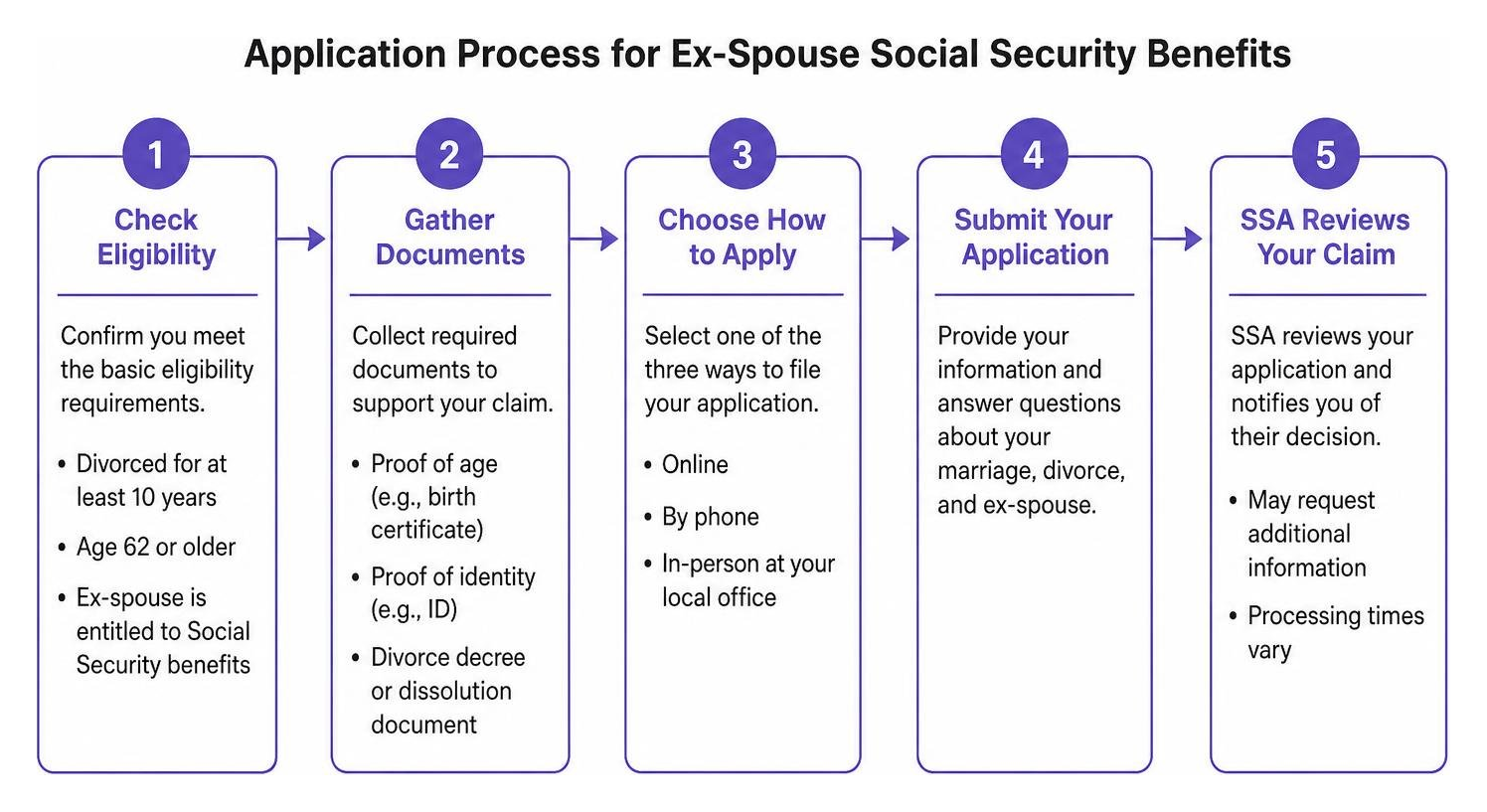
You can apply through three primary SSA channels:
- Online: Visit the official Social Security Administration website (ssa.gov).
- By Phone: Call the SSA national toll-free helpline at 1-800-772-1213 (TTY 1-800-325-0778).
- In-Person: Schedule an appointment at your local Social Security field office.
Required Documentation Checklist
When preparing your application, gather the following records:
- Your Social Security card and certified birth certificate.
- Proof of U.S. citizenship or lawful alien status.
- Marriage certificate establishing your marriage date.
- Final divorce decree establishing legal dissolution.
- Your ex-spouse’s Social Security number (SSN).
What if you don’t know your ex-spouse’s Social Security number? Don’t panic. If you cannot locate their SSN, the SSA representative can look up their record in their internal database using your ex-spouse’s full legal name, date of birth, birthplace, and parents’ full names.
For additional resources and context, consult AARP’s breakdown on Divorce and Social Security Spousal Benefits and financial advisory insights from Social Security Tips for Divorced Spouses and Widows | Mercer Advisors.
Frequently Asked Questions About Ex-Spouse Benefits
Can my ex-spouse block me from receiving Social Security benefits?
No. Your former partner has zero legal authority or administrative power to block, delay, or prevent you from receiving benefits on their record. Furthermore, non-solicitation or waiver clauses signed inside state divorce agreements attempting to waive Social Security spousal rights are void and unenforceable under federal law.
Will my ex-spouse be notified when I apply for benefits on their record?
No. The Social Security Administration maintains strict privacy protocols. The SSA does not send letters, emails, or notifications to your ex-spouse when you inquire about or file a claim on their work history.
What happens if both my ex-spouse and I have multiple past marriages?
If you have multiple former spouses from marriages that each lasted at least 10 years, you qualify to file on any of those records. When you file, the SSA automatically cross-references all eligible earnings records and pays you the single highest benefit amount available.
Conclusion
Understanding whether are ex spouses entitled to social security benefits can transform your financial trajectory in retirement. If you were married for at least 10 years, are currently unmarried, and are 62 or older, collecting benefits on an ex-spouse’s earnings record is a legal right codified by federal law. Claiming these funds takes nothing away from your former partner or their current family, and it can provide hundreds of dollars in additional monthly support.
At ContentVibee, our mission is to empower you with clear, outcome-oriented guides and practical financial calculators to navigate key retirement decisions. As you finalize your long-term income strategy, timing is critical — read our guide on how social security spousal benefits timing is everything to ensure you claim at the perfect moment for maximum financial security.