How to Handle a Lowball Car Accident Settlement Offer
Understanding the Settlement Offer Car Accident Process
A settlement offer car accident insurers make is a legal proposal to resolve your financial and medical claims without going to court. When you accept an offer, you agree to release the driver and their insurance company from any future legal liability in exchange for a set lump sum.
Settling out of court is the standard route for most motor vehicle claims. Both sides generally prefer settling because it provides financial certainty, avoids unpredictable jury verdicts, saves thousands in court costs, and speeds up recovery time. However, to negotiate effectively, you must understand how the process works from start to finish.
Key Phases of the Car Accident Settlement Timeline
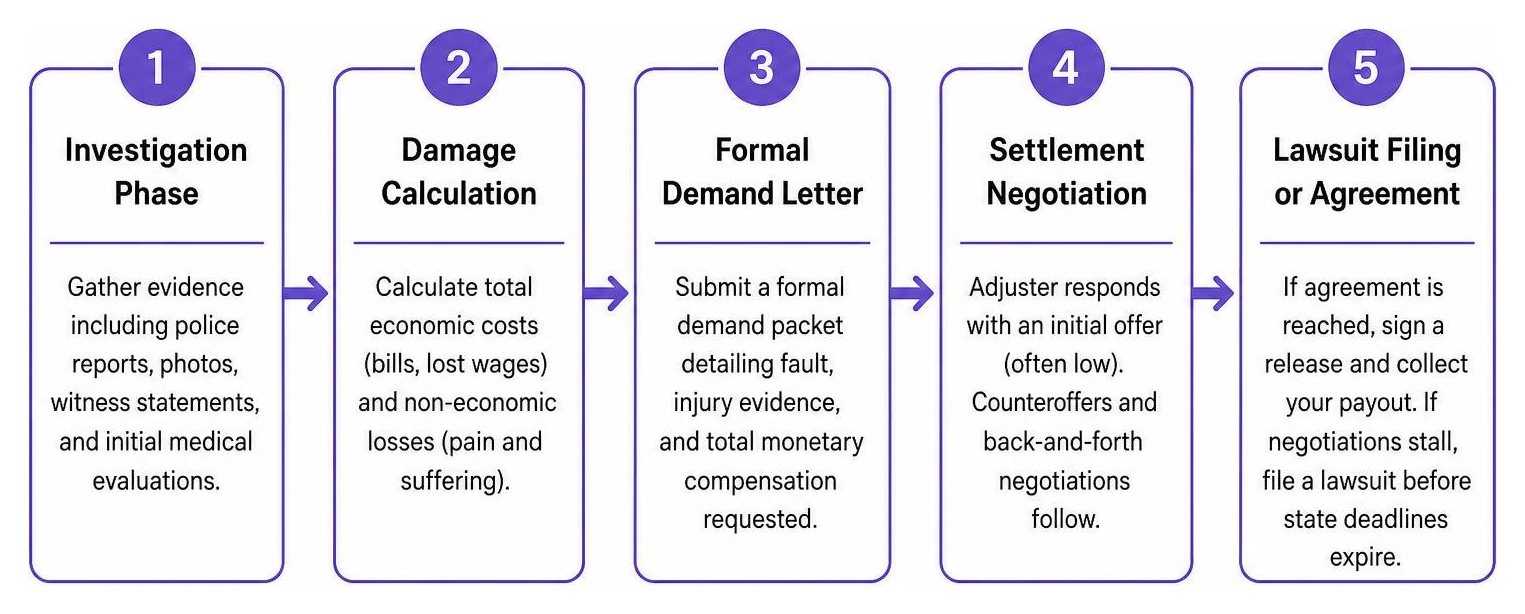
Resolving an insurance claim isn’t an overnight event; it unfolds across several distinct stages:
- Investigation Phase: You and your team gather evidence, including police reports, crash scene photos, witness statements, and initial medical evaluations.
- Damage Calculation: Once your medical treatment reaches a stable point, you calculate total economic costs (bills, lost wages) and non-economic losses (pain and suffering).
- Formal Demand Letter: You or your attorney submit a formal demand packet detailing fault, injury evidence, and total monetary compensation requested.
- Settlement Negotiation: The adjuster responds with an initial offer (often low). Counteroffers and back-and-forth negotiations follow.
- Lawsuit Filing or Agreement: If an agreement is reached, you sign a release form and collect your payout. If negotiations stall, you file a lawsuit before state deadlines expire. To dive deeper into these mechanics, read our guide on The Car Accident Settlement Formula and How to Beat It.
Role of Maximum Medical Improvement (MMI) and Healthcare Records
The single most critical concept in any bodily injury claim is Maximum Medical Improvement (MMI). MMI is the point where a doctor certifies that your medical condition has stabilized and further recovery is unlikely, even with continued care.
Settling before reaching MMI is a major gamble. If you sign a settlement check while still undergoing physical therapy, you cannot demand additional funds if you later discover you need spinal surgery or long-term pain management. Comprehensive medical records, doctor prognosis reports, and detailed billings provide the non-negotiable proof required to demand full compensation for past, present, and future care.
Why Insurance Companies Make Low Initial Settlement Offers
Insurance companies are for-profit businesses. Their primary financial goal is to minimize payouts while maximizing premium revenues.
Adjusters rely on sophisticated software risk models that evaluate claims strictly through data points rather than human impact. They understand that right after a crash, you are facing immense stress, mounting medical bills, and missed work. By extending a rapid, low initial settlement offer car accident claimants often feel tempted to accept, adjusters capitalize on this vulnerability to lock in a cheap release.
Risks of Accepting the First Settlement Offer Car Accident Claimants Receive
Accepting the initial offer carries massive financial risks:
- Signing a Release of All Claims: To get the check, you must sign a legally binding liability waiver. This permanently closes your case.
- Uncompensated Future Care: Initial offers rarely cover future surgeries, specialized physical therapy, or adaptive medical equipment.
- Overlooked Lost Earning Capacity: Early payouts may cover a week or two of missed work but fail to compensate for permanent reductions in your future earning potential.
According to research from legal experts like JTNY, early offers are almost always a fraction of what claims yield after thorough medical evaluations.
Common Adjuster Tactics and Claimant Mistakes
Insurance adjusters use specific, tested strategies to minimize their exposure:
- Requesting Recorded Statements: Adjusters may ask friendly questions designed to get you to minimize your pain or inadvertently admit partial fault.
- Broad Medical Authorizations: Insurers often ask you to sign broad release forms that allow them to dig through decades of unrelated medical history to blame your injuries on pre-existing conditions.
- Exploiting Social Media Slips: Posting photos of outdoor activities or family events during recovery gives adjusters ammunition to claim your injuries aren’t serious.
- Exploiting Care Gaps: Skipping doctor appointments or taking long breaks between physical therapy sessions allows insurers to argue your injuries were mild or caused by something else.
Lawyers at Dax F. Garza, P.C. point out that rushing into an early settlement is one of the most frequent reasons crash victims end up paying thousands out of pocket later.
Key Factors That Determine Settlement Value and Payout Limits
Your total claim value isn’t arbitrary; it relies on clear financial metrics divided into two main categories:
- Economic Damages: Direct financial losses, including hospital bills, medication costs, physical therapy expenses, lost wages, and property damage.
- Non-Economic Damages: Intangible losses, such as physical pain, emotional distress, loss of enjoyment of life, and physical impairment.
To learn how adjusters calculate pain and suffering payouts, read Cracking the Code: The Real Formula for Pain and Suffering Settlements.

Impact of Policy Limits, Minimums, and State Filing Deadlines
No matter how severe your injuries are, an insurance policy has a contractual cap (the policy limit). An insurer is rarely legally obligated to pay more than its policy caps, unless bad-faith handling applies.
Every state sets mandatory minimum liability limits and strict statutory deadlines for filing a personal injury lawsuit:
| State | Minimum Bodily Injury Limits | Property Damage Minimum | Statute of Limitations (Injury) |
|---|---|---|---|
| Texas | $30,000 / $60,000 | $25,000 | 2 Years |
| Illinois | $25,000 / $50,000 | $20,000 | 2 Years (5 Years for Property) |
| Florida | $10,000 (PIP No-Fault) | $10,000 | 2 Years |
| Ohio | $25,000 / $50,000 | $25,000 | 2 Years |
Note: In Florida, Personal Injury Protection (PIP) typically covers 80% of medical expenses and 60% of lost wages up to $10,000, regardless of fault.
If your damages exceed the policy limits, you may need to explore Uninsured/Underinsured Motorist (UM/UIM) coverage on your own insurance policy. For a comprehensive overview of limits on high-impact collisions, check our guide on The Million Dollar Question: Average Settlement for Commercial Vehicle Accidents.
How Comparative Negligence Rules Reduce Settlement Claims
Your settlement payout depends heavily on how legal blame is divided:
- Modified Comparative Fault (50% or 51% Bar Rules): In states like Texas (51% bar) or Illinois and Ohio (50% bar), you can recover damages as long as you are not more than 50% or 50.0% at fault. However, your compensation is reduced proportionally by your fault percentage. If your total damages are $100,000 and you were 20% at fault, you receive $80,000. If you cross the 50% or 51% threshold, you receive $0.
- Pure Comparative Fault: In states like New York, you can recover compensation even if you are 99% at fault, but your recovery is reduced by 99%.
As detailed by legal advocates at Paulozzi, Alkire & Condeni, adjusters frequently assign inflated fault percentages to injury victims early on to justify low initial offers.
How to Respond to a Lowball Insurance Offer
Receiving a low offer can feel insulting, but treat it as the opening move in a business negotiation. Do not panic, and do not lash out at the adjuster.
Steps to Counter a Settlement Offer Car Accident Insurers Issue
To turn a low offer into a fair payout, follow these action steps:
- Reject the Offer in Writing: Politely notify the adjuster that the offer is unacceptable because it fails to reflect your true losses.
- Request an Itemized Justification: Ask the adjuster to detail how they arrived at their figure. Which medical bills did they dispute? Did they reduce pain and suffering compensation?
- Re-calculate Total Losses: Gather all unpaid bills, future care cost estimates, and employer wage verification letters.
- Draft a Counter-Demand Letter: Submit a formal letter clearly pointing out missing medical evidence, highlighting the impact of your injuries, and providing a revised, realistic counter-number.
- Use Calculation Tools: Use our interactive Settlement Calculator: Estimate Your Claim Amount to build a baseline for your counter-demand. You can also explore specialized tools like our Personal Injury Settlement Calculator to refine your financial model.
Settlement Ranges by Injury Severity and When to Seek Legal Counsel
Settlement values vary widely based on injury severity:
- Minor Injuries (Soft tissue, minor whiplash, sprains): Typically range from $5,000 to $25,000.
- Moderate Injuries (Fractures, severe whiplash, minor concussions): Typically range from $30,000 to $100,000.
- Severe or Catastrophic Injuries (Spinal cord damage, traumatic brain injuries, permanent disability): Range from $100,000 to several million dollars, subject to available coverage limits.
National auto insurance data places average bodily injury payouts around $25,000–$28,000. If you are dealing with severe injuries, permanent impairment, disputed fault, or bad-faith delays, handling the claim alone becomes risky. Read DIY vs Attorney: Can You Handle Your Car Accident Settlement Alone? to determine if hiring an attorney is right for your case. If you need local legal support, explore our guides on A Comprehensive Guide to Finding a Car Accident Lawyer or Best Car Accident Lawyer Near Me: Your Local Guide to Legal Relief.
Frequently Asked Questions About Car Accident Settlements
How long do I have to accept or reject an insurance settlement offer?
Insurers may put a temporary expiration deadline on a specific settlement offer to create urgency, but this is usually a negotiation tactic. You generally have as long as your state’s statute of limitations allows (typically 2 years from the date of the crash in states like Texas, Illinois, Ohio, and Florida) to negotiate, file a lawsuit, or accept a settlement.
Can I reopen my case after signing a settlement release form?
No. Once you sign a release of all claims form and accept the settlement check, the agreement is legally binding and final. You give up all rights to pursue further financial compensation from the at-fault driver or insurer for that accident, even if you discover severe, hidden medical complications later.
Are car accident settlement payouts subject to federal income tax?
According to IRS regulations, compensation received for physical injuries, physical sickness, and related medical expenses is non-taxable. Pain and suffering damages stemming directly from physical injuries are also non-taxable. However, compensation awarded specifically for lost wages, punitive damages, or emotional distress unlinked to direct physical harm may be subject to federal income tax.
Conclusion
A low settlement offer car accident adjusters deliver is a standard starting point in negotiations, not the final word on what your claim is worth. By delaying settlement until you reach Maximum Medical Improvement, collecting organized medical and wage evidence, understanding state comparative fault rules, and submitting a structured counter-demand, you protect your rights and maximize your financial recovery.
Take control of your claim evaluation today. Use ContentVibee’s free claim estimation tools, including our Realistic Settlement Calculator, to calculate your true claim value before responding to the insurance adjuster. If you are navigating a complex claim in Southern California, review our comprehensive Car Accident Attorneys Los Angeles Guide 2026 to make informed legal decisions.