Understanding Legal Costs After a Commercial Vehicle Crash
What You Need to Know About Truck Accident Attorney Fees Before Hiring a Lawyer
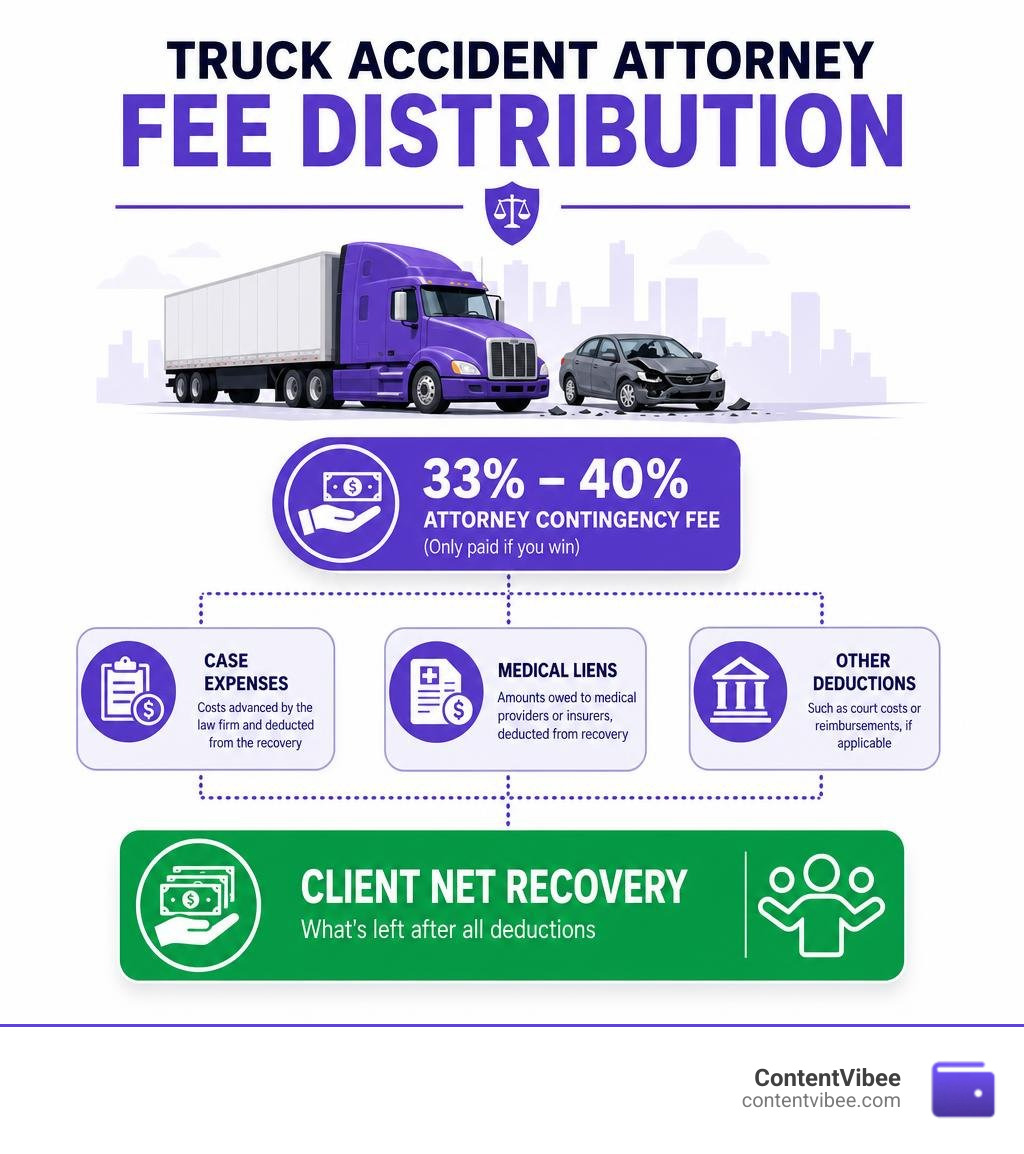
Truck accident attorney fees are almost always charged on a contingency basis — meaning you pay nothing upfront, and your lawyer only gets paid if you win.
Here’s a quick breakdown of what to expect:
| Stage | Typical Fee |
|---|---|
| Pre-litigation (settles before lawsuit) | ~33.3% of recovery |
| After lawsuit is filed | ~40% of recovery |
| Trial | 40%–45% of recovery |
| Upfront cost to hire a lawyer | $0 |
A few other key facts before we dive in:
- Case expenses (expert witnesses, black box downloads, court filing fees) are separate from attorney fees and are usually advanced by the law firm, then deducted from your settlement.
- If you lose, you typically owe no attorney fees — though your written agreement should spell out what happens to any advanced case costs.
- According to the Insurance Research Council, people who hire an attorney settle for 3.5 times more than those who handle claims on their own.
Truck accident cases are significantly more complex than standard car accident claims. They involve federal trucking regulations, multiple potentially liable parties, corporate insurance teams, and time-sensitive electronic evidence like black box data. That complexity is exactly why understanding the fee structure before you sign anything matters so much.
This guide walks you through every layer of the cost — from contingency percentages and case expenses to medical liens and fee agreement red flags — so you can make a confident, informed decision.
How Truck Accident Attorney Fees Work: Contingency Breakdown
When you are coping with severe injuries, mounting medical bills, and missed paychecks after a commercial truck crash, the last thing you can afford is a high hourly legal bill. That is why virtually all personal injury law firms handling heavy commercial vehicle claims operate on a contingency fee arrangement.
A contingency fee aligns your attorney’s financial success directly with yours. Instead of requiring a substantial cash retainer or billing you every month, the lawyer agrees to work on your case in exchange for a pre-agreed percentage of the final financial recovery. If your legal team does not recover money for you through an out-of-court settlement or jury verdict, they do not collect any attorney fee.
This zero-upfront-cost model provides crucial financial protection and equalizes the playing field against multi-billion-dollar trucking fleets and commercial insurance carriers. You can review our detailed guide on understanding contingency fee structures to see how these legal contracts operate across personal injury law.
Standard Percentages for Truck Accident Attorney Fees
While individual law firms establish their own rates, truck accident attorney fees across the legal industry generally follow predictable percentage bands based on the case’s progress:
- Pre-Litigation Settlement (33.3% to 35%): If your lawyer reaches an out-of-court settlement with the trucking company’s insurer before filing a formal lawsuit in civil court, the standard legal fee is usually one-third (33.3%) of the gross settlement amount.
- Post-Lawsuit Filing (36% to 40%): Once a legal complaint is filed with the court clerk, the workload expands dramatically. Written discovery, depositions, and motions require significant resources, pushing standard fees toward 40%.
- Trial and Appeals (40% to 45%+): If the commercial insurer refuses to offer fair compensation and your case proceeds to trial or formal arbitration, fees frequently adjust to 40%–45% to reflect the extensive preparation, courtroom hours, and heightened litigation risk.
Specific state rules and local practices also play a role. For example, regional standards and court filing structures in places like Missouri legal fee guidelines or DC truck accident fee frameworks demonstrate how regional court systems and statutory rules affect standard baseline percentages.
Gross vs. Net Recovery Calculations
One of the most critical clauses in any retainer contract is whether the attorney’s percentage is calculated against the gross recovery or the net recovery.
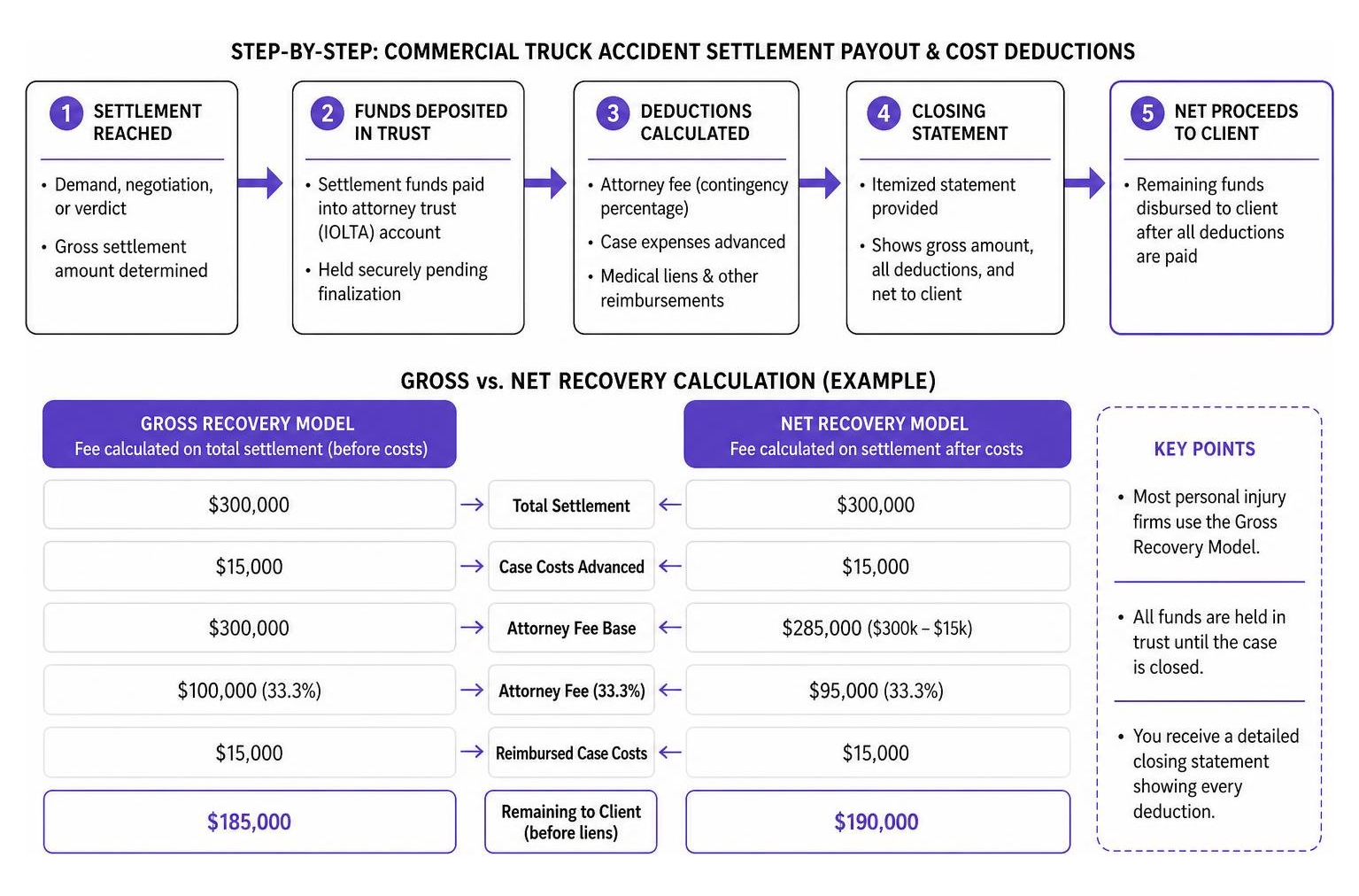
- Gross Recovery Model: The attorney calculates their percentage fee against the total settlement award before deducting out-of-pocket litigation expenses. This is the standard model used by most personal injury firms.
- Net Recovery Model: Litigation expenses are subtracted from the settlement total first, and the lawyer’s percentage is applied to the remaining balance.
Here is a side-by-side math breakdown of how both models function on a $300,000 settlement with a 33.3% contingency rate and $15,000 in advanced case costs:
| Calculation Factor | Gross Recovery Model | Net Recovery Model |
|---|---|---|
| Total Settlement | $300,000 | $300,000 |
| Case Costs Advanced | $15,000 | $15,000 |
| Attorney Fee Base | $300,000 | $285,000 ($300k – $15k) |
| Attorney Fee (33.3%) | $100,000 | $95,000 |
| Reimbursed Case Costs | $15,000 | $15,000 |
| Remaining to Client (before liens) | $185,000 | $190,000 |
All settlement funds are legally deposited into an attorney trust account (often called an IOLTA account). Your legal team then provides an itemized closing statement showing the full settlement amount, the calculated attorney fee, every reimbursed case expense, and all paid medical liens before disbursing your check.
Case Expenses vs. Legal Fees in Commercial Vehicle Litigation

It is vital to distinguish between attorney fees (the payment for your lawyer’s labor and expertise) and case expenses (the third-party costs required to build and litigate your claim). Building a successful commercial vehicle claim requires significant capital investment because trucking corporations employ aggressive defense teams from day one.
Most reputable law firms advance these case expenses on your behalf throughout the duration of the claim. You do not pay out of pocket as costs accrue; instead, the firm tracks every dollar and recovers those advanced funds directly from the final settlement or court judgment.
Advanced Expenses: Experts, ECM Downloads, and ELD Records
Commercial tractor-trailer crashes are evidence-intensive. To prove fault and establish liability against a motor carrier, attorneys must secure specialized electronic data and hire elite industry experts. The table below outlines typical line-item expenses involved in building a heavy truck crash case:
| Expense Category | Purpose & Description | Typical Cost Range |
|---|---|---|
| Black Box / ECM Download | Retrieving speed, braking, and engine data from the Electronic Control Module | $500 – $2,500 |
| ELD Log Audit | Extracting Electronic Logging Device hours-of-service history to spot fatigue violations | $1,000 – $3,500 |
| Accident Reconstruction | Engineering experts who build 3D crash simulations and analyze skid marks | $5,000 – $15,000+ |
| Medical & Biomechanical Experts | Specialists testifying on traumatic brain injury, spinal damage, and causation | $3,000 – $10,000 per expert |
| Deposition Court Reporters | Transcribing sworn testimonies of truck drivers, safety managers, and witnesses | $400 – $1,200 per deposition |
| Court Filing & Service Fees | Official civil court fees to file complaints and serve corporate summonses | $200 – $500 |
For deeper insights into how complex cases are built, see these resources on semi-truck fee structures and litigation costs and sideswipe truck accident charges.
Who Pays Investigation and Court Costs If You Lose?
A common fear for injury victims is whether they will be stuck with tens of thousands of dollars in expert witness bills if the case loses at trial.
Under a standard “no-win, no-fee” retainer contract, the law firm absorbs the loss on legal fees and waives reimbursement for advanced case expenses. In short: if there is no financial recovery, you owe nothing.
However, you must review the fine print of your retainer agreement. Some contracts include clauses holding the client personally responsible for hard out-of-pocket costs even if no settlement is achieved. Always ensure your agreement contains a explicit written clause stating that advanced case costs are fully contingent upon a successful recovery.
Factors Influencing Contingency Percentages and Alternative Fee Structures
While a 33.3% to 40% contingency range represents the national benchmark, several specific case dynamics can push a firm’s fee rate up or down.
- Multi-Party Liability: When a crash involves multiple defendants — such as the truck driver, the trucking company, the freight broker, the cargo loading team, and a third-party maintenance shop — the legal complexity rises dramatically.
- Federal Regulation Audits: Proving systemic violations of Federal Motor Carrier Safety Administration (FMCSA) regulations (such as improper driver qualification files or falsified maintenance records) requires extensive research hours.
- Severe Injury and Valuation: High-stakes catastrophic injury claims involving severe spinal cord damage or traumatic brain injury require larger financial reserves to litigate, which you can read about in our analysis of average commercial vehicle accident settlements.
Pre-Litigation vs. Trial Percentages
The single largest factor driving fee increases is whether your claim can be resolved during pre-litigation negotiations or must proceed into formal court litigation.
Filing a lawsuit instantly elevates administrative overhead, court fees, and expert witness hours. The contingency percentage steps up at specific milestone triggers defined in your agreement, such as:
- Filing the formal court complaint.
- Beginning formal depositions.
- Reaching 30 days prior to the scheduled trial date.
Comparing Hourly, Flat, and Hybrid Truck Accident Attorney Fees
Although contingency fees dominate personal injury representation, other fee models exist in broader legal practice:
- Hourly Billing ($300 – $600+/hour): The client pays for every minute spent on the case regardless of the outcome. Hourly billing is standard for corporate defense attorneys, but creates severe financial risk for injured crash victims. In fact, if a personal injury attorney asks an injured victim to pay hourly, it often indicates they lack confidence in the claim’s validity.
- Flat Fees ($500 – $2,500): A fixed rate paid upfront for a specific document review or limited contract analysis. Flat fees are virtually never used for full truck accident litigation because damage amounts and insurance pushback cannot be predicted in advance.
- Hybrid / Retainer Models: A combination of a reduced hourly rate alongside a lower contingency percentage. This approach is rarely seen in consumer injury law but can occasionally occur in commercial business disputes.
- Sliding-Scale Contingency Fees: A tiered fee structure where the lawyer’s percentage decreases as the total recovery surpasses specific thresholds (for instance, 33.3% on the first $1 million, and 25% on amounts above $1 million).
Medical Liens, Subrogation, and Calculating Your Final Payout

Many accident victims assume that after deducting attorney fees and case costs, the remaining settlement money goes straight to their bank account. However, outstanding medical debts and health insurance subrogation claims must be addressed before final funds are released.
How Medical Providers and Health Insurers Impact Net Recovery
If your health insurance carrier, Medicare, Medicaid, or a hospital system paid for your emergency care, surgery, or rehabilitation, they typically hold a legal claim — known as a medical lien or subrogation right — against your settlement proceeds.
- Health Insurance Subrogation: Private insurers (like BlueCross or UnitedHealthcare) and ERISA self-funded plan administrators have contractual rights to recover money spent on your accident-related care.
- Hospital & Provider Liens: In many states, hospitals file statutory liens against personal injury claims if your emergency medical bills remain unpaid.
- Government Claims (Medicare/Medicaid): Federal and state laws strictly enforce reimbursement for government benefits issued as a result of third-party negligence.
To understand how medical expenses and liability play into claim values, try using our interactive tool for estimating settlement amounts.
Negotiating Liens to Maximize Your Take-Home Settlement
One of the most valuable, underrated services a skilled attorney provides is negotiating medical liens down after a settlement is reached.
Under legal principles like the Made Whole Doctrine and common fund doctrine principles, healthcare providers and health plans often agree to reduce their repayment demands. For example, if an attorney negotiates a $50,000 medical lien down to $28,000, that $22,000 difference goes straight into your pocket as additional net recovery. Effective lien reduction directly offsets a major portion of the legal fees charged for representation.
Evaluating Fee Agreements and Comparing Truck vs. Car Accident Claims
Before you sign a client service agreement, review the contract terms thoroughly. The American Bar Association (ABA) Model Rules of Professional Conduct mandate that all contingency fee agreements must be put in writing, explicitly outlining fee percentages, expense policies, and deduction timing.
You can also read our expert guide on evaluating top tractor trailer attorneys to learn how to vet potential counsel.
Red Flags and Hidden Costs in Fee Agreements
When reviewing a contract, watch out for these red flags:
- Vague Cost Provisions: Contracts that do not specify whether case costs are waived if the claim is unsuccessful.
- Unusual Administrative Surcharges: Charging high arbitrary flat fees for routine in-house photocopying, internal postage, or general office overhead instead of actual third-party vendor expenses.
- Premature Fee Step-Ups: Agreements where the contingency fee increases from 33.3% to 40% merely upon sending an initial demand letter rather than filing a formal court lawsuit.
- Refusal to Provide Expense Summaries: A firm that refuses to provide periodic itemized statements of advanced costs throughout litigation.
Why Truck Wreck Claims Cost More Than Standard Auto Claims
Commercial truck collisions cost significantly more to investigate and litigate than standard passenger car accidents. The table below illustrates key differences:
| Parameter | Standard Passenger Car Claim | Commercial Truck Wreck Claim |
|---|---|---|
| Typical Policy Limits | $25,000 – $100,000 standard auto policy | $750,000 – $5,000,000+ federal freight mandate |
| Potentially Liable Parties | Single driver | Driver, motor carrier, broker, shipper, maintenance shop |
| Regulatory Scope | Local traffic laws | State traffic laws + complex federal FMCSA regulations |
| Electronic Evidence | Basic dashcam / cell phone records | ECM black box data, ELD logs, Qualcomm telematics, video |
| Investigation Expenses | $500 – $2,500 average | $10,000 – $50,000+ average |
| Defense Opponents | Local insurance claims adjuster | Corporate rapid-response teams & specialized defense counsel |
If you are currently evaluating representation options after a major commercial vehicle crash, read our deep-dive guide on finding the right big truck lawyer.
Frequently Asked Questions about Commercial Truck Legal Fees
Can I negotiate the contingency fee percentage with a truck accident lawyer?
Yes, contingency fee percentages are legally negotiable. However, experienced attorneys who specialize in commercial trucking claims rarely discount their standard percentages unless specific conditions exist — such as crystal-clear corporate liability, massive commercial insurance coverage, or extremely high catastrophic damages where a settlement is virtually guaranteed.
What happens if my case goes to trial instead of settling?
If your case proceeds to a jury trial, your attorney’s contingency fee percentage will likely increase (typically from 33.3% to 40% or 45%) as outlined in your fee agreement. Additionally, third-party case expenses will rise significantly to cover trial expert witness testimony, jury presentation graphics, court reporter fees, and trial exhibit creation.
Is hiring a commercial truck accident lawyer worth the fees involved?
Data consistently shows that hiring experienced counsel delivers a strong return on investment. The Insurance Research Council found that attorney-represented claimants receive 3.5 times higher payouts on average than unrepresented individuals handling claims alone. Commercial insurers employ teams of adjusters and attorneys whose primary goal is minimizing settlement payouts. A qualified attorney protects critical electronic evidence before it gets overwritten, uncovers hidden commercial insurance layers, and negotiates down medical debts to maximize your net recovery.
Conclusion
Navigating the financial stress following a major commercial truck crash can feel overwhelming, but understanding truck accident attorney fees empowers you to take control of your recovery. With a clear grasp of how contingency percentages operate, how case expenses are advanced, and how medical liens affect your bottom line, you can enter free legal consultations with confidence.
At ContentVibee, we provide comprehensive financial calculators, legal guides, and consumer resources to help crash victims make smart financial and legal decisions. Always ensure your legal contract is transparent, in writing, and structured so that your lawyer’s interests are perfectly aligned with yours.
Ready to take the next step in securing proper legal representation for a commercial truck injury claim? Read our comprehensive blueprint: The Ultimate Guide to Finding an 18 Wheeler Injury Lawyer Before It’s Too Late.