Spousal Benefits 101: How to Get Your Fair Share

Why Spousal Benefits Could Be Worth Thousands in Retirement
Spousal benefits are one of the most underused tools in Social Security — and one of the most valuable for couples where one partner earned significantly less (or nothing at all).
Here’s the short version of what you need to know:
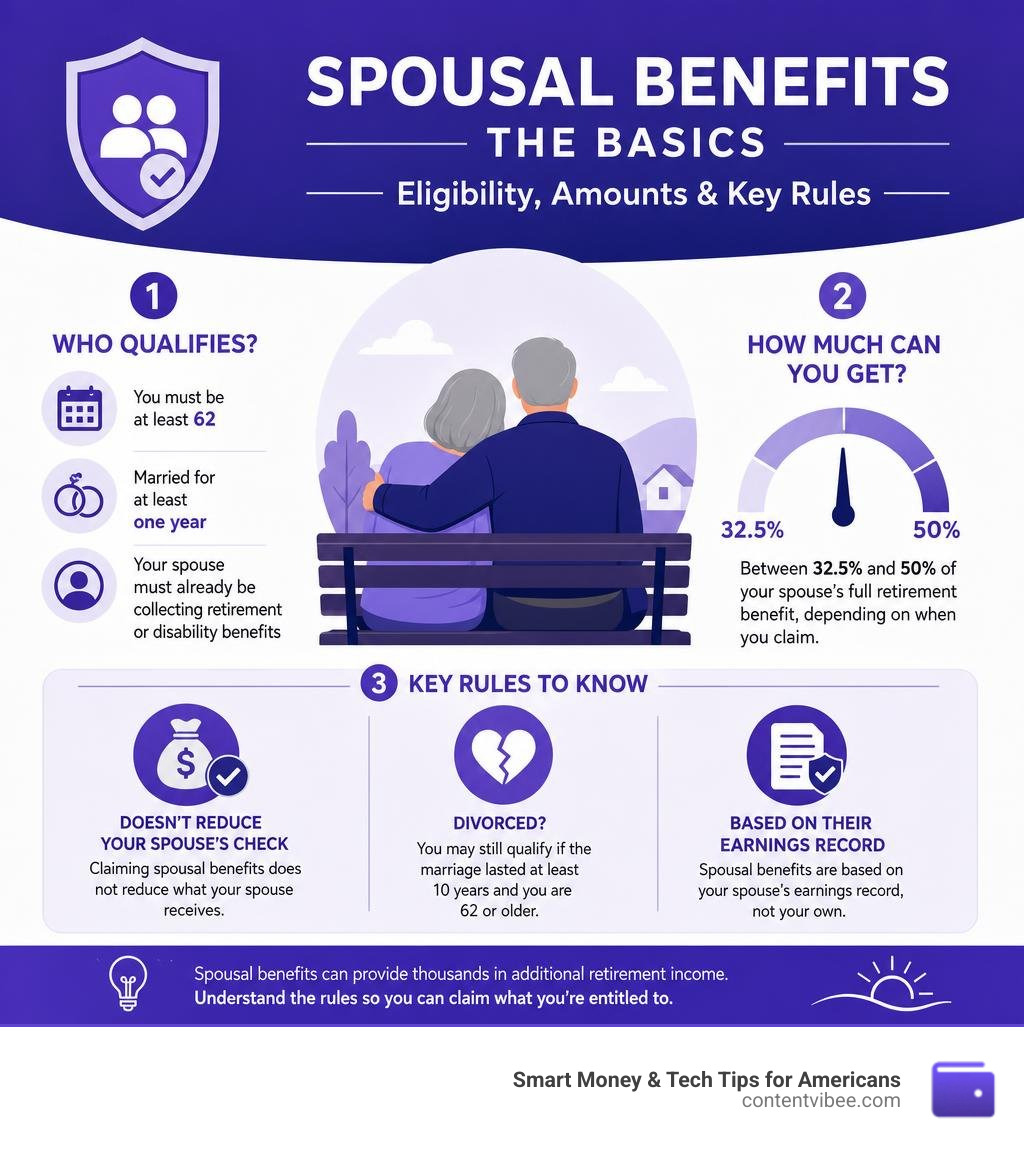
- What they are: Monthly Social Security payments based on your spouse’s earnings record, not your own
- Who qualifies: You must be at least 62, married for at least one year, and your spouse must already be collecting retirement or disability benefits
- How much you can get: Between 32.5% and 50% of your spouse’s full retirement benefit, depending on when you claim
- Does it affect your spouse’s check? No — claiming spousal benefits does not reduce what your spouse receives
- Divorced? You may still qualify if the marriage lasted at least 10 years and you are 62 or older
Many people approaching retirement don’t realize this benefit exists — or they assume it only applies in rare situations. In reality, millions of Americans leave significant money on the table simply because they don’t understand how spousal benefits work or when to claim them.
This guide breaks it all down in plain language, so you can make a confident, informed decision about your retirement income.
Understanding Spousal Benefits: Who Qualifies and How It Works
At Suppremo, we believe that navigating the complexities of federal programs shouldn’t feel like deciphering ancient hieroglyphics. When it comes to Social Security, the system is designed to provide financial security not just for individual workers, but for their households as well. This is where spousal benefits come into play.
Essentially, if you are married to someone who has paid into the Social Security system, you may be eligible to receive monthly payments based on their work history. This is particularly beneficial if you took time out of the workforce to care for family, worked in a lower-paying industry, or had a non-traditional career path. To understand the foundational rules, you can read our comprehensive guide on How To Understand Spousal Benefit Eligibility.
The legal framework for these rules is officially outlined in the SSA Handbook § 305, which details the exact criteria a spouse must meet to claim these auxiliary payments.
Eligibility Requirements for Married Partners
To qualify for a spousal benefit under the Social Security Administration (SSA) guidelines, there are several key requirements you must meet:
- Age: You must be at least 62 years old to claim retirement-based spousal benefits, unless you qualify under the “child-in-care” exception.
- The “Child-in-Care” Exception: If you are caring for a child who is under age 16 or disabled, and that child is entitled to benefits on your spouse’s record, you can claim spousal benefits at any age without an early retirement reduction.
- Marriage Duration: You must have been continuously married to your spouse for at least one full year before filing your application.
- Spouse’s Status: Your spouse must already be entitled to and receiving their own retirement or disability benefits. You cannot claim a spousal benefit on a record that is not yet active.
The SSA recognizes both “legal” and “deemed” spouses. A legal spouse is married under the laws of the state where the primary worker lives. A deemed spouse is someone who went through a marriage ceremony in good faith that would have been valid if not for a legal impediment (such as an administrative error in a prior divorce).
These strict legal definitions and alternative paths to qualifying are thoroughly documented in the official policy guidelines under SSA – POMS: RS 00202.001 – Definitions and Requirements for Spouse Benefits – 07/24/2017.
The Impact on the Primary Earner’s Payments
One of the most common myths we encounter is the fear that claiming a spousal benefit will somehow shrink the primary earner’s monthly check. Let us put your mind at ease: it absolutely does not.
Your spousal benefit is an auxiliary payment. It is funded by the Social Security trust funds, not deducted from your partner’s account. Your husband or wife will continue to receive 100% of the benefit they earned.
Furthermore, while there is a “family maximum” rule that limits the total amount of benefits that can be paid out on a single worker’s record, the SSA calculates these limits so that the primary worker’s benefit is never reduced. To see how these household dynamics play out in real life, check out our article on How Social Security Spousal Benefits Work For Married Couples.
How Spousal Payments Are Calculated and Reduced
Calculating your potential payment starts with understanding your partner’s Primary Insurance Amount (PIA). The PIA is the monthly benefit your spouse is eligible to receive if they wait until their exact Full Retirement Age (FRA) to claim.
According to the official guidelines on Do You Qualify for Social Security Spouse’s Benefits? | Social Security Matters | SSA, the maximum spousal benefit you can receive is exactly 50% of your partner’s PIA.
However, if you claim your benefit before you reach your own Full Retirement Age, that 50% cap is permanently reduced. Here is a quick breakdown of how your claiming age affects the percentage of your spouse’s PIA you will receive (assuming a Full Retirement Age of 67):
| Your Claiming Age | Percentage of Spouse’s PIA | Reduction from the Maximum |
|---|---|---|
| 67 (Full Retirement Age) | 50.0% | 0.0% |
| 66 | 45.8% | 4.2% |
| 65 | 41.7% | 8.3% |
| 64 | 37.5% | 12.5% |
| 63 | 35.0% | 15.0% |
| 62 (Earliest Claiming Age) | 32.5% | 17.5% |
How to Calculate Your Spousal Benefits
Let’s walk through a practical example to show how this math works without making your head spin.
Suppose your spouse’s PIA at their Full Retirement Age is $2,000 per month.
- If you wait until your own Full Retirement Age (which is 67 for anyone born in 1960 or later) to claim, your maximum spousal benefit is 50% of $2,000, which equals $1,000 per month.
- If you choose to claim early at age 62, your benefit will be reduced to 32.5% of their PIA, leaving you with $650 per month.
It is important to note that your spousal benefit is always calculated based on your spouse’s Full Retirement Age benefit, even if your spouse actually claimed their own benefit early or delayed it to get extra credits. To run your own numbers easily, use our free resource: How To Calculate Your Spousal Retirement Age Easily and consult the official calculator on Benefits for Spouses.
Early Claiming Reductions and Full Retirement Age
The reductions for claiming early are calculated using a precise monthly formula set by federal law:
- For the first 36 months before your Full Retirement Age, the spousal benefit is reduced by 25/36 of one percent for each month.
- If you claim even earlier (up to an additional 24 months, starting at age 62), the benefit is further reduced by 5/12 of one percent for each additional month.
This strict reduction schedule ensures that claiming at age 62 results in a permanent floor of 32.5% of the worker’s PIA. These payment rules, rounding policies, and adjustments are legally documented under SSA – POMS: RS 00202.020 – Spouse’s Benefits – Payment – 01/20/2026.
Deemed Filing and the “Higher of the Two” Rule
You might be wondering: “Can I claim my own retirement benefit first, and then collect my spousal benefit on top of it?”
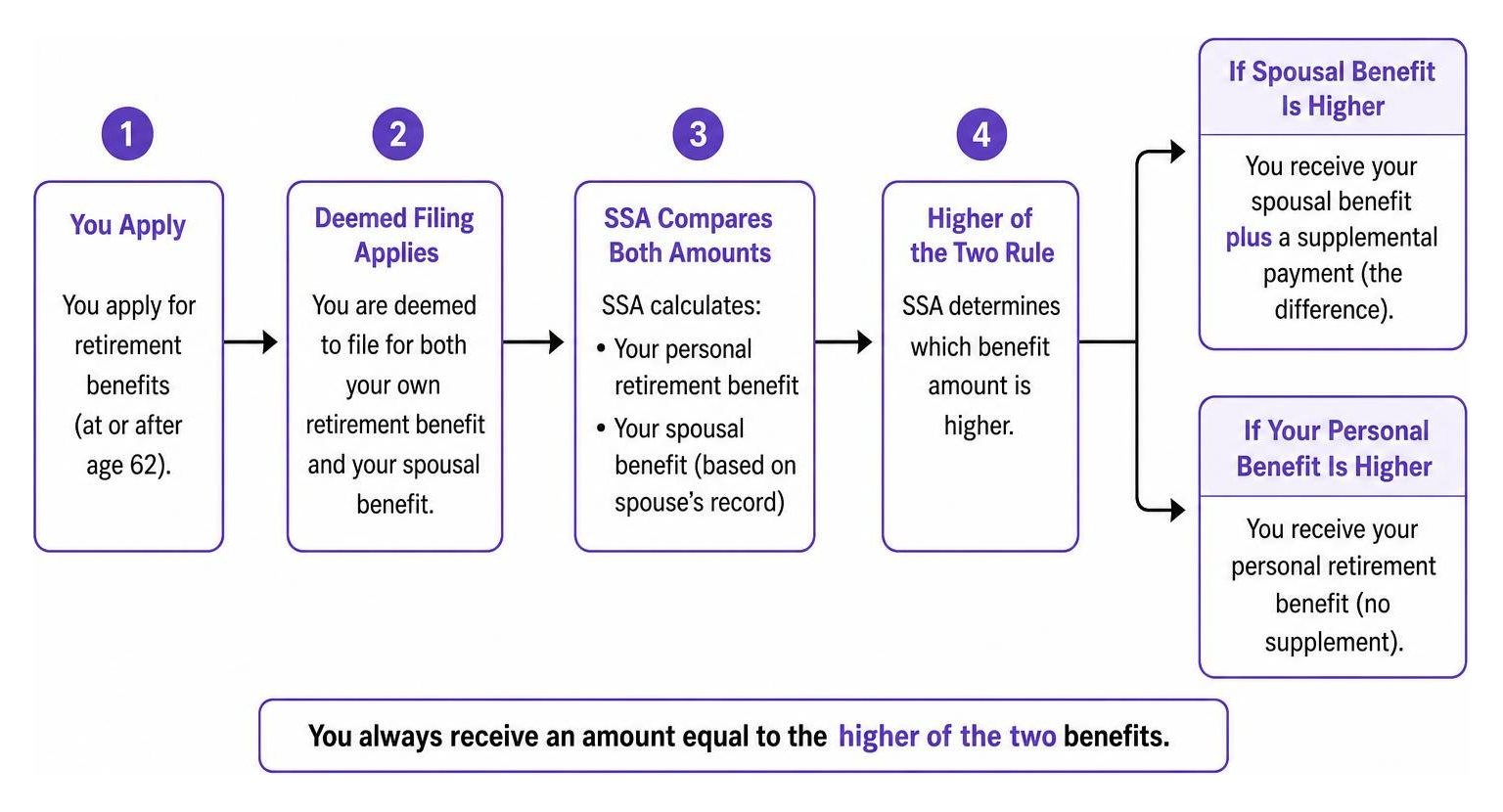
The short answer is no. Under a rule called deemed filing (which applies to anyone who turned 62 after January 2, 2016), when you apply for retirement benefits, you are “deemed” to be filing for both your own retirement benefit and your spousal benefit at the same time.
The SSA will look at both options and pay you your own retirement benefit first. If your spousal benefit is higher than your own retirement benefit, they will add a supplemental payment to make up the difference. You ultimately receive an amount equal to the higher of the two benefits.
Divorced Spousal Benefits: Rules for Ex-Spouses
Divorce can complicate many aspects of life, but it doesn’t necessarily mean you lose your right to Social Security spousal benefits. If your ex-spouse has a stronger earnings history than you do, you might still be able to claim benefits based on their record.
The best part? It won’t affect their current household benefits at all, and they don’t even have to know about it. For a deeper dive into this topic, see our guide: Can You Claim Your Exs Social Security Yes And It Wont Hurt Their Wallet.
The 10-Year Marriage Rule and Privacy Protections
To qualify for divorced spousal benefits, you must meet the following strict criteria:
- The 10-Year Rule: Your marriage to your ex-spouse must have lasted for at least 10 consecutive years before the divorce was finalized.
- Age: You must be at least 62 years old and currently unmarried.
- The 2-Year Rule: If your ex-spouse has not yet filed for their own retirement benefits, but is eligible to do so, you can still claim on their record as an “independently entitled divorced spouse”—provided you have been divorced for at least two continuous years.
Privacy is fully protected under these rules. The SSA will not notify your ex-spouse that you have filed on their record. Furthermore, an ex-spouse cannot block you from receiving these benefits through a divorce decree or prenuptial agreement. Learn more about how this works in our detailed article on How The Ten Year Marriage Rule Affects Your Divorced Spousal Benefits.
Remarriage and Switching Benefit Types
If you remarry, your eligibility to claim benefits based on your ex-spouse’s record immediately ends. However, if your subsequent marriage ends due to divorce, death, or annulment, you may regain eligibility to claim on your first ex-spouse’s record.
If your ex-spouse passes away, your divorced spousal benefit automatically converts into a survivor benefit, which can be worth up to 100% of their full benefit amount (and can be claimed as early as age 60, or age 50 if you are disabled).
Strategic Planning for Married Couples
Maximizing your household’s Social Security income is all about timing and coordination. While it can be tempting to claim benefits as soon as you turn 62, doing so can permanently reduce your monthly income.
Working with a professional or using smart strategy guides like Maximizing Spousal Benefits Without Leaving Money On The Table can help you avoid making costly mistakes.
Maximizing Spousal Benefits: Smart Strategies for Couples
A common strategy for married couples involves coordinating when each partner files:
- The Primary Earner Delays: The higher-earning spouse should consider delaying their claim as long as possible (up to age 70). This allows their personal retirement benefit to grow by 8% per year via delayed retirement credits.
- The Lower-Earning Spouse Claims: While delayed retirement credits increase the primary earner’s benefit, they do not increase the spousal benefit. Therefore, the lower-earning spouse should typically claim their spousal benefit as soon as they reach their Full Retirement Age to avoid leaving money on the table.
- Protecting the Survivor: Delaying the primary earner’s claim to age 70 also maximizes the future survivor benefit for the remaining spouse, ensuring greater financial security later in life.
How to Apply and Required Documentation
When you are ready to file for your benefits, you can apply online at the SSA website, call their toll-free number (1-800-772-1213), or schedule an in-person appointment at your local Social Security office.
To make the process as smooth as possible, make sure you have the following documents ready:
- Your birth certificate or other proof of age
- Proof of U.S. citizenship or lawful alien status
- Your marriage certificate (and divorce decrees, if applicable)
- W-2 forms or self-employment tax returns from the previous year
- Your bank routing and account numbers for direct deposit
For a step-by-step walkthrough of the filing process, check out our resource on Applying For Spousal Benefits.
Frequently Asked Questions About Spousal Benefits
Can I receive both my own retirement benefit and a spousal benefit at the same time?
No, you cannot receive both in full. Under the “dual entitlement” rules, the SSA will pay your own retirement benefit first. If your spousal benefit is higher than your own, you will receive a combination of payments that equals the higher spousal benefit amount.
Does claiming a spousal benefit reduce my partner’s monthly check?
No. Claiming a spousal benefit has absolutely no impact on your partner’s monthly retirement check. Their benefit remains 100% intact, and your auxiliary payment is paid independently.
What happens to my spousal benefit if my partner passes away?
If your spouse passes away, your spousal benefit will stop, and you will become eligible for survivor benefits. A surviving spouse can receive up to 100% of the deceased worker’s benefit. To understand the rules and eligibility requirements for widows and widowers, read Survivor Benefits 101 Can A Widow Get Her Husbands Social Security.
Conclusion
Securing your financial future requires understanding every tool in your retirement toolkit. Spousal benefits represent a vital, guaranteed income stream that can help you and your partner enjoy a comfortable, stress-free retirement.
At Suppremo, we are dedicated to bringing you the smartest retirement planning, tax strategies, and money tips to help you make informed financial decisions. Don’t leave your hard-earned money on the table. Take the first step toward optimizing your household strategy today and Calculate Your Spousal Benefits The Easy Way.