Can You Collect Social Security Disability From Your Spouse?
What You Need to Know Before Claiming Social Security Disability From Your Spouse
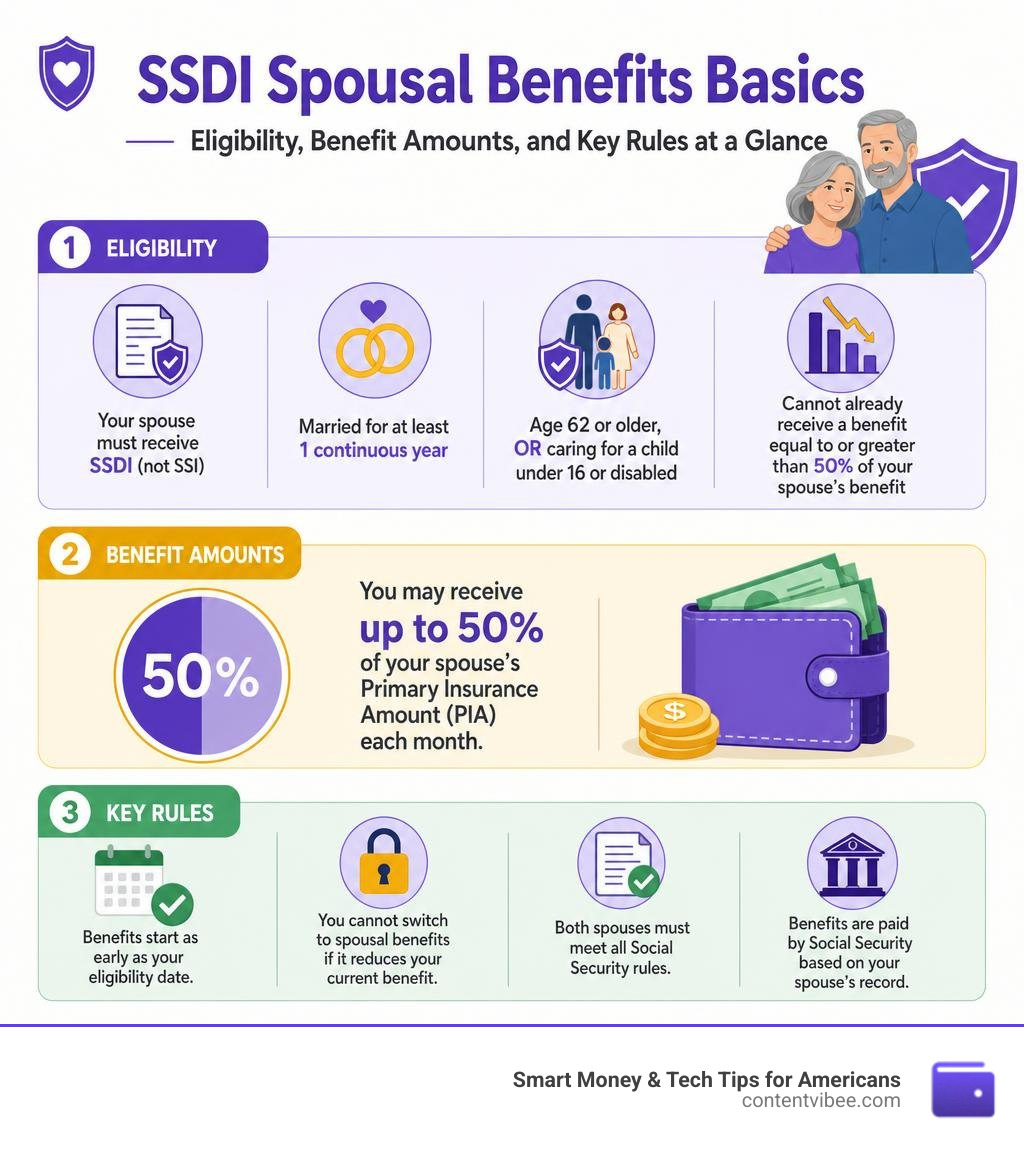
If you’ve been wondering can I draw disability off my spouse, the short answer is: yes, you likely can — as long as you meet a few key requirements.
Here’s a quick summary of who qualifies:
- Your spouse must receive SSDI (Social Security Disability Insurance) — not SSI
- You must have been married for at least 1 continuous year
- You must be age 62 or older, OR be caring for your spouse’s child who is under 16 or has a disability
- You cannot already receive a Social Security benefit equal to or greater than 50% of your spouse’s benefit
If you meet those conditions, you could receive up to 50% of your spouse’s Primary Insurance Amount (PIA) every month — even if you have little or no work history of your own.
That’s real money that many families leave on the table simply because they didn’t know it existed.
This guide walks you through exactly who qualifies, how much you can expect to receive, and how to apply — in plain language, no jargon.
Eligibility Rules: Can I Draw Disability Off My Spouse?
To determine if you can claim benefits on your partner’s record, we first have to look at the type of disability benefit your spouse receives. The Social Security Administration (SSA) manages two primary disability programs: Social Security Disability Insurance (SSDI) and Supplemental Security Income (SSI).
Spousal benefits are strictly available for spouses of SSDI recipients. Because SSDI is funded through payroll taxes, it is tied to the worker’s employment history. On the other hand, SSI is a needs-based program designed for individuals with limited income and assets; it does not offer dependent or spousal benefits.
If your partner is receiving SSDI, you may be eligible to draw a spousal benefit. According to the official SSA – POMS: RS 00202.001 – Definitions and Requirements for Spouse Benefits – 07/24/2017, a claimant must meet specific relationship criteria:
- Legal Spouse: Your marriage must be valid under the laws of the state where the primary worker resides when you file your application. You must have been married for at least one continuous year before your benefits can be approved.
- Deemed Spouse: If a legal impediment (such as an administrative error in a past divorce) technically invalidates your marriage, you may still qualify as a “deemed spouse” if you entered the marriage in good faith and are living in the same household.
For a deeper dive into these relationship requirements, you can read our comprehensive guide on How to Qualify for SSDI Spousal Benefits When Your Partner is Disabled.
Age Requirements: Can I Draw Disability Off My Spouse at Age 62?
If you do not have a qualifying child in your care, the minimum age to claim spousal benefits is 62. However, claiming early comes with a financial trade-off.
The SSA calculates your benefit based on your Full Retirement Age (FRA). For anyone born in 1960 or later, the FRA is 67. If you wait until your FRA to claim, you are entitled to the maximum spousal benefit, which is 50% of your spouse’s Primary Insurance Amount (PIA).
If you choose to file early at age 62, your monthly payment is permanently reduced. Under current rules in 2026, filing at exactly age 62 reduces your spousal benefit to 32.5% of your partner’s PIA. This reduction is permanent and will not increase when you reach your FRA.
For more details on how age impacts your eligibility, you can review the helpful resource from AARP on My Spouse Gets SSDI. Am I Eligible for Spousal Benefits?.
Caring for a Child: Can I Draw Disability Off My Spouse Under Age 62?
There is a major exception to the age 62 rule. If you are caring for a child of the disabled worker, you can collect spousal benefits at any age, and your benefit will not be reduced for early claiming.
To qualify for this “child-in-care” exception, the child must meet one of the following criteria:
- Be under the age of 16.
- Have a physical or mental disability that began before the age of 22.
Once the youngest child turns 16, the child-in-care spousal benefit will temporarily stop (or “suspend”) unless you are caring for a child who disabled before age 22. If your benefits are suspended because the child turned 16, you can apply to resume spousal benefits once you reach age 62.
How Much Can You Receive in SSDI Spousal Benefits?
Your spousal benefit is calculated using your partner’s Primary Insurance Amount (PIA) — the monthly amount they are entitled to receive at their full retirement age. The maximum spousal benefit is 50% of this amount.
It is important to note that your spousal benefit is based on your partner’s PIA, not their actual reduced or increased monthly check. If your spouse claimed their retirement benefits early, it will not reduce your spousal benefit.
To help you visualize how your claiming age affects your monthly payment, we have put together a comparison table:
| Claiming Age | Percentage of Spouse’s PIA | Permanent Reduction? |
|---|---|---|
| 67 (Full Retirement Age) | 50.0% | No |
| 66 | 45.8% | Yes |
| 65 | 41.7% | Yes |
| 64 | 37.5% | Yes |
| 63 | 35.0% | Yes |
| 62 | 32.5% | Yes |
| Any Age (with qualifying child) | 50.0% | No |
These calculations are governed by strict federal guidelines. For the exact legal framework, you can refer to the SSA – POMS: RS 00202.020 – Spouse’s Benefits – Payment – 01/20/2026.
The Family Maximum Benefit Cap
While multiple family members (such as a spouse and children) can technically qualify for benefits on a single worker’s SSDI record, there is a limit to how much the SSA will pay out to one household. This is known as the Family Maximum Benefit (FMB).
The family maximum for SSDI is generally lower than the maximum for standard retirement benefits. For disability records, the total family benefit is typically capped at 150% of the worker’s PIA.
If the total calculated benefits for the worker, spouse, and children exceed this cap, the worker’s benefit remains untouched, but the payments for all dependents are reduced proportionally to fit within the limit.
You can learn more about how these caps are applied directly from the SSA’s guide on Family benefits.
Rules for Divorced Spouses Claiming on an Ex-Partner’s Record

Many people are surprised to learn that they can collect spousal benefits based on an ex-spouse’s work history. If you are divorced, you can still ask yourself, “can I draw disability off my spouse?” and receive a “yes” — provided you meet these strict requirements:
- Length of Marriage: Your marriage to your ex-spouse must have lasted for at least 10 continuous years.
- Current Marital Status: You must be currently unmarried. If you remarried, you generally cannot claim on your ex-spouse’s record unless your subsequent marriage ended in death, divorce, or annulment.
- Age Requirement: You must be at least 62 years old.
- The Two-Year Rule: If your ex-spouse has not yet applied for their own disability or retirement benefits but is eligible for them, you can still claim on their record independently, provided you have been divorced for at least two consecutive years.
Crucially, claiming benefits on an ex-spouse’s record does not affect the benefit amount your ex-spouse receives, nor does it impact the benefits of their current spouse. Furthermore, divorced spouse benefits are entirely excluded from the Family Maximum Benefit calculation.
To understand how these rules apply after a breakup, explore our detailed guides on Divorced Spouse Benefits: What You Need to Know After the Split and Can You Claim Your Ex’s Social Security? Yes and It Won’t Hurt Their Wallet.
How Earnings and Other Benefits Affect Your Spousal Payments
If you plan to work while receiving spousal disability benefits, you must keep the SSA’s annual earnings limits in mind.
For the year 2026, the retirement earnings test limit is $24,480 (or $2,040 per month). If you are under your Full Retirement Age and earn more than this limit, the SSA will deduct $1 from your benefits for every $2 you earn above the threshold. Once you reach your Full Retirement Age, this earnings test no longer applies, and you can earn any amount without a reduction in your benefits.
Additionally, other deductions may apply. If your disabled spouse receives Worker’s Compensation or Public Disability Benefits (WC/PDB), it may offset and reduce the family’s total monthly payments.
For the complete policy on work deductions and offsets, check the SSA – POMS: RS 00202.035 – Spouse’s Benefits – Deductions – 09/15/2023 as well as Nolo’s breakdown of Dependent Benefits for Spouses of SSDI Recipients.
SSDI Spousal Benefits vs. Supplemental Security Income (SSI)
It is common to confuse SSDI spousal benefits with SSI, but they serve different purposes.
- SSDI Spousal Benefits are dependent benefits tied to a partner’s past work history and Social Security tax contributions. There are no asset limits to receive them.
- SSI (Supplemental Security Income) is a strictly needs-based program for individuals with limited income and resources. It does not look at a spouse’s work history.
In some cases, an individual may qualify for “concurrent benefits” — receiving both a small SSDI spousal benefit and a partial SSI payment. However, because SSI is highly sensitive to household income, receiving a spousal SSDI benefit will almost always reduce your SSI payment dollar-for-dollar after the first $20 of unearned income.
Step-by-Step Guide: How to Apply for Spousal Disability Benefits
Applying for spousal benefits is a straightforward process, but gathering the correct documentation beforehand will prevent processing delays.
The Application Process Flow
The application process generally follows this sequence:
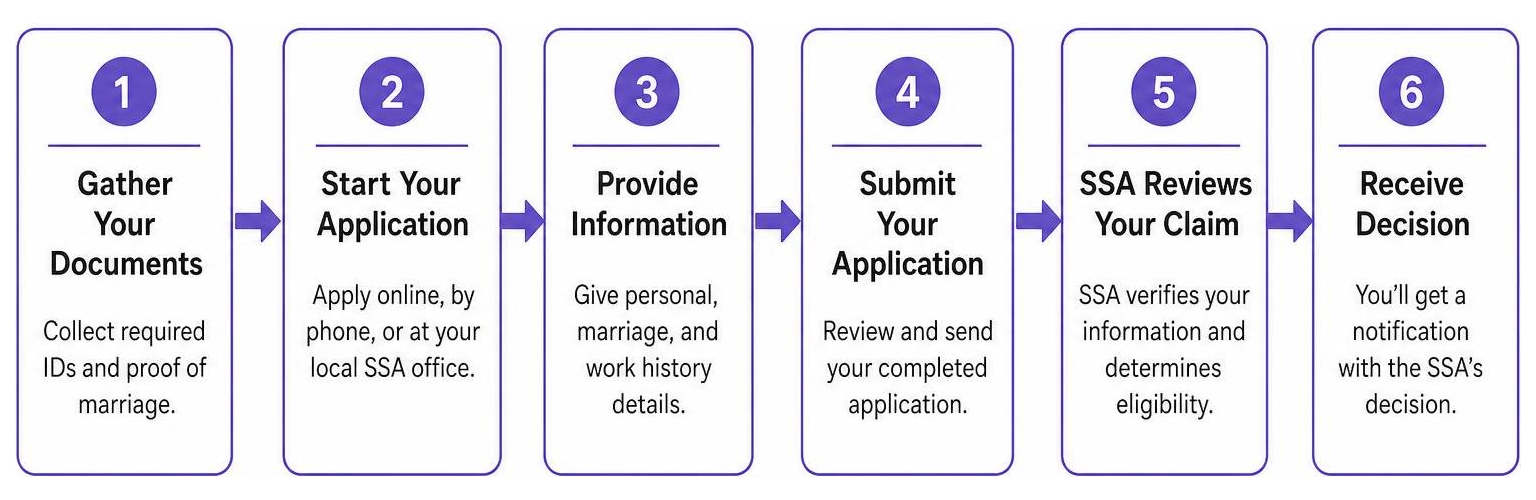
Step 1: Gather Your Documents
Before you contact the SSA, make sure you have the following information and documents ready:
- Your Social Security number and your spouse’s Social Security number.
- Your birth certificate.
- Your marriage certificate (and proof of when/how any prior marriages ended, such as divorce decrees or death certificates).
- Your recent W-2 forms or self-employment tax returns.
- Your bank account details (routing and account numbers) to set up direct deposit.
Step 2: Submit Your Application
You can submit your application in one of three ways:
- Online: Visit the official SSA website at ssa.gov to complete the application electronically.
- By Phone: Call the SSA toll-free at 1-800-772-1213 (TTY 1-800-325-0778) to speak with a representative and file over the phone.
- In Person: Visit your local Social Security office. We highly recommend calling ahead to schedule an appointment to avoid long wait times.
Frequently Asked Questions about Spousal Disability Benefits
Can I receive spousal benefits if I qualify for my own Social Security record?
The SSA does not allow you to combine or “double dip” on multiple benefits. This is known as the dual entitlement rule.
If you qualify for retirement or disability benefits on your own work record, the SSA will pay your own benefit first. If your spousal benefit is higher than your own benefit, you will receive a combination of payments that equals the higher spousal benefit amount. In short, you always receive the highest single benefit amount for which you are eligible.
What happens to my spousal disability benefits if my spouse passes away?
If your spouse passes away while receiving SSDI, your spousal benefit will end, and you will transition to survivor benefits. Survivor benefits are significantly more generous; as a surviving spouse, you can receive up to 100% of your deceased partner’s benefit amount once you reach your Full Retirement Age.
To understand how this transition works and how to protect your household income, read our guide on What You Need to Know About Spousal Survivor Benefits.
Are there special spousal benefits for disabled veterans?
Yes, the Department of Veterans Affairs (VA) offers separate programs for the spouses of disabled veterans:
- Dependency and Indemnity Compensation (DIC): A tax-free monthly survivor benefit paid to eligible survivors of veterans whose death resulted from a service-related injury or illness.
- Survivors Pension: An income-based benefit for low-income, unmarried surviving spouses of wartime veterans.
- Dependent Compensation Increases: If a veteran has a VA disability rating of 30% or higher, their monthly compensation is automatically increased to help support their spouse and dependents.
These VA programs are completely separate from the SSA and have their own distinct application processes.
Conclusion
Determining how to maximize your household income when a partner is disabled can feel overwhelming, but we are here to help you navigate these complex rules. Understanding whether you qualify to draw disability off your spouse is a critical step in securing your family’s financial future.
To get an estimate of what your household could receive, use our interactive Social Security Spousal Benefit Calculator. Keeping your records organized and understanding your claiming options will ensure you do not leave any of your hard-earned benefits behind.