The Golden Rules: Can a Spouse Collect SS Spousal Benefits?
What You Need to Know Before Claiming SS Spousal Benefits
Can a spouse collect SS spousal benefits? Yes — and for millions of Americans, this benefit is a critical piece of their retirement income puzzle.
Here is the short answer:
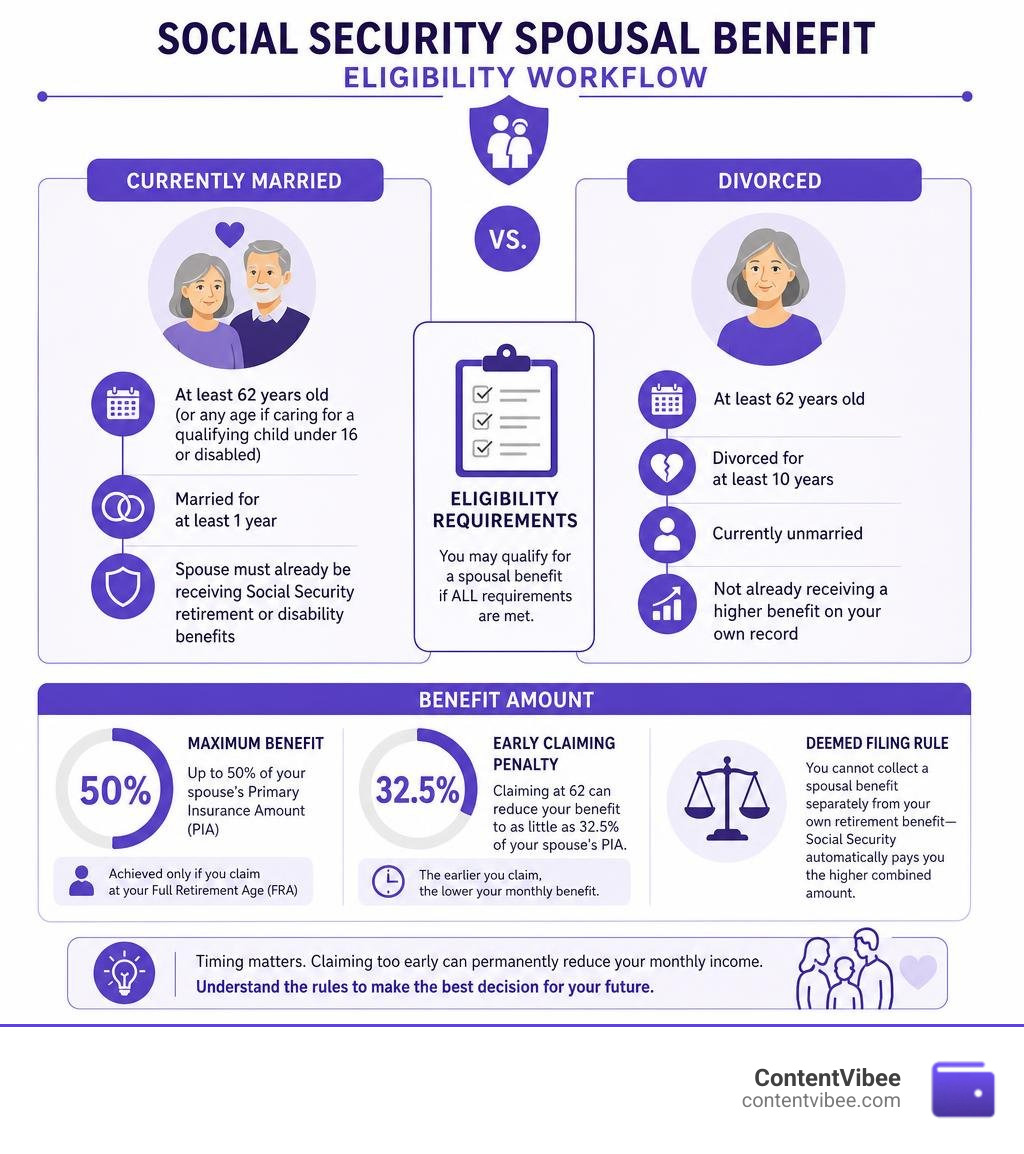
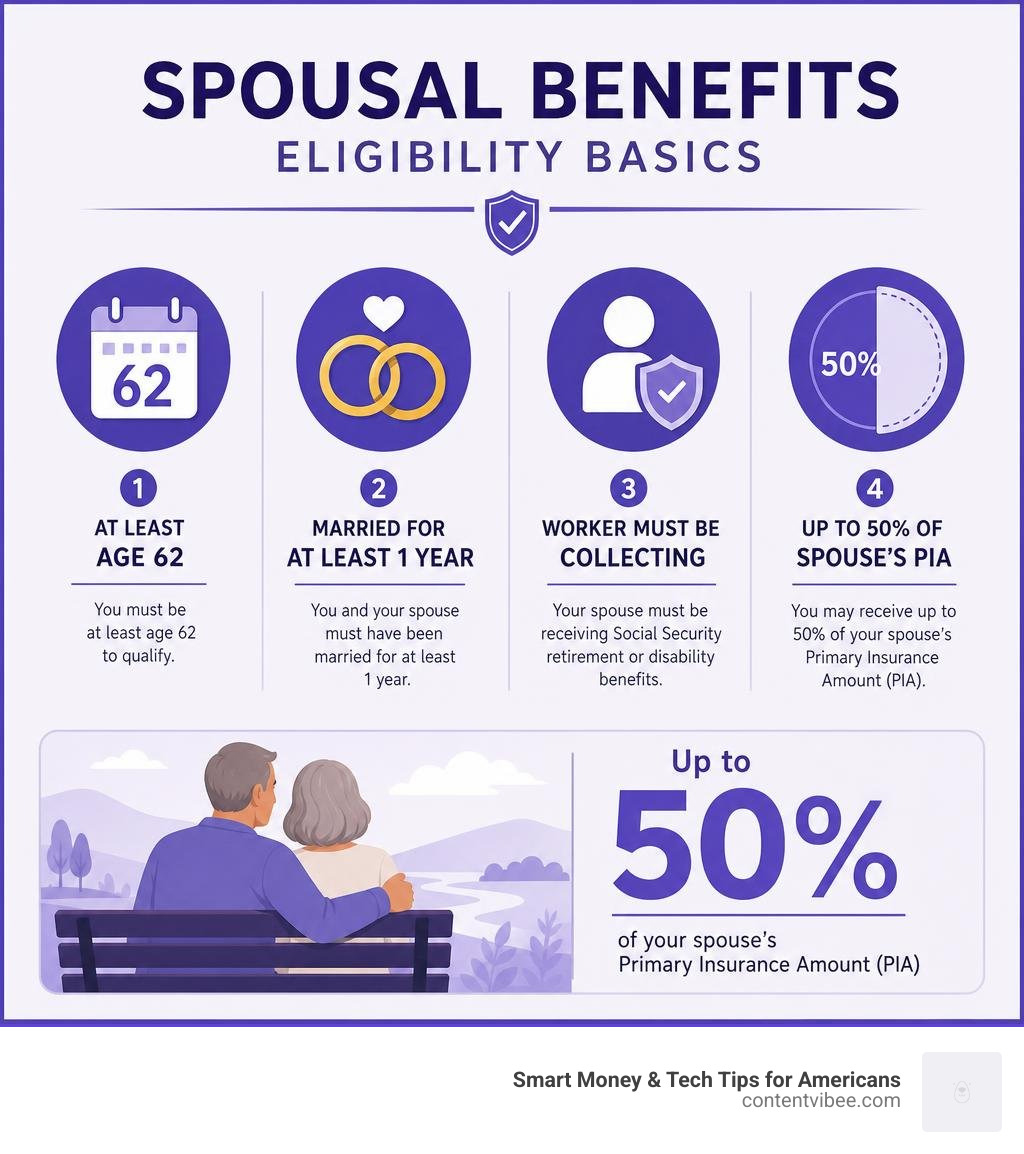
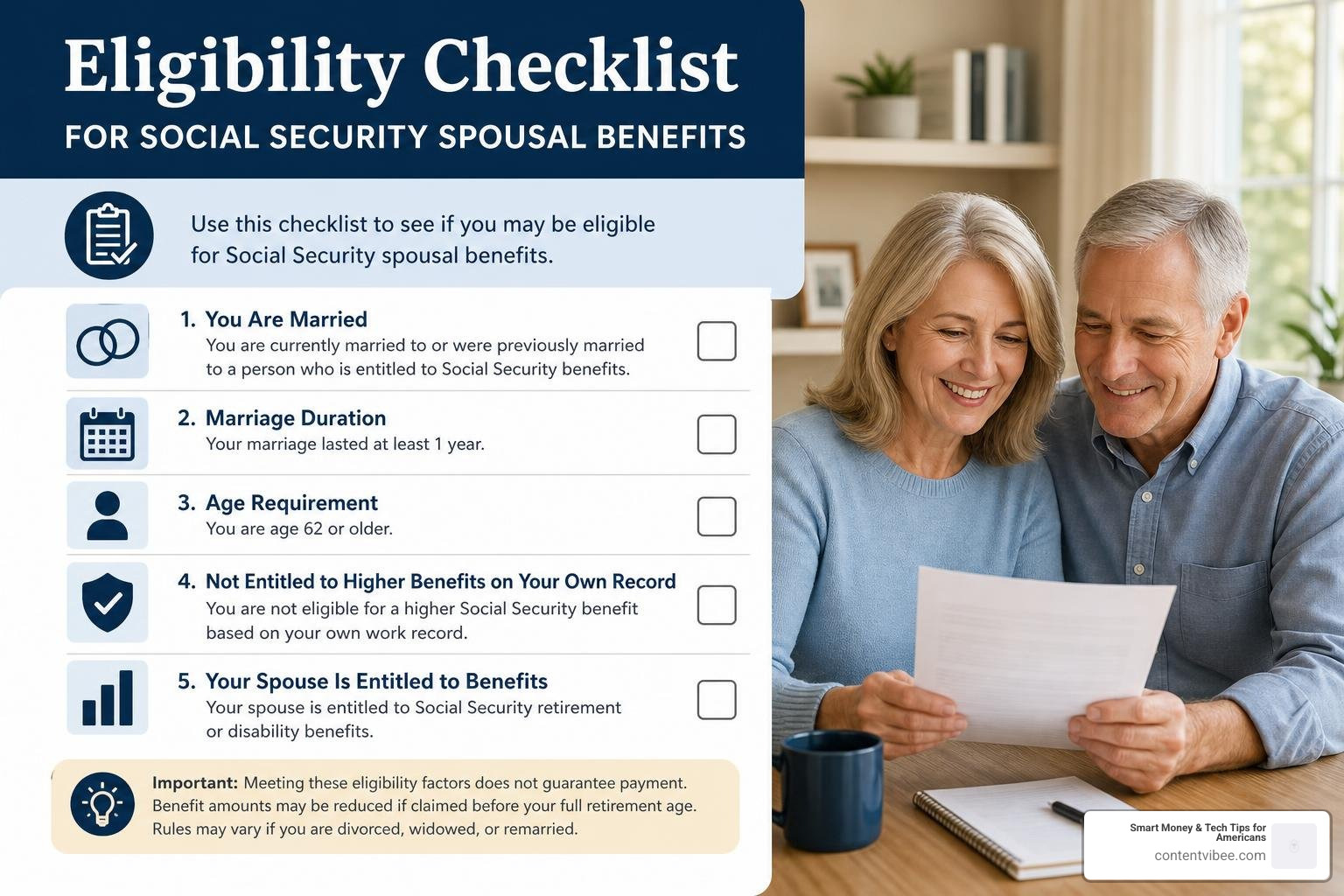
You can collect Social Security spousal benefits if:
- Your spouse is already receiving Social Security retirement or disability benefits
- You are at least age 62 (or any age if caring for a qualifying child under 16 or disabled)
- You have been married for at least 1 year
- Your own retirement benefit is less than what you would receive as a spouse
How much can you get?
| Claiming Age | Approximate % of Spouse’s Full Benefit |
|---|---|
| Full Retirement Age (66-67) | Up to 50% |
| Age 65 | ~45.8% |
| Age 64 | ~41.7% |
| Age 63 | ~37.5% |
| Age 62 | ~35% |
About 5.9 million spouses received spousal benefits as of December 2022, with an average monthly payment of $814. It is one of the most underused benefits in the Social Security system.
Whether you are married, divorced after a long marriage, or widowed, the rules are different for each situation — and getting them right can mean thousands of dollars more over your lifetime.
Eligibility Requirements: Can a Spouse Collect SS Spousal Benefits?
When we look at retirement planning, understanding who qualifies for what is half the battle. If you are asking yourself, can a spouse collect ss spousal benefits, the answer is a resounding yes—provided you meet specific criteria established by the Social Security Administration (SSA).
To build a solid financial foundation, you must first understand the baseline requirements. According to the SSA Handbook § 305, a spouse is entitled to benefits on a worker’s record if the primary worker is already entitled to retirement or disability benefits. In other words, you cannot claim a spousal benefit until your partner has actively filed for their own Social Security benefits.
Here are the core eligibility rules you need to know:
- The Age Milestone: You must be at least 62 years old to file for spousal benefits. However, claiming at 62 means accepting a permanently reduced monthly payout.
- The One-Year Marriage Rule: For currently married couples, you must be married for at least one continuous year before filing. There are exceptions to this rule, such as if you are the natural parent of the worker’s biological child or if you were entitled to certain auxiliary benefits immediately before your marriage.
- The Child-In-Care Exception: If you are under age 62, you can still collect spousal benefits if you are caring for a child of the worker. The child must be under the age of 16 or have a disability that began before age 22. In this specific scenario, your benefit is not reduced for early claiming.
- The Benefit Comparison: You cannot collect a spousal benefit that is equal to or less than your own retirement benefit. The SSA will always look at your own work record first. If your personal retirement benefit is higher than 50% of your spouse’s benefit, you will receive your own benefit instead.
For a deeper dive into these complex regulations, you can check out The Ultimate Guide to Spousal Social Security Eligibility to see how your specific situation fits into the framework.
Beyond standard legal marriages, the SSA also recognizes “deemed spouses.” If you entered into a marriage ceremony in good faith but a legal impediment (such as an administrative error or an unresolved previous divorce) made the marriage technically invalid, you may still qualify as a deemed spouse under federal policy.
How Spousal Benefits Are Calculated and Reduced
Calculating exactly how much you will receive can feel like doing high-level calculus, but we are here to break down the math into simple terms.
The maximum spousal benefit you can receive is 50% of your spouse’s Primary Insurance Amount (PIA). The PIA is the monthly amount your spouse is eligible to receive at their Full Retirement Age (FRA). It is important to note that even if your spouse delays claiming their benefits past their FRA to earn delayed retirement credits (which increase their personal payout by up to 8% per year until age 70), your spousal benefit is capped at 50% of their FRA amount. You do not get a share of those extra delayed credits.
If you decide to claim your spousal benefit before reaching your own Full Retirement Age, the SSA applies a strict reduction formula. The benefit is reduced by:
- 25/36 of 1% for each of the first 36 months before your FRA.
- 5/12 of 1% for each additional month beyond 36 months.
Let us look at how this math plays out in the real world. Imagine your spouse has a PIA of $2,000. If you wait until your FRA to claim, your maximum spousal benefit is $1,000 (50% of $2,000).
However, if your FRA is 67 and you choose to claim at age 62, you are claiming 60 months early.
- For the first 36 months, the reduction is: $36 times (25/36 times 1%) = 25%$
- For the remaining 24 months, the reduction is: $24 times (5/12 times 1%) = 10%$
- Total reduction: $25% + 10% = 35%$
Your spousal benefit is reduced by 35%, leaving you with 65% of the original $1,000 spousal benefit, which is $650. This represents exactly 32.5% of your spouse’s PIA.
To help visualize this, here is a comparison of how early claiming permanently impacts your monthly check:
| Months Early | Reduction Percentage | Percentage of Spouse’s PIA You Receive | Example Payout (Spouse PIA = $2,000) |
|---|---|---|---|
| 0 (At FRA) | 0% | 50% | $1,000 |
| 12 Months | 8.33% | 45.8% | $917 |
| 24 Months | 16.67% | 41.7% | $833 |
| 36 Months | 25.00% | 37.5% | $750 |
| 48 Months | 30.00% | 35.0% | $700 |
| 60 Months | 35.00% | 32.5% | $650 |
To run your own numbers based on your exact birth date and planned retirement month, you can utilize the official calculation tools on the Benefits for Spouses page.
Navigating Deemed Filing and Dual Entitlement

One of the most common points of confusion for couples is how their own work record interacts with their spousal benefits. Can you choose to only take your spousal benefit and let your own retirement benefit grow?
Historically, a strategy known as the “restricted application” allowed some retirees to do just that. However, that loophole has fully closed. Under the current “deemed filing” rules, when you apply for either your own retirement benefit or a spousal benefit, you are “deemed” to have applied for both simultaneously.
The SSA will look at both records and apply the dual entitlement rule. This means:
- The SSA will always pay your own retirement benefit first.
- If your spousal benefit is higher than your own retirement benefit, you will receive an additional amount on top of your own benefit to make up the difference.
- The combined total you receive will equal the higher spousal benefit amount.
You can read more about how this rule applies to your household on the official Do You Qualify for Social Security Spouse’s Benefits? | Social Security Matters | SSA page.
Under What Conditions Can a Spouse Collect SS Spousal Benefits Simultaneously with Retirement?
Simultaneous collection does not mean you get to add your full retirement check and your full spousal check together for a double payday. Instead, it functions as a top-off.
Let us look at a real-world scenario to see how this combined payment works:
Meet Sandy. Sandy is eligible for a retirement benefit of $1,000 per month based on her own work history. Her husband, Jim, has a much higher lifetime earnings record, and his PIA at Full Retirement Age is $2,500.
Because Sandy has reached her Full Retirement Age, she is eligible for a spousal benefit of up to 50% of Jim’s PIA, which is $1,250.
When Sandy files for benefits:
- The SSA first pays Sandy her own retirement benefit of $1,000.
- The SSA then calculates her “excess spousal benefit”: $1,250 (maximum spousal benefit) – $1,000 (Sandy’s own benefit) = $250.
- The SSA adds this $250 excess spousal benefit to Sandy’s $1,000 retirement benefit.
- Sandy’s final monthly check is $1,250.
If Sandy’s own retirement benefit had been $1,300, she would not receive any spousal benefit because her own work record yielded a higher payment. The SSA always ensures you get the largest single amount you are entitled to, but never both in full.
Special Rules for Divorced and Widowed Spouses
Life does not always follow a straight line, and the SSA has specific provisions for those who are divorced or widowed.
Divorced Spouses
If you are divorced, you may still be able to claim benefits on your ex-spouse’s record. To qualify, you must meet the following conditions:
- Your marriage lasted for at least 10 years.
- You are currently unmarried (if you remarry, you generally lose eligibility for benefits on your ex’s record unless the subsequent marriage ends).
- You are at least 62 years old.
- Your ex-spouse is eligible for retirement or disability benefits (even if they have not filed yet, as long as you have been divorced for at least two continuous years, you can claim independently).
Crucially, claiming benefits on an ex-spouse’s record does not impact their personal benefit amount, nor does it affect the benefit of their current spouse if they have remarried.
Widowed Spouses (Survivor Benefits)
Survivor benefits are entirely separate from living spousal benefits and follow different, more generous rules. While a living spousal benefit tops out at 50% of the worker’s PIA, a surviving spouse can receive up to 100% of the deceased worker’s benefit.
Key differences include:
- Claiming Age: Widows and widowers can claim survivor benefits as early as age 60 (or age 50 if they have a disability).
- Marriage Duration: The marriage must have lasted at least 9 months prior to the spouse’s death (with exceptions for accidental deaths or military service).
- Remarriage Rules: If you remarry after age 60 (or age 50 if disabled), your eligibility for survivor benefits on your deceased spouse’s record is unaffected.
- No Deemed Filing: Deemed filing does not apply to survivor benefits. A surviving spouse can choose to claim survivor benefits early while letting their own retirement benefit grow until age 70, or vice versa.
According to the policy guidelines outlined in SSA – POMS: RS 00202.020 – Spouse’s Benefits – Payment – 01/20/2026, payments to divorced or surviving family members are calculated carefully to ensure all statutory minimums are met without violating family maximum limits.
How to Apply: Required Documents and Steps
Applying for benefits is a straightforward process, but showing up unprepared can cause frustrating delays. The SSA requires official evidence to verify your identity, age, and relationship status.
Before you begin, make sure you have the following documents ready:
- Your Social Security card and birth certificate.
- Your spouse’s (or ex-spouse’s) Social Security number and date of birth.
- Your marriage certificate.
- Divorce decrees (if claiming as a divorced spouse) showing the start and end dates of the marriage.
- W-2 forms or self-employment tax returns for the previous year.
- U.S. citizenship papers or lawful alien registration documents if you were born outside the United States.
To make sure you do not miss a single detail during your application process, read through The Ultimate Checklist for Your Application for Spousal Benefits to keep your paperwork organized.
For more technical details on how the agency processes these records, you can refer to the official SSA – POMS: RS 00202.050 – Spouse’s Benefits – Evidence and Forms Requirements – 02/16/2006 manual.
Step-by-Step Guide: Can a Spouse Collect SS Spousal Benefits Online?
Yes, the easiest way to apply for spousal benefits is online through the official SSA portal. Here is how to complete the process:
- Create or Log In to Your Account: Go to the SSA website and access your personal my Social Security account.
- Start the Application: Select the option to apply for retirement and spousal benefits. The online system is designed to automatically check if you qualify for spousal benefits based on the partner information you enter.
- Fill Out the Information: Input your personal details, your marriage history, and your spouse’s information.
- Submit Digital Documents: In many cases, the SSA can verify your records electronically. If physical documents are required (such as an original marriage certificate), the system will print a receipt with instructions on how to mail them or drop them off at your local office.
- Review and Submit: Double-check your effective filing month, sign the digital application, and submit.
If you prefer not to apply online, you can call the SSA toll-free at 1-800-772-1213 to schedule an appointment to apply over the phone or in person at your local Social Security office.
Frequently Asked Questions about Spousal Benefits
Navigating federal systems always raises a few extra questions. Here are the answers to some of the most common queries we receive.
Does claiming spousal benefits reduce the worker’s own benefit?
No. When you claim a spousal benefit based on your partner’s record, it has absolutely no impact on their monthly payout. They will still receive their full retirement or disability benefit. Additionally, benefits paid to a divorced spouse do not impact the family maximum or reduce the amount payable to a current spouse.
Can same-sex spouses collect spousal benefits?
Yes. The SSA recognizes same-sex marriages for all benefit determinations. As long as your marriage was legally performed in any U.S. state or foreign jurisdiction that recognizes same-sex marriage, you have the exact same rights and eligibility requirements as any other spouse. You can review the official definitions in the policy manual SSA – POMS: RS 00202.001 – Definitions and Requirements for Spouse Benefits – 07/24/2017.
How does working while receiving spousal benefits affect payments?
If you choose to work while receiving spousal benefits and you are under your Full Retirement Age, your benefits may be subject to the Retirement Earnings Test.
Under this test, if your earnings exceed a specific annual limit, the SSA will temporarily withhold a portion of your benefit:
- The SSA deducts $1 from your benefits for every $2 you earn above the annual limit.
- In the year you reach your FRA, a higher limit applies, and the SSA deducts $1 for every $3 you earn above the limit up until the month you reach FRA.
- Once you reach Full Retirement Age, there is no limit on your earnings, and the SSA will recalculate your monthly benefit upward to account for the payments that were withheld.
Conclusion
At Smart Money & Tech Tips for Americans, we believe that securing your financial future requires a mix of smart planning, timely action, and utilizing every resource available to you. Understanding whether can a spouse collect ss spousal benefits and knowing how to coordinate your claiming strategies can add substantial security to your golden years.
By coordinating your filing dates, comparing your individual records, and keeping your documents organized, you can maximize your household retirement income. If you are still exploring your options, make sure to read our detailed guide on what is a social security spousal benefit to ensure you are making the best decisions for your financial future.