The Truth About Lawyer Fees and What Percentage They Actually Take

The Truth About What You Actually Keep From a Personal Injury Settlement
What percentage does a lawyer take from a settlement is one of the most important questions you can ask before signing anything with an attorney — and the short answer is: typically between 33% and 40%.
Here’s a quick breakdown so you have the numbers right away:
| Case Stage | Typical Attorney Fee |
|---|---|
| Pre-lawsuit settlement | ~33% (one-third) |
| After lawsuit is filed | ~36–38% |
| Case goes to trial | ~40% |
| Appeal | ~40–45% |
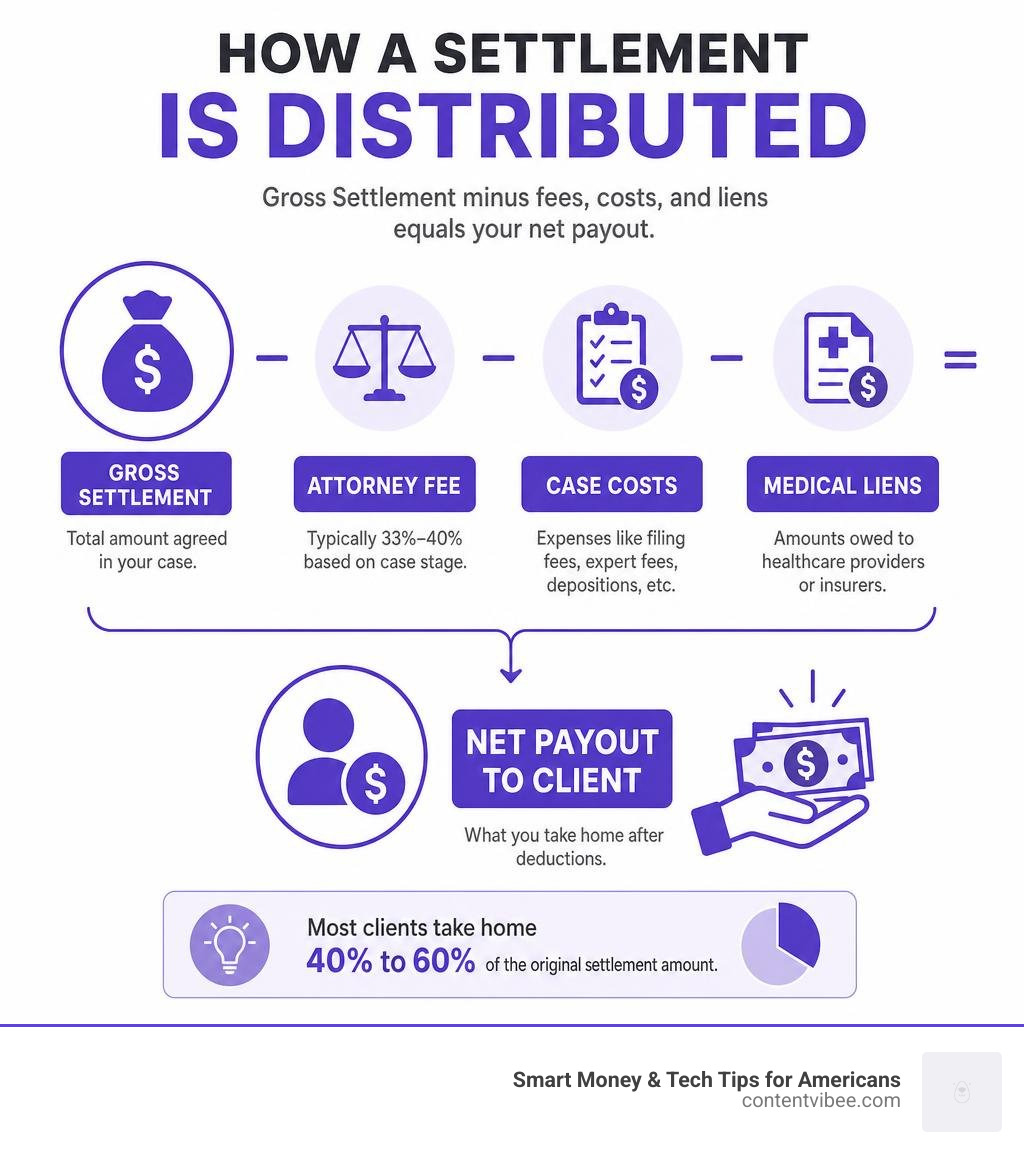
But the attorney’s percentage is only part of the story. After fees, case expenses, and medical liens are deducted, most clients end up taking home 40% to 60% of the original settlement amount.
For example, on a $100,000 settlement:
- Attorney fee (33%): ~$33,000
- Case expenses: ~$5,000–$15,000
- Medical liens: varies
- You receive: roughly $50,000–$65,000
This guide breaks down exactly how lawyer fees work, what drives the percentage up or down, and how to make sure you’re getting the best deal possible before you sign a fee agreement.
What percentage does a lawyer take from a settlement further reading:
- is it worth hiring an attorney for a car accident
- motorcycle accident lawyer
- truck accident lawyer florida
What Percentage Does a Lawyer Take From a Settlement?

When you are hurt in an accident, the last thing you want to worry about is how you are going to pay a lawyer by the hour just to get the insurance company to pay attention to you. Fortunately, the legal system has a built-in mechanism that allows everyday Americans to secure high-quality representation without paying a single dollar out of pocket.
According to a comprehensive What Percentage Does a Lawyer Take From a Settlement? Guide, the vast majority of consumer-facing civil attorneys utilize a contingency fee model. This means their pay is directly tied to the success of your claim. If they do not recover money for you, they do not get paid an attorney fee.
In the United States, the standard percentage a lawyer takes from a settlement typically hovers right around 33% to 40%. This percentage is not just a random number; it represents a balanced industry standard that aligns your attorney’s financial incentives directly with yours. The more money they recover for you, the more money they make for their firm.
The Standard Contingency Fee Structure
Under a standard contingency fee agreement, the attorney agrees to handle your case in exchange for a specified percentage of the final recovery. This arrangement acts as a massive “risk premium” for the law firm. Because the attorney is taking on the risk of working dozens or hundreds of hours on a case that might ultimately yield zero payout, the percentage is set to compensate for that risk.
This “no win, no fee” approach is the great equalizer in the American civil justice system. It allows an injured individual to go toe-to-toe with multi-billion-dollar insurance corporations that employ armies of hourly defense lawyers. If you want to dive deeper into how to navigate these relationships, check out our personal injury lawyer tips guide.
How Case Stages Affect What Percentage Does a Lawyer Take From a Settlement
The percentage your attorney takes is rarely set in stone for the entire life of a case. Most contingency fee agreements feature a “sliding scale” or tiered structure based on how far the case progresses.
Why does this happen? Because as a case moves through different procedural stages, the amount of work, stress, and firm resources required increases exponentially.
| Case Stage | Typical Percentage Range | Why the Fee Changes |
|---|---|---|
| Pre-Litigation | 33% to 33⅓% | The case is resolved through negotiation with the insurance adjuster before any formal lawsuit is filed in court. |
| Lawsuit Filed (Litigation) | 35% to 38% | The attorney must draft, file, and serve a formal complaint, initiate the discovery process, and attend depositions. |
| Trial Verdict | 40% | The attorney must prepare exhibits, select a jury, hire expert witnesses to testify, and spend days or weeks in a courtroom. |
| Appeals | 45% or more | Post-judgment motions and writing appellate briefs require highly specialized legal research and writing. |
As you can see, if your attorney can settle your case early on with a few phone calls and a solid demand letter, they will take a lower percentage. However, if the insurance company digs its heels in and forces your legal team to prepare for a full-blown courtroom battle, the percentage will rise to cover those extensive litigation hours. To learn more about whether this process is worth it for your specific situation, read our guide on to hire or not to hire when a car accident lawyer is actually worth it.
Factors That Influence the Attorney Fee Percentage

While the 33% to 40% range is the national benchmark, several key factors can push your attorney’s actual fee percentage higher or lower. Understanding these variables can help you evaluate whether the fee you are being quoted is fair.
- The Complexity of the Case: Straightforward rear-end car accidents with clear liability are relatively simple to resolve. On the other hand, medical malpractice, product liability, and commercial trucking accidents are highly complex, require massive upfront investments, and carry a higher risk of loss.
- Attorney Experience and Reputation: A highly sought-after trial attorney with a track record of multi-million-dollar verdicts may demand a higher contingency fee (such as a flat 40% from day one) compared to a newly minted solo practitioner who might agree to 30% to win your business.
- State Laws and Ethical Rules: Many states have strict legal limits on how much an attorney can charge in certain types of cases or at different stages of litigation.
State Laws and Ethical Rules Governing Fees
Different states have varying approaches to regulating what attorneys can charge. For example, the Florida Bar sets strict, tiered contingency fee maximums depending on the stage of the case and the total amount recovered. If a Florida case settles before the defendant files an answer to the lawsuit, the fee is capped at 33⅓% of any recovery up to $1 million, 30% of any portion between $1 million and $2 million, and 20% of any portion exceeding $2 million. If the case goes to court, those caps rise to 40% of the first $1 million.
In Nevada, rules like Rule 1.5 require all attorney fees to be reasonable, and the state caps medical malpractice contingency fees at 35% of the net recovery.
Meanwhile, California has its own set of rules, particularly regarding medical malpractice claims, which use a strict sliding scale starting at 40% for the first $50,000 recovered and decreasing as the settlement amount grows. If you are filing a claim in the Golden State, it is highly recommended to read a detailed breakdown of What Percentage Do Lawyers Take From Settlements in CA? to understand how these local regulations protect your payout.
Case Complexity and Negotiation Options
Can you actually negotiate the percentage your lawyer takes? Yes! While many attorneys present their standard retainer agreements as non-negotiable, you have the right to ask for a lower rate, especially if:
- Liability is absolutely clear (e.g., you were hit by a drunk driver who was arrested at the scene).
- The defendant has a massive insurance policy that will easily cover your damages.
- You have already gathered all the medical records and police reports yourself, saving the law firm initial legwork.
In these scenarios, you might negotiate a tiered structure (e.g., 25% if settled within 60 days, rising to 33% if it takes longer) or even a hybrid fee arrangement that combines a small hourly rate with a vastly reduced contingency percentage. For a deeper look at how these alternative fee arrangements function, check out What Is a Contingent Fee and How Does It Work? – LegalClarity.
How Settlement Payouts Are Calculated: Gross vs. Net
One of the most common points of confusion for personal injury clients is the difference between a gross calculation and a net calculation. This single distinction can change your final take-home payout by thousands of dollars.
To see how these calculations play out in real time, you can play around with a Settlement Payment Calculator: Net After Fees | Settlement Insight, but we will break down the core mechanics below.
Understanding Gross vs. Net Fee Calculations
When an attorney calculates their fee, they will do so using one of two methods:
- The Gross Settlement Method (Most Common): The attorney’s contingency percentage is applied directly to the total settlement amount before any case expenses, court costs, or medical bills are deducted.
- The Net Settlement Method (Client-Friendly): Case expenses are deducted from the total settlement amount first. The attorney’s contingency percentage is then calculated based on the remaining balance.
Let’s look at how this plays out with a $100,000 settlement where the attorney’s fee is 33.3% and case expenses total $10,000:
-
Under the Gross Method:
- Gross Settlement: $100,000
- Attorney Fee (33.3% of $100,000): $33,333
- Case Expenses: $10,000
- Remaining for Client (before medical liens): $56,667
-
Under the Net Method:
- Gross Settlement: $100,000
- Case Expenses: -$10,000
- Net Amount: $90,000
- Attorney Fee (33.3% of $90,000): $30,000
- Remaining for Client (before medical liens): $60,000
By ensuring your retainer agreement specifies the Net Method, you keep an extra $3,333 in your pocket. Always read the fine print of your retainer agreement to see which method your attorney uses!
Real Math: What Percentage Does a Lawyer Take From a Settlement in Practice
To give you a realistic look at how the “settlement waterfall” actually flows, let’s review a real-world case breakdown. If you want to see how this math scales across different tiers, including minor soft-tissue cases at $30,000 all the way up to catastrophic commercial truck accidents at $1,000,000, read this detailed guide on How Much Do I Actually Take Home From a Personal Injury Settlement in California? Real Math at $30K, $100K, $250K, and $1M.
Let’s look at a typical $100,000 settlement for a moderate injury case (such as a disc herniation without surgery):
- Gross Settlement: $100,000
- Attorney Fee (33.3% pre-litigation): -$33,333
- Advanced Case Costs (Filing fees, medical records): -$2,500
- Negotiated Medical Liens (What you owe health insurance/doctors): -$15,000
- Net Take-Home to Client: $49,167 (49.1% of the gross settlement)
While keeping roughly half of your settlement might sound frustrating at first glance, research consistently shows that claimants who hire an attorney recover an average of 3 to 3.5 times more than those who go it alone.
If you settled a case by yourself for $15,000, you might keep 100% of it. But if a lawyer can negotiate that same claim up to $100,000, your 49% take-home of $49,167 is vastly superior to the $15,000 you would have received on your own!
Additional Costs and Deductions From Your Settlement
As demonstrated in the math above, your attorney’s fees are only one slice of the pie. There are several other out-of-pocket expenses that must be settled before you receive your final check.
Litigation Expenses and Court Costs
To build a strong case, your lawyer has to spend money upfront. In a standard contingency agreement, the law firm will “advance” these costs so you don’t have to pay them out of pocket. These expenses are separate from the lawyer’s fee and include:
- Court Filing Fees: Typically $100 to $500 to formally start a lawsuit.
- Process Servers: $20 to $100 to hand-deliver legal papers to the defendant.
- Deposition Transcripts: Court reporters charge $2 to $7.50 per page, which can easily total thousands of dollars for a single case.
- Expert Witnesses: Medical specialists, accident reconstructionists, and economic life-care planners can charge anywhere from $2,000 to $10,000+ to provide professional analysis and testimony.
Medical Liens and Health Insurance Subrogation
If you used private health insurance, Medicare, or Medicaid to pay for your medical treatments after an accident, those entities have a legal right to be reimbursed from your settlement. This process is known as subrogation.
Additionally, some doctors may treat you on a “medical lien” basis, meaning they agree to treat you for free upfront in exchange for a guaranteed payment directly from your future settlement.
One of the highest-leverage activities a skilled personal injury attorney performs is negotiating these liens down. A good lawyer can often negotiate private health insurance liens down by 30% to 70%, and Medicare liens by 20% to 50%. This directly increases the final net amount that lands in your bank account.
Frequently Asked Questions About Lawyer Settlement Fees
Can you negotiate a lawyer’s contingency fee percentage?
Yes, you can absolutely negotiate. While highly experienced attorneys in high-demand firms may refuse to lower their rates, many lawyers are open to negotiating a lower percentage (such as 25% to 30%) if your case is highly straightforward, liability is clear, or the potential payout is exceptionally large.
What happens to attorney fees if the case is lost?
Under a standard “no win, no fee” contingency agreement, if your case is lost or dismissed, you owe your attorney zero dollars in attorney fees. However, you must carefully read your contract to see how advanced case costs are handled. Most reputable personal injury firms will waive these costs if they lose, but some contracts state that the client is still responsible for reimbursing the firm for court costs and expert fees.
How long does it take to receive a settlement check?
Once a settlement is agreed upon, it typically takes 30 to 60 days for the final check to arrive in your hands. The insurance company sends the gross settlement check directly to your attorney’s Interest on Lawyers’ Trust Account (IOLTA). The bank usually takes 3 to 10 business days to clear the funds. From there, your attorney must resolve all outstanding medical liens and prepare a formal “disbursement sheet” showing every deduction before releasing your net check.
Conclusion
Navigating the financial realities of a legal claim can feel overwhelming, but understanding what percentage does a lawyer take from a settlement is the first step toward protecting your financial future. By knowing the standard rates, identifying the difference between gross and net calculations, and understanding how medical liens impact your final payout, you can step into your attorney’s office as an informed consumer.
At Smart Money & Tech Tips for Americans, we believe that financial literacy is your greatest asset. If you are preparing to meet with an attorney for a free consultation, make sure you come armed with the right questions. We highly recommend reviewing our guide on x questions to ask when you need an injury lawyer and checking out our deep dive into how much does a personal injury lawyer cost to ensure you secure the best representation for your hard-earned money.