To Hire or Not to Hire: When a Car Accident Lawyer Is Actually Worth It

After a Car Accident, Should You Hire a Lawyer u2014 or Go It Alone?
Is it worth hiring an attorney for a car accident? For most people dealing with injuries, missed work, or a stubborn insurance company, the answer is yes u2014 but it depends on your situation.
Here’s the quick answer:
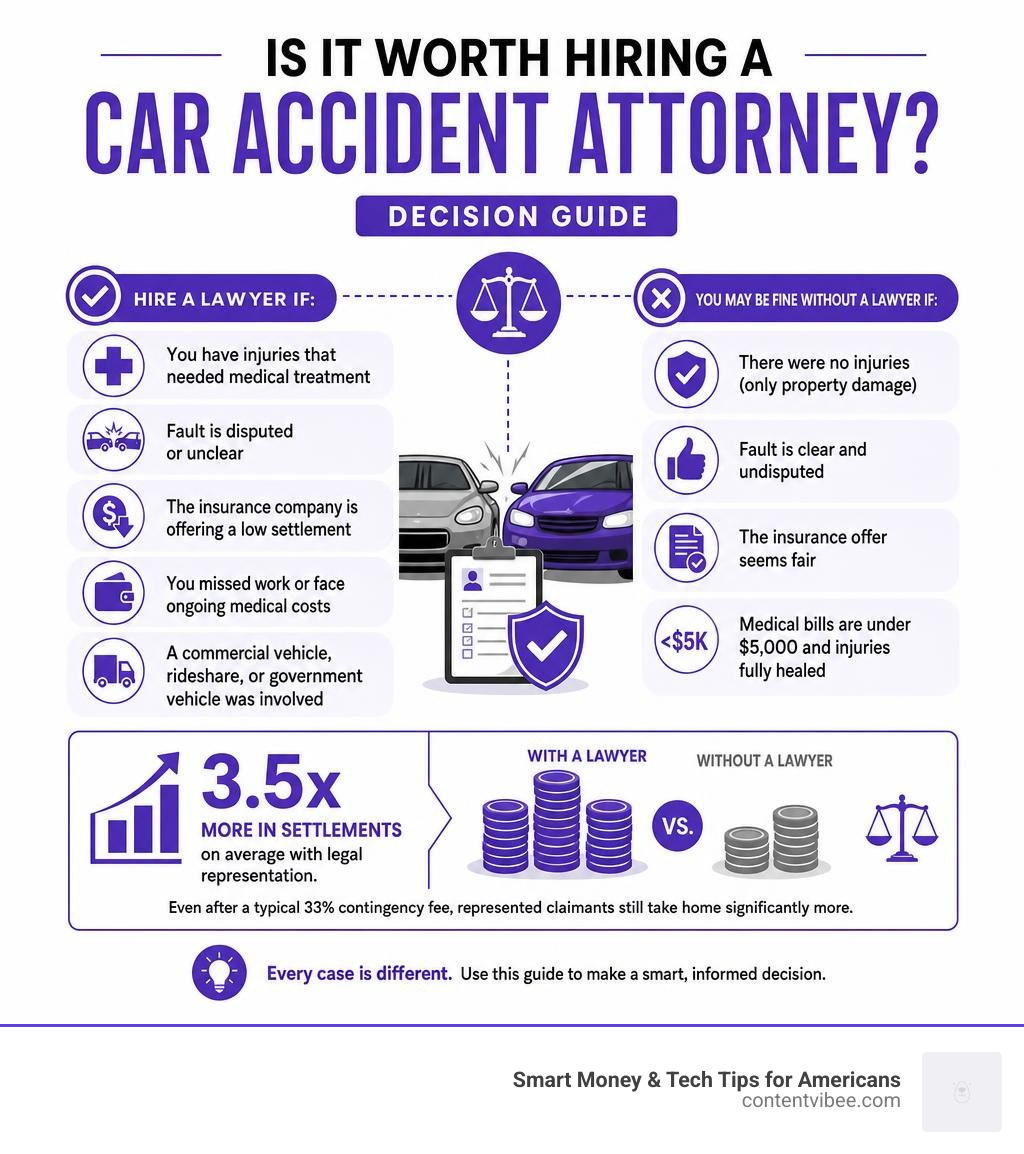
Hire a car accident lawyer if:
- You have injuries that needed medical treatment
- Fault is disputed or unclear
- The insurance company is offering a low settlement
- You missed work or face ongoing medical costs
- A commercial vehicle, rideshare, or government vehicle was involved
You may be fine without a lawyer if:
- There were no injuries (only property damage)
- Fault is clear and undisputed
- The insurance offer seems fair
- Medical bills are under $5,000 and injuries fully healed
The data backs this up. Studies show people with legal representation recover 3.5x more in settlements on average. Even after paying a typical 33% contingency fee, represented claimants still take home significantly more than those who go it alone.
But here’s the honest part: not every case justifies hiring an attorney. For a minor fender bender with no injuries and a fair offer on the table, the math may not work in your favor.
This guide breaks it all down u2014 the numbers, the situations, and the mistakes to avoid u2014 so you can make a smart, informed decision.
Is it worth hiring an attorney for a car accident terms to know:
Is It Worth Hiring an Attorney for a Car Accident? The Hard Math
When we look at whether it is financially smart to hire a lawyer, we have to look past the marketing hype and focus strictly on the math. The most important metric in any personal injury claim is your net recoveryu2014the amount of money you actually keep in your pocket after medical bills, attorney fees, and case expenses are paid.
According to data from the Insurance Research Council (IRC), represented claimants recover up to 3.5 to 4 times more in gross settlement value than those who handle claims on their own. In fact, industry data reveals that roughly 85% of all bodily injury insurance payouts go to claimants who have hired legal representation.
But how does the math work when you factor in a lawyer’s fee?
Most car accident attorneys work on a contingency fee basis, meaning they do not charge any upfront fees. Instead, they take a percentage of your final settlementu2014typically around 33.3% (one-third) if the case is settled before a lawsuit is filed, and up to 40% if the case goes to trial or arbitration.
To justify a standard 33.3% contingency fee, an attorney needs to improve your expected settlement outcome by more than 50%.
For example, let’s look at how this math plays out in real-world scenarios across different injury severities:
Settlement Comparison: With vs. Without an Attorney
| Injury Severity | Average Settlement (Unrepresented) | Average Settlement (Represented) | Attorney Fee (33.3%) | Net to Client (Represented) | Net Gain with Attorney |
|---|---|---|---|---|---|
| Minor Injury (e.g., mild strain) | $4,500 | $8,500 | $2,833 | $5,667 | +$1,167 |
| Moderate Injury (e.g., severe whiplash) | $12,000 | $28,000 | $9,324 | $18,676 | +$6,676 |
| Significant Injury (e.g., simple fracture) | $28,000 | $85,000 | $28,305 | $56,695 | +$28,695 |
| Serious Injury (e.g., herniated disc) | $65,000 | $245,000 | $81,585 | $163,415 | +$98,415 |
| Severe Injury (e.g., traumatic brain injury) | $180,000 | $650,000+ | $216,450 | $433,550 | +$253,550 |
To see a deeper breakdown of these metrics, you can explore this Data-driven settlement analysis.
As you can see, the financial gap between represented and unrepresented claimants widens dramatically as the severity of the injuries increases. In a minor case, the difference might be small. But in moderate to severe cases, trying to negotiate on your own often means leaving tens of thousands of dollars on the table.
When You Definitely Need a Lawyer After a Crash

While some minor claims can be handled solo, there are several “red flag” situations where navigating the insurance maze alone is highly risky. In these scenarios, the insurance company’s goal is to minimize their financial exposure, often at your expense.
We recommend securing a lawyer immediately if your accident involves any of the following:
- Severe or Permanent Injuries: If you suffered broken bones, head trauma, spinal damage, or any injury requiring surgery or ongoing physical therapy, the stakes are too high to handle alone.
- Disputed Liability: If the other driver or their insurer claims you were at fault (or partially at fault), you need an advocate to gather evidence, interview witnesses, and reconstruct the accident.
- Commercial, Rideshare, or Government Vehicles: Accidents involving delivery trucks, Uber/Lyft drivers, or municipal vehicles involve complex, layered insurance policies and strict legal timelines.
- Uninsured or Underinsured Motorists: If you were hit by someone with no insurance, or whose limits cannot cover your medical bills, you will need to navigate your own policy’s UM/UIM coverage, which can be surprisingly adversarial.
- Multiple Vehicles Involved: Multi-car pileups quickly turn into a finger-pointing match where multiple insurance companies try to shift the blame to avoid paying.
If your crash matches any of these descriptions, you can read more about the critical Signs you need a lawyer to protect your physical and financial recovery.
Evaluating Injury Severity: Is It Worth Hiring an Attorney for a Car Accident with Minor Injuries?
It is incredibly common to walk away from a car crash thinking, “I’m just a little sore, I’ll be fine.”
However, adrenaline is a powerful painkiller. Immediately following an accident, your body is flooded with fight-or-flight hormones that mask physical trauma. Soft-tissue injuries like whiplash, muscle tears, concussions, and micro-tears in the spine often do not show symptoms until days or even weeks later.
If you settle your claim quickly with the insurance company for a few hundred dollars and a promise to cover your initial ER bill, you will sign a release of liability. If your neck starts radiating pain two weeks later and you need an MRI or physical therapy, you cannot go back for more money. The case is legally closed forever.
This is why we always recommend a professional medical clearance from a doctor within 14 days of the crash. Before you rule out an attorney, make sure you understand the long-term outlook of your physical health. For more tips on navigating this early phase, check out our Evaluating injury claims checklist.
Complex Claims: Is It Worth Hiring an Attorney for a Car Accident with Disputed Fault?
What happens when the police report is vague, or the other driver lies about what happened?
Most states follow some form of comparative negligence laws. Under these rules, your financial recovery is directly reduced by your percentage of fault. For example, if your total damages are $100,000 but you are found to be 20% at fault, your recovery is cut to $80,000. In modified comparative negligence states, if you are found to be 50% or 51% at fault (depending on the state), your recovery drops to zero.
Insurance adjusters are experts at using recorded statements to trick you into admitting partial fault. They might ask seemingly innocent questions like, “Could you have done anything to avoid the crash?” A polite response like, “Well, maybe if I was looking closer…” can be used to assign 20% fault to you, saving the insurance company thousands of dollars.
A skilled lawyer knows how to counter these tactics by securing objective evidence, such as:
- Nearby commercial security camera or residential doorbell footage
- Dashcam recordings
- Vehicle “black box” event data recorder (EDR) information
- Accident reconstruction expert testimony
When You Can Safely Handle a Claim Yourself

We want to be completely honest: you do not always need a lawyer. In fact, hiring one for a very small claim can sometimes leave you with less money than if you handled it yourself.
You can likely handle your claim without an attorney if your situation meets all of these criteria:
- No Bodily Injuries: Neither you nor your passengers suffered any physical pain, discomfort, or injuries requiring medical visits.
- Property Damage Only: The only damage was to your vehicle, and the repair costs are clear and straightforward.
- Clear, Undisputed Liability: The other driver was clearly at fault (for example, they rear-ended you while you were stopped at a red light), and their insurance company has fully admitted 100% liability.
- A Fair Offer is Made: The insurance company quickly offers to pay the full Kelley Blue Book value of your vehicle (if totaled) or covers the repair shop bills directly, without delays or runarounds.
If your accident fits this description, you can easily handle the property damage claims directly with the insurance adjusters. For a step-by-step walkthrough on how to manage this process independently, you can refer to this Self-representation guide.
What Does a Car Accident Lawyer Actually Do?
Many people believe that a personal injury lawyer’s job is simply to file a lawsuit and go to court. In reality, about 95% of personal injury cases are settled out of court long before a trial.
So, what does a car accident attorney actually do day-to-day to earn their contingency fee? They use seven specific mechanisms to maximize your claim’s value:
- Complete Damage Identification: Insurance companies only pay for what you explicitly claim. A lawyer ensures that your demand includes past and future medical bills, lost wages, loss of earning capacity, and non-economic damages like pain and suffering.
- Medical Documentation and MMI Timing: A lawyer will advise you to wait until you reach Maximum Medical Improvement (MMI)u2014the point where your recovery has plateauedu2014before negotiating. This ensures all future medical needs are accounted for.
- The Credible Trial Threat: Insurance databases track law firms. If they know your lawyer is a “settlement mill” who never goes to court, they will offer lowball numbers. If they know your attorney is trial-ready, their settlement offers increase significantly.
- Prevention of Self-Inflicted Damage: Your lawyer acts as a buffer. They handle all communications, preventing you from giving damaging recorded statements or signing over broad medical releases.
- Evidence Preservation: Attorneys send immediate “spoliation of evidence” letters to trucking companies, municipalities, or local businesses to legally force them to preserve vital evidence like black box data and camera footage before it is deleted.
- Lien Negotiation: This is a major hidden value. If your health insurance paid for your medical care, they will place a “lien” on your settlement to get paid back. Attorneys regularly negotiate these liens down by 20% to 50%, putting that saved money directly back into your pocket.
- Identifying All Available Coverage: A lawyer will dig to find additional insurance policies, such as umbrella policies, employer liability (if the at-fault driver was working), or multiple household auto policies.
Before you sign an agreement with any firm, make sure to ask the right questions. You can use our guide on Questions to ask a lawyer to ensure you are hiring a trial-ready advocate, not a high-volume settlement mill.
Frequently Asked Questions About Car Accident Attorneys
Navigating the legal aftermath of a car accident can feel overwhelming. Here are clear answers to the most common questions we receive from U.S. consumers.
How much does a car accident lawyer cost?
Car accident lawyers almost always work on a contingency fee basis. This means there are zero upfront, out-of-pocket costs to you. They pay for all the case expenses (filing fees, medical record retrieval, expert witnesses), and they only get paid if they secure a financial recovery for you.
Their fee is a percentage of your final settlement, typically 33.3% for cases settled out of court, and up to 40% if a lawsuit must be filed and prosecuted. If they do not win your case, you owe them nothing for their time.
When should you get a lawyer after a car accident?
You should contact a lawyer as soon as possible, ideally within the first week of the accident. While most states have a personal injury statute of limitations ranging from two to three years, waiting too long can devastate your case.
Physical evidence at the scene disappears, skid marks fade, and traffic camera footage is often overwritten within 30 to 90 days. Additionally, getting an attorney early prevents you from making costly mistakes during early conversations with insurance adjusters.
What mistakes do people make when handling a claim without a lawyer?
The three most common mistakes are:
- Giving a Recorded Statement: Insurance adjusters are trained to ask misleading questions to get you to admit fault or downplay your pain.
- Accepting a Fast, Lowball Settlement: Taking a quick check of $1,000 within days of the crash before you have seen a doctor or realized the true extent of your injuries.
- Posting on Social Media: Posting photos of your activities, vacations, or even writing “I’m doing okay!” can be used by insurance defense attorneys to argue that your injuries are not severe.
Conclusion
At Smart Money & Tech Tips for Americans, our goal is to help you protect your hard-earned money and make smart financial decisions. Deciding whether to hire a car accident attorney is ultimately a cost-benefit calculation.
If your accident was a minor fender bender with no physical pain, save your money and handle the property damage claim yourself. But if you are dealing with medical bills, ongoing pain, or a disputable liability claim, trying to handle it alone is a financial risk. A skilled attorney doesn’t just reduce your stressu2014they level the playing field against multi-billion dollar insurance corporations to ensure you receive the full compensation you deserve.
To learn more about how legal fees work and what to expect financially, read our comprehensive guide on Understanding personal injury lawyer costs.