Timing Is Everything: How Married Couples Can Claim Social Security Simultaneously

Why Timing Your Social Security Claims as a Couple Changes Everything
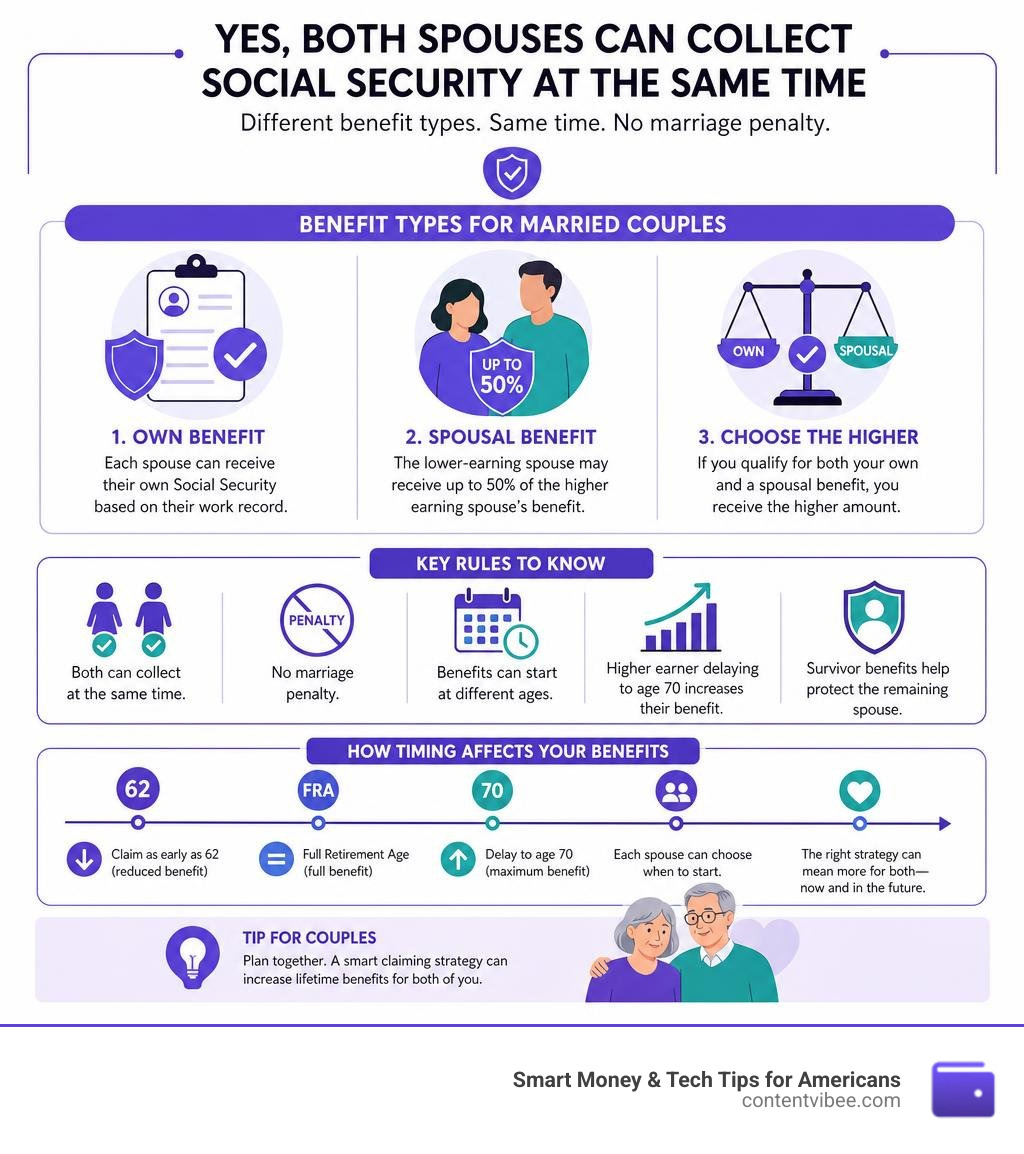
Can both spouses collect Social Security at the same time? Yes — and there is no marriage penalty that cuts either spouse’s check.
Here’s the quick answer:
| Situation | Can Both Collect? | Key Rule |
|---|---|---|
| Both spouses have their own work record | Yes | Each receives their own benefit independently |
| One spouse has little or no work history | Yes | Non-working spouse may claim up to 50% of the other’s benefit |
| One spouse qualifies for both own + spousal benefit | Yes, but… | You receive the higher amount, not both added together |
| Both claim at age 62 | Yes | Benefits are permanently reduced by up to 30% |
| Higher earner delays to age 70 | Yes | Benefit grows by 8% per year past Full Retirement Age |
The rules get more complex from there. When you each claim — and in what order — can mean tens of thousands of dollars more or less over your lifetime together.
For most couples, the big decisions come down to three things:
- Whether each spouse qualifies for their own benefit (you need roughly 10 years of work history)
- Whether one spouse is better off claiming a spousal benefit instead of their own
- How timing affects survivor benefits — what the remaining spouse collects after one passes away
This guide walks you through all of it, step by step.
Can both spouses collect social security at the same time glossary:
- can a divorced spouse collect social security
- can a surviving spouse get social security benefits
- can divorced spouse get social security benefits
Can Both Spouses Collect Social Security at the Same Time?
One of the most persistent myths in retirement planning is that marriage limits your Social Security payments. Many couples worry that the Social Security Administration (SSA) caps household benefits or applies a “marriage penalty” to dual-income households.
Fortunately, we have some excellent news: there is absolutely no marriage penalty for standard retired-worker benefits. If both of you worked and paid into the system, you can both claim your full, independent retirement checks simultaneously.

To qualify for your own retirement check, you must meet the standard individual work credit requirements. In 2026, the rules remain unchanged: you need to earn at least 40 work credits (which translates to roughly 10 years of covered employment) to qualify for benefits based on your own earnings record. Your benefit amount is calculated based on your 35 highest-earning years, adjusted for historical wage changes.
When both partners have a robust work history, the household receives two separate checks based entirely on those individual records. For example, if one spouse qualifies for a $1,400 monthly payment and the other qualifies for $1,200, the household will receive a combined monthly benefit of $2,600. Neither spouse’s benefit is reduced because they are married.
If you are wondering, Do Both Spouses Collect Social Security, the answer is a resounding yes. You are both entitled to the fruits of your respective labors. Under these rules, there is no combined cap or household limit on retired-worker benefits. If you both earned the maximum possible benefit throughout your careers, you can both receive the maximum individual amounts. To learn more about how this works for dual-earner households, see our detailed guide on how Can a Married Couple Both Collect Social Security.
However, it is worth noting a major exception to this rule: Supplemental Security Income (SSI). SSI is a needs-based program for low-income, disabled, or elderly individuals. For married couples on SSI, the federal government does apply a strict limit. Married couples on SSI receive a Federal Benefit Rate that is only 1.5 times the individual rate. This standard is a significant contributor to the 45.1% poverty rate observed among married SSI recipients, compared to just 9.8% for non-married recipients. But for standard Social Security retirement benefits, your marriage status will not reduce your individual checks.
Understanding Spousal Benefits and the “Higher Of” Rule
But what happens if one spouse has a limited work history or took years out of the workforce to raise a family? This is where spousal benefits come into play.
The spousal benefit is designed to protect a husband or wife with lower lifetime earnings. Under this rule, a spouse can receive a benefit worth up to 50% of the higher-earning partner’s Primary Insurance Amount (PIA) if claimed at Full Retirement Age (FRA). The PIA is the monthly benefit a worker is entitled to receive if they claim at their exact FRA.
The SSA handles this through a mechanism known as the “higher of” rule, or dual entitlement. If you qualify for both your own retired-worker benefit and a spousal benefit, the SSA will not pay you both amounts added together. Instead, as noted in the official guidance, Can I collect Social Security spouse’s benefits and my own retirement benefits? | Frequently Asked Questions | SSA, they will always pay your own retired-worker benefit first. If your spousal benefit is larger than your own, you will receive an additional “spousal top-up” to bridge the difference, ensuring you receive the higher total amount.
To understand how this looks in practice, let’s look at a comparative breakdown:
| Benefit Source | Calculation Method | Maximum Value | Permanent Reductions |
|---|---|---|---|
| Own Work Record | Based on your 35 highest-earning years | 100% of your PIA (grows by 8% per year if delayed up to age 70) | Reduced by up to 30% if claimed early at age 62 |
| Spousal Benefit | Based on your spouse’s work record | Up to 50% of your spouse’s PIA at their FRA | Reduced permanently if claimed before your own FRA (down to 35% at age 62) |
To see how these numbers shake out for your specific household, it is highly recommended to Calculate Spouse Retirement Benefits before making a formal application. For a deeper dive into the mechanics of this system, read our comprehensive explainer on What is a Social Security Spousal Benefit.
Eligibility Requirements for Spousal Benefits
To successfully claim a spousal benefit, you must meet several strict criteria:
- Age Requirement: You must be at least 62 years old to claim spousal benefits, unless you are caring for a child of the worker who is under age 16 or disabled.
- Marriage Duration: You must be married to the primary worker for at least one continuous year before applying.
- The Primary Worker Must Have Filed: You cannot collect a spousal benefit on your partner’s record until they have already filed for their own retirement benefits.
- Reduction for Early Claiming: If you claim spousal benefits before your own Full Retirement Age (which is age 67 for anyone born in 1960 or later), your monthly payment is permanently reduced. While a spousal benefit is 50% of the worker’s PIA at your FRA, claiming at age 62 reduces it to just 35%.
To avoid costly mistakes and understand how these rules apply to your family, review The Golden Rules Can a Spouse Collect SS Spousal Benefits.
How Deemed Filing Affects When Can Both Spouses Collect Social Security at the Same Time
In the past, savvy retirees used a popular loophole known as the “restricted application.” A higher-earning spouse could file a restricted application for spousal benefits only at their Full Retirement Age, allowing them to collect a monthly check based on their partner’s work history while letting their own retirement benefit grow by 8% per year until age 70.
However, the Bipartisan Budget Act of 2015 permanently closed this loophole for anyone who turned 62 after January 1, 2016. Today, the rules are governed by what is called deemed filing.
Under the deemed filing rules, when you apply for either your own retirement benefit or a spousal benefit, you are “deemed” to have applied for both simultaneously. The SSA will automatically calculate both benefits and award you the higher amount. You can no longer choose to collect only the spousal benefit while letting your own benefit accumulate delayed retirement credits.
Furthermore, voluntary suspension rules have changed. If a primary worker files for benefits and then suspends them to earn delayed retirement credits, all spousal benefits payable on that worker’s record are also suspended during that period.
For the official rules and exceptions, you can consult the Benefits Planner: Retirement | Filing Rules for Retirement and Spouses Benefits | SSA. Understanding these strict regulations is essential for couples mapping out how Both Spouses Collect Social Security successfully in 2026.
Coordinated Claiming Strategies for Married Couples
Because of deemed filing, married couples must approach Social Security as a team. Since more than 90 percent of married couples have age differences within 10 years of each other, coordinating your claiming ages is one of the most powerful ways to secure your household’s financial future.

The most effective strategy for many couples is the “split strategy.” Because delaying your own retirement claims past your Full Retirement Age increases your monthly payment by 8% each year up to age 70, patience is a highly lucrative virtue. At age 70, your benefit can reach up to 124% of your PIA (if your FRA is 67).
In a split strategy, the lower-earning spouse claims their benefit early (often at age 62 or FRA) to provide immediate household cash flow. Meanwhile, the higher-earning spouse delays claiming their own benefit until age 70. This maximizes the delayed retirement credits on the larger benefit, which will eventually provide a much larger monthly check for the household and secure a higher safety net for the surviving spouse.
To explore how these timing options affect your personal timeline, visit the official Social Security Retirement Decisions | SSA portal, and read our comprehensive guide, The Smart Couples Guide to Social Security Strategies.
Maximizing Survivor Benefits vs. Spousal Benefits
It is critical to distinguish between spousal benefits and survivor benefits, as they operate under completely different rules.
- Spousal Benefits: Available while both spouses are alive. The maximum benefit is 50% of the worker’s PIA.
- Survivor Benefits: Available after one spouse passes away. The surviving spouse is eligible to receive up to 100% of the deceased spouse’s actual monthly benefit (including any delayed retirement credits they earned).
A surviving spouse is eligible for between 71 percent (if claiming at age 60) and 100 percent (if claiming at Full Retirement Age) of what the deceased spouse was receiving. Because of this, maximizing the higher earner’s benefit is actually a form of longevity insurance. If the higher earner delays claiming until age 70, they permanently lock in a higher survivor benefit for the spouse who outlives them.
For women, who statistically tend to outlive their husbands, this coordination is particularly vital. We highly recommend reading the SSA’s guide on [PDF] 5 Things Every Woman Should Know About Social Security to understand how these rules protect widows. For a detailed breakdown of how to coordinate these two distinct benefits, check out His Hers and Ours The Ultimate Guide to Dual Social Security Benefits.
Strategic Timing: How Can Both Spouses Collect Social Security at the Same Time to Maximize Income
For couples with a dually entitled low earner, there are over 9,000 different month-of-age claiming combinations available. Navigating this sea of choices requires a clear strategy.
One highly effective approach is the bridge strategy. In this scenario, a couple uses withdrawals from their traditional retirement accounts (like IRAs or 401ks) to cover their living expenses in their early-to-mid 60s. This allows both spouses to delay claiming Social Security, letting their benefits grow by 8% per year.
When planning your timing, keep the following 2026 updates in mind:
- Cost-of-Living Adjustment (COLA): The COLA update for 2026 is 2.8%, which helps protect your future benefits from inflation.
- Earnings Test Limits: If you claim benefits before your FRA and continue working in 2026, the earnings limit is $24,480. For every $2 you earn above this limit, the SSA will withhold $1 in benefits. In the year you reach FRA, the limit rises to $65,160 (withholding $1 for every $3 earned above the limit prior to your birthday month).
Special Rules: Divorced Spouses and the Family Maximum
If you are divorced, you may still be entitled to collect benefits on your ex-spouse’s record. This is a highly valuable provision that does not affect your ex-spouse’s payments in any way—nor does it reduce the benefits of their current spouse if they have remarried.
To qualify for divorced spouse benefits, you must meet the following criteria:
- Your marriage to your ex-spouse must have lasted for at least 10 consecutive years.
- You must currently be unmarried.
- You must be at least 62 years old.
- Your ex-spouse must be eligible for retirement or disability benefits (though they do not need to have actively claimed them yet, provided you have been divorced for at least two continuous years).
Another important rule to understand is the Family Maximum Benefit. This is a cap on the total amount that can be paid to a family on an individual worker’s earnings record. The family maximum typically ranges between 150% and 188% of the worker’s PIA.
Crucially, when both spouses work and claim benefits on their own individual records, the family maximum does not apply. The cap is only triggered when multiple family members (such as a spouse and dependent children) claim benefits on a single worker’s record. Furthermore, divorced spouse benefits are completely excluded from the family maximum equation, as detailed in the official SSA policy manual SSA – POMS: RS 00202.020 – Spouse’s Benefits – Payment – 01/20/2026.
If you want to know more about navigating these complex scenarios, explore our guide: Can Divorced Spouse Get Social Security Benefits.
Exceptions to Deemed Filing Rules
While deemed filing is the standard rule of the land, there are a few highly important exceptions where you are not forced to claim both benefits at the same time:
- Survivor Benefits: Deemed filing does not apply to survivor benefits. A widow or widower can strategically choose to file for survivor benefits as early as age 60 while letting their own retirement benefit grow until age 70, or vice versa.
- Disability Benefits: If you are receiving Social Security Disability Insurance (SSDI) and are entitled to spousal benefits, you are exempt from deemed filing.
- Child-in-Care Exception: If you are receiving spousal benefits because you are caring for a child of the worker who is under age 16 or disabled, deemed filing does not apply.
Frequently Asked Questions about Married Couples and Social Security
Does my spouse collecting a benefit reduce my own payment?
No. If your spouse claims a spousal benefit on your record, or claims their own retired-worker benefit, your personal monthly check remains exactly the same. The system is designed to pay out benefits based on earned work records independently. Any spousal top-up they receive is an addition to the household, not a deduction from your individual earnings.
What is the maximum monthly Social Security check in 2026?
For individuals reaching Full Retirement Age in 2026, the maximum possible monthly Social Security benefit is $4,152. For those who maximize their earnings over 35 years and delay claiming until age 70, the maximum possible monthly benefit rises to $5,181.
Can I collect spousal benefits while my own benefits grow?
Generally, no. Due to the deemed filing rules established by the Bipartisan Budget Act of 2015, you cannot claim a spousal benefit first while letting your own retirement benefit grow. When you file, you are filing for both. The only major exception is if you are filing for survivor benefits, which are exempt from deemed filing.
Conclusion
At Suppremo, we believe that navigating retirement shouldn’t feel like decoding ancient hieroglyphics. When it comes to Social Security, treating your benefits as a coordinated team strategy is the single best way to maximize your lifetime household income.
By understanding how spousal benefits, survivor benefits, and deemed filing rules interact, you can make informed decisions that protect both you and your partner for the long haul. Ready to take the next step in securing your retirement? Read The Ultimate Guide to Spousal Social Security Eligibility to build your perfect claiming strategy today.