So Youu2019ve Had an Accident: Navigating the Settlement Timeline

What You Need to Know About a Car Accident Settlement
A car accident settlement is a formal agreement between you and an insurance company to resolve your injury claim u2014 without going to court.
Here’s a quick overview of what to expect:
| What You’re Wondering | Quick Answer |
|---|---|
| What is the average payout? | ~$30,416 for injury claims nationally |
| How long does it take? | Typically 6 to 12 months |
| What damages can I claim? | Medical bills, lost wages, pain and suffering, property damage |
| Does fault affect my payout? | Yes u2014 your percentage of fault can reduce your compensation |
| Should I hire an attorney? | Studies show represented victims recover significantly more, even after fees |
You’re dealing with a lot right now. Medical bills are piling up. Your paycheck may have stopped. And an insurance adjuster is probably already calling with an offer that sounds reasonable u2014 but may be far less than what you’re actually owed.
That’s the situation most accident victims in Long Beach face after a crash.
The settlement process doesn’t have to be a mystery. This guide walks you through every stage u2014 from the moment of impact to the moment you receive your check u2014 so you can make confident, informed decisions about your claim.
Understanding the Average Car Accident Settlement Payouts
When you are hurt in a collision, one of the first questions you will naturally ask is, “What is my claim actually worth?” It is a vital question because those medical bills and repair receipts do not pay themselves.
To set realistic expectations, we must look at both national benchmarks and regional realities. Across the United States, the average car accident settlement involving injuries sits at approximately $30,416. However, general statistics only tell a fraction of the story. Most standard injury claims settle within a broader range of $15,000 to $38,000, while the overall national average payout across all claims (including minor property damage disputes) is estimated at around $23,900 to $28,000.
But these numbers are highly fluid. Depending on where your accident occurs, the legal framework of your state can dramatically shift your final payout. You can explore these baseline calculations in depth with the Average Settlement For Car Accident (May 2026) guide.

National Averages and State-by-State Variations
Why does location matter so much? Because state laws dictate how insurance coverage is structured, how fault is assigned, and whether there are caps on certain types of compensation.
Let’s look at three distinct examples:
- California: The Golden State is a major outlier. Settlements here average a whopping $185,000u2014which is roughly six times the national average. Why? California has a high cost of living that inflates medical costs and vehicle repairs, uses a pure comparative negligence system, and imposes no hard caps on non-economic damages (pain and suffering) in standard auto liability cases. For a deeper breakdown of these regional trends, look at the California Car Accident Settlement Calculator: Average Values by City & Injury (2026) | SetCalc .
- Texas: In the Lone Star State, the typical range for a standard car accident settlement sits between $15,000 and $30,000. Texas uses a modified comparative negligence system with a 51% bar rule, meaning if you are found to be mostly at fault, your recovery drops to zero.
- Arkansas: In Arkansas, many personal injury claims settle between $10,000 and $100,000. However, just like other states, if the accident results in catastrophic, life-altering injuries or wrongful death, these payouts quickly scale into six- or seven-figure territory.
Key Factors That Influence Your Car Accident Settlement Value
While averages provide a helpful starting point, your specific case value is determined by a unique combination of variables. No two accidents are identical, and insurance adjusters evaluate claims based on a strict set of criteria:
- Severity of the Injuries: A minor soft-tissue injury (like mild whiplash) will naturally command a lower payout than a broken bone, a traumatic brain injury (TBI), or a spinal cord injury requiring surgery.
- Quality of Medical Evidence: Gaps in medical treatment or delayed diagnoses give insurance adjusters a reason to argue that your injuries were not caused by the crash. Clean, consistent, and immediate medical records are the bedrock of any successful claim.
- Clear Liability: If the other driver was 100% at fault and cited at the scene, your negotiating position is incredibly strong. If there is a dispute over who ran the red light, the insurer will use that ambiguity to drive down their offer.
- Policy Limits: The at-fault driver’s insurance policy dictates the maximum amount the insurer is legally obligated to pay. If your damages total $100,000 but the driver only carries a $30,000 bodily injury liability policy, recovering the difference can be exceptionally difficult without underinsured motorist coverage.
To get a clearer picture of how these elements interact in your specific situation, you can use our Tools/Settlement Calculators/Car Accident Settlement Calculator to run your own numbers.
How Damages Are Calculated in a Claim
Calculating the true value of a car accident settlement is not a matter of guesswork. It is a structured process of categorizing and adding up the losses you have suffered. In the legal world, these losses are called “damages,” and they are split into two primary categories: economic and non-economic.

Economic Damages: Medical Bills and Lost Wages
Economic damages are the tangible, monetary losses resulting from your accident. These are the bills that have a clear dollar amount printed on them. They are relatively straightforward to calculate because they are backed by concrete paper trails.
Economic damages include:
- Medical Expenses: This covers everything from the initial ambulance ride and emergency room visit to diagnostic imaging (MRIs and X-rays), physical therapy sessions, prescription medications, and any future surgeries or treatments your doctors anticipate you will need.
- Lost Income: If your injuries forced you to miss work, you are entitled to compensation for the wages you lost. This is calculated using your hourly wage or salary and the exact number of hours or days you missed, backed by a letter from your employer and your pay stubs.
- Property Damage: The cost to repair your vehicle, or its actual cash value if it was declared a total loss, falls under this category. It also covers any personal property destroyed in the crash, such as a child’s car seat, laptops, or cell phones.
Non-Economic Damages: Pain and Suffering
Non-economic damages represent the intangible, personal toll the accident has taken on your life. These losses do not come with an invoice, making them much more subjective and harder to quantify.
Non-economic damages include:
- Pain and Suffering: The physical discomfort and daily agony caused by your injuries.
- Emotional Distress: Anxiety, depression, PTSD, or sleep disturbances stemming from the trauma of the collision.
- Loss of Enjoyment of Life: The inability to participate in hobbies, sports, or family activities that you loved before the accident.
To calculate non-economic damages, insurance companies and attorneys typically use one of two methods:
- The Multiplier Method: This is the most common approach. Your total economic damages are multiplied by a number (usually between 1.5 and 5) depending on the severity of your injuries. A minor whiplash claim might use a 1.5 multiplier, while a severe spinal injury could warrant a 4 or 5 multiplier.
- The Per Diem Method: A daily rate (often equal to your daily wage) is assigned to your pain, and that rate is multiplied by the number of days it takes you to reach maximum medical improvement.
Navigating the Timeline: From Crash to Check
The path from the initial collision to holding a settlement check in your hand is rarely a straight line. It is a multi-step journey that requires patience, strategy, and careful timing. Attempting to rush the process is one of the most common reasons claimants walk away with a fraction of what they deserve.
To understand how these stages flow together, you can read the Car Accident Settlement Process & What To Know (2026) overview.
Step-by-Step: The Car Accident Settlement Process Explained
Let’s break down the typical lifecycle of a personal injury claim:
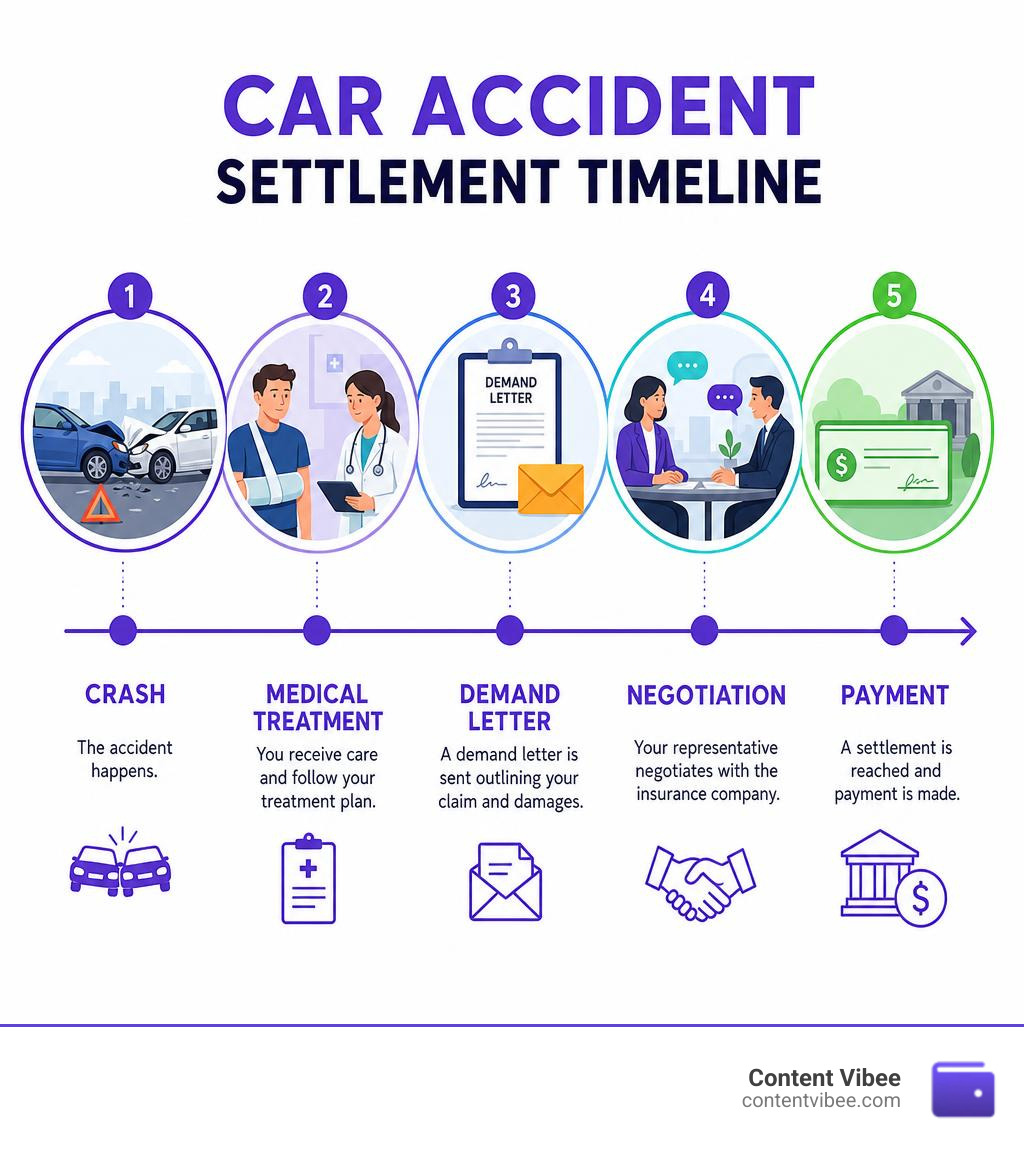
- The Investigation: Immediately after the crash, the gathering of evidence begins. This includes obtaining the official police report, taking photos of the scene and your injuries, securing witness statements, and collecting all initial medical records.
- Medical Treatment and MMI: You must continue your medical treatment until you reach Maximum Medical Improvement (MMI). MMI means your injuries have healed as much as they are expected to. Settling before this point is risky because you cannot claim compensation for future medical needs that haven’t been diagnosed yet.
- The Demand Letter: Once you reach MMI, your attorney will compile your medical bills, proof of lost wages, and evidence of pain and suffering into a comprehensive “demand package.” This letter is sent to the insurance company, outlining the facts of the case and stating the specific dollar amount required to settle the claim.
- Negotiation: The insurance company will review the demand and almost always respond with a lower counteroffer. This kicks off the negotiation phase, where both sides exchange arguments, clarify medical details, and work toward a compromise. Learn more about how a legal professional manages this high-stakes communication by reading How An Auto Accident Lawyer Can Help You.
How Long Does It Take to Get Paid?
On average, it takes 6 to 12 months to resolve a car accident claim and receive your payout.
If your injuries are minor, liability is clear, and you require minimal treatment, your case might settle in as little as 3 to 4 months. However, if you suffered severe injuries that require ongoing care, or if the insurance company disputes who was at fault, the timeline can easily stretch past a year.
Once an agreement is finally reached, you must sign a settlement release form. This is a legally binding document stating that you release the at-fault party and their insurer from all future liability in exchange for the agreed-upon payout. After the release is processed, the insurer typically issues the check within 2 to 6 weeks.
Policy Limits and Negligence Laws
Two major legal guardrails dictate the boundaries of your car accident settlement: the negligence laws of your state and the insurance policy limits of the parties involved. Understanding these rules helps prevent unpleasant surprises late in the negotiation process.
Comparative vs. Contributory Negligence
Every state handles fault differently. If you played a role in causing the accidentu2014even a tiny oneu2014it will impact your final payout.
- Pure Comparative Negligence: States like California allow you to recover damages even if you were 99% at fault. However, your payout is reduced by your exact percentage of blame. For example, if your damages are $100,000 but you are found to be 20% at fault for speeding, you will receive $80,000.
- Modified Comparative Negligence: Many states (such as Texas and Arkansas) use a “51% bar rule” (or a 50% bar rule). Under this system, you can recover damages as long as your share of the fault is below the threshold. If you are found to be 51% or more at fault, you are barred from recovering any compensation whatsoever.
- Contributory Negligence: In a handful of states, if you contributed to the accident in any wayu2014even just 1%u2014you cannot recover any damages.
Insurance Policy Limits and Colossus Software
No matter how severe your injuries are, the at-fault driver’s insurance policy limits act as a structural ceiling on your payout. If the driver carries a minimum liability policy of $30,000, that is generally the maximum the insurance company will pay out, regardless of whether your hospital bills total $150,000.
Additionally, many major insurers (like State Farm) do not rely on human intuition to value your injuries. Instead, they feed your medical codes, treatment duration, and injury types into algorithmic claims software called Colossus.
Colossus is programmed to evaluate claims conservatively. It assigns point values to specific medical diagnoses (ICD codes) and translates those points into a tight settlement range. Because these algorithms are designed to minimize payouts, having an experienced attorney who knows how to present evidence to challenge the software’s assumptions is incredibly valuable.
Frequently Asked Questions about Car Accident Settlements
What is the average settlement for broken bones in a car accident?
The average settlement for broken bones in a car accident is approximately $89,688, with typical ranges spanning from $15,000 to $200,000. Broken bones are highly valued by insurance companies because they are objective injuriesu2014they are clearly visible on X-rays, leaving no room for the insurer to argue that you are exaggerating your pain.
Can I reject a settlement offer from the insurance company?
Yes, you have every right to reject an offer. The initial offer from an insurance adjuster is almost always a lowball figure designed to see if you are financially desperate enough to settle quickly. You can counter their offer with a higher, evidence-backed demand.
How does comparative negligence affect my payout?
Comparative negligence reduces your final payout by your percentage of fault. If a jury or insurance adjuster determines you were 10% responsible for the accident (perhaps because a brake light was out), your final settlement check will be reduced by exactly 10%.
Conclusion
Navigating the aftermath of a collision is stressful, but understanding how a car accident settlement works empowers you to make smart financial decisions. Remember to focus on your recovery, document every expense, and avoid rushing into an early, lowball agreement before your injuries are fully understood.
If you are wondering what your claim is truly worth or need help standing up to aggressive insurance adjusters, getting professional legal guidance is a wise next step. Explore our How To Find A Good Car Accident Lawyer guide to find the right advocate for your case, or read our comprehensive Az Guide To How Much Is My Car Accident Settlement Worth to take control of your financial recovery today.