How to Calculate Gross Profit Rate Without Losing Your Mind

What Is the Gross Profit Rate (and Why Should You Care)?
The gross profit rate is one of the most important numbers in business finance — and one of the most misunderstood. In simple terms, it tells you how much money a business keeps from each dollar of sales after paying the direct costs of making its product or delivering its service.
Quick Answer: Gross Profit Rate at a Glance
| Term | Definition |
|---|---|
| Gross Profit Rate | (Revenue – COGS) ÷ Revenue × 100 |
| What COGS includes | Raw materials, direct labor, production costs |
| What it does NOT include | Rent, marketing, admin, taxes, interest |
| Average across all industries | ~36.56% |
| “Healthy” rule of thumb | 5% = low, 10% = solid, 20% = strong |
Here is a simple example: if your business brings in $100,000 in revenue and spends $35,000 producing your goods, your gross profit is $65,000 — and your gross profit rate is 65%.
That one number can tell investors, lenders, and business owners whether a company is running efficiently or quietly bleeding money.
And yet, many business owners focus only on revenue. You could be selling at record levels and still be in financial trouble if your gross profit rate is too low to cover your costs.
This guide will walk you through exactly how to calculate it, what a good rate looks like for your industry, and how to improve it — without the accounting jargon.
Demystifying the Gross Profit Rate: What It Is and Why It Matters
When we talk about the health of a business, we often hear terms like “the bottom line” or “revenue growth.” But looking at revenue alone is like looking at the speed of a car without checking the fuel gauge. You might be moving fast, but you could run out of gas at any second.
The gross profit rate (often referred to interchangeable with the gross profit margin) is the ultimate metric for understanding your core business economics. It measures the percentage of revenue that exceeds your Cost of Goods Sold (COGS).
To understand this deeply, we have to look at the two components that make up this metric:
- Revenue (or Net Sales): This is the total amount of money your business brings in from selling products or services, minus any returns, allowances, or discounts.
- Cost of Goods Sold (COGS): These are the direct expenses incurred to produce your product or deliver your service. This includes raw materials, direct labor (the people physically making the product), and factory or production overhead.
By subtracting COGS from your revenue, you get your gross profit. When you express that gross profit as a percentage of your total revenue, you get your gross profit rate.
If you want to read more about how this ratio acts as a baseline indicator of financial health, check out this glossary guide on What is the gross profit margin.
Why the Gross Profit Rate is Critical for Business Survival
Why should you, as a business owner or financial manager, care so much about this percentage? Why isn’t the total dollar amount of profit enough?
First, the gross profit rate dictates your pricing power and operational flexibility. A high rate means you have a cushion. If raw material prices spike or a competitor starts a price war, a high-margin business can survive the blow. A low-margin business, operating on razor-thin percentages, can be wiped out by a minor supply chain disruption.
Second, this rate determines your ability to scale and reinvest. If you keep $0.70 of every dollar you make (a 70% rate), you have plenty of capital left over to hire marketing teams, rent nicer offices, develop new products, and attract investors. If you only keep $0.10 of every dollar (a 10% rate), your growth will be slow, and investors may steer clear because your business model lacks scalability.
For a deeper dive into how these direct production costs impact the long-term viability of a small business, take a look at our article on Gross Margin Cost Demystified For Small Businesses.
Product-Based vs. Service-Based Business Margins
It is impossible to analyze your gross profit rate without considering your business model. Product-based businesses and service-based businesses live in entirely different financial universes.
- Product-Based Businesses: These companies deal with physical inventory, raw materials, manufacturing labor, and shipping. Because they have to buy or make physical items, their COGS is usually high, which naturally keeps their gross profit rates lower. A retail clothing store might have a gross profit rate between 25% and 50%, while an auto manufacturer might operate on a tight 11% to 12% margin due to the massive cost of steel, microchips, and factory labor.
- Service-Based and Software Businesses: If you run a consulting firm, a law practice, or a Software-as-a-Service (SaaS) company, your direct cost of production is incredibly low. A software company doesn’t need to buy steel or plastic to sell another subscription; they just need to pay for web hosting and customer support. Consequently, software companies regularly enjoy gross profit rates of 70% to 85%.
However, do not let these high service margins fool you. While a software company might have an exceptional gross profit rate, they often have massive operating expenses (like software developers’ salaries, marketing, and sales teams) that eat away at their final net profit.
How to Calculate and Analyze Your Profitability Metrics
To truly master your business finances, you need to understand how to calculate and interpret your numbers. Let’s start with the tools of the trade.

Before we run the numbers, we must distinguish between different types of costs:
- Variable Costs: These are costs that change directly with your sales volume. If you sell one more bicycle, you have to buy one more set of tires, one more metal frame, and pay for the labor to assemble it. These costs belong in COGS.
- Fixed Costs: These are costs that stay the same regardless of how much you sell. Your office rent, your liability insurance, and your administrative staff’s salaries don’t change whether you sell 10 products or 10,000. These are operating expenses, not COGS.
Understanding this distinction is the secret to accurate financial reporting. If you want to explore the easiest methods to run these numbers without getting a headache, check out our guide on The Easiest Way To Calculate Profit Margin.
Step-by-Step: How to Calculate Your Gross Profit Rate
Now, let’s look at the math. The formula for the gross profit rate is straightforward:
$$\text{Gross Profit Rate} = \left( \frac{\text{Revenue} – \text{COGS}}{\text{Revenue}} \right) \times 100$$
Alternatively, you can write it as:
$$\text{Gross Profit Rate} = \left( \frac{\text{Gross Profit}}{\text{Revenue}} \right) \times 100$$
Let’s break this down into a simple, logical process:
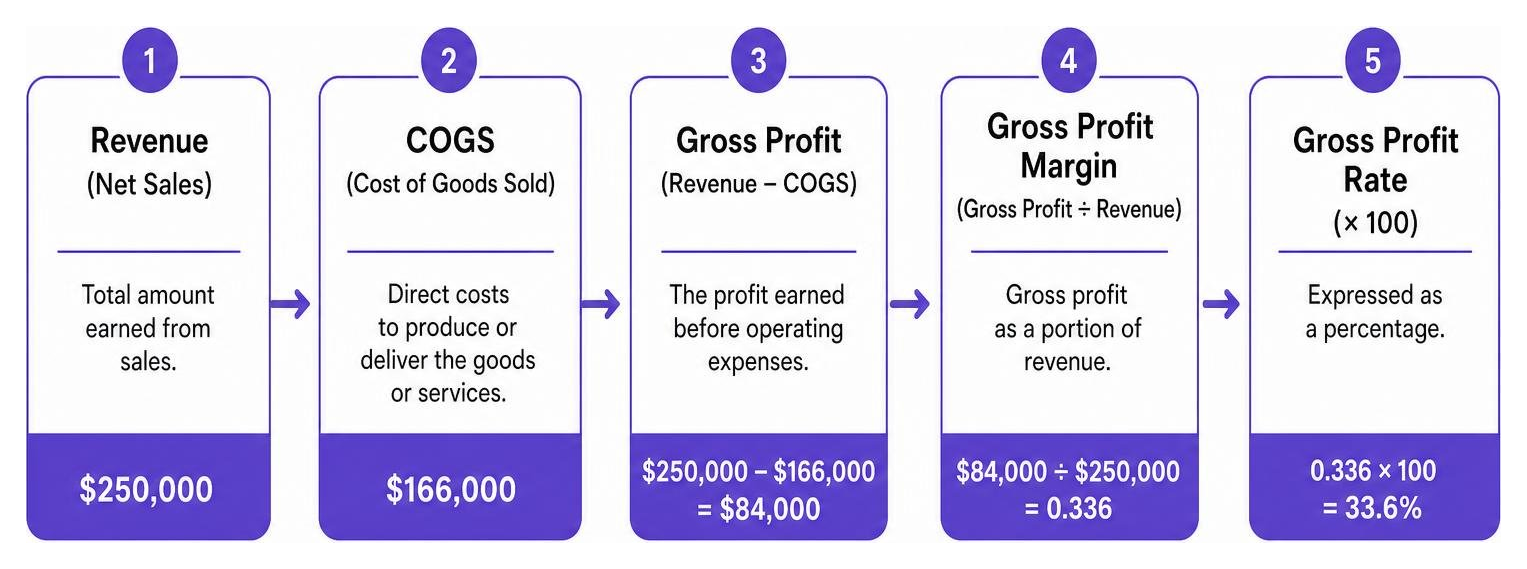
A Real-World Example
Let’s look at a fictional business, “US Flag & Banner Co.”
- Total Revenue (Net Sales): $250,000
- Opening Inventory: $112,000
- Purchases (Raw Materials): $54,000
- Direct Production Labor & Freight-In: $9,000
- Closing Inventory: $23,000
First, we calculate the Cost of Goods Sold (COGS):
$$\text{COGS} = \text{Opening Inventory} + \text{Purchases} + \text{Direct Expenses} – \text{Closing Inventory}$$
$$\text{COGS} = \$112,000 + \$54,000 + \$9,000 – \$23,000 = \$152,000$$
Next, we calculate the Gross Profit:
$$\text{Gross Profit} = \text{Revenue} – \text{COGS}$$
$$\text{Gross Profit} = \$250,000 – \$152,000 = \$98,000$$
Finally, we apply our gross profit rate formula:
$$\text{Gross Profit Rate} = \left( \frac{\$98,000}{\$250,000} \right) \times 100 = 39.2\%$$
This means that for every dollar US Flag & Banner Co. earns, they keep roughly $0.39 to cover their operating expenses, taxes, and bottom-line profit.
For a comprehensive look at the mathematical nuances of this equation, you can read the expert breakdown on the Gross profit ratio | Gross profit equation — AccountingTools page. If you want to quickly convert your markups to margins to make sure your pricing matches your target rates, try our Tools/Margin Calculator/Markup To Margin Calculator.
Gross Profit vs. Operating and Net Profit Margins
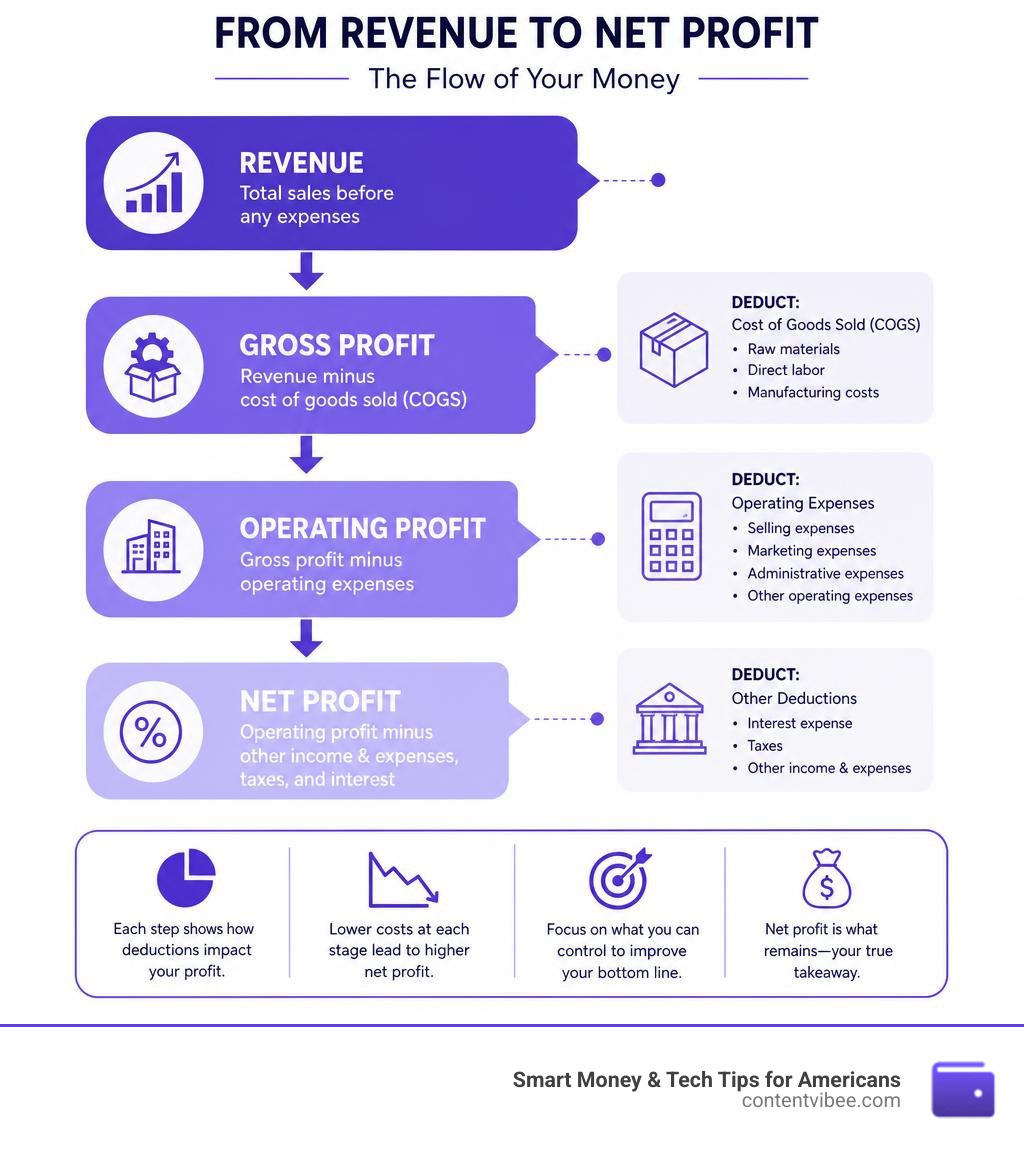
A common trap for business owners is confusing gross profit with other profitability metrics. To prevent this, you must understand the three distinct levels of profitability on your income statement:
- Gross Profit Margin: As we’ve discussed, this only subtracts the direct costs of production (COGS) from your revenue. It tells you how efficient your production process is.
- Operating Profit Margin: This subtracts both COGS and your operating expenses (overhead, marketing, rent, administrative salaries, and depreciation). It tells you how efficient your overall business operations are.
- Net Profit Margin: This is the ultimate “bottom line.” It subtracts every single expense — including taxes, interest on debt, and one-time write-offs — from your revenue. This is the actual money left over for the business owners or shareholders.
To see how these margins stack up in the real world, let’s look at the historical margins of a global giant like Amazon:
- Gross Margin: ~26% (reflecting the heavy cost of shipping, warehouses, and inventory)
- Operating Margin: ~5% (after paying for massive tech infrastructure, corporate staff, and marketing)
- Net Margin: ~3% (the final slice of pie left after taxes and interest)
If you want to explore the data behind these different margins and see how they are calculated across public companies, check out NYU Stern’s database on Operating and Net Margins. You can also use our comprehensive Tools/Margin Calculator to compare all three margins for your own business.
Industry Benchmarks and How to Improve Your Margins
Is a 40% gross profit rate good? The honest answer is: it depends entirely on what you sell.
Comparing the gross margin of a local grocery store to a software startup is like comparing a bicycle to a rocket ship. To help you understand where your business stands in 2026, let’s look at the actual industry benchmarks.
What is a Healthy Margin in 2026?
According to comprehensive financial data from 2026, the average gross profit margin across all industries is 36.56%, while the average net profit margin is 8.54%.
Let’s look at how these benchmarks vary across different sectors:
| Industry Sector | Average Gross Profit Margin | Average Net Profit Margin |
|---|---|---|
| Banks (Money Center) | 100.00% | 30.89% |
| Software (System & Application) | 71.52% | 19.54% |
| Retail (REITs) | 77.63% | ~10.00% |
| Apparel / Clothing Retail | 51.93% | 3.00% – 13.00% |
| Machinery & Manufacturing | 37.08% | ~6.00% |
| Auto & Truck Industry | 12.45% | ~4.00% |
| Real Estate (Development) | 34.39% | -16.35% |
Data Source Notes: Banks technically report a 100% gross margin because their business model (deposits and loans) does not involve traditional cost of goods sold. Conversely, real estate developers often experience negative net margins during cyclical downturns or heavy construction phases, as reflected in the -16.35% average net margin.
To find more detailed, industry-specific benchmarks for your exact niche, read the comprehensive report on Gross Margin by Industry Benchmarks (2026) | CalcMastery. You can also cross-reference these numbers with the financial planning insights found in the Industry Benchmarks of Gross, Net and Operating Profit Margins – Vena analysis.
Actionable Strategies to Boost Your Profitability
If your calculated gross profit rate is below your industry average, don’t panic. There are several proven strategies you can implement to turn things around:
- Optimize Your Pricing: Many businesses fall into the trap of “cost-plus pricing” (adding a flat percentage to their costs). Instead, consider value-based pricing. Can you raise your prices by 5% to 10% without losing customers? Often, a small price increase has a massive, compounding positive effect on your gross margins.
- Negotiate Better Supplier Terms: Don’t just accept the first price a supplier gives you. Consolidate your purchases, ask for bulk discounts, or negotiate longer payment terms. If you can lower your raw material costs, your gross profit rate will immediately rise.
- Eliminate Low-Margin Products: Analyze your product portfolio. Are you spending a massive amount of time and money producing a product that only yields a 10% margin? It might be time to prune those underperforming offerings and focus your sales efforts on your highest-margin items.
- Embrace Automation: If your production process relies heavily on manual labor, look for ways to automate repetitive tasks. Investing in software or specialized machinery might have an upfront cost, but it will dramatically reduce your direct labor costs over time, permanently boosting your gross profit rate.
If you run an online store and want to see how changes in shipping costs, transaction fees, and product pricing will impact your bottom line, use our interactive Ecommerce Profit Calculator Calculate Ecommerce Profit tool.
Frequently Asked Questions About Gross Profit
What is the difference between margin and markup?
This is the single most common pricing mistake business owners make, and it can be incredibly costly.
- Margin is profit expressed as a percentage of the selling price.
- Markup is profit expressed as a percentage of the cost.
For example, if you buy a product for $60 and sell it for $100, your profit is $40.
- Your margin is $40 ÷ $100 = 40%.
- Your markup is $40 ÷ $60 = 66.7%.
If you mistakenly assume a 40% markup will give you a 40% margin, you will underprice your products and lose money. To avoid this math headache entirely, you can use our interactive Tools/Margin Calculator/Omni Margin Calculator to instantly calculate the correct pricing.
Can a business have a negative gross profit?
Yes, absolutely. A negative gross profit occurs when your Cost of Goods Sold (COGS) exceeds your total revenue. This is a severe red flag. It means that it costs you more money to make your product than you are selling it for.
Negative gross profits are usually caused by:
- Severe pricing problems: Selling products at a loss to gain market share without a clear path to profitability.
- Raw material price spikes: A sudden increase in the cost of materials that hasn’t been passed on to customers.
- Bookkeeping errors: Misclassifying operating expenses (like office rent or marketing software) as COGS, which artificially inflates your production costs.
How should startups interpret early gross margin data?
Startups and brand-new small businesses often have incredibly low (or even negative) gross profit rates. This is completely normal. In the early stages, you lack the operational efficiencies and purchasing power of scale. You might be buying raw materials in small quantities at retail prices, and your production process might still have a lot of waste.
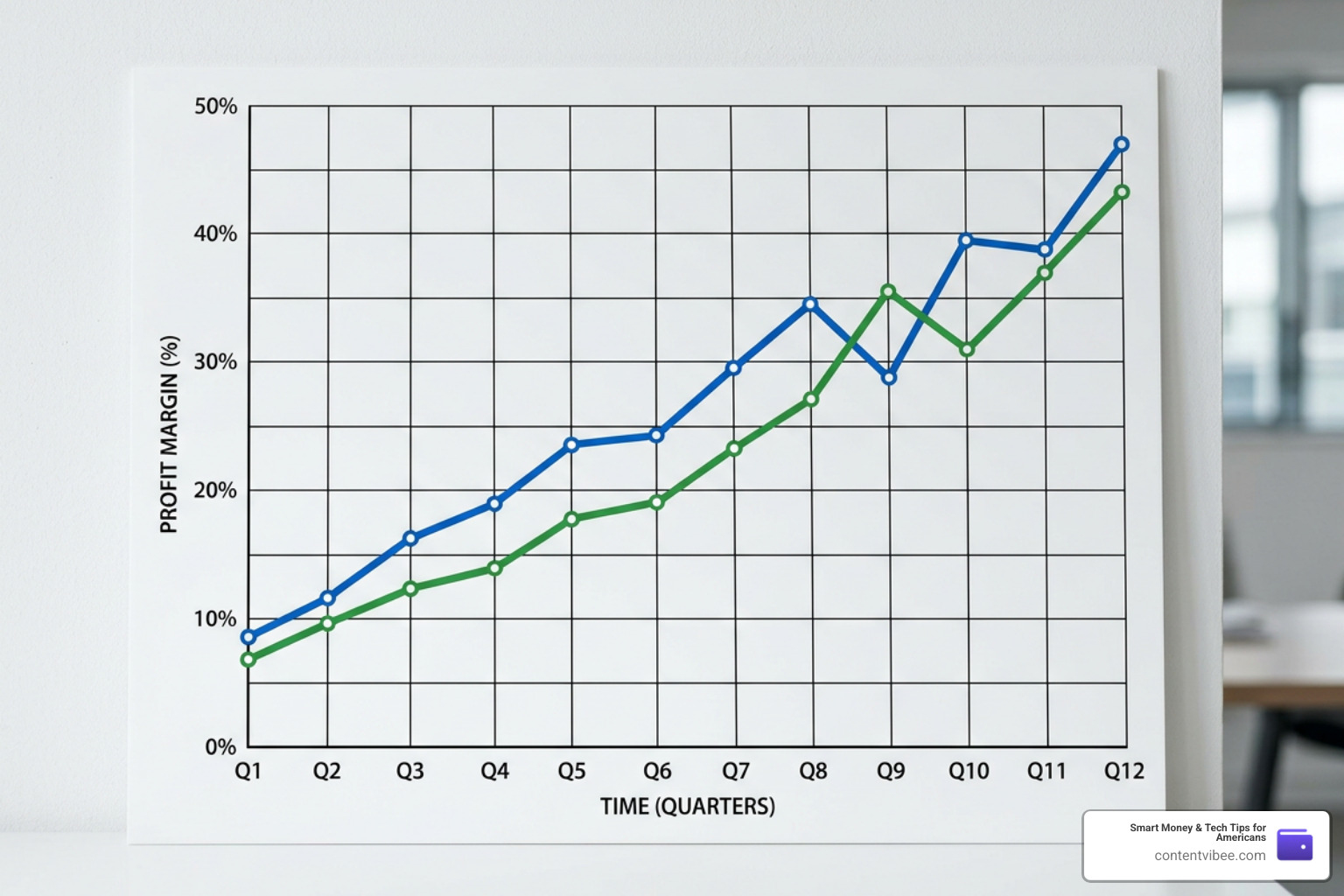
When analyzing early-stage data, pay less attention to the absolute number and more to the trajectory. Is your gross profit rate improving month-over-month as you sell more units and streamline your operations?
Note for sole proprietors: Be sure to account for your own labor! Many founders show artificially high margins because they don’t pay themselves a wage for the hours they spend physically making the product. To get an accurate picture of your business’s health, always calculate what it would cost to hire someone else to do that production work.
Conclusion
Understanding your gross profit rate is like turning on the headlights while driving at night. It illuminates the road ahead, showing you exactly which products are profitable, where your production process is inefficient, and how much room you have to grow.
By calculating this metric regularly, benchmarking it against your industry peers, and taking strategic steps to control your costs and optimize your pricing, you can build a highly resilient, profitable business.
At Suppremo, we are dedicated to providing smart money and technology tips to help American business owners thrive. Don’t leave your pricing to guesswork. Calculate your margins instantly with the Omni Margin Calculator and take control of your financial future today!