How to Avoid Taxes with a 60-Day Traditional IRA Rollover

What Is a 60 day rollover traditional ira and How Does It Work?
A 60-day rollover traditional IRA is one of the most useful — and most misunderstood — moves in retirement planning. Done right, it lets you move money between retirement accounts without paying a single dollar in taxes. Done wrong, it can trigger an unexpected tax bill and penalties you didn’t see coming.
Here’s the quick answer if that’s all you need:
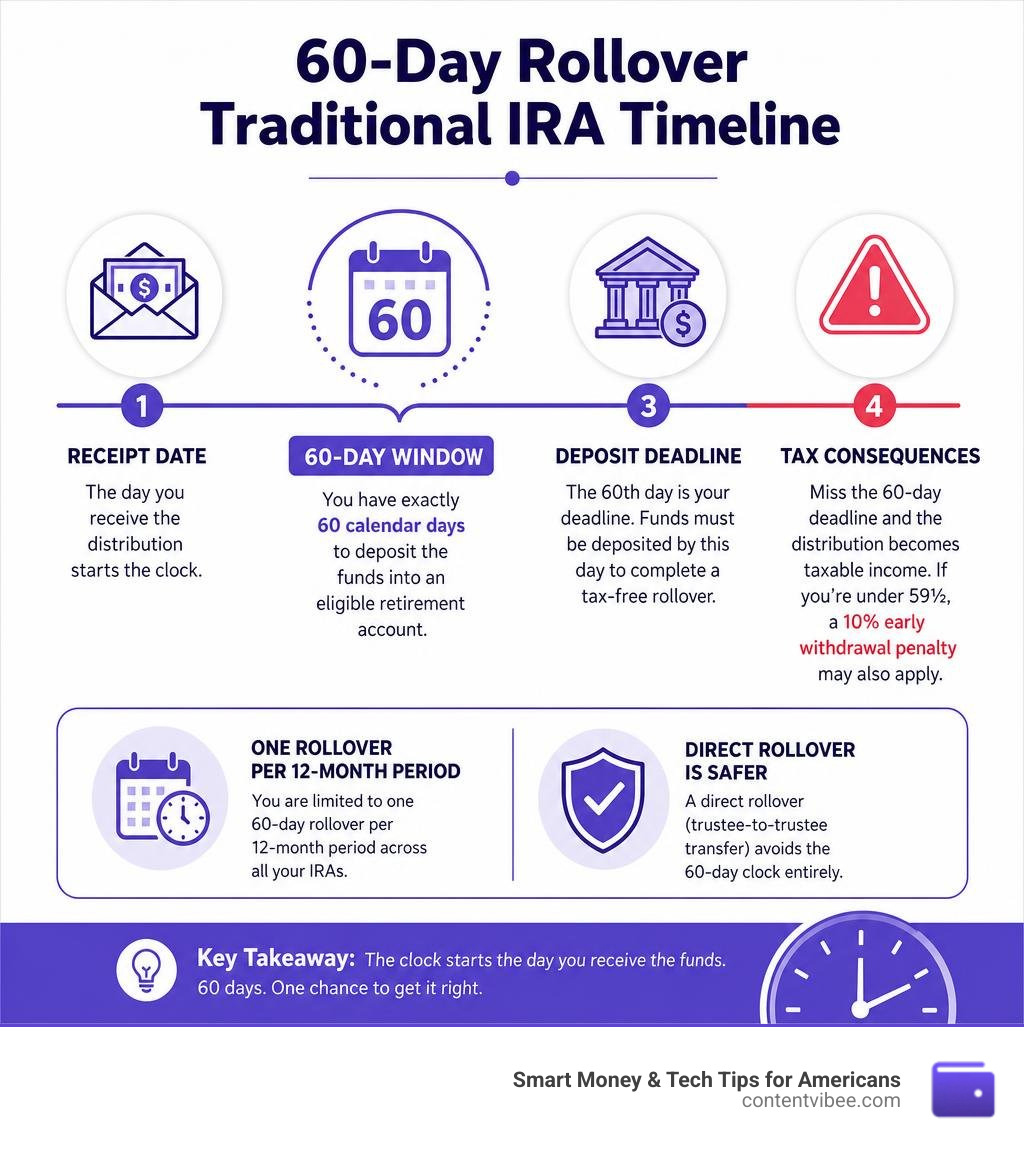
- A 60-day rollover means you receive a distribution from your traditional IRA, then have exactly 60 calendar days to deposit it into another eligible retirement account
- If you meet the deadline, the transfer is completely tax-free
- If you miss it, the full amount becomes taxable income — and if you’re under age 59½, you also face a 10% early withdrawal penalty
- You are limited to one 60-day rollover per 12-month period across all your IRAs (not per account)
- A direct rollover (trustee-to-trustee transfer) avoids the 60-day clock entirely — and is usually the safer option
The stakes are real. Most people don’t realize the clock starts the day they receive the funds — not the postmark date, not when they open the envelope. And the IRS counts every single calendar day, including weekends and holidays.
Whether you’re consolidating old accounts, correcting a distribution mistake, or just need temporary access to your retirement savings, understanding this rule is essential to protecting your money.
To understand how a 60 day rollover traditional ira works, we first need to break down the mechanics of moving retirement funds. When you want to transfer money from one traditional IRA to another, or from an employer-sponsored plan like a 401(k) to an IRA, you generally have two paths: a direct transfer or an indirect transfer.
An indirect rollover is what we commonly refer to as a 60-day rollover. Unlike a direct transfer, where the money moves seamlessly behind the scenes between financial institutions, an indirect rollover involves the money passing directly through your hands. The old custodian cuts a check payable to you personally, or deposits the cash directly into your personal checking account.
Once those funds land in your account, the IRS starts a strict countdown timer. You have exactly 60 calendar days to deposit those funds into another eligible retirement account, such as a new traditional IRA or an employer’s qualified plan. If you complete this deposit on time, the transaction is treated as a tax-free transfer, and your money continues its tax-deferred growth journey.
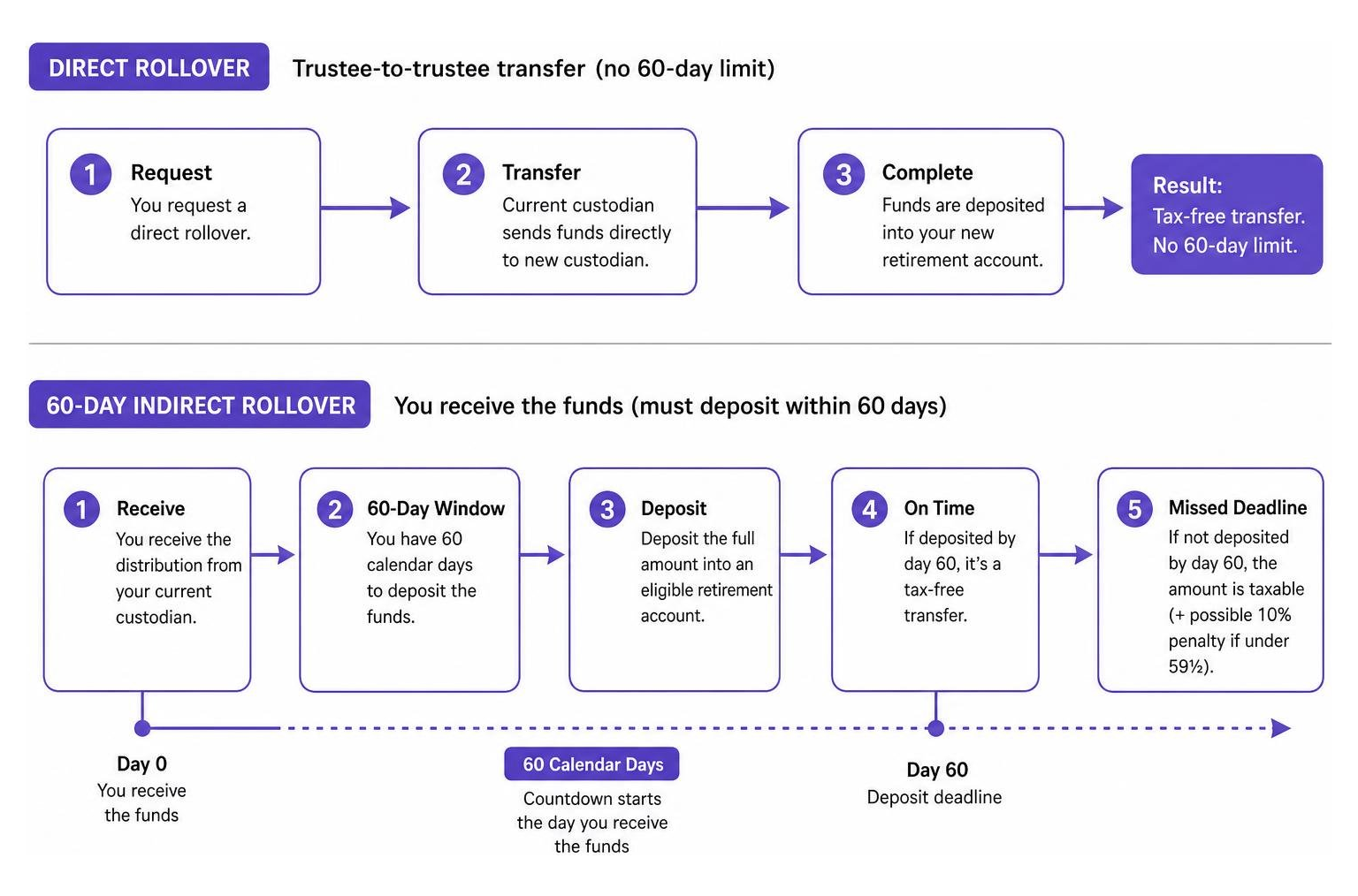
While we almost always recommend direct rollovers because they carry far less logistical risk, there are times when an indirect rollover is either unavoidable or chosen strategically. For instance, some older employer-sponsored plans only issue physical checks made out to the participant.
Additionally, some people use this 60-day window as a form of short-term, interest-free loan. Because you have physical possession of the cash for up to 60 days, you could technically use it to cover an emergency expense or bridge a financial gap. However, this is an incredibly high-wire act. If any delay prevents you from returning the exact amount to an eligible account by day 60, the tax consequences are severe.
To clarify the structural differences, let us look at how these two methods stack up against each other:
| Feature | Direct Rollover (Trustee-to-Trustee) | 60-Day Indirect Rollover |
|---|---|---|
| Who receives the funds? | Sent directly to the new custodian | Paid directly to you (the account holder) |
| IRS 60-Day Clock? | No | Yes (Starts the day after receipt) |
| Tax Withholding? | None | 10% default for IRAs; 20% mandatory for 401(k)s |
| Annual Frequency Limits? | Unlimited | Only one per rolling 12-month period |
| Risk of Tax Penalties? | Virtually zero | High if deadlines or withholding rules are missed |
Understanding these differences is key to mastering the rules. If you want to dive deeper into the overarching mechanics of moving retirement funds, check out the official IRS guidance on What is the 60-day rollover rule? to see how different custodians handle these transactions.
Crucial IRS Rules, Deadlines, and the 12-Month Limit
Navigating the IRS regulations for a 60 day rollover traditional ira requires a sharp eye on the calendar and a clear understanding of federal tax laws. In the eyes of the IRS, retirement accounts are tax-sheltered vaults; taking money out, even temporarily, triggers strict compliance rules. As of the current 2026 tax year, these rules remain as rigid as ever.
The 60-Day Deadline for a 60 day rollover traditional ira
The absolute cornerstone of this process is the 60-day time limit. The clock does not start when your former custodian approves the distribution, nor does it start on the check’s postmark date. The 60-day clock begins the day after you physically receive the distribution (whether that is a check in your mailbox or a direct deposit clearing into your bank account).
The IRS counts calendar days, not business days. This means weekends, federal holidays, and even leap days count toward your 60-day limit. If day 60 falls on a Sunday or a holiday, you do not get an automatic extension to Monday; the funds must be in the new account by that deadline.
Because of this tight timeline, we strongly advise setting a target deposit date of day 50. This 10-day buffer accounts for mail delays, bank hold periods on large checks, and administrative processing times at your new financial institution. If you want to ensure you do not make a costly mistake during this window, read our guide on How To Complete An Indirect Rollover Without Irs Penalties to safeguard your savings.
The One-Rollover-Per-12-Month Limit on a 60 day rollover traditional ira
Another vital trap to avoid is the one-rollover-per-year rule. Under IRS regulations, you can make only one indirect, 60-day rollover from an IRA to another (or the same) IRA in any rolling 12-month period. This limit applies across all IRAs you own, including traditional, Roth, SEP, and SIMPLE IRAs (though SIMPLE IRAs have a strict two-year waiting period before they can be rolled over at all).
This rule was heavily clarified following the landmark tax court case Bobrow v. Commissioner, which established that you cannot bypass the limit by using different IRA accounts. If you have five different traditional IRAs and perform a 60-day indirect rollover with IRA #1 in March, you cannot perform another 60-day rollover with IRA #2, #3, #4, or #5 until March of the following year.
If you attempt a second indirect rollover within that 12-month window, the second distribution will be treated as ordinary taxable income, and you may face excess contribution penalties if you try to deposit it into another IRA. To learn more about how this rule is structured and how to avoid violating it, refer to our detailed breakdown on Understanding The 12 Month Limit On Ira Rollovers.
Tax Withholding Rules, Penalties, and IRS Waivers
One of the biggest financial shocks of a 60 day rollover traditional ira comes in the form of tax withholding. Depending on where the money is coming from, the IRS mandates that a portion of your distribution be withheld for federal income taxes before the check even reaches your hands.

Here is how the withholding rules differ based on the account source:
- From an Employer Plan (like a 401(k)): If you request an indirect distribution from a workplace plan, the plan administrator is legally required to withhold a mandatory 20% for federal income taxes. If you have $10,000 in your 401(k), you will only receive a check for $8,000. However, to complete a tax-free rollover, you must deposit the full gross amount ($10,000) into your new IRA within 60 days. This means you must find $2,000 from other personal savings to make up the difference. If you only roll over the $8,000 you received, the $2,000 withheld is treated as a taxable distribution.
- From a Traditional IRA: IRA-to-IRA distributions are not subject to mandatory withholding. Instead, the default withholding is 10%, but you have the right to elect out of withholding entirely by submitting IRS Form W-4R. Electing 0% withholding allows you to receive 100% of your funds, making it much easier to execute a clean, full rollover without dipping into your personal cash reserves.
If you miss the 60-day deadline, the entire distributed amount becomes taxable income in the year it was received. If you are under the age of 59½, this failed rollover is also hit with a 10% early withdrawal penalty.
If you are moving funds from an old workplace account, it is critical to understand the timeline constraints. Check out our guide on How Long Do You Have To Rollover A 401K After Quitting to see how the 60-day rule applies to post-employment distributions.
For official government guidelines on withholding rates and eligible distributions, you can consult the IRS page on Rollovers of retirement plan and IRA distributions.
What If You Miss the Deadline? IRS Waivers and Self-Certification
We are all human, and sometimes life gets in the way of our financial planning. If you miss the 60-day deadline due to circumstances beyond your control, the IRS does provide a few lifelines. Under Revenue Procedure 2016-47, you may qualify for a waiver of the 60-day requirement through three main pathways:
- Automatic Waiver: This applies if you delivered the funds to a financial institution within the 60 days, followed all their instructions, and the delay was entirely due to a bank or custodian error. The funds must be deposited into your account within one year of the start of the 60-day period.
- Self-Certification: If you do not qualify for an automatic waiver, you can self-certify that you missed the deadline due to one of 11 approved reasons (such as a lost or misplaced check, severe illness, death in the family, postal error, or natural disaster). You must complete a model letter and present it to your new custodian, depositing the funds as soon as practicable (usually within 30 days of the obstacle being resolved).
- Private Letter Ruling (PLR): If you do not meet the criteria for self-certification, you can apply directly to the IRS for a waiver. However, this is an expensive and time-consuming process, requiring a $10,000 IRS filing fee and professional tax assistance.
To explore these waiver options in detail, review the official Retirement plans FAQs relating to waivers of the 60-day rollover requirement.
Step-by-Step Guide to Executing a 60-Day Rollover Safely
If you have decided that an indirect rollover is the right path for your financial situation, following a strict checklist is the best way to avoid costly tax mistakes.

Here is our step-by-step guide to executing a 60 day rollover traditional ira safely:
Step 1: Request the Distribution
Contact your current custodian and request a distribution. If you are rolling over from a traditional IRA, make sure to submit Form W-4R and elect 0% tax withholding. This ensures you receive the full amount of your savings, eliminating the need to cover a withholding gap out of pocket.
Step 2: Document the Exact Date of Receipt
The moment the check arrives in your mailbox or the funds clear into your bank account, write down that date. Keep the physical mailing envelope if possible, as the postmark and delivery date can serve as vital evidence if you ever need to self-certify a late rollover.
Step 3: Calculate Your Required Deposit Amount
If you rolled over from an employer plan and had 20% withheld, calculate exactly how much money you need to add from your personal savings to match 100% of the gross distribution. If you accidentally over-contribute or make a deposit error, refer to our guide on How To Correct Over Contributing To Your Ira Before The Irs Finds Out.
Step 4: Deposit the Funds as a “Rollover Contribution”
When depositing the money with your new custodian, clearly instruct them to code the deposit as a rollover contribution, not a standard annual contribution. Standard contributions have strict annual limits, and mislabeling your rollover can trigger tax penalties. Aim to complete this step by day 50 of your window.
Step 5: Report the Rollover on Your Federal Tax Return
Even though a completed 60-day rollover is tax-free, you must report it to the IRS.
- Your old custodian will issue Form 1099-R showing the distribution.
- Your new custodian will issue Form 5498 confirming the rollover deposit.
- On your Form 1040, you will report the gross distribution on Line 5a, and enter $0 as the taxable amount on Line 5b, writing “Rollover” next to the line to show the IRS that the transaction was completed successfully. For more details on these forms, see Topic no. 413, Rollovers from retirement plans.
Frequently Asked Questions about Traditional IRA Rollovers
Can I roll over an inherited traditional IRA?
If you are a non-spouse beneficiary, the answer is a strict no when it comes to 60-day indirect rollovers. Under IRS rules, a non-spouse beneficiary cannot receive a check and perform an indirect rollover. Any distribution paid directly to a non-spouse beneficiary is immediately taxable.
To move inherited traditional IRA funds to another custodian, you must use a direct, trustee-to-trustee transfer, and the account must remain styled as an inherited IRA in the name of the deceased owner for your benefit. Spouse beneficiaries, however, have more flexibility and can treat the inherited IRA as their own. To navigate these complex distinctions, read our comprehensive guide on Navigating The Complex Rules Of Inherited Ira Rollovers.
Does the 60-day rule apply to required minimum distributions?
No, the 60-day rollover rule does not apply to Required Minimum Distributions (RMDs). The IRS strictly prohibits the rollover of RMDs. If you have reached the age where RMDs are required (age 73 under current law in 2026), any distribution you take up to your RMD amount is considered an ineligible distribution.
If you attempt to roll over an RMD into another traditional IRA, it will be treated as an excess contribution, which carries a 6% annual excise tax penalty for every year the excess funds remain in the account.
What happens if I only roll over a portion of the distribution?
If you choose to perform a partial rollover, only the portion of the distribution that you successfully deposit into the new retirement account within 60 days remains tax-free. The remaining, un-deposited portion is treated as ordinary taxable income.
Furthermore, if you are under age 59½, that un-rolled portion will also be subject to the 10% early withdrawal penalty. When dealing with partial distributions, the IRS applies pro-rata rules to determine which portions of the withdrawal consist of pre-tax contributions, earnings, or after-tax dollars.
Conclusion
Mastering the mechanics of a 60 day rollover traditional ira is a powerful tool for optimizing your retirement portfolio, but it requires meticulous attention to detail. A single missed deadline, a misunderstood withholding rule, or an accidental violation of the one-rollover-per-year limit can result in a painful tax bill and unnecessary penalties.
At Suppremo, we believe that smart money management starts with clear, actionable education. By understanding these IRS regulations and taking proactive steps—like aiming for a 50-day deposit window and opting out of voluntary withholding—you can protect your hard-earned savings and keep your retirement security firmly on track.
If you are currently evaluating your retirement distribution strategy, we highly recommend reading our in-depth guide to retirement withdrawal rules to make sure every move you make aligns with your long-term financial goals.