The Great Social Security Showdown: Spousal Share vs. Your Own Record

Why the Spousal Benefit vs Own Benefit Decision Could Be Worth Thousands of Dollars
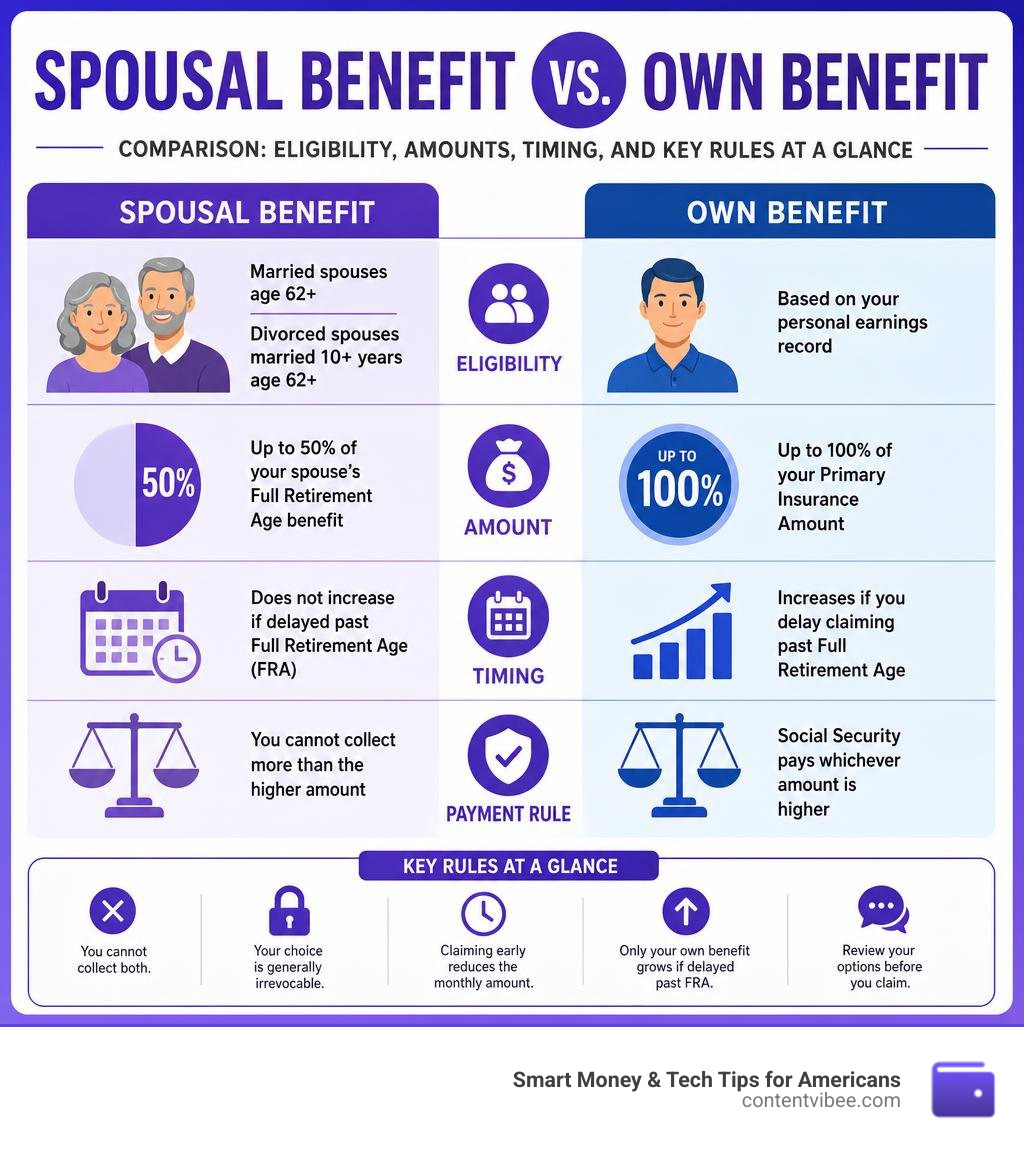
When it comes to spousal benefit vs own benefit, Social Security gives you two separate paths to monthly income — and picking the wrong one can cost you tens of thousands of dollars over your retirement.
Here’s the quick answer most people need:
| Question | Answer |
|---|---|
| What is a spousal benefit? | Up to 50% of your spouse’s full retirement age benefit |
| What is your own benefit? | Based on your personal earnings record, up to 100% of your Primary Insurance Amount |
| Can you collect both? | No — Social Security pays whichever amount is higher |
| Who qualifies for a spousal benefit? | Married spouses (age 62+) and divorced spouses (married 10+ years) |
| Does delaying past FRA increase the spousal benefit? | No — only your own benefit grows past Full Retirement Age |
Right now, about 2 million Americans receive an average spousal benefit of $986 per month. Many of them never realized they had a choice — or that the timing of their claim would permanently lock in that amount.
If you spent years out of the workforce, worked part-time, or simply earned less than your spouse, the spousal benefit might be your best option. But for others, a delayed personal benefit can easily exceed that 50% cap.
The gap between the best and worst claiming strategy for a married couple with unequal earnings can exceed $200,000 in lifetime benefits. That’s not a rounding error — that’s real money.
This guide breaks down exactly how each benefit works, what the rules say, and how to figure out which path puts more money in your pocket.
Understanding the Core Difference: Spousal Benefit vs Own Benefit
To make the best decision for your household wealth, we first need to look under the hood of how these two types of payments are structured.
Your own retirement benefit (often called retired worker benefits) is built entirely on your personal work history. The Social Security Administration (SSA) looks at your 35 highest-earning years, adjusts those earnings for inflation, and calculates your monthly check. If you have worked and paid Social Security taxes for at least 10 years (earning 40 work credits), you qualify for this benefit independently.
A spousal benefit, on the other hand, is designed to provide retirement income for spouses who either did not work outside the home or earned significantly less than their partners. Instead of using your own earnings record, this benefit is calculated using your spouse’s work history.
This means even if you have never worked a single day in a traditional job, you can still receive monthly Social Security payments based on your partner’s earnings. To understand how these two paths interact, you can read our guide on How Social Security Spousal Benefits Work for Married Couples and explore the specific criteria in our Detailed Guide to Spousal Benefits Eligibility.
How the SSA Calculates Your Spousal Benefit vs Own Benefit
The foundation of all Social Security calculations is the Primary Insurance Amount (PIA). Your PIA is the monthly amount you are eligible to receive if you claim your benefits at your exact Full Retirement Age (FRA).
When it comes to the spousal benefit, the calculation is strictly capped. The maximum spousal benefit you can receive is 50% of your spouse’s PIA.
Here is the most important calculation rule to remember: The spousal benefit is based on your spouse’s PIA at their Full Retirement Age, not what they actually receive. If your spouse delays claiming their benefit past their FRA to get a larger check, your maximum spousal benefit remains capped at 50% of their FRA amount.
Let’s look at a quick mathematical example of how the SSA compares your spousal benefit vs own benefit:
- Spouse A has a PIA of $2,400.
- Spouse B has their own work record with a PIA of $900.
- At Full Retirement Age, Spouse B’s maximum spousal benefit is 50% of Spouse A’s PIA, which equals $1,200.
- Because the spousal benefit of $1,200 is higher than Spouse B’s own retirement benefit of $900, Spouse B is eligible for the higher amount.
To see how this math applies to your unique situation, you can read our breakdown of Determining Your Spousal Social Security Benefit Amount. If you want to estimate your specific figures directly, the SSA provides a helpful tool on their Benefits for Spouses page.
Can You Collect Both Benefits Simultaneously?
We often hear the question: “Can I double-dip and collect both my own retirement benefit and my spousal benefit at the same time?”
The short answer is no. You cannot receive both benefits in full.
Instead, the SSA uses a policy called dual entitlement. Under these rules, if you qualify for both your own retirement benefit and a spousal benefit, the SSA will always pay your own retirement benefit first. If your spousal benefit is higher than your personal benefit, they will then pay you an additional spousal “top-off” to make up the difference. The combined payment will equal the higher spousal benefit amount.
Using our previous example:
- Spouse B receives $900 based on their own record.
- The SSA adds a spousal top-off of $300.
- Spouse B’s total monthly deposit is $1,200.
This ensures you always get the maximum amount you are eligible for, but you never receive both checks added together. For a deep dive into how the government manages these dual accounts, you can view the official policy via the SSA – POMS: RS 00615.020 – Dual Entitlement Overview – 12/05/2023 and read our comprehensive article His, Hers, and Ours: The Ultimate Guide to Dual Social Security Benefits.
How Claiming Age Impacts Your Monthly Payout
Timing is everything in retirement planning. The age at which you choose to claim your benefits has a permanent impact on how much money you receive each month.
Your Full Retirement Age (FRA) depends on the year you were born. For anyone born in 1960 or later, the FRA is 67. Claiming any time before reaching this age is considered “early claiming” and results in a permanent reduction of your monthly check.
To find your exact retirement age and see how it fits into your broader financial plan, read The Complete Guide to Social Security Full Retirement and Understanding Your Social Security Full Retirement Age.
The Math Behind Early Reductions for a Spousal Benefit vs Own Benefit
If you decide to claim benefits early, both your personal benefit and your spousal benefit will be reduced—but they are reduced using different formulas.
For your own retirement benefit, claiming at the earliest possible age of 62 can reduce your monthly payout by up to 30% compared to what you would receive at FRA.
For a spousal benefit, the reduction is even steeper. If you claim a spousal benefit at age 62, the payment is reduced to just 32.5% of your spouse’s PIA (which is a 35% reduction from the maximum 50% spousal cap).
Here is how the early claiming reduction math works for spousal benefits:
- The benefit is reduced by 25/36 of 1% for each of the first 36 months before your FRA.
- It is further reduced by 5/12 of 1% for each additional month beyond 36 months.
Let’s look at how claiming age affects a spousal benefit if your spouse’s FRA benefit is $2,000 (making your maximum spousal benefit $1,000):
- Claiming at FRA (Age 67): You receive the full 50%, which is $1,000/month.
- Claiming at Age 65: You receive 45.8%, which is $916/month.
- Claiming at Age 64: You receive 41.7%, which is $834/month.
- Claiming at Age 63: You receive 37.5%, which is $750/month.
- Claiming at Age 62: You receive 32.5% (or 35% if your FRA was 66), which is $650/month.
Claiming early permanently reduces the amount of benefits paid out over your lifetime. To run these numbers for your own retirement timeline, check out our resources on how to Calculate Spouse Retirement Benefits and Calculate Spousal Benefits: How Much Will You Get?.
Why Delaying Past FRA Only Helps Your Personal Record
If you delay claiming your own retirement benefit past your Full Retirement Age, your monthly check will increase by 8% for each year you wait, up to age 70. This means by waiting until 70, you can receive up to 124% of your PIA.
However, this delayed retirement credit does not apply to spousal benefits.
The spousal benefit is strictly capped at 50% of your partner’s PIA once you reach your own FRA. Waiting until age 68, 69, or 70 to claim a spousal benefit will not increase the monthly payment by a single penny.
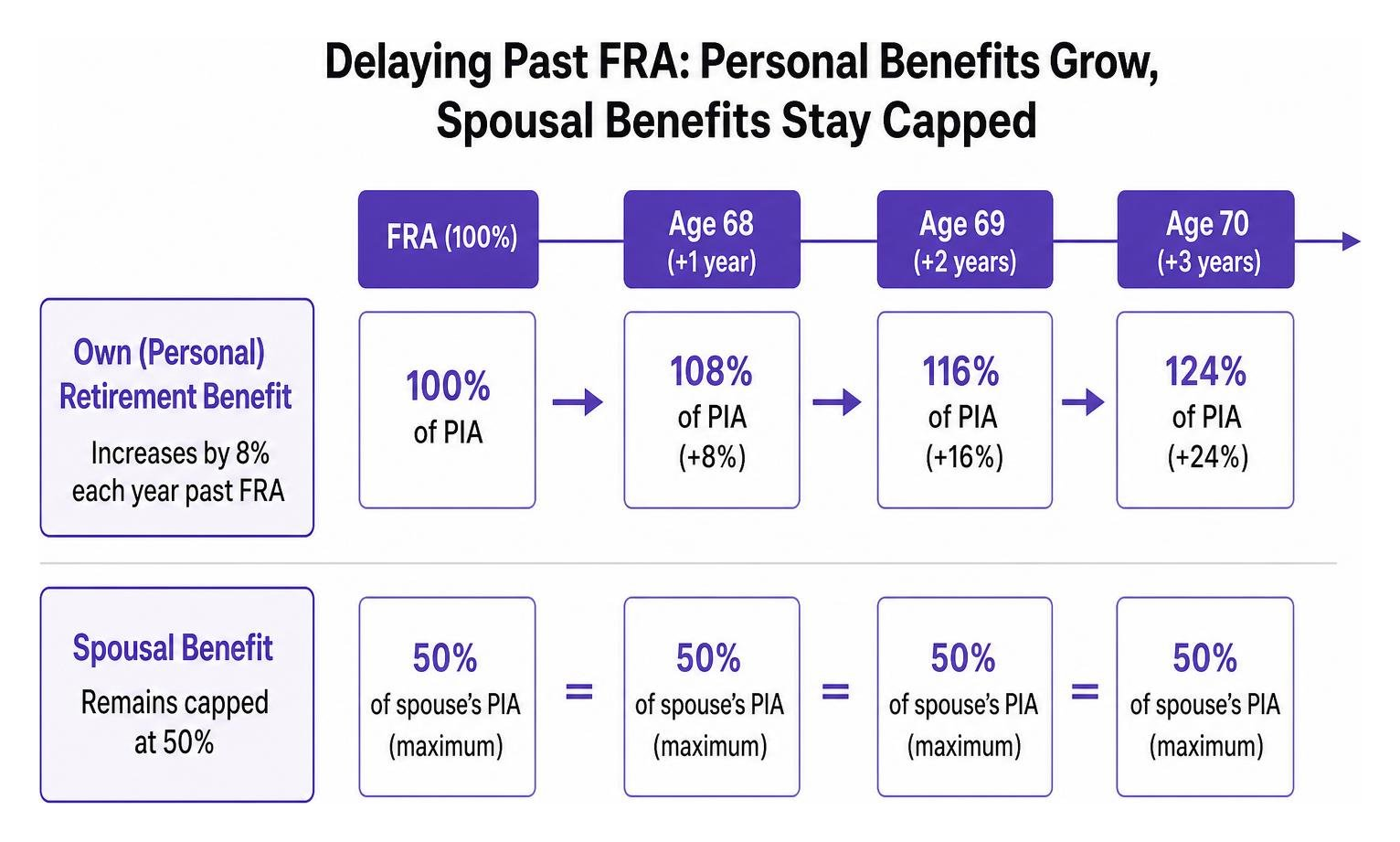
Therefore, if you know you will be receiving a spousal benefit because your own record is very small, there is absolutely no financial advantage to waiting past your Full Retirement Age to file. For a deeper academic look at how these claiming age combinations affect couples, you can read the Research: Social Security Retirement Benefit Claiming-Age Combinations Available to Married Couples.
Eligibility Rules for Married, Divorced, and Common-Law Couples
To qualify for a spousal benefit, you must meet specific criteria established by the SSA. These rules vary depending on your marital status.

For Married Couples
To claim on your current spouse’s record, you must:
- Be at least 62 years old (unless you are caring for a child of the worker who is under 16 or disabled).
- Have been married for at least one continuous year before filing.
- Your spouse must have already filed for their own retirement benefits. You cannot claim a spousal benefit until your partner is actively receiving their own check.
For Divorced Couples
You can claim a spousal benefit on an ex-spouse’s record if:
- Your marriage lasted for at least 10 consecutive years.
- You are currently unmarried (if you remarry, you generally lose the right to claim on your ex-spouse’s record, unless your subsequent marriage ends).
- You are at least 62 years old.
- Your ex-spouse is eligible for retirement benefits (even if they haven’t claimed them yet, provided you have been divorced for at least two continuous years).
Importantly, claiming on an ex-spouse’s record has zero impact on their benefit amount, nor does it affect the benefits of their current spouse if they have remarried. For answers to common post-divorce questions, read Answers to Your Biggest Social Security Questions After Divorce and our guide on How to Understand Spousal Benefit Eligibility.
For Common-Law Couples
If you live in a state that recognizes common-law marriage, you may still qualify for spousal benefits. You will need to provide the SSA with local evidence that your relationship meets your state’s legal standards. To learn more about this process, read The Ultimate Guide to Social Security and Common Law Marriage.
The 2026 Earnings Limit
If you plan to work while receiving either your own benefit or a spousal benefit before reaching your FRA, you must keep an eye on the annual earnings limit. In 2026, the earnings limit for individuals under FRA is $24,480. If you earn more than this amount, the SSA will temporarily withhold $1 in benefits for every $2 you earn above the limit.
Modern Claiming Rules: Deemed Filing and Voluntary Suspension
In the past, couples used creative claiming strategies to maximize their payouts. However, the Bipartisan Budget Act of 2015 closed these loopholes for the vast majority of retirees today.
The most critical change is the expansion of deemed filing.
Under the current rules, if you were born on or after January 2, 2016 (or turned 62 after that date), you no longer have the option to choose which benefit to file for. When you apply for either your own retirement benefit or a spousal benefit, you are “deemed” to have applied for both simultaneously. The SSA will automatically calculate both and pay you the higher amount.
The 2015 law also eliminated the popular “file and suspend” strategy. Previously, a higher-earning spouse could file for retirement benefits to allow their partner to claim a spousal benefit, and then immediately suspend their own payments to continue earning delayed retirement credits.
Today, if you choose to voluntarily suspend your retirement benefits, all benefits payable on your record—including your spouse’s spousal benefit—are also suspended.
To learn more about how these legislative updates impact your planning, read Double the Fun: A Guide to Social Security Spousal Benefits for Couples and Double the Fun: Understanding Your Spousal Social Security Benefits.
Strategic Coordination: Maximizing Combined Household Benefits
When coordinating your retirement plans as a couple, your goal should be to maximize the total lifetime income for the household, rather than looking at each record in isolation.
Here is a comparison of common claiming strategies for couples with unequal earnings:
| Strategy | Lower Earner Claiming Age | Higher Earner Claiming Age | Household Financial Impact |
|---|---|---|---|
| Early Rush | 62 | 62 | Lowest Lifetime Payout. Both benefits are permanently reduced. Ideal only if facing severe health issues or immediate cash needs. |
| Split Strategy | FRA (67) | 70 | Highly Optimized. The lower earner gets a solid spousal benefit at FRA, while the higher earner maximizes their personal benefit and secures the highest possible survivor benefit. |
| Max Delay | 70 | 70 | Asymmetric Return. Excellent for the higher earner, but the lower earner gains nothing past age 67 if they are receiving a spousal benefit. |
For many couples, a split strategy works best. Because the higher earner’s benefit has the greatest growth potential (8% per year up to age 70), it is usually best for the higher-earning spouse to delay claiming as long as possible. Meanwhile, the lower-earning spouse can claim their own benefit earlier to provide retirement cash flow for the household. Once the higher earner finally files, the lower earner can then be topped off with their spousal benefit.
To build a customized plan for your household, read The Ultimate Guide to Social Security Benefit Optimization, check out The Smart Couples Guide to Social Security Strategies, and learn about timing in Timing Is Everything: How Married Couples Can Claim Social Security Simultaneously.
Planning for the Future: Spousal vs. Survivor Benefits
As you plan, it is critical not to confuse spousal benefits with survivor benefits. They have entirely different rules:
- Spousal benefits are paid while your partner is still alive and are capped at 50% of their PIA.
- Survivor benefits are paid after your partner passes away. A surviving widow or widower is eligible to receive up to 100% of the deceased spouse’s actual benefit (including any delayed retirement credits they earned by waiting until age 70).
This is why it is so important for the higher-earning spouse to delay claiming until age 70 if they have average-to-above-average life expectancy. By waiting, they are not only maximizing their own monthly check, but they are also securing a much larger, inflation-protected survivor benefit for their spouse.
Additionally, survivor benefits are exempt from deemed filing. A surviving spouse can choose to claim a survivor benefit as early as age 60 (or 50 if disabled) while letting their own personal retirement benefit grow untouched until age 70, then switch to their own higher record.
Frequently Asked Questions about Spousal and Personal Benefits
Can I switch from my own benefit to a spousal benefit later?
Yes, but only under specific circumstances. Because of deemed filing, you cannot actively choose to switch back and forth. However, if you file for your own retirement benefit at age 62, and your spouse has not yet claimed their benefit, you cannot receive a spousal benefit yet.
Once your spouse eventually files for their retirement, the SSA will automatically review your account. If 50% of your spouse’s PIA is higher than your own retirement benefit, the SSA will automatically add the spousal top-off to your monthly check.
Does my spouse’s claim reduce my own retirement benefit?
No. Claiming a spousal benefit on your partner’s work record does not reduce their personal monthly check in any way. Your spouse will still receive 100% of the benefit they earned. The spousal benefit is an auxiliary payment created by the government, not a withdrawal from your partner’s personal account.
How do I calculate my estimated benefits online?
To get accurate projections, both you and your spouse should log into your personal my Social Security accounts on the SSA website. This will show you your exact earnings records and estimated benefits at different claiming ages.
Once you have your PIAs, you can use specialized tools to compare your options. We recommend reading Do the Math: Top Social Security Calculators for Married Couples and exploring our interactive Tools/Finance Calculator/Social Security Spousal Benefit Calculator. For more general calculations, check out the Social Security Calculator: How to Calculate Retirement Benefits and the Social Security Calculator: Estimate Your Benefit Amount.
Conclusion

Deciding between your spousal benefit vs own benefit is one of the most important financial milestones of your retirement journey. By understanding how the 50% cap works, avoiding early claiming penalties when possible, and coordinating your filing dates with your partner, you can secure a larger monthly income stream.
At Suppremo, we are dedicated to helping you navigate these complex rules to build a secure financial future. Don’t leave your hard-earned benefits on the table. Take control of your retirement planning today by using our step-by-step guide to calculate your spousal benefits the easy way and make the choice that maximizes your household wealth.