The No-Nonsense Guide to Figuring Margin Percentage and Boosting Sales

Why Figuring Margin Percentage Can Make or Break Your Business
Figuring margin percentage is one of the most important financial skills any business owner, freelancer, or retiree managing side income can learn — yet it’s also one of the most commonly confused.
Here’s the quick answer most people need:
How to calculate margin percentage:
- Subtract your cost from your revenue to get gross profit
- Divide gross profit by revenue (not cost)
- Multiply by 100
Example: You sell something for $100 and it cost you $60 to make or buy. Your margin is ($100 – $60) / $100 × 100 = 40%.
Important: Always divide by revenue, never by cost. Dividing by cost gives you markup — a different number entirely.
Quick reference table:
| You know | Formula | Example |
|---|---|---|
| Cost + Revenue | (Revenue – Cost) / Revenue × 100 | ($100 – $60) / $100 = 40% |
| Profit + Revenue | Profit / Revenue × 100 | $40 / $100 = 40% |
| Target margin | Cost / (1 – Margin) | $60 / 0.60 = $100 price |
Here’s why this matters beyond just a formula. Too many business owners focus only on revenue — how much is coming in — while ignoring whether they’re actually keeping enough of it. You can be selling constantly and still be losing ground if your margins are too thin to cover your real costs.
The average gross profit margin across all U.S. industries sits at 39%, but that number swings wildly — from around 11% in auto manufacturing to over 72% in software. Knowing where you stand against your industry is just as important as knowing the math.
This guide walks you through everything: the formulas, the margin vs. markup distinction (they are not the same), industry benchmarks for 2026, and how hidden costs like platform fees and shipping quietly eat into your real margin.
What is Margin Percentage and How Does It Differ From Markup?
The most common financial mistake small business owners make is confusing profit margin with markup. While both metrics use the exact same two inputs—cost and selling price—they describe completely different financial realities.
Let’s define them clearly:
- Margin (or Gross Profit Margin) is the percentage of the selling price that is profit. It is calculated based on revenue. It answers the question: “Of every dollar my business brings in, how many cents do we keep?”
- Markup is the percentage added to the cost of an item to arrive at its selling price. It is calculated based on cost. It answers the question: “How much extra did we charge on top of what this item cost us?”
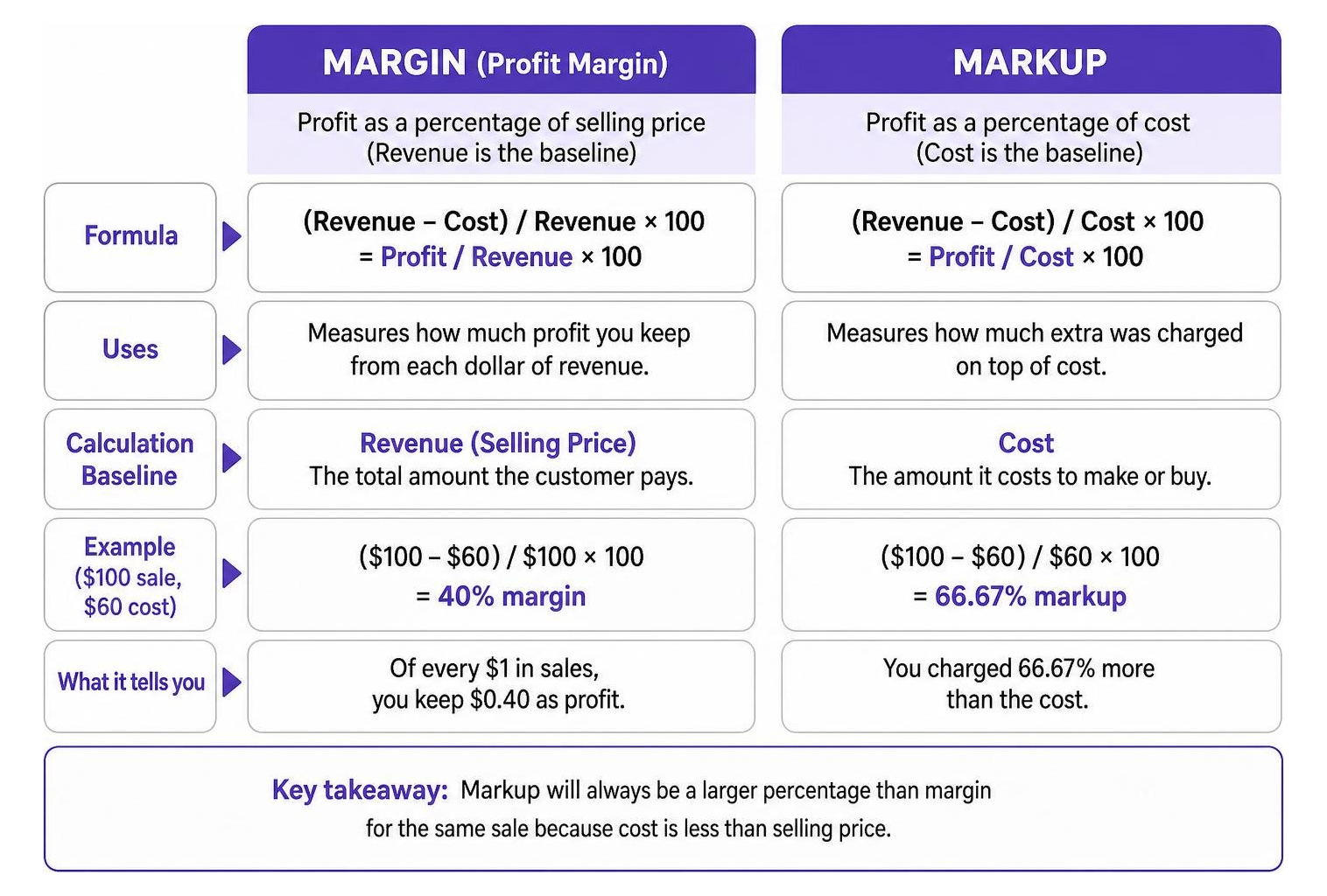
Because margin is calculated using a larger denominator (selling price) and markup uses a smaller denominator (cost), markup will always be a larger percentage than margin for any given transaction.
For example, if you buy a custom-designed t-shirt for $15 and sell it for $25:
- Your gross profit is $10.
- Your margin is $10 divided by your $25 selling price, which equals 40%.
- Your markup is $10 divided by your $15 cost, which equals 66.67%.
If you confuse these two, you risk severely underpricing your products. Imagine you want to achieve a 40% profit margin on an item that costs you $60 to produce. If you mistakenly apply a 40% markup instead, you will add 40% of $60 ($24) to the cost, setting your price at $84.
However, at an $84 selling price and a $60 cost, your actual profit is $24. When you divide $24 by your $84 revenue, your actual margin is only 28.57%. By confusing markup with margin, you just lost out on over 11% of your planned profitability!
To avoid this trap, Learn more about the easiest way to calculate profit margin to ensure your pricing strategies match your real-world financial goals.
| Financial Scenario | Margin Perspective | Markup Perspective |
|---|---|---|
| Underlying Question | What percentage of my revenue is profit? | What percentage over cost did I charge? |
| Formula | (Profit / Selling Price) × 100 | (Profit / Cost Price) × 100 |
| Mathematical Limit | Can never exceed 100% (unless costs are negative). | Can be infinitely large (e.g., 500% or 1,000% for luxury goods). |
| Who Uses It? | CFOs, investors, and accounting software to evaluate overall business health. | Sales managers and purchasing departments to quickly set retail prices. |
The Step-by-Step Formula for Figuring Margin Percentage
To calculate gross profit margin percentage manually, you only need to follow a simple four-step process.
- Identify your Total Revenue: This is the net sales amount generated by your product, service, or business over a specific timeframe.
- Identify your Cost of Goods Sold (COGS): This includes only the direct costs associated with producing or purchasing the items you sold. For physical goods, this means materials, direct manufacturing labor, and packaging. For services, this means direct labor hours used to deliver that specific service.
- Calculate your Gross Profit: Subtract your COGS from your Total Revenue.
- Divide and Convert: Divide your Gross Profit by your Total Revenue, then multiply the result by 100 to turn it into a percentage.
Mathematically, the formula looks like this:
$$\text{Margin Percentage} = \left( \frac{\text{Revenue} – \text{COGS}}{\text{Revenue}} \right) \times 100$$
Let’s walk through a real-world example. Imagine you run an online artisanal candle shop. Last month, you generated $12,000 in revenue. Your raw wax, wicks, fragrance oils, jars, and shipping boxes cost you $4,800.
- Revenue: $12,000
- COGS: $4,800
- Gross Profit: $12,000 – $4,800 = $7,200
- Margin Calculation: ($7,200 / $12,000) × 100 = 60%
This means that for every dollar your customer spent on your candles, you kept 60 cents as gross profit to help run your business and pay yourself. To see how these numbers impact your broader business model, Discover how gross margin costs affect small businesses.
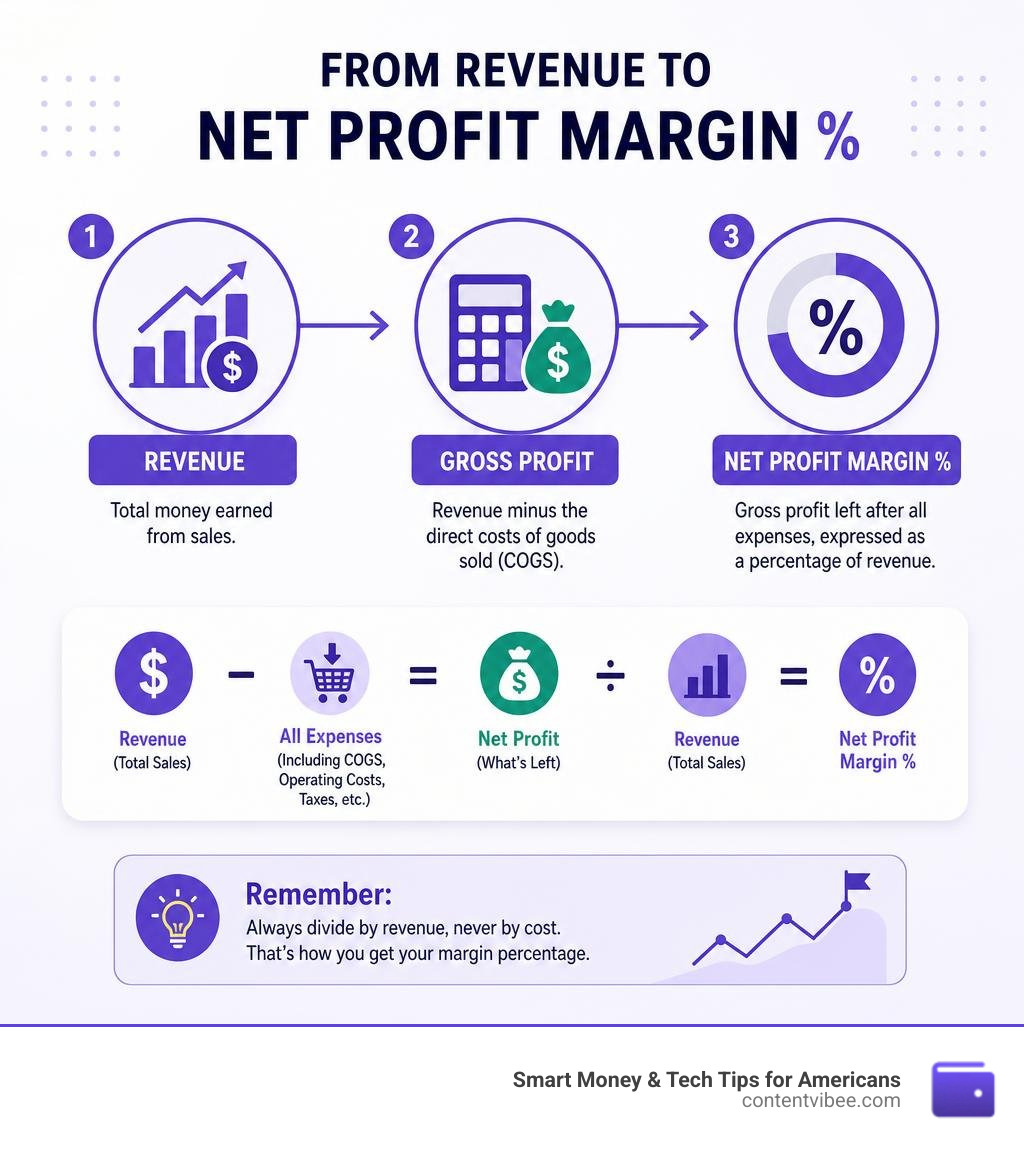
Gross Profit Margin vs. Net Profit Margin
While figuring your gross margin percentage is fantastic for checking the profitability of individual products, it doesn’t tell the whole story of your business’s financial health. To get the complete picture, you must understand the difference between gross profit margin and net profit margin.
- Gross Profit Margin only subtracts the direct costs of production (COGS) from your revenue. It completely ignores overhead like rent, software subscriptions, advertising, administrative salaries, insurance, and taxes.
- Net Profit Margin is the ultimate metric of business viability. It subtracts all business expenses from your revenue before calculating the percentage. It represents your true “bottom line.”
For instance, if your candle shop brought in $12,000 in revenue, had a 60% gross margin ($7,200 gross profit), but you spent $4,000 on digital advertising, $1,000 on rent for your workspace, $500 on software, and $700 on taxes, your remaining net income is only $1,000.
Your net profit margin is ($1,000 / $12,000) × 100 = 8.33%.
A healthy gross margin is a prerequisite for a healthy business, but if your operating expenses are too high, even a 90% gross margin product can result in a net loss.
Converting Margin to Markup: The Mathematical Relationship
Because margin and markup are closely related, they share a fixed mathematical relationship. You can easily convert between the two without even knowing the specific cost or revenue figures.
If you know your target margin and want to find the required markup to achieve it, use this formula:
$$\text{Markup \%} = \frac{\text{Margin \%}}{100\% – \text{Margin \%}} \times 100$$
Conversely, if you want to know what margin a specific markup percentage yields, use this formula:
$$\text{Margin \%} = \frac{\text{Markup \%}}{100\% + \text{Markup \%}} \times 100$$
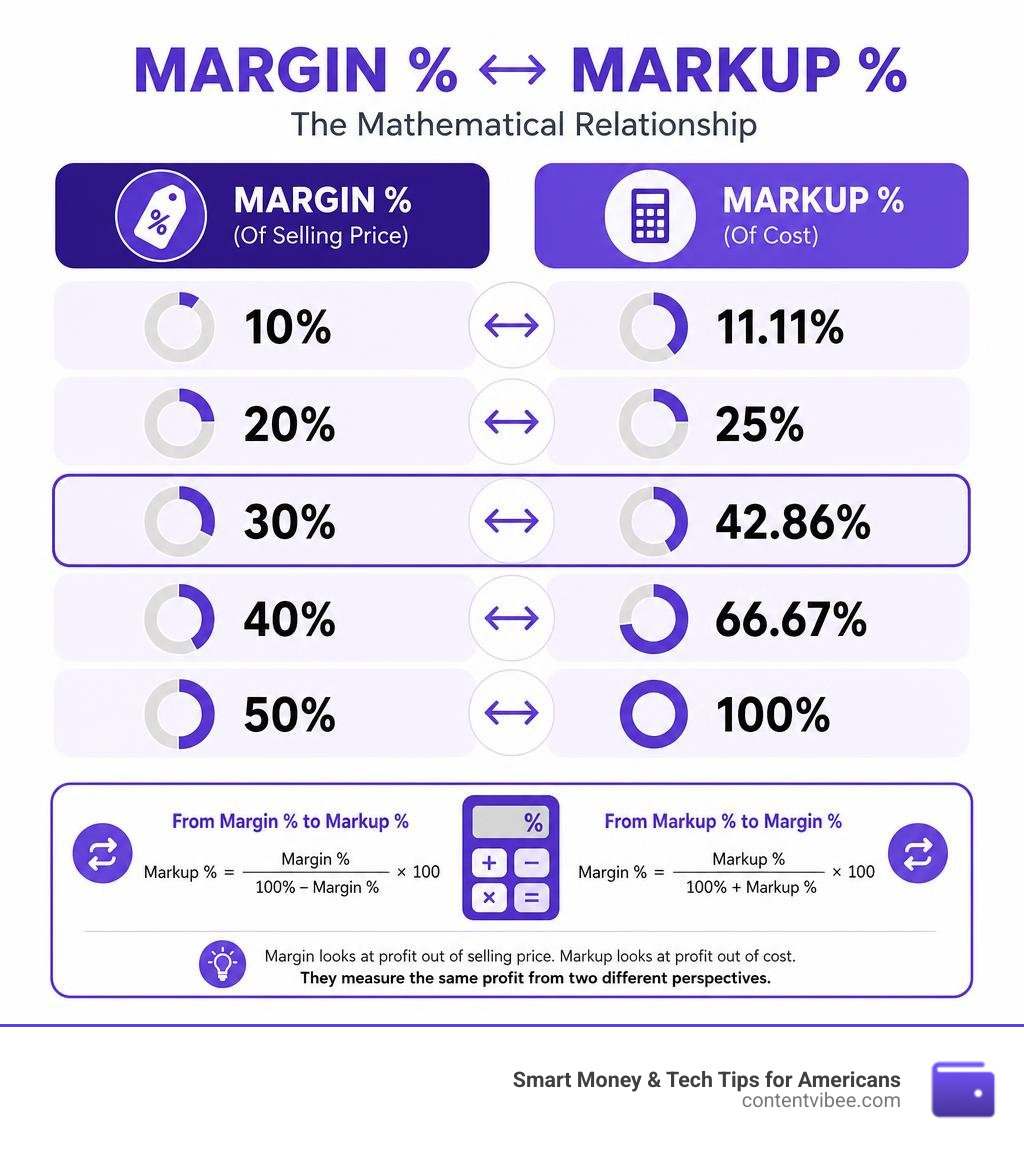
Understanding these conversions is crucial for protecting your profit margins. If a supplier raises your wholesale costs by 10% and you simply raise your retail price by 10%, your dollar profit increases, but your margin percentage actually shrinks!
To make these calculations effortless and avoid costly pricing errors, Check out this Markup to Margin Calculator tool to quickly convert your targets.
Industry Benchmarks: What is a Good Profit Margin in 2026?
What constitutes a “good” profit margin? The honest answer is that it depends entirely on your industry, business model, and growth stage. Comparing a local grocery store’s margins to a software-as-a-service (SaaS) company is like comparing apples to spaceships.
As a general rule of thumb across the business landscape:
- 5% net margin is considered poor or tight.
- 10% net margin is average and okay.
- 20% net margin is considered good and highly sustainable.
However, when we look at gross profit margins, the benchmark numbers shift dramatically depending on the sector. Here is a breakdown of average gross profit margins across various U.S. industries:
- Retail Real Estate Investment Trusts (REITs): 77.48%
- Software Systems & Applications: 72.38%
- Financial Services (Non-Bank & Insurance): 68.37%
- Entertainment Software: 65.38%
- Healthcare Products: 56.04%
- Machinery Manufacturing: 37.08%
- General Retail: 32.22%
- Food Wholesalers: 15.36%
- Healthcare Support Services: 13.16%
- Auto & Truck Manufacturing: 11.11%
- Oilfield Services: 10.71%
High-margin businesses (like software and financial services) require less sales volume to survive because they keep a massive portion of every dollar. Low-margin businesses (like grocery stores, wholesale food, and auto manufacturing) must rely on massive transaction volume and high inventory turnover to generate substantial net profits.
How to Improve Your Business Margin Percentage
If you look at your current margin percentage and realize it is too low to sustain your business, you have two primary levers to pull: increase your prices or lower your costs.

Here are five practical, strategic steps to improve your margin percentage:
- Audit Every Cost Component: Break down your COGS into individual items. Are you paying too much for packaging? Can you source raw materials from a different supplier or buy in bulk to receive volume discounts?
- Implement Small, Strategic Price Increases: You don’t have to double your prices overnight to see a massive difference. An annual price increase of just 2% to 5% can dramatically boost your margin percentage because that extra revenue goes straight to your bottom line without increasing your costs.
- Shift Your Product Mix: Analyze which of your products have the highest gross margins and focus your marketing budget on promoting those specific items. Conversely, consider phasing out low-margin products that take up excessive storage space or labor.
- Negotiate Supplier Terms Annually: Don’t accept price hikes passively. Request competing quotes from alternative vendors and use those quotes as leverage to negotiate better rates with your existing suppliers.
- Increase Average Order Value (AOV): Implement product bundling, upselling, and cross-selling at checkout. Shipping and transaction processing costs are relatively fixed per order; by encouraging customers to buy more per transaction, you spread those fixed costs across a larger revenue base, improving your effective margin.
Understanding your financial boundaries is key to making these decisions safely. Read our guide on margin of safety in managerial accounting to learn how to calculate the buffer your business needs before a drop in sales turns into a financial crisis.
Frequently Asked Questions About Figuring Margin Percentage
What is the easiest way of figuring margin percentage in Excel?
Calculating margin percentage in Microsoft Excel or Google Sheets is incredibly simple and allows you to automate your pricing analysis.
To set up a basic margin calculator in your spreadsheet:
- Input your product’s cost price in cell A2.
- Input your product’s selling price (revenue) in cell B2.
- In cell C2, enter the formula
=B2-A2to calculate your profit. - In cell D2, enter the formula
=C2/B2to calculate your margin. - Highlight cell D2 and click the Percent Style (%) button in the Excel toolbar to format the decimal as a clean percentage.
By setting up your sheet this way, you can drag the formulas down to analyze hundreds of products simultaneously. Learn how to easily add margin formulas in Excel for advanced techniques, including how to calculate target selling prices based on a desired margin.
How does figuring margin percentage differ for service businesses?
Service-based businesses and freelancers don’t have physical inventory, meaning they don’t have a traditional Cost of Goods Sold (COGS). Instead, their primary cost is time and specialized labor.
To calculate your effective margin as a service provider:
- Calculate your direct labor cost (the hourly rate you pay yourself or your employees to complete the work).
- Add any direct software, materials, or subcontractor expenses required for that specific client project.
- Subtract these direct costs from your total project fee to find your gross profit.
- Divide your gross profit by the total project fee.
For example, if you charge a client $1,000 for a website design, and it takes you 10 hours of work (valuing your direct labor at $50/hour), your direct cost is $500. Your gross profit is $500, giving you a 50% gross margin.
If you are an accountant, consultant, or agency owner, Explore our margin calculator for accountants to stop undercharging and ensure your billable hours are priced to maximize business growth.
How do platform fees and shipping affect my effective margin?
Many online sellers suffer from what financial analysts call “Phantom Loss.” They calculate a beautiful 60% gross margin on paper, only to find their bank accounts empty at the end of the month. This happens because they fail to account for variable transaction and platform fees.
If you sell on marketplaces like Amazon or Etsy, or use payment processors like Stripe, these platforms take a cut of your total revenue (including shipping charges).
- Standard payment processing: Typically 2.9% + $0.30 per transaction.
- Etsy transaction fees: 6.5% plus payment processing fees.
- Amazon referral fees: Often 15% of the total sales price.
If you sell a handmade ceramic mug for $25 that costs you $10 to make, your paper gross margin is a healthy 60%. However, if you sell it on Etsy and charge $5 for shipping:
- Total customer paid: $30
- Etsy transaction fee (6.5% of $30): $1.95
- Payment processing fee (3% + $0.25): $1.15
- Actual shipping label cost: $5.50
- Net revenue received: $21.40
- Your actual profit: $21.40 – $10 (cost) = $11.40
- Your effective margin drops from 60% to 38% ($11.40 profit / $30 total revenue).
Always build these variable platform expenses directly into your COGS to protect your bottom line from being quietly eroded by transaction fees.
Conclusion
Figuring your margin percentage accurately is the difference between running a thriving, profitable business and working yourself to the bone for zero financial return. By mastering the distinction between margin and markup, tracking your true COGS, and factoring in hidden platform fees, you gain the confidence to price your products for real sustainability.
Never guess your pricing. Take control of your numbers today and Calculate your target pricing instantly with the Omni Margin Calculator to secure the profits your hard work deserves.