How the Multiplier Method Decides Your Accident Payout

What Is the Formula for Auto Accident Settlement?
The formula for auto accident settlement is how insurance companies and attorneys put a dollar amount on your injury claim — and understanding it could be the difference between accepting a lowball offer and getting what you actually deserve.
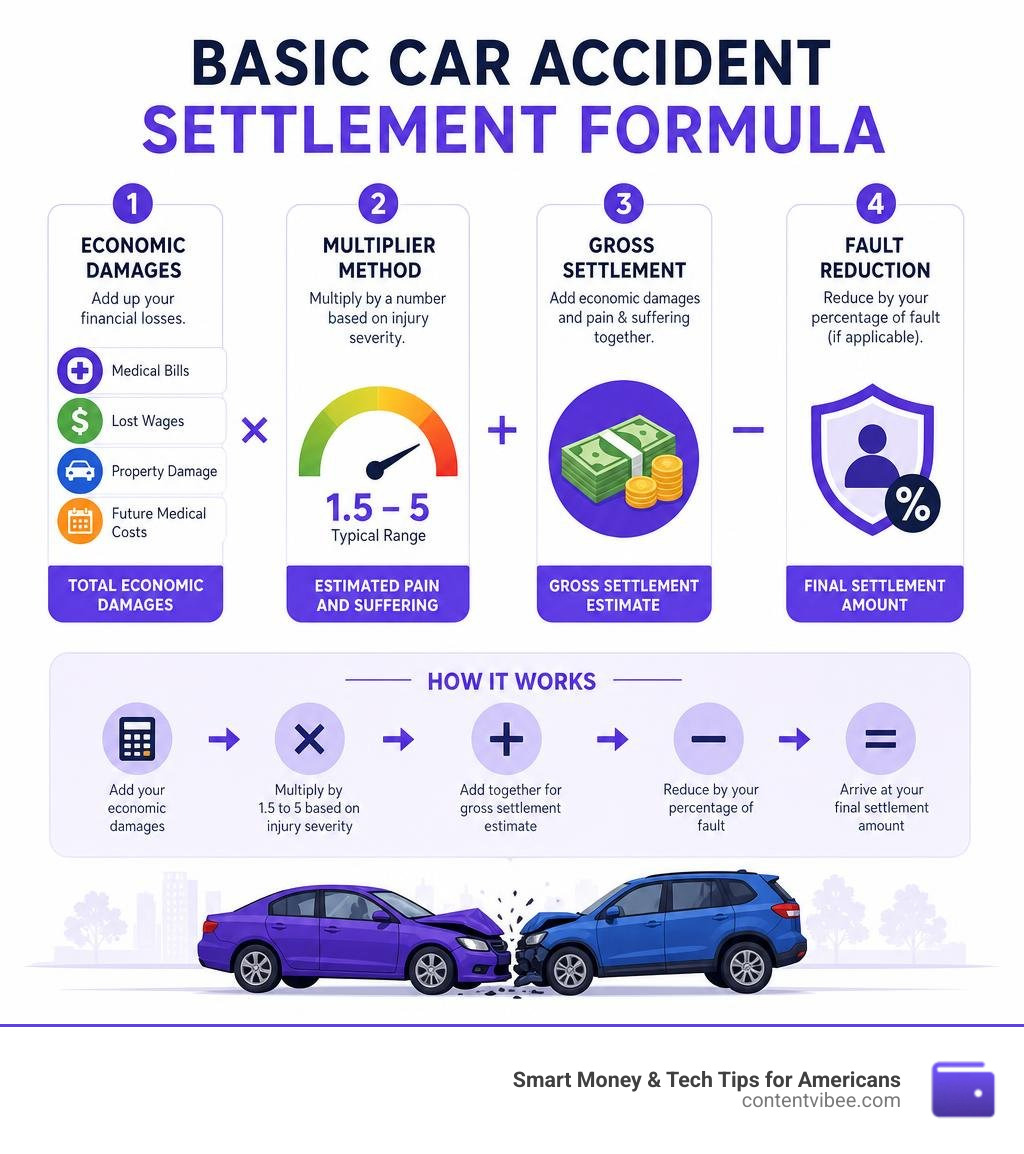
Here’s the core formula in plain English:
- Add up your economic damages (medical bills + lost wages + property damage + future medical costs)
- Multiply by a number between 1.5 and 5 (based on how serious your injuries are) — this estimates your pain and suffering
- Add both together to get your gross settlement estimate
- Reduce by your percentage of fault (if you were partly to blame)
Quick example:
| Item | Amount |
|---|---|
| Medical bills | $10,000 |
| Lost wages | $5,000 |
| Property damage | $2,000 |
| Total economic damages | $17,000 |
| Multiplier (moderate injury) | × 3 |
| Pain and suffering estimate | $51,000 |
| Estimated gross settlement | $68,000 |
The national average car accident settlement in 2026 is $30,416 — but that number means very little on its own. A whiplash case and a spinal cord injury both get lumped into that average. Your actual payout depends heavily on your specific injuries, your state’s laws, and the insurance policy limits involved.
The math looks simple. But knowing which multiplier applies to your case — and how fault rules in your state change the final number — is where most people leave money on the table.
Understanding the Formula for Auto Accident Settlement
To understand how the math works, we have to look at the two building blocks of any personal injury claim: economic damages and non-economic damages. When you are negotiating with an insurance adjuster, they will not just look at a single lump sum. They break your life down into these two categories to build their offer.
If you want to know how the insurance company plays this game, you can read our deep dive on The Car Accident Settlement Formula and How to Beat It. For now, let’s look at how these two types of damages are defined and calculated.
Economic Damages: Calculating Your Special Damages
Economic damages (also known legally as “special damages”) are the tangible, easily provable financial losses resulting from your wreck. These are the bills that come in the mail and the paychecks you missed because you were recovering in a hospital bed.
Calculating these damages is relatively straightforward because they leave a paper trail. To get an accurate total, you must gather:
- Medical Bills: This includes ambulance rides, ER visits, surgeries, physical therapy, medication, and medical devices. In some states, like California (under the Howell v. Hamilton Meats ruling), you can only recover the amount actually paid by your health insurance, not the initial inflated sticker price. For a deeper look at this, check out this guide on How to calculate personal injury damages.
- Lost Wages: Any income you lost because your injuries kept you from working. This includes sick leave or vacation time you had to burn.
- Property Damage: The cost to repair or replace your vehicle and any personal items inside (like laptops or car seats) that were damaged in the crash.
- Future Expenses: If you require ongoing chiropractic care, future surgeries, or have a permanent disability that limits your future earning capacity, these must be estimated and added to your economic damages.
Non-Economic Damages: Quantifying Pain and Suffering
Non-economic damages (or “general damages”) represent the human cost of the accident. These are the losses that do not come with a receipt. How do you put a price tag on waking up with chronic back pain, experiencing severe anxiety every time you merge onto the highway, or being unable to pick up your toddler?
Non-economic damages cover:
- Physical pain and suffering
- Emotional distress and mental anguish (insomnia, PTSD, depression)
- Loss of enjoyment of life (being unable to participate in hobbies or sports)
- Loss of consortium (the negative impact on your relationship with your spouse)
- Scarring, disfigurement, or permanent physical impairment
Because there is no invoice for emotional trauma, insurance companies and attorneys rely on formulas to turn these intangible losses into a concrete dollar amount. If you want to see how these elements apply to a real claim, take a look at our AZ Guide to How Much Is My Car Accident Settlement Worth.
The Multiplier Method vs. The Per Diem Method
To calculate non-economic damages, the insurance industry primarily uses two formulas: the Multiplier Method and the Per Diem Method.
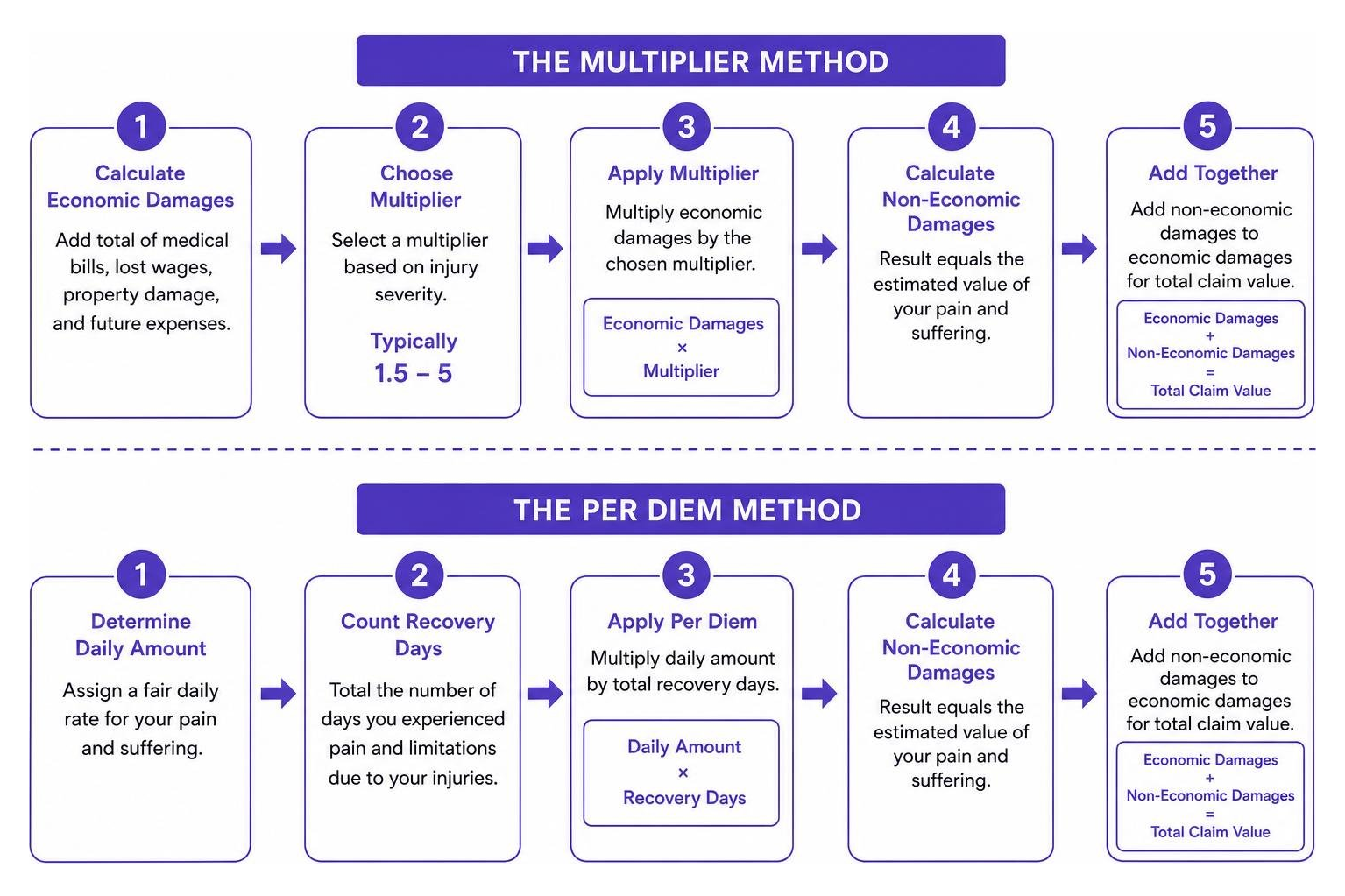
While both methods aim to quantify your pain and suffering, they approach the math from completely different angles. Here is a quick snapshot of how they compare:
| Feature | The Multiplier Method | The Per Diem Method |
|---|---|---|
| Primary Driver | Total cost of your medical bills and lost wages | The number of days you spent recovering |
| The Formula | Economic Damages × Multiplier (1.5 to 5) | Daily Rate × Number of Days in Recovery |
| Best Used For | Moderate to severe injuries with long-term impacts | Short-term, clear-cut recoveries with a defined end date |
| Adjuster Preference | Highly preferred by major insurers (often built into software) | Rarely used for major injuries; open to heavy negotiation |
How the Multiplier Method Decides Your Pain and Suffering Value
The multiplier method is the undisputed heavyweight champion of the insurance world. It is the formula adjusters and attorneys use most often to kick off negotiations.
Under this method, we take your total economic damages and multiply them by a factor between 1.5 and 5. This multiplier is chosen based on the severity of your injuries:
- 1.5x to 2x multiplier: Minor, soft-tissue injuries (like whiplash or mild muscle strains) where you make a full recovery in a few weeks.
- 2x to 3x multiplier: Moderate injuries (like simple bone fractures or herniated discs) requiring physical therapy or minor procedures.
- 3x to 5x multiplier: Severe, long-term injuries (like complex fractures requiring surgery, nerve damage, or moderate traumatic brain injuries).
- 5x to 10x+ multiplier: Catastrophic, permanent injuries (such as paralysis, loss of a limb, severe spinal cord damage, or wrongful death).
To see how these ranges shift depending on your specific injuries, you can use the Personal Injury Settlement Calculator 2026 to run your own numbers.
How the Per Diem Method Calculates Daily Suffering
“Per diem” is Latin for “by the day.” This method assigns a specific daily dollar value to your pain and suffering and multiplies it by the number of days it took you to reach Maximum Medical Improvement (MMI) — the point where your doctor says you have recovered as much as you realistically can.
How do we determine the daily rate? A common rule of thumb is to use your actual daily earnings. The logic is that living with the pain of an injury is at least as difficult as a hard day of work.
For example, if you make $250 a day at your job, and it takes you 90 days of medical treatment and physical therapy to fully recover from a shoulder injury, the per diem calculation would look like this:
$$\text{90 days} \times \$250/\text{day} = \$22,500 \text{ for pain and suffering}$$
We then add this $22,500 to your actual medical bills and lost wages to find your total settlement target. You can learn more about how this daily calculation interacts with state laws by visiting the Car Accident Settlement Calculator Multiplier, Per Diem & Fault.
How Insurers Choose Your Multiplier (1.5x to 5x)
Insurance companies do not just let human adjusters pick a multiplier out of thin air. In fact, major insurance carriers (like State Farm, GEICO, and Allstate) use complex claims-handling software like Colossus or Claims Outcome Advisor.
These programs analyze your medical records, diagnostic codes, and treatment history to assign “severity points” to your claim. If you want to estimate what an insurance company’s software might output for your specific situation, you can use our Settlement Calculator Estimate Your Claim Amount.
To get a higher multiplier, we must show the insurance company objective evidence. The software looks for specific “value drivers,” including:
- Invasive treatments: Surgeries, injections, or skin grafts get much higher multipliers than chiropractic adjustments or massage therapy.
- Objective diagnostic evidence: MRIs showing a herniated disc or X-rays showing a shattered bone carry far more weight than a doctor simply writing down that you have “neck pain.”
- Treatment consistency: If you have a 3-week gap where you did not go to physical therapy, the software assumes you were not actually in pain and will slash your multiplier.
- Permanent impairment: A written statement from your physician confirming that you will suffer from chronic pain or limited mobility permanently is the strongest multiplier driver.
Real-World Adjustments to Your Accident Payout
The mathematical formula is a great starting point, but in the real world, several massive legal and financial factors can slash your actual payout or cap it entirely.

How Shared Fault Affects the Formula for Auto Accident Settlement
If you played a role in causing the accident, your final payout will be reduced based on your state’s comparative negligence laws. The U.S. uses three primary systems for handling shared fault:
- Pure Comparative Negligence (e.g., California, New York, Florida): You can recover damages even if you were 99% at fault for the crash. However, your payout is reduced by your exact percentage of blame. If your total damages are $100,000, but a jury finds you were 20% at fault because you were speeding, your final check will be $80,000.
- Modified Comparative Negligence (50% or 51% Bar): In these states (like Texas or Illinois), you can only recover money if your share of the blame is below a certain threshold. In a 50% bar state, you get nothing if you are 50% or more at fault. In a 51% bar state, you get nothing if you are 51% or more at fault.
- Contributory Negligence (The Strictest System): In a handful of jurisdictions (like Virginia, Maryland, and North Carolina), if you contributed to the accident by even 1%, you are completely barred from recovering any compensation.
To see how your state’s fault rules might impact your numbers, try using this Auto Settlement Calculator.
How Policy Limits Cap the Formula for Auto Accident Settlement
You could have a textbook case worth $500,000, but if the driver who hit you only carries the state-minimum bodily injury liability limit of $15,000, you are facing a massive roadblock.
Insurance companies will never pay out more than their policy limits, regardless of what the formula for auto accident settlement says your case is worth. If the at-fault driver has a $25,000 limit, the insurance company will write a check for $25,000 and close the file.
To protect yourself from this scenario, we always recommend checking your own auto policy for Uninsured/Underinsured Motorist (UM/UIM) coverage. If the at-fault driver’s policy cannot cover your full damages, your own insurance carrier steps in to pay the difference up to your UM/UIM policy limits.
Additionally, if you hire an attorney to navigate these limits, it is helpful to understand how their payment works. You can read our guide on Demystifying Personal Injury Lawyer Fees and Contingency Percentages to see how legal fees are deducted from your final settlement check.
Why Online Calculators Often Fall Short
If you search the internet, you will find dozens of free car accident settlement calculators. While they are fun to use, most of them are highly inaccurate.
The biggest flaw in generic online calculators is that they ignore location. Where your accident happened is actually one of the single biggest factors in your case value. For example, according to 2026 data:
- The average settlement in New York is $287,000 (844% above the national average).
- The average settlement in California is $185,000 (508% above the national average).
- A whiplash injury in rural Nebraska might settle for $12,000, while the exact same injury in downtown Manhattan could easily settle for $65,000+ due to local jury tendencies and higher medical costs.
Most online tools use a flat, outdated multiplier that does not account for local court systems, state damage caps, or the specific software algorithms used by insurance adjusters. If you want a more realistic estimate that actually accounts for these variables, check out the Realistic Settlement Calculator: Get an Accurate Estimate (2026) or explore our own Tools Settlement Calculators Realistic Settlement Calculator.
Frequently Asked Questions about Car Accident Settlements
What is the average car accident settlement in 2026?
The national average car accident settlement in 2026 is $30,416. However, averages can be incredibly misleading because they pool minor scratches together with catastrophic, life-altering injuries.
To give you a better idea of what realistic cases look like, let’s break down the median settlements by injury type:
- Whiplash / Neck Injury: Median settlement of $11,271 (typical range: $4,164 to $33,791).
- Back Strain / Soft Tissue: Median settlement of $18,344 (typical range: $7,100 to $60,000).
- Lumbar Disc Injury (Herniated/Bulging Disc): Median settlement of $63,594 (typical range: $20,192 to $248,912).
- Semi-Truck / 18-Wheeler Accidents: Average settlement of $103,654 (3.4 times higher than general passenger car accidents due to commercial insurance policies).
- Wrongful Death: Median settlement of $2,125,000.
- Spinal Cord Injury: Median settlement of $16,059,715 (due to the lifelong cost of medical care and assistance).
For a deeper dive into these statistics, you can review the Car Accident Settlement 2026: Average Values & Calculator.
When are punitive damages available in a car accident case?
Punitive damages are incredibly rare in car accident cases. Unlike economic and non-economic damages, which are designed to compensate the victim, punitive damages are designed to punish the defendant and deter others from similar behavior.
You cannot get punitive damages for simple negligence (like failing to yield or accidentally running a stop sign). They are only awarded if the at-fault driver acted with:
- Malice or Intent: Intentionally ramming your car in a road rage incident.
- Extreme Recklessness: Drunk driving with a highly elevated BAC, street racing, or fleeing the police.
How can I maximize my car accident settlement?
If you want to beat the insurance company’s lowball initial offers (which average 30% to 50% below fair value), you must take active steps to protect your claim:
- Seek immediate medical attention: Do not “wait and see” if your neck pain goes away. Go to an ER or urgent care within 72 hours. Gaps in treatment are the #1 excuse insurers use to deny claims.
- Collect evidence at the scene: Take photos of the vehicle damage, road conditions, skid marks, and the other driver’s license and insurance card. Get a copy of the police report.
- Keep a pain journal: Document your daily pain levels and note specific things you could not do because of your injuries (e.g., “Could not sleep due to shoulder pain,” or “Missed my daughter’s soccer game”).
- Finish your treatment plan: Do not stop going to physical therapy just because you feel “mostly better.” Wait until your doctor officially releases you or declares you have reached Maximum Medical Improvement (MMI).
- Consider hiring an attorney: Insurance industry studies show that accident victims represented by attorneys walk away with 3 to 4 times more money on average than those who represent themselves, even after paying the attorney’s contingency fee.
If you are worried about the cost of hiring a lawyer, you can read our breakdown on Will a Car Accident Lawyer Take All My Money Understanding Contingency Fees.
Conclusion
At Suppremo, our mission is to provide you with smart money tips and clear strategies for financial recovery after life throws you a curveball. A car accident is stressful enough without having to decipher confusing insurance mathematics on your own.
By understanding the formula for auto accident settlement, you can confidently push back against lowball insurance adjusters and protect your financial future. You do not have to accept their first offer, and you do not have to navigate this complex legal landscape alone.
Ready to see what your case might actually be worth? Estimate your potential payout with our tools and take the first step toward getting the financial justice you deserve.