How Much Does It Cost to Sell Stock on Fidelity?

What Is the Fidelity Stock Transaction Fee When You Sell?
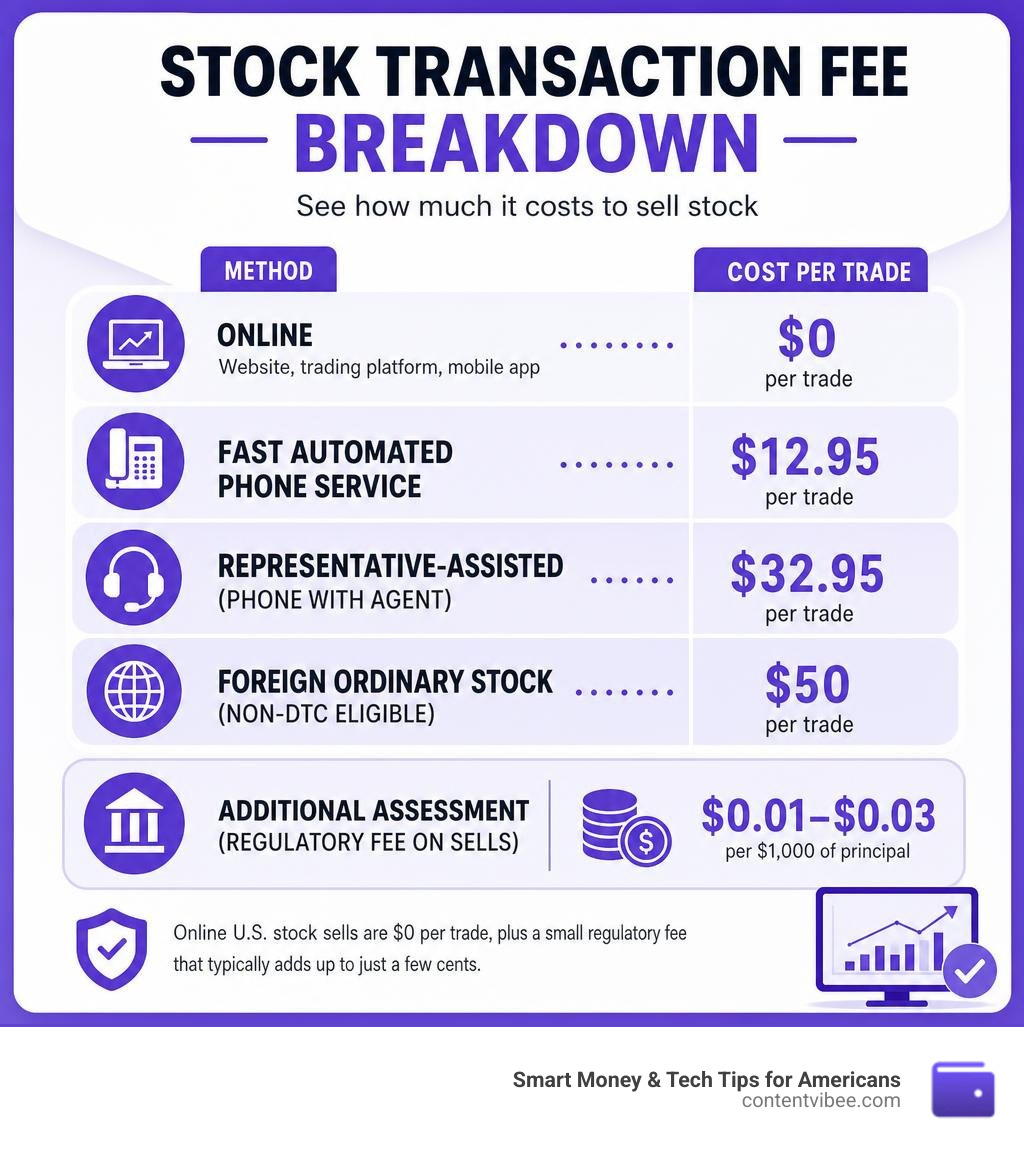
The fidelity stock transaction fee for most everyday investors is $0 — Fidelity charges no commission on online U.S. stock trades, no matter how many shares or how many trades you place.
Here’s a quick breakdown of what selling stock on Fidelity actually costs:
| Selling Method | Cost |
|---|---|
| Online (Fidelity.com, Active Trader Pro, Mobile) | $0 per trade |
| FAST automated phone service | $12.95 per trade |
| Representative-assisted (phone with agent) | $32.95 per trade |
| Additional Assessment (regulatory fee on sells) | $0.01–$0.03 per $1,000 of principal |
| Foreign ordinary stock (non-DTC eligible) | $50 per trade |
So if you’re selling U.S. stocks online, the cost is essentially zero — with one small exception: a tiny regulatory pass-through fee on sell orders called the Activity Assessment, which typically works out to a few cents per trade.
But there’s more to the story. Certain situations — like selling mutual funds early, trading foreign stocks, or using a phone representative — can trigger fees you didn’t expect. And if you’re on margin, interest charges add up fast.
This guide walks you through every cost that could apply when you sell stock on Fidelity, so there are no surprises.
Terms related to fidelity stock transaction fee:
Understanding the Fidelity Stock Transaction Fee Structure
To master your investment strategy in 2026, you need to understand how brokerage pricing actually works under the hood. For years, the financial industry has moved toward a model where online trades are free. But “free” often comes with caveats.
Fidelity stands out by offering some of the most competitive, straightforward pricing in the industry. When you place a standard online trade for a U.S.-listed stock or Exchange-Traded Fund (ETF), your direct commission is exactly $0. This applies whether you are unloading 5 shares of a blue-chip stock or liquidating a massive block of 10,000 shares.
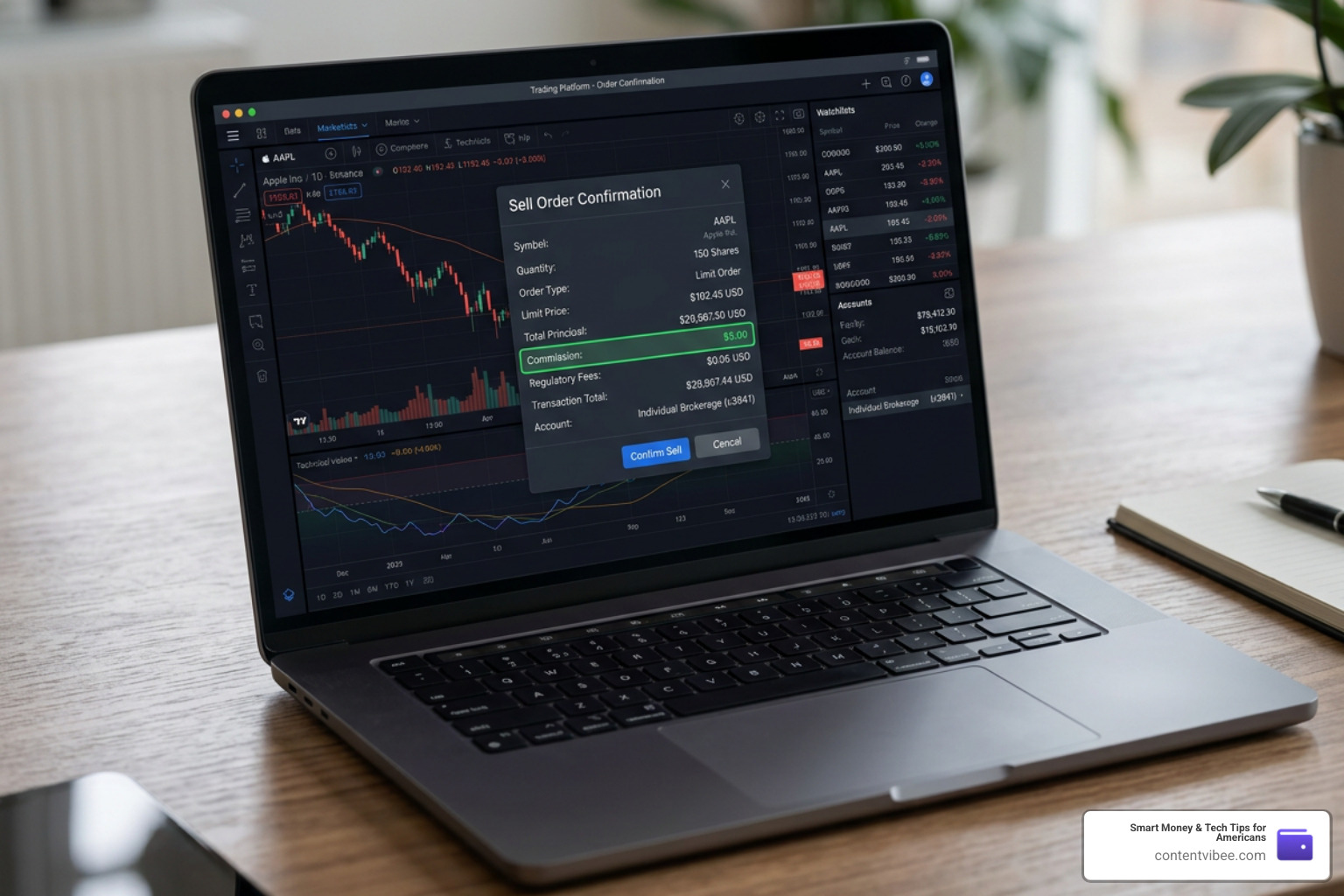
This clean fee structure is highly attractive to retail investors. However, the exact fidelity stock transaction fee you pay depends heavily on how you place your order. While we all love the convenience of mobile apps and web browsers, some investors still prefer older or more direct channels. That is where the pricing structure shifts. To learn more about the broader cost ecosystem, you can read our comprehensive fidelity stock trading cost analysis.
For complete transparency, we can also look directly at how the brokerage defines its standard pricing model. Their commitment to Straightforward and Transparent Pricing means you will rarely find hidden platform fees, account maintenance charges, or surprise billing on your monthly statements.
Online vs. Phone-Based Fidelity Stock Transaction Fee Rates
While online trades cost you nothing in direct commissions, using other execution channels will cost you. If you choose to place a trade over the phone, you have two options: automated or human-assisted.
The first alternative is the Fidelity Automated Service Telephone (FAST) system. This automated interactive voice response system allows you to place trades by speaking or pressing buttons on your keypad. If you sell stocks through FAST, you will pay a flat fee of $12.95 per trade.
The second alternative is calling and speaking directly to a live broker. If you require a human touch to execute your sell order, a representative-assisted trade will cost you a flat fee of $32.95 per trade.
Why is there such a massive gap? Live brokers require payroll, training, and real-time support infrastructure. If you are looking to keep your costs as close to zero as possible, you should always opt for the online route via the website, the mobile app, or Active Trader Pro. For a deeper look into why these phone fees are priced the way they are, take a look at our guide on fidelity representative trade fees explained.
Professional Trader Rates and the Standard Fidelity Stock Transaction Fee
Most of us are retail investors, meaning we manage our personal portfolios, retirement accounts, or family trusts. But what if you are classified as a Professional Equity Trader?
Professional traders operate under a completely different regulatory and pricing framework. Instead of a flat $0 online commission, registered professional traders on the platform are charged a per-share rate. Specifically, professional equity trades incur a fee of $0.001 per share (rounded up to the nearest cent).
While a fraction of a cent per share sounds incredibly small, it can add up quickly if you are executing high-volume, institutional-sized block trades. For the vast majority of retail accounts, however, this professional surcharge does not apply. You can learn more about how standard retail trading fees work in our breakdown of the fidelity fee per trade.
Hidden Costs and Regulatory Fees When Selling Stock
Even if you execute your sell order online for $0, you will notice a tiny deduction from your total proceeds on your trade confirmation screen. This is not a commission pocketed by the brokerage; rather, it is a regulatory pass-through fee.
When you sell a security, self-regulatory organizations (SROs) like the Financial Industry Regulatory Authority (FINRA) and government bodies like the Securities and Exchange Commission (SEC) assess transaction fees. Brokerages are legally required to pay these, and they pass the exact cost down to you.
On your trade receipt, this charge is listed as the Activity Assessment Fee (or Additional Assessment). For stock sales, this fee is exceptionally small: typically between $0.01 and $0.03 per $1,000 of principal (the total dollar value of the stock you sold).
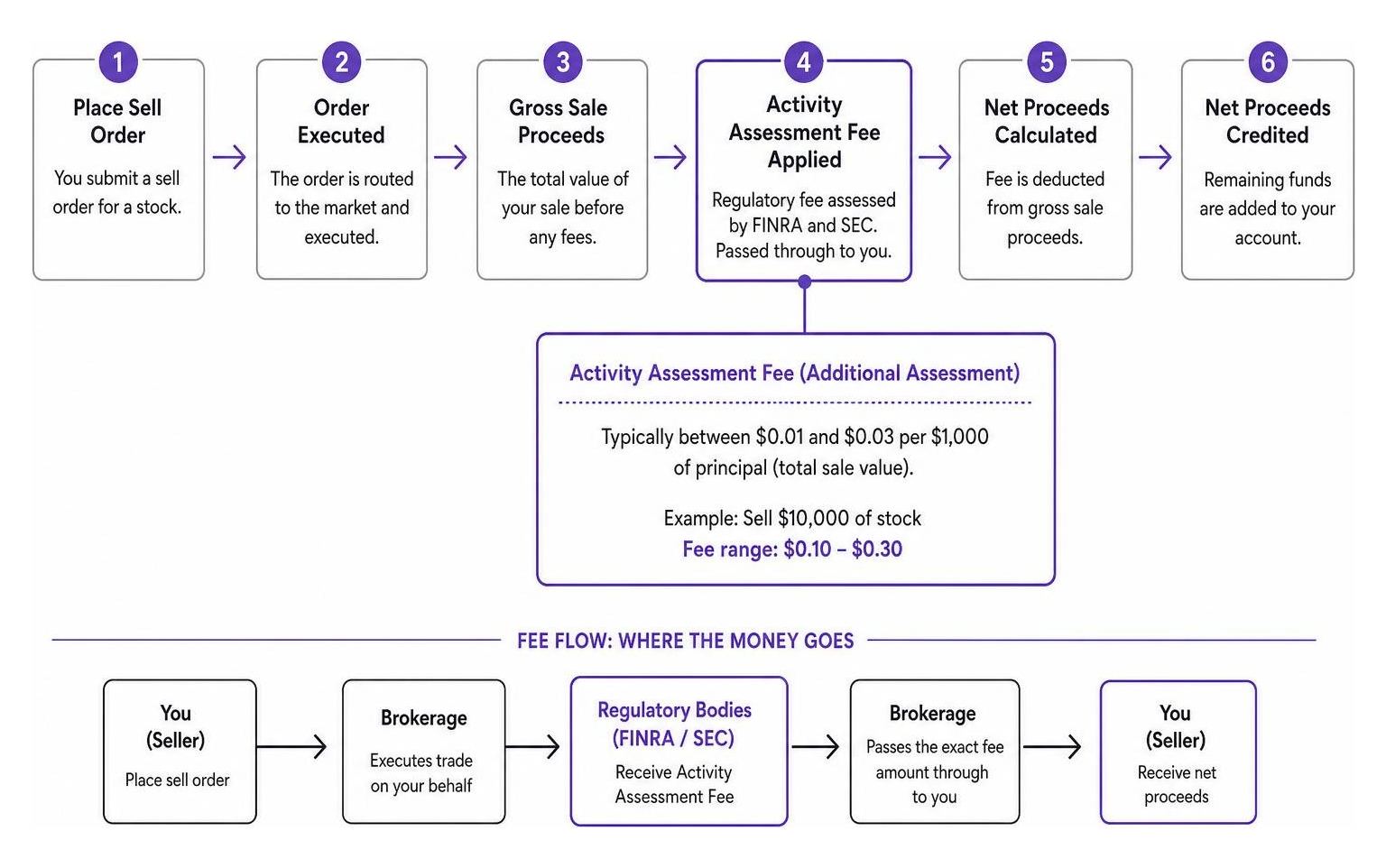
For example, if you sell $10,000 worth of stock, your Activity Assessment Fee will likely range between $0.10 and $0.30. It is a tiny fraction of your overall transaction, but it is important to know about so you don’t feel cheated when your cash proceeds are slightly lower than your gross sale price. To make sure you are fully prepared for these tiny regulatory slices, check out our guide on fidelity stock selling fees.
For those who want to review the fine print directly from the source, you can read the official Brokerage Commission and Fee Schedule.
Special Considerations: Foreign Stocks, Options, and Mutual Funds
The $0 online commission rule is fantastic for standard U.S. equities, but the financial markets are vast. If you venture into international stocks, derivatives, or mutual funds, the fee schedule changes significantly.
If you decide to trade foreign ordinary stocks that are not Depository Trust Company (DTC) eligible, you will face a steep foreign settlement fee of $50 per trade. Additionally, holding foreign assets can trigger other costs. For instance, there is a fee of 1% of the principal for foreign dividends and corporate reorganizations when a dividend is paid or a corporate action occurs on a foreign asset held in USD.
Furthermore, if you need to convert your U.S. Dollars to a foreign currency to wire funds abroad, you could be charged up to 3% of the principal for foreign exchange wires.
If options are more your style, selling contracts online is also highly competitive. While there is a $0 base commission to trade options online, you must pay a contract fee of $0.65 per contract.
There is some great news for options writers, though: if you enter a “buy-to-close” order to buy back an option contract that is currently priced at $0.65 or less, the transaction is completely commission-free. This allows you to lock in your profits on decaying options without paying an extra contract fee. For a complete look at these derivatives costs, read our fidelity options cost guide what youll actually pay.
How Account Types and Margin Impact Your Fidelity Stock Transaction Fee
Your choice of account type and whether you use leverage can also influence your overall transaction costs. If you trade using a standard cash account, you must closely follow Federal Reserve Board Regulation T rules.
If you sell a stock in a cash account, those funds take one business day to officially settle (T+1). If you use unsettled cash to buy another stock and then sell that new stock before the cash settles, you could trigger cash account violations like “good faith violations,” “cash liquidation violations,” or “free riding.” Accumulating three of these violations within a 12-month period will result in a 90-day restriction on your account.

If you use a margin account to avoid these settlement restrictions, you must pay attention to margin interest rates. If you carry a debit balance, interest will accumulate daily. As of July 2026, the base margin rate is 10.575% (effective since December 12, 2025). The actual rate you pay is tiered based on your balance:
- Balances under $25,000: 11.825% (Base + markup)
- Balances of $1,000,000+: As low as 7.50%
While margin does not increase your direct stock selling commission, high interest rates can quickly eat into your trading profits if you hold a leveraged position for too long. If you want to understand how different account types manage these fees, read our fidelity brokerage account fees review what you need to know.
Mutual Fund Transaction Fees and Short-Term Redemption Penalties
Mutual funds are another area where transaction fees can surprise you. While the platform offers thousands of funds with no transaction fees (NTF), buying and selling non-Fidelity transaction-fee funds is costly.
If you purchase a transaction-fee mutual fund that is not on their NTF list, you will pay a steep fee of $49.95 or $100 per purchase (though redemptions/sells are $0).
Additionally, we must watch out for the dreaded short-term trading fee. If you sell shares of an NTF non-Fidelity mutual fund that you have held for 60 days or less, you will be charged a flat $49.95 short-term redemption fee. This rule is designed to discourage short-term market timing in mutual funds, which are built for long-term holding. To avoid this fee, simply commit to holding your mutual funds for at least two full months before selling. To learn more about how to navigate these fund costs, check out our guide: fidelity mutual fund trade fee when is free not actually free.
Frequently Asked Questions about Selling Stock on Fidelity
Does Fidelity charge a fee to sell fractional shares?
No! One of the best features of modern online brokerages is the ability to trade fractional shares. You can buy or sell fractional shares of over 7,000 U.S. stocks and ETFs online with a transaction minimum of just $1.
Whether you are selling 0.5 shares or 9.75 shares, the commission rate is exactly $0. This makes dollar-based investing and automatic rebalancing incredibly cost-efficient. To learn more about how this works, take a look at our fidelity fractional shares review fees limits and how it works article.
Are there any inactivity or account closure fees?
Fortunately, there are no inactivity fees or account maintenance fees for standard retail brokerage accounts or IRAs. You can leave your account sitting idle for years without worrying about balance-depleting maintenance charges.
Furthermore, unlike many major competitors who charge between $50 and $75 to transfer your assets out of their platform, there is a $0 fee for outgoing ACAT transfers. This means you can transfer your cash and securities to another institution completely free of charge. For an in-depth review of these consumer-friendly policies, read our guide: fidelity trades really free demystifying the fees.
How long does it take for stock sale proceeds to settle?
Under standard U.S. financial regulations, stock and ETF transactions settle on a T+1 schedule (Transaction date plus one business day).
If you sell your stock on a Monday, your trade will officially settle, and the cash will become fully settled on Tuesday. While you can often use unsettled cash to purchase other securities immediately, you must be careful not to violate cash account trading rules before that cash officially settles. For official details on how trading restrictions work, you can refer directly to the Trading FAQs: Trading Restrictions – Fidelity page.
Conclusion
When it comes to minimizing investment friction, keeping your trading costs low is one of the most effective strategies you can use. The standard online fidelity stock transaction fee of $0 makes the platform an incredibly cost-effective home for American retail investors in 2026.
By executing your trades online, holding your mutual funds for at least 60 days, and avoiding expensive broker-assisted phone calls, you can keep your trading expenses virtually non-existent.
We at Suppremo are committed to helping you build long-term wealth through smart money habits and clear financial strategies. To learn how to maximize your portfolio’s efficiency and discover advanced ways to keep more of your hard-earned cash, explore our ultimate guide on fidelity trading fees and savings.