Skip the SSA Line: Your Step-by-Step Guide to Applying for Spousal Benefits Online

The Fastest Way to Apply for Spousal Social Security Benefits Without the Wait
Can I apply for spousal benefits online? Yes — and it’s often the fastest, easiest way to get started.
Here’s the quick answer:
- Yes, you can apply online at ssa.gov if you are within 3 months of age 62 or older.
- You’ll need a my Social Security account to submit your application digitally.
- You must be married for at least 1 year, and your spouse must already be receiving their own Social Security benefits.
- The maximum spousal benefit is 50% of your spouse’s full retirement age benefit — but claiming early can reduce it to as little as 35%.
- If online filing is blocked (which can happen if you already receive your own benefits), you can call 1-800-772-1213 — though wait times can exceed 120 minutes during peak hours.
About 2 million Americans currently receive an average monthly spousal benefit of $986. Yet many eligible retirees delay or miss out simply because they don’t know how the online process works.
The SSA phone lines are notoriously slow. Visiting a local office takes time. But applying online — when you know exactly what to do — can save you hours.
This guide walks you through every step.
Can I Apply for Spousal Benefits Online? Eligibility and Rules
The short answer is a resounding yes! But as with anything involving the federal government, there is a catch: you have to meet specific requirements first. The Social Security Administration (SSA) allows you to file for these benefits online, but only if you are within three months of turning 62 or are already older.
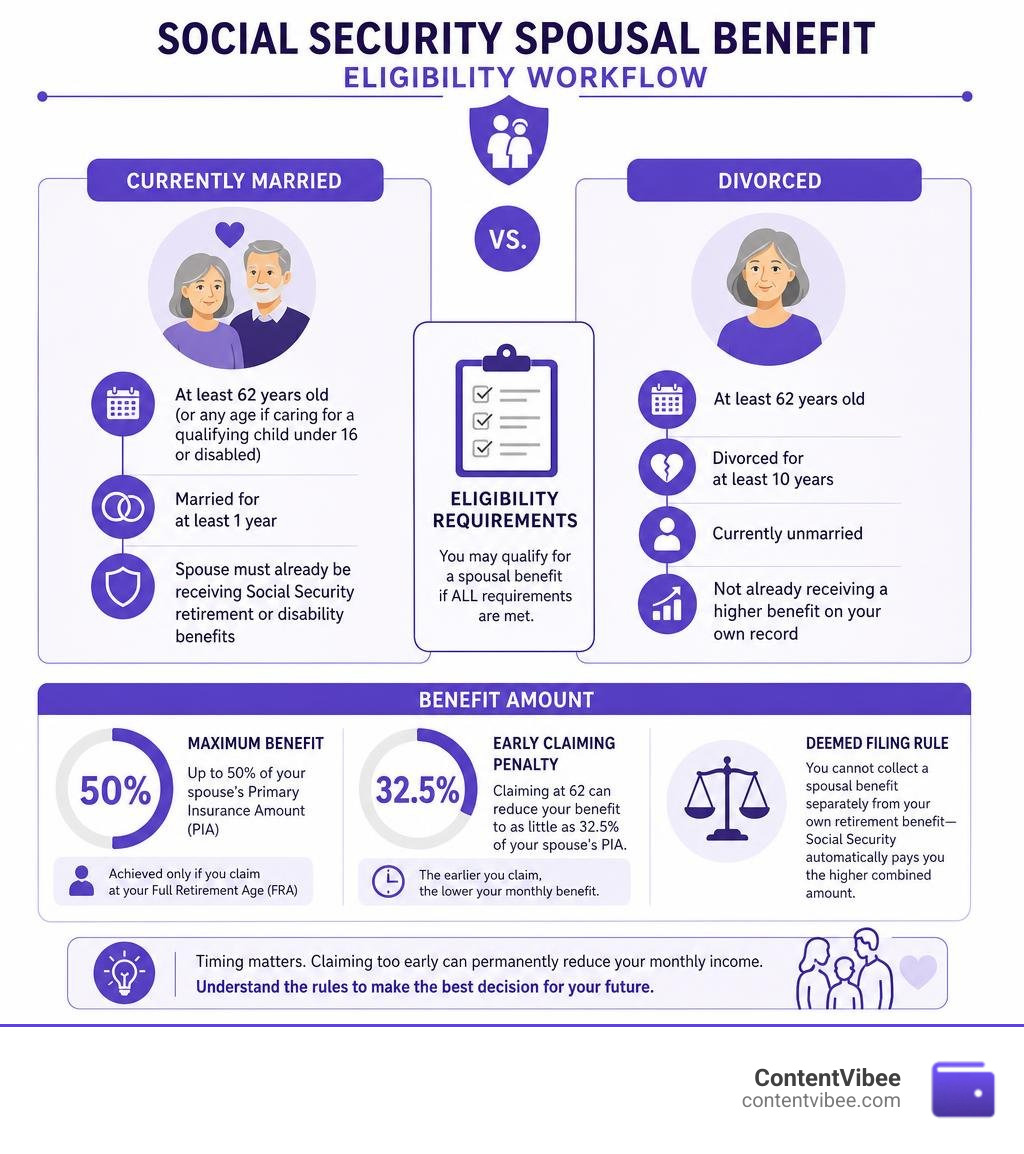
To successfully secure these monthly payments, you must satisfy several core eligibility requirements. First, you must be married to your spouse for at least one continuous year before filing. Second, your spouse must already be collecting their own retirement or disability benefits. Finally, you must be at least 62 years old (unless you are caring for a qualifying child who is under age 16 or disabled).
The maximum spousal benefit you can receive is capped at 50% of your spouse’s Primary Insurance Amount (PIA)—which is the amount they are entitled to at their Full Retirement Age (FRA). To get the full 50%, you must wait until your own Full Retirement Age (which is 67 for anyone born in 1960 or later) to claim. If you claim as early as age 62, your monthly check will be permanently reduced to roughly 32.5% to 35% of your spouse’s benefit.
For a deeper dive into these rules, check out our Detailed Guide to Spousal Benefits Eligibility. The underlying legal definitions and structural framework are governed by strict federal rules, which you can read about in detail in the official SSA – POMS: RS 00202.001 – Definitions and Requirements for Spouse Benefits – 07/24/2017 .
Who Can I Apply for Spousal Benefits Online For? (Married vs. Divorced)
Are you currently married? Or perhaps you are divorced but wondering if your ex-spouse’s work record can help fund your golden years? The online application system accommodates both scenarios, but the rules differ slightly.
If you are a divorced spouse, you can apply for benefits on your ex-spouse’s record online without them ever knowing. The SSA maintains strict privacy protections; your ex-spouse is not notified when you apply, and your claim will have absolutely zero impact on their monthly benefit or any benefit their current spouse receives.
To qualify as a divorced spouse, you must meet the 10-year marriage rule:
- Your marriage must have lasted for at least 10 consecutive years before the divorce was finalized.
- You must currently be unmarried (if you remarry, you generally lose eligibility for benefits on your ex-spouse’s record, unless your subsequent marriage ends).
- You must be at least 62 years old.
- Your ex-spouse must also be at least 62.
Unlike married couples, if you have been divorced for at least two continuous years, your ex-spouse does not need to be actively receiving retirement benefits for you to claim. They only need to be eligible to receive them. For more details on how these rules apply to your specific situation, review our guide on How to Understand Spousal Benefit Eligibility.
How Can I Apply for Spousal Benefits Online If I Already Receive My Own Retirement?
This is where many retirees hit an unexpected speed bump. If you are already receiving your own retirement benefits and your spouse recently retired, you might log into your account hoping to quickly add your spousal top-off online, only to find the system blocks you.
Why does this happen? The SSA’s online portal is designed primarily for initial, clean-slate claims. When you already have an active retirement claim and need to transition to or add a spousal benefit, the digital system often flags this as a complex case.
If the portal blocks your online application, do not panic. Your workaround is to call the national toll-free number at 1-800-772-1213. To beat the legendary wait times (which can easily exceed 120 minutes during midday peak hours), we recommend calling first thing in the morning—right when they open at 8:00 AM local time—to schedule a phone appointment. For a complete strategy on navigating this technical roadblock, read this How to Apply for Spousal SS Benefits Online – Expert Guide .
Step-by-Step: How to Apply for Spousal Benefits Online
Filing your application online is incredibly convenient if you prepare beforehand. Think of it like baking a cake: if you gather all your ingredients first, the process is a breeze. If you have to keep running to the store for sugar, it becomes a headache.
When you apply online, you are essentially filling out the digital version of Form SSA-2 (the official Application for Spouse’s Insurance Benefits). You will also need to provide your direct deposit details so the government can send your monthly payments straight to your bank account. To understand the layout of this digital form before you click “Submit,” take a look at Your Digital Guide to Form SSA-2 and Online Spousal Claims.
Step 1: Gather Your Required Documents
Before you open a single browser tab, make sure you have your paperwork ready. The SSA is highly meticulous about documentation. While they will accept photocopies of your W-2 tax forms, they require original documents or certified copies for almost everything else.
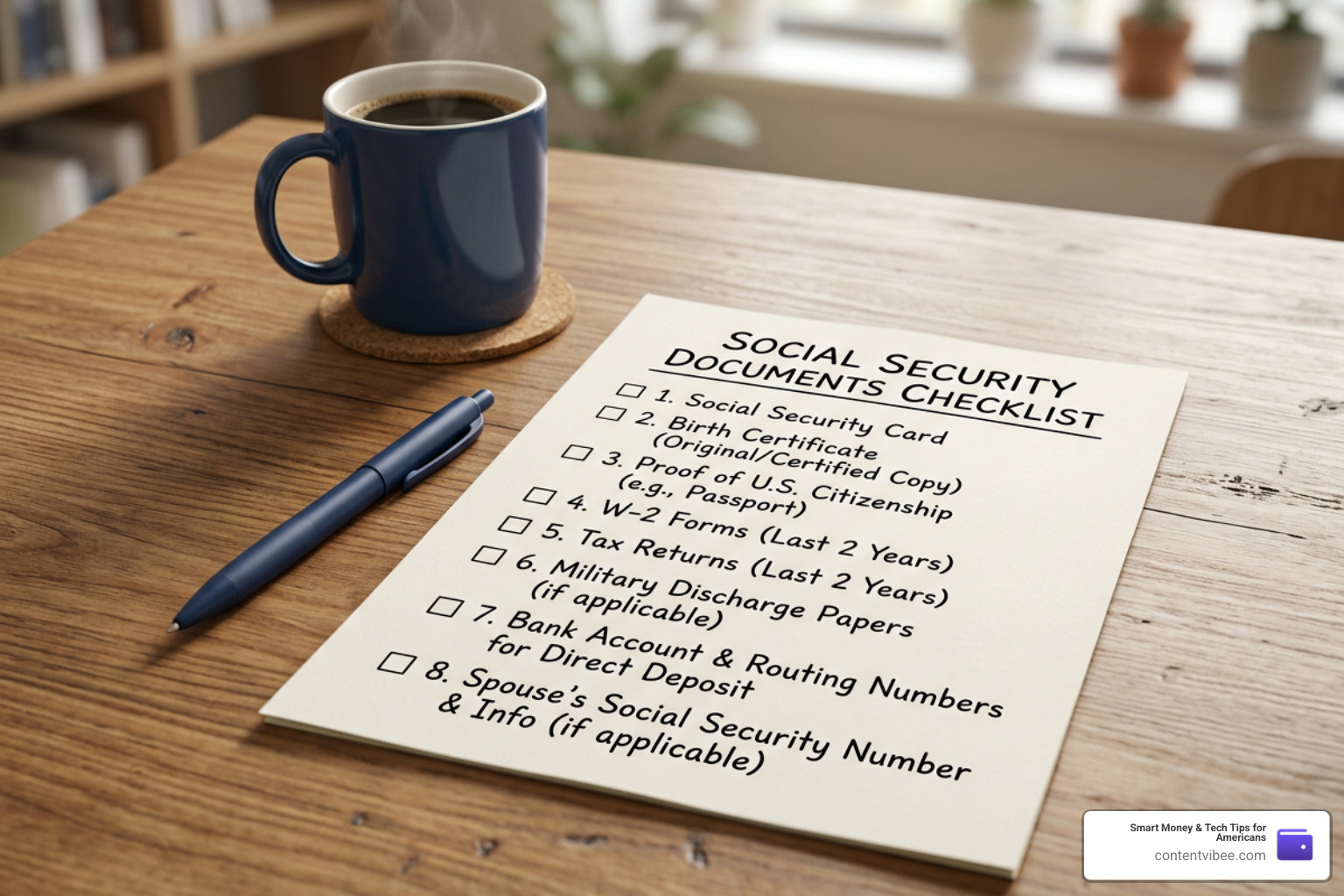
Here is what you should have on hand:
- Your Social Security number (SSN) and your spouse’s SSN.
- Your original birth certificate (or other proof of age).
- Your marriage certificate (to prove you meet the marriage duration rules).
- Your divorce decree (if you are applying as a divorced spouse).
- Your W-2 forms or self-employment tax returns from the previous year.
- Your bank routing and account numbers for direct deposit.
Do not delay applying if you are missing a document! The SSA will often help you locate or verify records after you submit your application. To make sure you don’t miss a single piece of paper, refer to The Complete Checklist of Documents for Spousal Social Security Benefits. For official policy guidelines on what constitutes acceptable evidence, you can review the SSA – POMS: RS 00202.050 – Spouse’s Benefits – Evidence and Forms Requirements – 02/16/2006 .
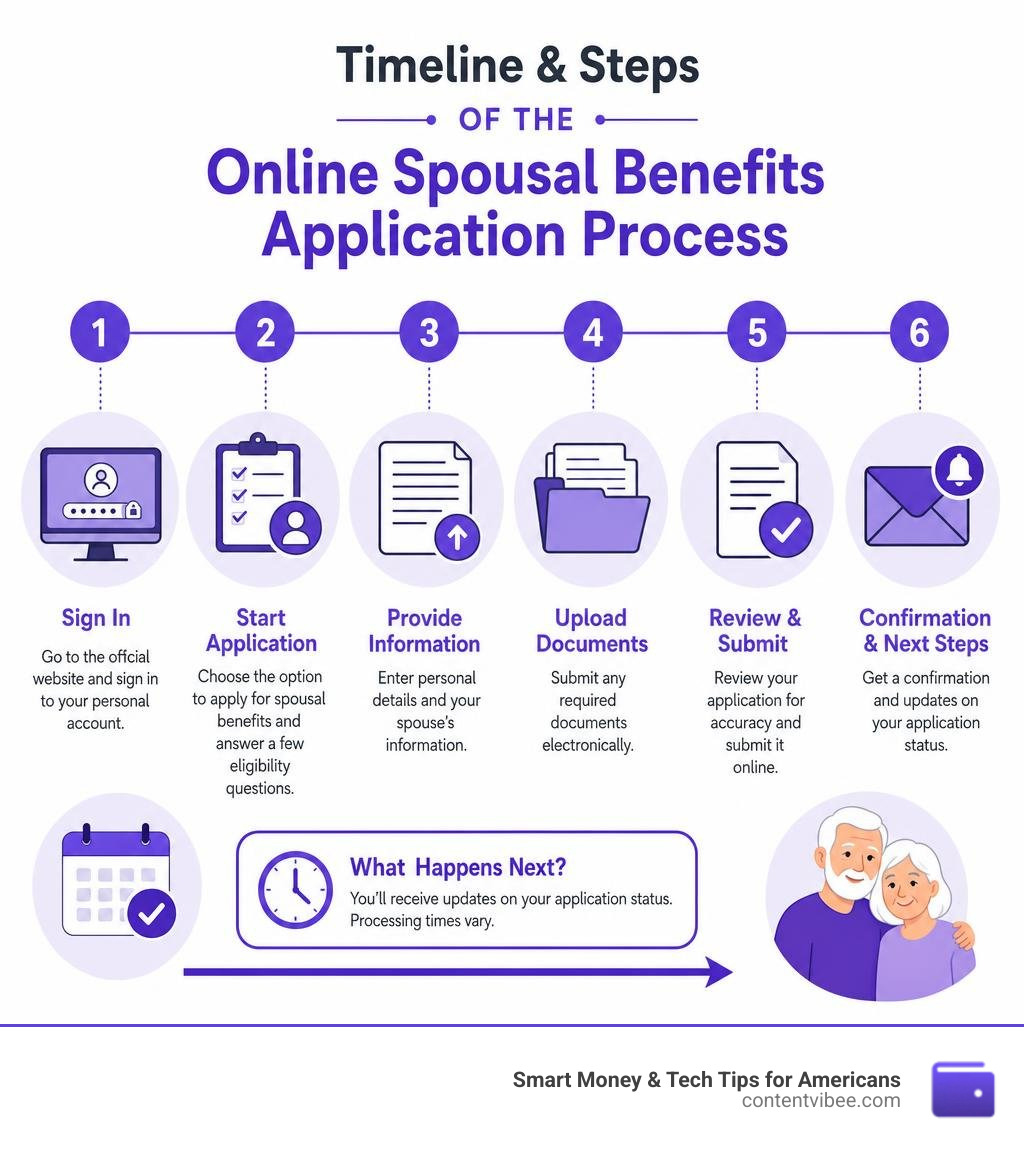
Step 2: Log In and Navigate the SSA Portal
Once your paperwork is organized, it is time to log in:
- Head over to the official government website at ssa.gov.
- Log into your personal my Social Security account. If you do not have one yet, you will need to create one by verifying your identity through Login.gov or ID.me.
- Once logged in, look for the option labeled “Apply for Benefits” or “Apply for Retirement/Spouse’s Benefits.”
- The system will guide you through a series of questions. When prompted, select that you are applying for spouse’s benefits and enter your spouse’s full name, date of birth, and Social Security number. This links your application to their earnings record.
Step 3: Submit and Track Your Application
After answering all the questions about your employment, military history, and marriage, review your answers carefully. Once you are satisfied, hit the submit button.
Crucial Step: Save, screenshot, or print the confirmation page at the end of the process. This page contains your tracking number and the exact date of submission.
You can track the progress of your application in real-time by logging back into your my Social Security account. If the claims representative reviewing your file needs additional documentation (like your physical marriage certificate), they will mail you a request. If you encounter any digital glitches or have questions while waiting, you can call their national toll-free number, but tracking the status online is usually much faster.
Deemed Filing and the “File and Suspend” Rules
Understanding how different benefits interact is critical to maximizing your retirement income. Years ago, couples used clever loopholes like “file and suspend” to let their own benefits grow while collecting spousal benefits. However, the Bipartisan Budget Act of 2015 permanently closed these loopholes for the vast majority of retirees.
Today, the dominant rule you must understand is the deemed filing rule. Under this rule, when you apply for either your own retirement benefit or a spousal benefit, you are “deemed” to be applying for both simultaneously. The SSA will calculate both amounts and pay you the higher of the two. You cannot choose to collect only the spousal benefit while letting your own retirement benefit grow, unless you were born before January 2, 1954, or meet very narrow exceptions (such as caring for a disabled child).
The administrative procedures that dictate how the SSA evaluates these dual claims are outlined in the SSA – POMS: GN 00204.004 – Considering Possible Entitlement to Retirement Insurance Benefits (RIB) when a Claimant Files an Application for Spouse’s Benefits – 01/03/2017 . To see how these rules play out for couples planning their retirement timeline together, check out Double the Fun: A Guide to Social Security Spousal Benefits for Couples.
How Deemed Filing Affects Your Claiming Strategy
Because of deemed filing, timing is everything. Your spousal benefit is tied directly to your claiming age. If you claim any benefit before your Full Retirement Age, your spousal benefit is permanently reduced.
For example, if your spouse’s Primary Insurance Amount (PIA) at their Full Retirement Age is $2,000, your maximum possible spousal benefit is $1,000 (50%). However, if you claim early, that percentage drops significantly.
Here is how your claiming age affects your spousal benefit percentage:
| Your Claiming Age | Percentage of Spouse’s FRA Benefit | Your Monthly Benefit (Example: Spouse FRA is $2,000) |
|---|---|---|
| 67 (Full Retirement Age) | 50.0% | $1,000 |
| 66 | 45.8% | $916 |
| 65 | 41.7% | $834 |
| 64 | 37.5% | $750 |
| 62 (Earliest Age) | 32.5% to 35.0% | $650 to $700 |
Note: The exact reduction depends on the number of months prior to your FRA that you begin collecting.
Frequently Asked Questions about Spousal Social Security Benefits
Can I apply for spousal benefits if my spouse has not yet filed for their own?
If you are currently married, the answer is no. You cannot collect spousal benefits on your husband or wife’s record until they have actually filed and begun receiving their own retirement or disability benefits.
However, there is a major exception for divorced couples. If you have been divorced for at least two consecutive years, you can claim spousal benefits on your ex-spouse’s record even if they have not yet filed for retirement—provided they are at least 62 years old and qualify for benefits. For tips on bypassing unnecessary delays, see Claiming Spousal Benefits Without the Government Red Tape.
What are the differences between applying online versus by phone or in person?
Applying online is by far the most convenient method. You can complete the application from your couch at any time of day, avoiding the long wait times on the phone and the hassle of traveling to a local office.
| Application Method | Pros | Cons |
|---|---|---|
| Online (ssa.gov) | Fast, 24/7 access, no hold times, easy tracking. | Can be blocked if you already receive benefits. |
| Phone (1-800-772-1213) | Help from a live agent, scheduled appointments. | Long hold times (often over 120 minutes). |
| In Person | Direct face-to-face assistance. | Requires travel, long office wait times without an appointment. |
To make sure you get every penny you deserve regardless of how you apply, check out Spousal Benefits 101: How to Get Your Fair Share.
How long does it take to get a decision on a spousal benefits application?
Typically, it takes two to six weeks for the SSA to process a spousal benefits application and issue a decision letter. If your application is approved, any retroactive payments you are owed will be deposited directly into your bank account. To keep your stress levels low while waiting for the government to process your paperwork, read our guide on How to Claim Spousal Retirement Benefits Without Losing Your Mind.
Conclusion
Taking control of your retirement planning doesn’t have to be overwhelming. By understanding the rules, preparing your documents, and applying online, you can bypass the long lines at the physical SSA offices and secure your financial future from the comfort of your own home.
At Suppremo, we are dedicated to providing clear, actionable smart money tips to help Americans achieve long-term financial security. Ready to see what your retirement check might look like? Estimate your spousal benefit amount using our Social Security Spousal Benefit Calculator today!