Calculate Your Spousal Benefits the Easy Way

Why Knowing How to Calculate Spousal Benefits Can Mean Thousands More in Retirement
If you want to calculate spousal benefits accurately, here is the core formula:
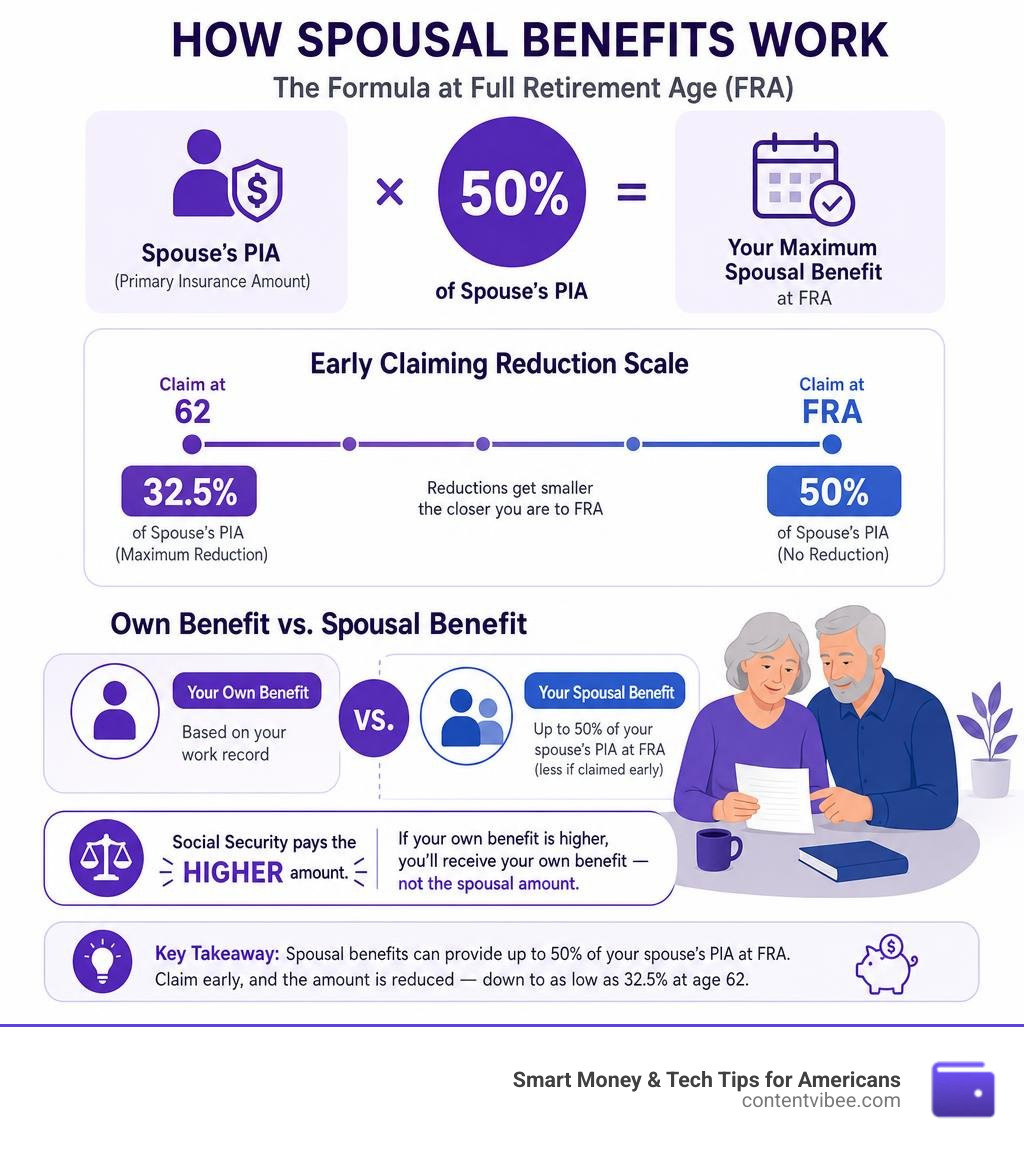
Spousal Benefit = 50% of the higher earner’s Primary Insurance Amount (PIA) — but only if you claim at your own Full Retirement Age (FRA).
Quick Answer: How to Calculate Your Spousal Benefit
- Find your spouse’s PIA (their monthly benefit at full retirement age — available at ssa.gov)
- Multiply by 50% — this is your maximum spousal benefit
- Compare that to your own retirement benefit at FRA
- If your own benefit is higher, Social Security pays your benefit — not the spousal amount
- If you claim before your FRA, your spousal benefit is permanently reduced — down to as low as 32.5% of your spouse’s PIA if you claim at 62
Example:
- Spouse’s PIA: $2,000/month
- Your maximum spousal benefit at FRA: $1,000/month
- Your claim at age 62 (FRA of 67): approximately $650/month
For millions of Americans, spousal benefits are one of the most valuable — and most misunderstood — parts of Social Security. About 641,000 people were receiving benefits on a former spouse’s record as of December 2023, with women making up roughly 95% of that group.
The rules sound simple on the surface. But the details — when to claim, how your own work record interacts, and what happens if you worked for a government employer — can make a difference of tens of thousands of dollars over a retirement that lasts 20 or 30 years.
This guide walks you through every piece of the calculation, clearly and step by step.
What Are Social Security Spousal Benefits and Who Qualifies?
Social Security spousal benefits are designed to provide financial security for married couples, particularly where one spouse earned significantly less over their career or stepped out of the workforce entirely to care for family. At Suppremo, we talk to couples every day who assume that if they didn’t work 10 full years, they get nothing. That is a myth we love to bust!
The spousal benefit program ensures that a lower-earning spouse can receive up to half of the higher-earning spouse’s retirement benefit. It doesn’t matter if you have never worked a single day in your life or paid a dime in Social Security payroll taxes; you can still qualify.
To get started, we recommend checking out the ultimate guide to spousal social security eligibility to see how the overall system works. If you are ready to check your own status, read our step-by-step walkthrough on how to check your eligibility for spousal social security benefits.
The Core Eligibility Requirements
To successfully claim a spousal benefit, you must meet several strict criteria set by the Social Security Administration (SSA):
- The Marriage Rule: You must currently be married to the worker, and the marriage must have lasted for at least one continuous year before you apply.
- The Age Rule: You must be at least 62 years old to claim. (There is an exception: if you are caring for a child of the worker who is under age 16 or disabled, you can claim at any age, and your benefit will not be reduced for early claiming).
- The Worker Must Have Filed: You cannot claim a spousal benefit until your spouse has officially filed for their own retirement or disability benefits.
We often get asked, “When is the perfect time to pull the trigger?” To answer this, we broke down the age-based rules in detail in our guide, at what age can i claim my spouses social security. For a complete list of what is allowed, check out the golden rules can a spouse collect ss spousal benefits.
Spousal Benefits vs. Survivor Benefits
It is incredibly common to confuse spousal benefits with survivor benefits, but they serve different purposes and use completely different math.
- Spousal Benefits: Paid while your spouse is still alive. The maximum benefit is capped at 50% of your spouse’s Primary Insurance Amount (PIA) at their Full Retirement Age.
- Survivor Benefits: Paid to you after your spouse passes away. This can be up to 100% of the actual benefit your deceased spouse was receiving at the time of their death.
If your spouse delayed claiming until age 70 to maximize their benefit, your survivor benefit is based on that higher, delayed amount. However, your spousal benefit while they are alive never receives delayed retirement credits. Because husbands typically predecease wives by 5 to 7 years on average, optimizing for survivor benefits is a critical part of household planning.
To dig deeper into these differences, read our guide on what is a social security spousal benefit.
How to Calculate Spousal Benefits: The Step-by-Step Formula
Now, let’s get into the actual math. To calculate spousal benefits accurately, we must first understand two critical concepts: the Primary Insurance Amount (PIA) and Full Retirement Age (FRA).
Your spouse’s PIA is the monthly amount they are entitled to receive if they claim exactly at their FRA. For anyone born in 1960 or later, the FRA is 67. If you want to estimate these numbers yourself, you can start by reading calculate spouse retirement benefits or simplify the timeline using our guide on how to calculate your spousal retirement age easily.
The 50% Primary Insurance Amount (PIA) Rule
The baseline rule is simple: if you wait until your own Full Retirement Age to claim, your spousal benefit will be exactly 50% of your spouse’s PIA.
The SSA will look at your own retirement benefit based on your work history and compare it to 50% of your spouse’s PIA. If 50% of your spouse’s PIA is larger, you will receive a combination of benefits that equals that higher spousal amount.
For official quick calculations directly from the source, you can also check out the Benefits for Spouses – Social Security Administration page.
Here is a quick look at how the math plays out at Full Retirement Age (assuming an FRA of 67 for both spouses):
| Scenario | Higher Earner’s PIA | Lower Earner’s Own PIA | 50% of Higher Earner’s PIA | Final Monthly Payout for Lower Earner |
|---|---|---|---|---|
| Scenario A | $2,400 | $800 | $1,200 | $1,200 (Own $800 + $400 spousal top-off) |
| Scenario B | $3,000 | $1,600 | $1,500 | $1,600 (Receives own benefit only) |
| Scenario C | $2,000 | $0 | $1,000 | $1,000 (Pure spousal benefit) |
How Claiming Age Affects Your Monthly Payment
What happens if you don’t want to wait until your Full Retirement Age? You can claim as early as age 62, but doing so comes with a permanent cost.
The SSA reduces your spousal benefit using a specific formula:
- For the first 36 months before your FRA, the benefit is reduced by 25/36 of 1% per month (about 8.33% per year).
- For any additional months beyond 36 months (up to 60 months total if claiming at 62 when your FRA is 67), the benefit is reduced by an additional 5/12 of 1% per month (5% per year).
If your FRA is 67 and you claim at age 62 (60 months early), your spousal benefit is slashed by a total of 35%. This means instead of getting 50% of your spouse’s PIA, you will receive just 32.5%.
To see personalized projections based on your real earnings history, log into your official my Social Security account and check out the Spouse’s Benefit Estimates | SSA page.
Key Factors and Strategies to Maximize Your Spousal Benefit
Social Security calculations are rarely done in a vacuum. To truly maximize your household’s lifetime income, you must navigate several rules that catch many retirees off guard.
If you plan on working while receiving benefits, make sure you understand the rules by reading working in retirement are spousal benefits reduced by working.
Using Online Tools to Calculate Spousal Benefits
We don’t expect you to do all this heavy algebraic lifting on a yellow legal pad. There are excellent digital tools available to do the math for you.
First, we highly recommend trying our interactive Tools/Finance Calculator/Social Security Spousal Benefit Calculator to run side-by-side scenarios.
To compare different tools, read our review of the do the math top social security calculators for married couples. For official government projections, visit the Benefit Calculators | SSA portal or use the Social Security Calculator: Estimate Your Benefits – AARP to model different claiming ages.
How to Calculate Spousal Benefits for Divorced Spouses
If you are divorced, you might still be eligible to claim spousal benefits on your ex-spouse’s record — and the best part is, they will never even know! It does not affect their benefit, nor does it affect the benefit of their new spouse if they remarried.
To qualify for divorced spousal benefits, you must meet these rules:
- Your marriage to your ex-spouse must have lasted for 10 consecutive years or longer.
- You must currently be unmarried. If you remarry, you lose eligibility to claim on your ex’s record (unless your second marriage also ends by death or divorce).
- Your ex-spouse must be at least 62 years old.
- If you have been divorced for at least two continuous years, your ex-spouse does not even need to have filed for their own benefits yet for you to claim.
This is often called the “best-kept secret” in Social Security. If you have been divorced and want to explore this option, check out our guide: can divorced spouse get social security benefits.
The Impact of the Earnings Test and Government Pensions
If you plan to claim spousal benefits early while continuing to work, you must keep an eye on the Social Security Earnings Test.
For 2026, the annual earnings limit is $24,480 for those under their Full Retirement Age. If you earn more than this limit, the SSA will withhold $1 in benefits for every $2 you earn above the threshold. If you reach your FRA in 2026, the limit rises to $65,160, with $1 withheld for every $3 earned above the limit until the month you reach FRA. Once you hit FRA, the earnings test disappears entirely, and your benefit is recalculated to credit you for the months benefits were withheld.
The Social Security Fairness Act of 2023 / 2024 Update
Historically, workers who received a pension from a government job (like teachers, police officers, or firefighters) where they did not pay Social Security taxes had their spousal benefits severely reduced or wiped out by the Government Pension Offset (GPO).
However, under the Social Security Fairness Act of 2023 (which took full effect for benefits payable starting in 2025/2026), the GPO and the Windfall Elimination Provision (WEP) were eliminated. This historic change means government pension recipients can now receive their full, unreduced spousal and survivor benefits!
Strategic Claiming Decisions for Married Couples
When it comes to Social Security, married couples should always plan as a team rather than optimizing individually.
For most couples, the optimal strategy looks like this:
- The Higher Earner Delays: The higher earner should delay claiming their own benefit as long as possible, ideally up to age 70. This maximizes their own monthly payout (via an 8% annual delayed retirement credit) and locks in the highest possible survivor benefit for the lower-earning spouse.
- The Lower Earner Claims Strategically: The lower earner can claim their own retirement benefit earlier to bring income into the household, then top up to a spousal benefit once the higher earner files.

To design a personalized plan, read the smart couples guide to social security strategies and explore coordinate options in his hers and ours the ultimate guide to dual social security benefits.
Frequently Asked Questions About Spousal Benefits
To make sure you have all the facts, here are answers to the most common questions we receive.
Can both spouses collect Social Security at the same time?
Yes, absolutely! Both spouses can collect monthly benefits simultaneously. However, you cannot “double dip” by receiving your full retirement benefit and a full spousal benefit.
The SSA uses the “higher-of” rule. If you qualify for both, they will pay your retirement benefit first. If your spousal benefit is higher, they will add an extra amount (a spousal top-off) to bring your total payment up to the spousal benefit level.
To learn more about how this works for two-income households, read can a married couple both collect social security and our companion piece on both spouses collect social security.
Does delaying past Full Retirement Age increase the spousal benefit?
No, it does not. While your own retirement benefit increases by 8% per year for every year you delay claiming past your FRA up to age 70 (thanks to Delayed Retirement Credits), spousal benefits do not receive these credits.
Your spousal benefit maxes out at exactly 50% of your spouse’s PIA when you reach your own Full Retirement Age. Delaying your spousal claim past your FRA is simply leaving money on the table.
For more details on this cap, check out do both spouses collect social security.
What is the difference between deemed filing and the higher-of rule?
Under the Bipartisan Budget Act of 2015, the concept of “deemed filing” was expanded. If you were born after January 2, 1954, you no longer have the option to file a “restricted application” to claim only spousal benefits while letting your own retirement benefit grow.
Now, when you file for either retirement or spousal benefits, you are “deemed” to have filed for both. The SSA automatically applies the higher-of rule, calculating both amounts and paying you the larger total.
To understand how to navigate these filing rules, read our guide on how to claim spousal benefits.
Conclusion
At Suppremo, we believe that taking control of your retirement shouldn’t require a degree in advanced mathematics. Knowing how to calculate spousal benefits is one of the most powerful ways to secure your financial future and make sure you aren’t leaving money on the table.
Whether you are coordinating claims with your spouse, planning after a divorce, or navigating the newly simplified rules following the elimination of the GPO, timing is everything.
To make sure you don’t miss a single detail, take a moment to read the ultimate guide to spousal social security eligibility and start planning your perfect retirement strategy today!