Maximizing Spousal Benefits Without Leaving Money on the Table

Why Maximizing Spousal Retirement Benefits Could Be Worth $200,000 or More
Maximizing spousal retirement benefits is one of the most powerful — and most overlooked — ways married couples can boost their lifetime Social Security income.
Here’s a quick answer to get you started:
How to maximize spousal retirement benefits:
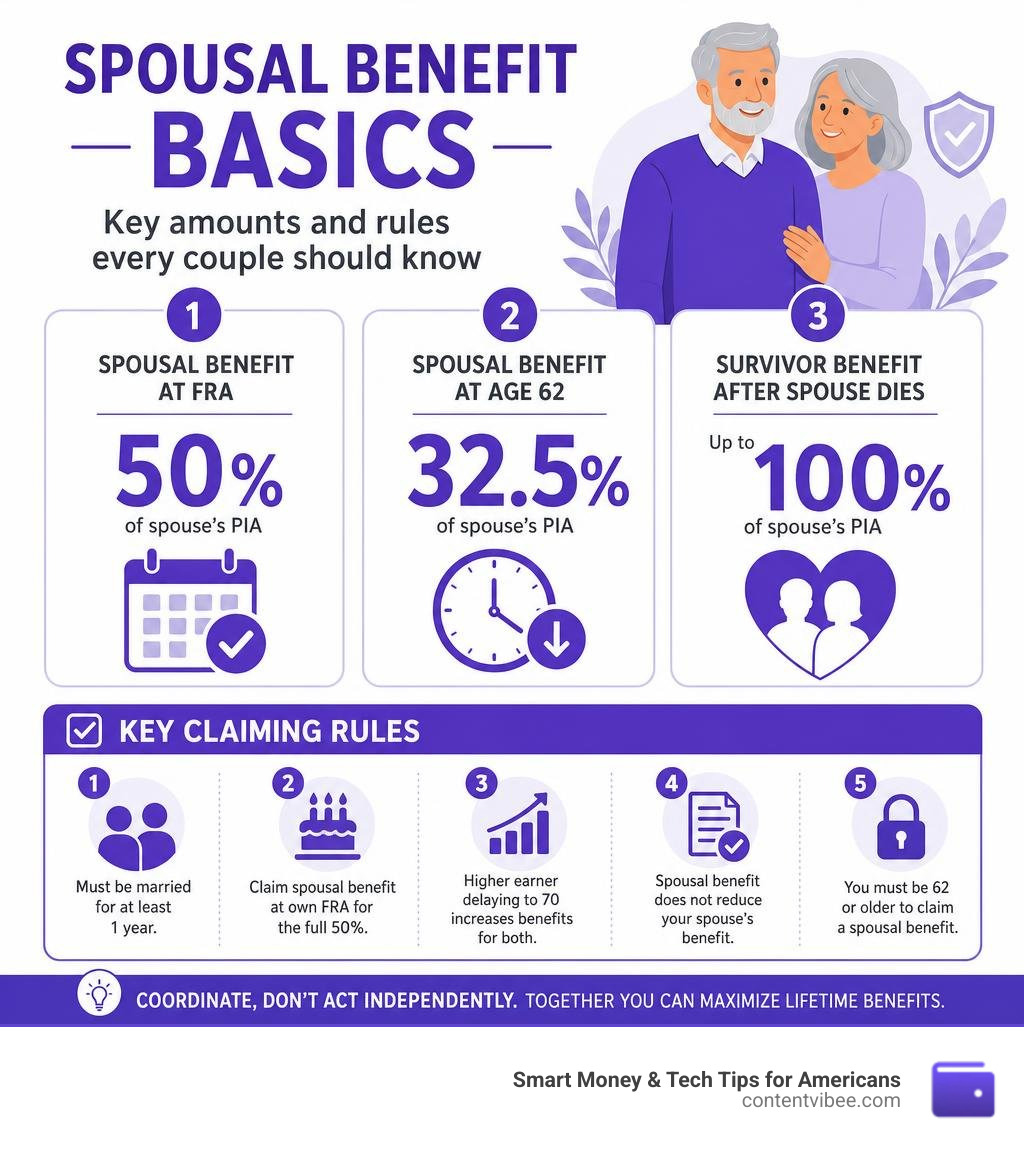
- Know your spousal benefit cap — you can receive up to 50% of your spouse’s Primary Insurance Amount (PIA), but only if you claim at your own Full Retirement Age (FRA).
- Don’t claim early unless necessary — claiming at 62 permanently reduces your spousal benefit to as low as 32.5% of your spouse’s PIA.
- Have the higher earner delay to 70 — this locks in a larger benefit for both retirement and survivor income.
- Coordinate, don’t act independently — the timing of each spouse’s claim directly affects the other’s payout.
- Understand spousal vs. survivor benefits — spousal benefits pay up to 50% while alive; survivor benefits can pay up to 100% after your spouse dies.
The stakes are real. A typical couple in their 60s today may receive $1 million or more in lifetime Social Security benefits. But the difference between a well-coordinated strategy and a poorly timed one can easily exceed $200,000 over a 30-year retirement.
Most couples don’t realize that Social Security isn’t just an individual decision — it’s a household decision. The age at which each spouse claims, the gap in their earnings histories, and even how long each person expects to live all shape the optimal strategy.
This guide walks you through everything you need to know: eligibility rules, how claiming age affects your payout, the best coordination strategies for couples, and the critical difference between spousal and survivor benefits.
Handy maximize spousal retirement benefits terms:
- calculate spouse retirement benefits
- calculate survivor retirement benefits
- full retirement age calculator
Understanding Spousal Benefits and Eligibility Rules
Before we dive into advanced strategies, we need to understand the foundational rules of how spousal benefits actually work.
At its core, a What is a Social Security Spousal Benefit is a monthly payment designed to protect a spouse with lower lifetime earnings (or no work history at all). Under the rules of the Social Security Administration (SSA), a spouse can receive a benefit equal to up to 50% of the higher-earning spouse’s Primary Insurance Amount (PIA).
Your PIA is the monthly benefit you are entitled to receive if you claim at your exact Full Retirement Age (FRA). It’s calculated based on your 35 highest-earning years, adjusted for inflation.

Here is the most important rule to keep in mind: your spousal benefit is based on your partner’s PIA, not their actual monthly payout. If your spouse delays their own retirement claim past their FRA to earn delayed retirement credits, their personal payout will grow. However, your maximum spousal benefit remains capped at 50% of their FRA benefit.
To dive deeper into the official rules, you can review the Benefits for Spouses – Social Security Administration page. For a complete breakdown of the legal guidelines, check out The Ultimate Guide to Spousal Social Security Eligibility.
How to Check Your Eligibility for Spousal Social Security Benefits
To qualify for a spousal benefit on a living partner’s record, you must meet several strict criteria:
- Age Requirement: You must be at least 62 years old, unless you are caring for a child of the worker who is under age 16 or disabled.
- Marriage Duration: You must be married for at least one continuous year before you can file for spousal benefits.
- Your Spouse Must Have Filed: You cannot claim a spousal benefit on your partner’s record until they have actually filed for their own retirement benefits (with a notable exception for divorced couples, which we discuss below).
If you have your own work history, the SSA will evaluate both your own retirement benefit and your potential spousal benefit. You do not get to “double dip” or add them together. Instead, the SSA pays your own benefit first. If your spousal benefit is higher, they will add an incremental amount to your check to bring your total monthly payout up to the spousal benefit level.
To see if you qualify and how the math shakes out for your household, read our guide on How to Check Your Eligibility for Spousal Social Security Benefits and learn if Can A Married Couple Both Collect Social Security simultaneously.
Rules for Divorced Spouses Claiming on an Ex-Spouse’s Record
Many retirees do not realize that divorce does not necessarily mean losing access to a former partner’s earnings record. If you are divorced, you may still be eligible to claim spousal benefits on your ex-spouse’s record.
To qualify, you must meet these conditions:
- Your marriage to your ex-spouse must have lasted for at least 10 consecutive years.
- You must currently be unmarried. If you remarry, you generally lose the right to claim on your ex’s record (unless your subsequent marriage ends).
- Both you and your ex-spouse must be at least 62 years old.
Divorced spouses actually have a major planning advantage over married couples. If you have been divorced for at least two continuous years, you can claim spousal benefits on your ex-spouse’s record even if they have not yet filed for their own retirement benefits. This is a massive planning tool that prevents an uncooperative ex-spouse from locking up your retirement income.
Furthermore, claiming on an ex-spouse’s record has absolutely zero impact on their personal benefit amount, nor does it affect the benefits of their current spouse if they have remarried. For a comprehensive look at these unique rules, refer to our Can Divorced Spouse Get Social Security Benefits article and the Divorced Spouse Social Security Guide 2026.
How Claiming Age Affects Your Spousal Payout
Just like personal retirement benefits, the age at which you claim spousal benefits has a permanent impact on your monthly check. If you claim spousal benefits before reaching your Full Retirement Age (FRA), your payout is permanently reduced.
For anyone born in 1960 or later, the FRA is 67. If you claim your spousal benefit at the earliest possible age of 62, your payout is slashed. Instead of receiving the maximum 50% of your partner’s PIA, you will receive only 32.5% of their PIA.
The reduction is calculated using a strict formula:
- The benefit is reduced by 25/36 of one percent for each of the first 36 months before your FRA.
- It is further reduced by 5/12 of one percent for each additional month beyond 36 months.
The table below illustrates how claiming early permanently reduces your spousal benefit, assuming your spouse has a PIA of $2,000 (meaning your maximum spousal benefit at FRA is $1,000):
| Claiming Age (Assuming FRA is 67) | Months Before FRA | Spousal Benefit Percentage of Spouse’s PIA | Monthly Payout Example (Spouse PIA = $2,000) |
|---|---|---|---|
| 67 (Full Retirement Age) | 0 | 50.0% | $1,000 |
| 66 | 12 | 45.8% | $916 |
| 65 | 24 | 41.7% | $834 |
| 64 | 36 | 37.5% | $750 |
| 63 | 48 | 35.0% | $700 |
| 62 (Earliest Age) | 60 | 32.5% | $650 |
As you can see, claiming five years early at age 62 results in a permanent 35% reduction in your monthly spousal income. To calculate your exact milestones, check out our guide on How To Calculate Your Spousal Retirement Age Easily and read At What Age Can I Claim My Spouses Social Security.
Why Delaying Past FRA Won’t Maximize Spousal Retirement Benefits
While delaying your personal retirement benefit past your FRA is a great way to earn delayed retirement credits (which grow your personal payout by 8% per year up to age 70), this rule does not apply to spousal benefits.
Spousal benefits reach their absolute maximum at your Full Retirement Age. They do not earn delayed retirement credits. If your FRA is 67 and you wait until age 70 to claim your spousal benefit, your payout will still be capped at 50% of your spouse’s PIA.
In other words, delaying spousal benefits past your FRA means you are simply leaving free money on the table. To learn more about how timing impacts your personal vs. spousal track, read our analysis on the Best Age To Collect Ss.
The Impact of Deemed Filing and Legislative Changes
If you are researching Social Security strategies online, you might run into outdated articles discussing loopholes like the “file-and-suspend” strategy or “restricted applications.”
We want to make sure you have the most up-to-date facts for June 2026:
- The Death of File-and-Suspend: Under old rules, a higher earner could file for benefits at FRA and immediately suspend them, allowing their spouse to claim spousal benefits while the higher earner’s personal benefit continued to grow. The Bipartisan Budget Act of 2015 permanently closed this loophole. Today, a spouse cannot claim spousal benefits unless the primary worker is actively receiving their retirement check.
- Deemed Filing Rules: Under “deemed filing,” when you apply for either retirement or spousal benefits, you are automatically deemed to be filing for both. The SSA will calculate both amounts and automatically pay you the higher of the two. You can no longer choose to claim only a spousal benefit while letting your own retirement benefit grow, unless you were born before January 2, 1954 (which means you would already be over age 72 today in 2026).
These changes make a coordinated household claiming strategy more critical than ever before.
Coordinated Claiming Strategies to Maximize Spousal Retirement Benefits
Because of deemed filing and the elimination of old loopholes, maximizing your household’s lifetime wealth requires careful coordination. You cannot plan in a vacuum.
For couples with unequal earnings histories, we often recommend an asymmetric claiming strategy. In this scenario, the lower earner claims their personal retirement benefits early to provide immediate household cash flow. Meanwhile, the higher-earning spouse delays claiming their own benefit until age 70.

This strategy is highly effective because delaying the higher earner’s benefit yields a guaranteed 8% annual increase. Because their baseline benefit is much larger, those 8% percentage-based increases translate to significantly more absolute dollars for the household.
To explore these concepts in depth, check out The Smart Couples Guide To Social Security Strategies and His Hers And Ours The Ultimate Guide To Dual Social Security Benefits.
How to Coordinate Claims When One Spouse Has Lower Earnings
Let’s look at a real-world mathematical example of how coordinating your claims can prevent you from leaving serious money on the table.
Consider Robert and Jessica:
- Robert has a PIA of $3,200 at his FRA of 67.
- Jessica has a PIA of $1,200 based on her own work history.
- Jessica’s maximum spousal benefit is 50% of Robert’s PIA, which equals $1,600.
If Robert and Jessica act independently and both claim at their FRA of 67, Jessica will receive her own $1,200 benefit, plus a $400 spousal top-off, giving her a total of $1,600. Robert receives $3,200. Their combined household income is $4,800 per month.
Now, let’s look at a coordinated strategy:
- Jessica claims her own retirement benefit of $1,200 at her FRA of 67.
- Robert delays his claim until age 70. His monthly benefit grows by 24% (8% per year for 3 years), increasing from $3,200 to $3,968.
- Once Robert files at age 70, Jessica switches to her spousal benefit. Because she waited until her FRA to file, she gets the full spousal top-off, raising her monthly check to $1,600.
By having Robert delay to age 70, their combined household income jumps to $5,568 per month ($3,968 + $1,600). This coordinated strategy yields an extra $184,000 over a 20-year retirement compared to both claiming at FRA, and easily beats both claiming early at 62 by hundreds of thousands of dollars.
To run these numbers for your own situation, read our guide to Calculate Spouse Retirement Benefits.
Factoring in Life Expectancy, Health, and Portfolio Assets
While delaying benefits to age 70 is often mathematically superior on paper, a “one-size-fits-all” approach does not work. We must factor in health, family longevity, and your overall investment portfolio.
- The Longevity Factor: For a couple at age 65 today, there is a very high probability that at least one partner will survive to age 93. On average, 1 in 4 65-year-old men will live to 93, and 1 in 4 women will live to 95. If you or your spouse have a family history of long life expectancies, delaying the higher earner’s claim is almost always the right move.
- The Break-Even Analysis: A couple with similar incomes and long life expectancies can gain approximately $270,000 in additional lifetime benefits by both deferring to age 70 instead of claiming at 62. However, if both spouses have serious health issues and shorter life expectancies (around age 76-77), claiming early at 62 is actually more profitable, yielding about $127,000 more in lifetime benefits than waiting.
- Portfolio Coordination: If you choose to delay claiming Social Security, you will need “bridge income” to cover your living expenses in your 60s. This means withdrawing money from your 401(k), IRA, or taxable portfolios. We must carefully balance the sequence-of-returns risk of drawing down your portfolio early against the guaranteed 8% return of delaying Social Security.
For a deeper dive into these calculations, read our Timing Is Everything The Best Age To Take Social Security Calculator Guide.
Spousal Benefits vs. Survivor Benefits: Key Differences
One of the most common points of confusion we see is the difference between spousal benefits and survivor benefits. Understanding how these two distinct programs interact is the ultimate key to protecting your household’s long-term financial security.
Let’s lay out the differences clearly:
- Spousal Benefits: These are paid while your spouse is still alive. The maximum payout is capped at 50% of your spouse’s PIA.
- Survivor Benefits: These are paid after your spouse passes away. The surviving spouse is entitled to receive up to 100% of the deceased spouse’s actual monthly benefit, including any delayed retirement credits they earned.
When one spouse dies, the lower of the couple’s two individual monthly checks stops. The surviving spouse then transitions to the single highest check.
This transition can create a severe financial shock, often referred to as the “widow’s tax penalty,” because household income drops while fixed living expenses (like housing and utilities) remain largely the same. For a detailed guide on navigating this transition, read Claiming Whats Yours A Guide To Deceased Spouse Social Security.
How Delaying to Age 70 Helps Maximize Spousal Retirement Benefits for Survivors
Because the surviving spouse inherits 100% of the deceased worker’s actual benefit, the higher-earning spouse acts as the survivor anchor for the household.
If the higher earner delays their claim until age 70, they are not just boosting their own retirement check — they are locking in the maximum possible survivor benefit for their partner.
- The Early Claiming Penalty: If the higher earner claims their retirement benefit early at age 62, they permanently reduce the future survivor benefit for their spouse by up to 30%, even if the surviving spouse waits until their own FRA to claim survivor benefits.
- The Delay Advantage: If the higher earner delays claiming until age 70, the surviving spouse’s future benefit can increase by up to 24% (compared to claiming at FRA) or more than 76% compared to claiming at 62.
- The Lifetime Value: Waiting until age 70 instead of claiming at 62 can increase a surviving spouse’s lifetime Social Security benefits by about 22% (approximately $80,000) over their remaining lifespan.
To see how these projections fit into your overall retirement income model, follow our guide to Estimate Your Monthly Retirement Benefits In 5 Easy Steps.
Frequently Asked Questions about Spousal Benefits
As a digital media company offering guides on retirement benefits like Social Security, we receive many questions from Americans trying to navigate these complex rules. Here are the answers to the most common questions we get.
Can I claim spousal benefits if my spouse hasn’t filed yet?
If you are currently married, no. Your spouse must actively be receiving their own retirement benefits (or disability benefits) before you can claim a spousal benefit on their record.
However, if you are divorced and your marriage lasted at least 10 years, you can claim spousal benefits even if your ex-spouse has not yet filed, provided you have been divorced for at least two consecutive years and both of you are at least 62.
Are spousal benefits reduced if I continue working in retirement?
Yes, but only if you claim spousal benefits before reaching your Full Retirement Age (FRA).
If you are under your FRA and continue to work, your benefits are subject to the Social Security Earnings Test. For 2026, the rules state:
- If you are under FRA for the entire year, the SSA will withhold $1 in benefits for every $2 you earn above the annual limit (which is adjusted annually for inflation).
- In the year you reach FRA, the SSA will withhold $1 in benefits for every $3 you earn above a much higher limit, up until the exact month you reach FRA.
- Once you reach your FRA, the earnings test no longer applies. You can earn an unlimited amount of money with zero reductions to your spousal or retirement benefits.
To learn more about how working impacts your monthly payments, read our comprehensive guide: Working In Retirement Are Spousal Benefits Reduced By Working.
Can we change our claiming strategy after we start receiving benefits?
Yes, but your options are limited and time-sensitive:
- The 12-Month Withdrawal (The “Redo”): If you regret claiming your benefits early, you can withdraw your application within 12 months of your initial claiming date. However, you must repay every dollar of benefits you (and your spouse) received. This resets your record, allowing your benefit to grow as if you had never filed. You can only do this once in your lifetime.
- Voluntary Suspension: If you have already reached your FRA but are not yet 70, you can choose to suspend your benefits. This allows your personal retirement benefit to start earning delayed retirement credits (growing by 8% per year) until you turn 70. Suspending your own benefit will also suspend any spousal benefits being paid to your partner on your record during that time.
Conclusion
Maximizing your spousal retirement benefits is not about finding a magic loophole; it is about understanding the rules, communicating as a household, and executing a coordinated plan.
At Suppremo, we believe that taking a proactive approach to your retirement is the single best way to protect your hard-earned wealth. Before you file your paperwork with the SSA, we highly recommend taking these three actionable steps:
- Get Your Statements: Both you and your spouse should log into your personal accounts at ssa.gov to retrieve your official earnings histories and estimated PIAs.
- Run the Calculations: Use our interactive Social Security Spousal Benefit Calculator to model different claiming ages and see exactly how your household income changes.
- Download the Checklist: To ensure you have all your documents in order before you contact the SSA, review The Ultimate Checklist For Your Application For Spousal Benefits.
Social Security represents a major portion of your retirement wealth. By coordinating your claiming ages, protecting the higher earner’s benefit, and planning for the long-term survivor phase, you can secure your financial future and ensure you don’t leave a single dollar on the table.