Double the Fun: A Guide to Social Security Spousal Benefits for Couples

Why Social Security Spousal Benefits for Couples Could Be Worth Thousands
Social Security spousal benefits for couples are one of the most underused tools in retirement planning — and understanding them could significantly boost your household income in retirement.
Quick answer: Here is what you need to know right now:
| Key fact | Detail |
|---|---|
| Maximum spousal benefit | Up to 50% of your spouse’s full retirement age benefit |
| Minimum age to claim | 62 (or any age if caring for a qualifying child) |
| Spouse must be | Already receiving Social Security retirement or disability benefits |
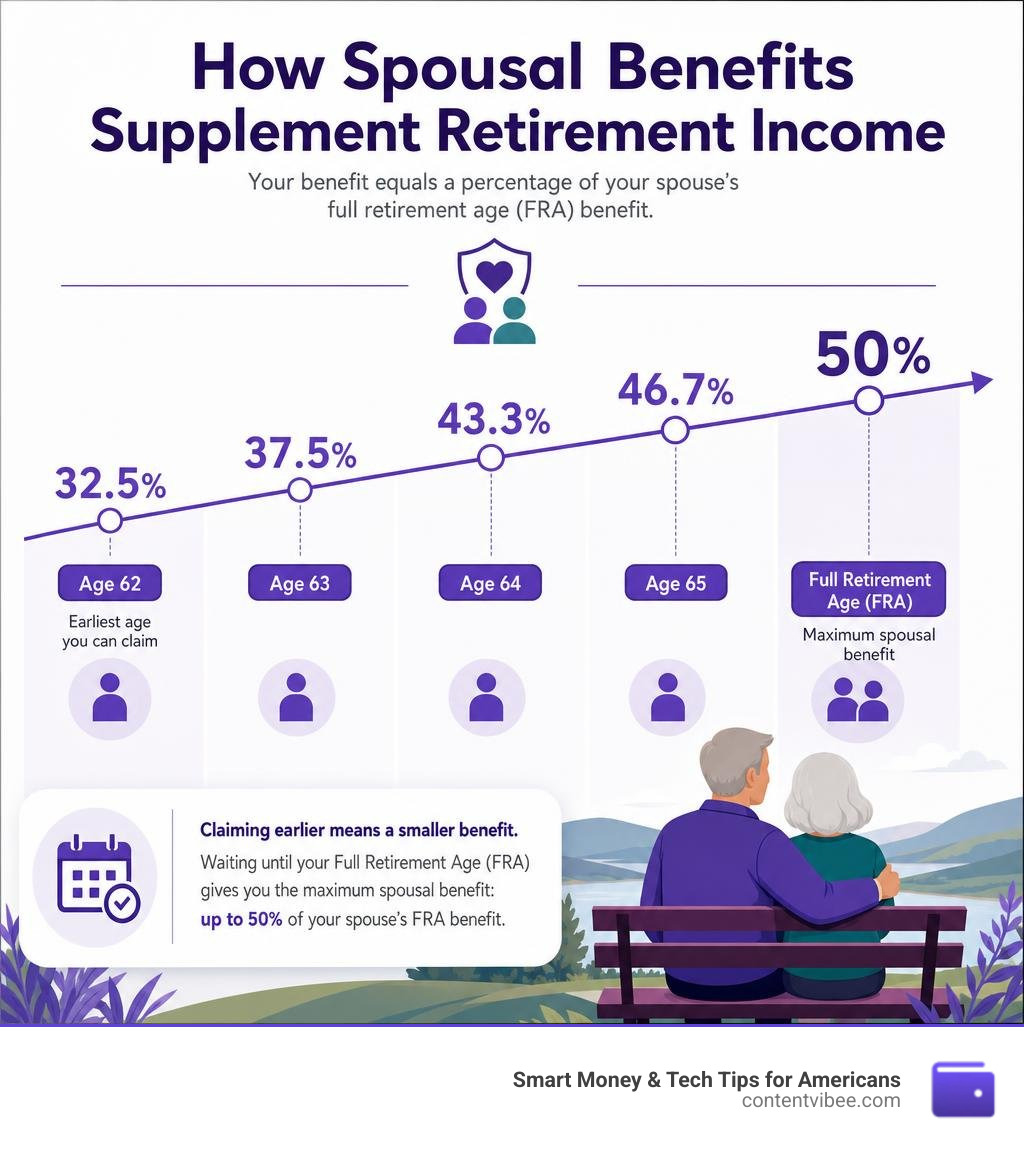
| Claiming early reduces your benefit | Down to as low as 32.5% of your spouse’s benefit at age 62 |
| Your partner’s payment | Not affected by your spousal benefit claim |
| Divorced spouses | May qualify if married 10+ years |
As of December 2023, about 5.8 million spouses were receiving Social Security spousal benefits. Women averaged $895 per month and men averaged $523 per month from these benefits alone. For many households — especially those where one partner earned significantly less — this benefit can make a real difference.
Yet many couples either don’t know they qualify or leave money on the table by claiming at the wrong time.
This guide breaks down everything you need to know: eligibility rules, how benefits are calculated, what happens if you claim early, and how divorced spouses fit into the picture.
Similar topics to Social Security spousal benefits for couples:
Understanding Social Security Spousal Benefits for Couples

To truly grasp how Social Security spousal benefits for couples work, we first need to pull back the curtain on how the Social Security Administration (SSA) views household earnings records.
Every worker who pays into the system accumulates “credits” based on their earnings. Once you earn 40 credits (typically requiring 10 years of work), you become eligible for your own retirement benefits. The amount you receive is based on your highest 35 years of indexed earnings, culminating in your Primary Insurance Amount (PIA). Your PIA is the exact monthly benefit you are entitled to receive if you wait until your Full Retirement Age (FRA) to claim.
But what happens if one spouse stayed home to raise children, ran a household, or worked in a lower-paying field? This is where spousal benefits shine. The SSA recognizes the immense value of non-earning or lower-earning partners by allowing them to receive a benefit based on their husband or wife’s work history instead of their own.
When you apply for benefits, the SSA evaluates both your personal earnings record and your spouse’s record. If you qualify for a spousal benefit that is higher than your own retirement benefit, you will receive a combination of payments that equals the higher spousal amount.
To explore this further, you can read the official SSA blog post on Do You Qualify for Social Security Spouse’s Benefits? or check out our comprehensive breakdown in The Ultimate Guide to Spousal Social Security Eligibility.
Eligibility Rules for Social Security Spousal Benefits for Couples
Before you can start planning how to spend that extra retirement cash, we need to make sure you tick all the necessary regulatory boxes. The basic rules for a current spouse to qualify are straightforward but strict:
- The Marriage Requirement: You must be legally married to the worker. Under standard rules, you must have been married for at least one continuous year before filing for benefits.
- The Age Requirement: You must be at least 62 years old to claim a reduced spousal benefit, or at your Full Retirement Age to claim the maximum 50% benefit (unless you qualify under the “child-in-care” exception).
- The Partner’s Status: Your spouse must already be entitled to and actively receiving their own retirement or disability benefits. If your partner has not filed yet, you cannot collect a spousal benefit on their record.
The legal definition of a spouse is strictly governed by state laws. According to the SSA Handbook § 305, a claimant must be legally married under the laws of the state where the primary worker lives (is domiciled) at the time the application is filed. This includes valid common-law marriages and same-sex marriages. In cases where a legal marriage might have technical flaws, the SSA may recognize a “deemed spouse” if the marriage ceremony was entered into in good faith.
Special Rules for Child-in-Care Spouses
There is a major exception to the age 62 rule. If you are caring for a child who is under the age of 16, or a child of any age who was disabled before age 22, you can receive spousal benefits at any age.
Even better, if you qualify under the “child-in-care” rule, your spousal benefit is not subject to age-based reductions. You will receive the full, unreduced spousal benefit (up to 50% of your partner’s PIA) regardless of how young you are when you file.
However, once the youngest child turns 16 (unless they are disabled), your child-in-care spousal benefits will stop until you reach age 62, at which point you can reapply under the normal age-based rules. The exact parameters governing these scenarios are outlined in the SSA policy manual SSA – POMS: RS 00202.001 – Definitions and Requirements for Spouse Benefits – 07/24/2017.
How Spousal Benefits Are Calculated and Reduced

Now, let’s talk numbers. The maximum spousal benefit a husband or wife can receive is 50% of the worker’s Primary Insurance Amount (PIA).
It is incredibly important to emphasize that this 50% limit is based on the worker’s PIA (their benefit at Full Retirement Age), not their actual payout if they claimed early or delayed. If your spouse files early at age 62 and receives a permanently reduced payment, your maximum spousal benefit is still calculated as half of what they would have received if they had waited until their FRA.
Conversely, if your spouse delays claiming past their FRA to earn delayed retirement credits, your spousal benefit is still capped at 50% of their base FRA benefit. Delaying does not boost the spousal benefit.
To figure out what your potential household payments look like, we suggest reading our guide on how to Calculate Spouse Retirement Benefits and checking out the official calculator tools on the Benefits for Spouses page.
How to Calculate Social Security Spousal Benefits for Couples
If you decide to claim your spousal benefit before you reach your own Full Retirement Age, the SSA will permanently reduce your monthly payment. The reduction is calculated using a specific monthly fraction:
- For the first 36 months before your FRA, your spousal benefit is reduced by 25/36 of 1% for each month.
- For any additional months beyond 36 months (up to a maximum of 60 months if you claim at age 62), the benefit is further reduced by 5/12 of 1% per month.
Here is how those reductions play out in real life for someone whose Full Retirement Age is 67:
| Claiming Age | Months Before FRA | Total Reduction Percentage | Your Spousal Benefit (as % of Spouse’s PIA) |
|---|---|---|---|
| 67 (Full Retirement Age) | 0 months | 0% | 50.0% |
| 66 | 12 months | 8.33% | 45.8% |
| 65 | 24 months | 16.67% | 41.7% |
| 64 | 36 months | 25.00% | 37.5% |
| 63 | 48 months | 30.00% | 35.0% |
| 62 (Minimum Age) | 60 months | 35.00% | 32.5% |
If you want to plug in your own specific details and birth dates to run the numbers, we highly recommend utilizing our interactive Tools/Finance Calculator/Social Security Spousal Benefit Calculator.
The Impact of Delayed Retirement Credits
If you are the primary earner, delaying your Social Security retirement claim past your Full Retirement Age is a fantastic strategy to maximize your monthly check. For every year you delay claiming up to age 70, your benefit increases by 8% due to delayed retirement credits.
However, as we mentioned earlier, these delayed retirement credits do not pass on to your living spouse’s spousal benefit. Your spouse’s benefit is strictly capped at 50% of your PIA.
The story changes completely, however, when it comes to survivor benefits. If you delay claiming and build up your retirement benefit to its absolute maximum, and then you pass away, your surviving spouse is entitled to receive up to 100% of your actual benefit (including all those 8% yearly delayed retirement credits). Therefore, if you are the higher-earning spouse, delaying your claim is often less about your own retirement and more about protecting your partner’s financial security if you pass away first.
Navigating Deemed Filing and Dual Eligibility
A common point of confusion for many couples is whether they can “double dip” by claiming their own retirement benefit first while letting their spousal benefit grow, or vice versa.
In the past, savvy retirees used a strategy called a “restricted application” to do exactly this. However, the law changed. Today, the rules of “deemed filing” apply to almost everyone.
Under deemed filing, when you apply for either your own retirement benefit or a spousal benefit, you are “deemed” to have applied for both at the same time. The SSA will calculate both amounts and pay you a total benefit that is equal to the higher of the two. You do not get to choose which one to receive, nor do you get to collect both in full.
To see how this works, let’s look at the classic “Sandy” example:
The Sandy Example:
Sandy has worked throughout her life and is entitled to her own retirement benefit of $1,000 per month at her Full Retirement Age. Her husband, John, has a much higher earnings history, and his retirement benefit at FRA is $2,500 per month.Because they are both at Full Retirement Age, Sandy’s maximum spousal benefit is 50% of John’s benefit, which equals $1,250 per month.
When Sandy files, the SSA looks at both records. Because her spousal benefit ($1,250) is higher than her own retirement benefit ($1,000), she qualifies for the spousal amount. The SSA pays her own $1,000 retirement benefit first, and then adds a spousal supplement of $250. Her total monthly payout is $1,250.
If Sandy’s own retirement benefit had been $1,500, she would have simply received her own $1,500, and she would not have been eligible for any spousal supplement because her own benefit exceeded 50% of John’s.
For a deeper dive into these complex claiming rules, read the official Filing Rules for Retirement and Spouses Benefits or review our comprehensive guide: His, Hers, and Ours: The Ultimate Guide to Dual Social Security Benefits.
Rules for Divorced Spouses and Independent Entitlement
What happens if a marriage doesn’t last, but you still contributed to the household or sacrificed your career path? Fortunately, the SSA provides a financial safety net for divorced individuals. If you are divorced, you can still collect spousal benefits on your ex-spouse’s record, provided you meet the following conditions:
- The 10-Year Rule: Your marriage must have lasted for at least 10 consecutive years before the divorce was finalized.
- The Marital Status Rule: You must currently be unmarried. If you remarry, you generally lose your eligibility to collect benefits on your ex-spouse’s record (unless your subsequent marriage ends by death, divorce, or annulment).
- The Age Rule: You must be at least 62 years old.
- The Benefit Rule: The benefit you are entitled to on your own record must be less than the benefit you would receive on your ex’s record.
One of the biggest advantages for divorced spouses is the concept of independent entitlement. For married couples, you cannot collect a spousal benefit until your partner has actually filed for their own benefits. However, if you have been divorced for at least two continuous years, you can claim benefits on your ex-spouse’s record even if they have not yet filed for retirement! As long as your ex is eligible for benefits (meaning they are at least 62) and you meet the other requirements, you can file independently.
Best of all, your ex-spouse will never be notified by the SSA that you have filed on their record. Your claim has absolutely zero impact on their monthly benefit amount, and it will not affect the benefits of their current spouse if they have remarried. The payment rules and calculations are legally insulated, as outlined in the SSA – POMS: RS 00202.020 – Spouse’s Benefits – Payment – 01/20/2026.
For a complete step-by-step roadmap on navigating this process, check out our Divorced Spouse Social Security Guide 2026.
How to Estimate and Apply for Spousal Benefits
Now that you know the rules, how do you actually go about claiming what you are owed? The easiest and most efficient way to estimate and apply for your benefits is online through the SSA’s digital portal.
Here is our recommended step-by-step process to get started:
- Create or Sign In to Your Account: Head over to the SSA website and log in to your personal my Social Security account. If you don’t have one, creating an account takes just a few minutes and requires identity verification.
- Use the Retirement Calculator: Once logged in, scroll to the Retirement Calculator section. Here, you can select the option to estimate benefits as a spouse, enter your partner’s FRA benefit estimate, and compare different claiming ages.
- Gather Your Documents: Before you begin the application, make sure you have the necessary documents on hand. This typically includes your Social Security number, your spouse’s Social Security number, your marriage certificate, and divorce decrees (if applicable).
- Submit Your Application: You can apply online as early as three months before you want your benefits to start. If you prefer not to apply online, you can call the SSA at 1-800-772-1213 to schedule an appointment over the phone or at your local California SSA office.
To make sure you don’t miss any critical steps or documents during this process, we have put together The Ultimate Checklist for Your Application for Spousal Benefits.
Frequently Asked Questions about Spousal Benefits
Does receiving a spousal benefit reduce my partner’s retirement payment?
No! This is one of the most common myths about Social Security. Claiming a spousal benefit does not reduce your partner’s retirement check by a single penny. Your partner will still receive the full amount they earned based on their own work history. Furthermore, payments made to you as a spouse do not count toward the “family maximum” limit of your spouse’s record if you are a divorced spouse or a legal spouse claiming standard benefits.
Can I receive spousal benefits if my partner has not yet filed?
If you are currently married, no. Your spouse must be actively receiving their own retirement or disability benefits for you to collect a spousal benefit on their record. However, if you are divorced and have been divorced for at least two consecutive years, you can receive benefits on their record even if they haven’t filed yet, provided they are at least 62 years old.
What happens to my spousal benefit if my spouse passes away?
If your spouse passes away, your spousal benefit will stop, and you will transition to survivor benefits. Survivor benefits are much more generous than spousal benefits — you can receive up to 100% of your deceased spouse’s actual monthly benefit. You can claim survivor benefits as early as age 60 (or age 50 if you are disabled).
To learn more about how to navigate this emotional and financial transition, read our guide on Claiming What’s Yours: A Guide to Deceased Spouse Social Security.
Conclusion
At Suppremo, our mission is to simplify complex financial rules so you can make highly informed, confident decisions for your future. Social Security spousal benefits for couples are a vital piece of the retirement puzzle, and coordinating your claiming strategy with your partner can mean the difference of tens of thousands of dollars over your lifetimes.
Whether you are currently married, planning to retire soon, or navigating the rules as a divorced individual, taking the time to understand these rules is one of the smartest financial moves you can make.
Ready to master the rest of the playbook? Check out our essential breakdown of The Golden Rules: Can a Spouse Collect SS Spousal Benefits? and start maximizing your household retirement income today!