Tax Loss Harvesting: The Secret Weapon of Robo-Advisors
Why Robo-Advisor Tax-Loss Harvesting Could Be Your Biggest Tax Break
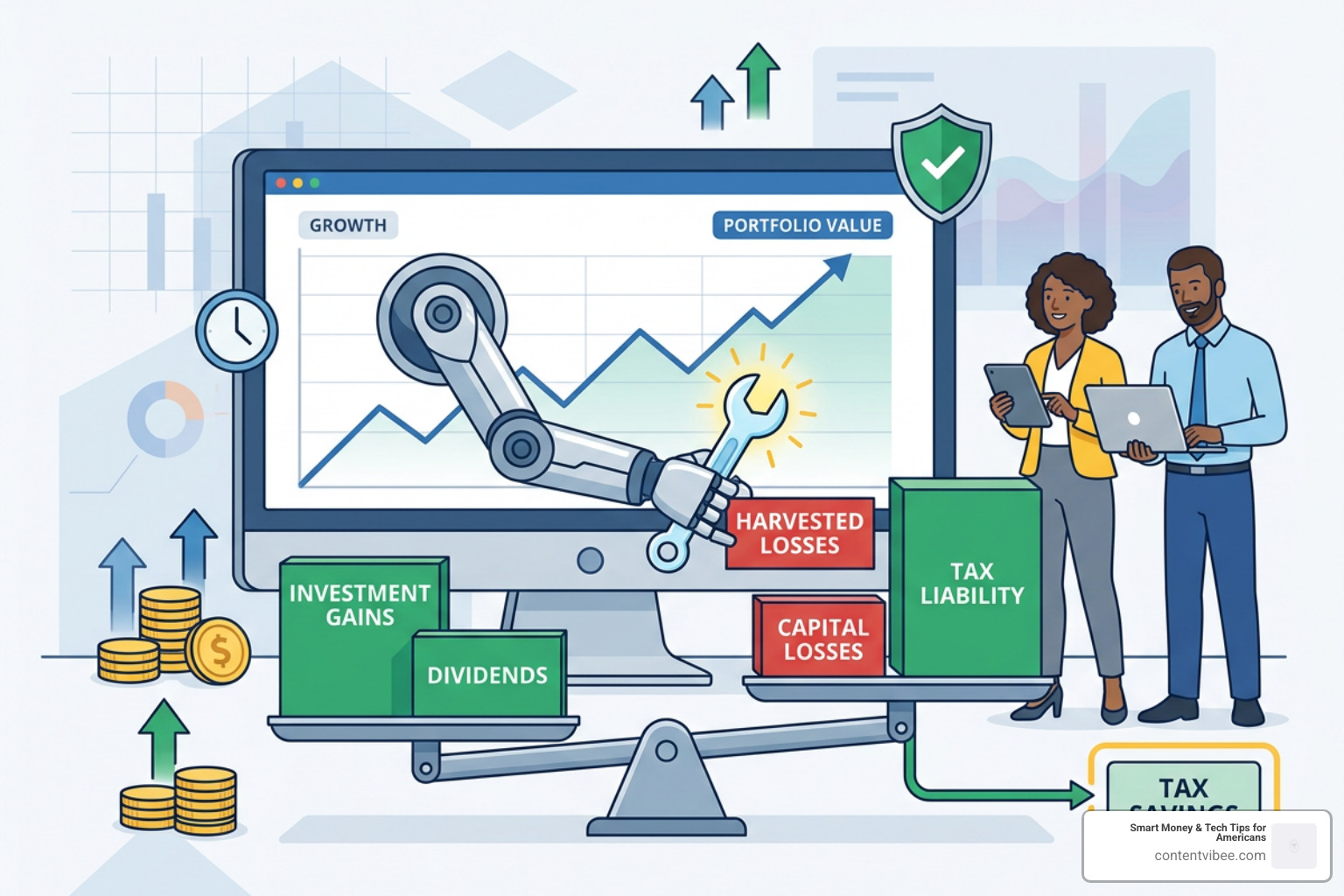
Robo advisor tax loss harvesting is one of the most powerful — and most overlooked — ways to reduce your investment tax bill automatically.
Here’s a quick summary of what it is and how it works:
- What it is: An automated strategy where a robo-advisor sells investments that have lost value to offset gains elsewhere in your portfolio
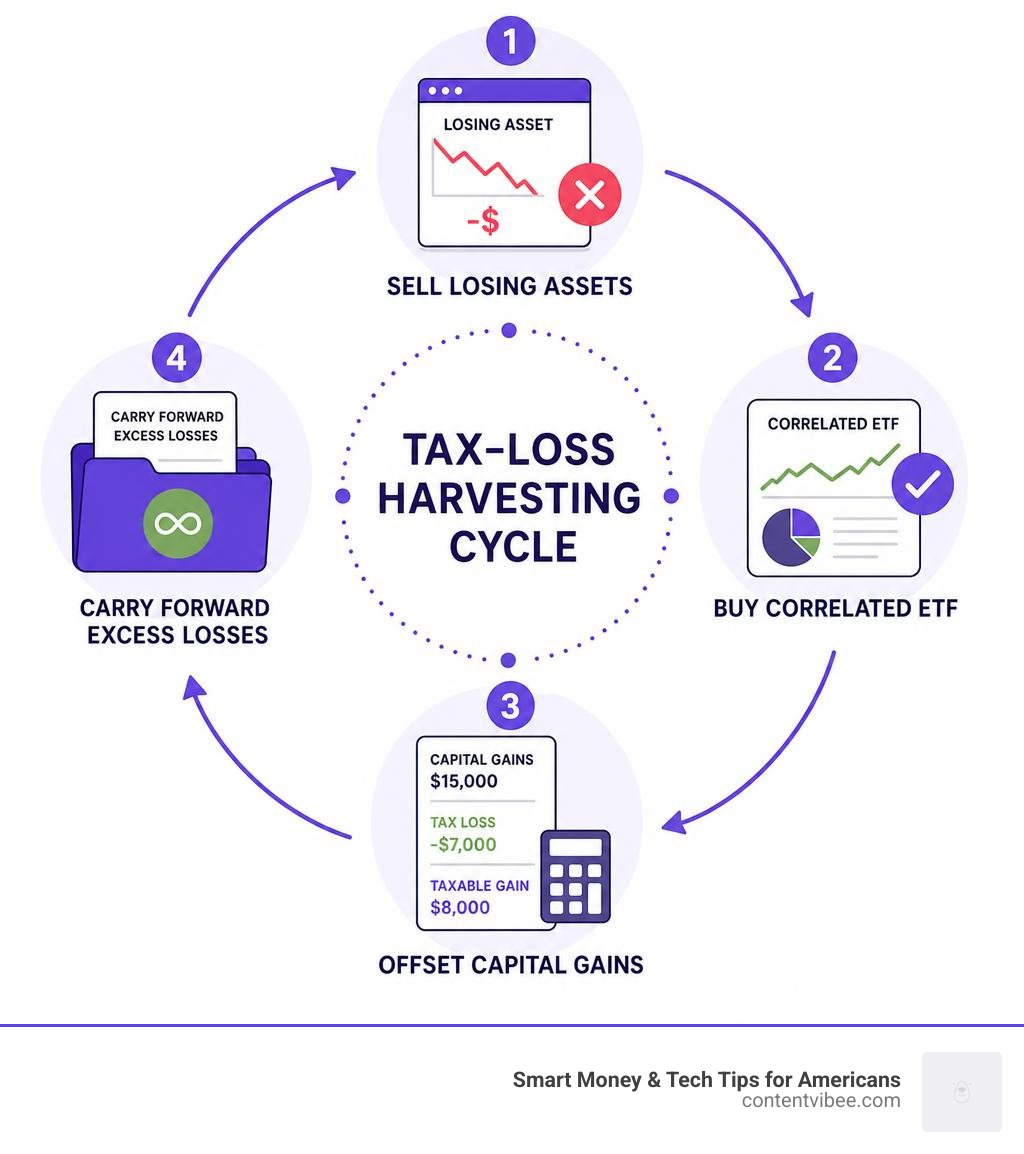
- How it saves money: Those harvested losses cancel out taxable gains — for example, a $7,000 loss against a $15,000 gain means you only owe taxes on $8,000
- The $3,000 bonus: If your losses exceed your gains, up to $3,000 can offset ordinary income each year — with leftover losses carried forward
- Why robo-advisors do it better: Algorithms scan your portfolio daily, while a human advisor typically does this once a year at most
- The key rule to know: The IRS wash-sale rule means you can’t buy back the same security within 30 days — robo-advisors handle this automatically by swapping in a similar ETF
Most investors leave significant tax savings on the table every year simply because they don’t know this strategy exists — or think it’s only for the wealthy.
The good news? Robo-advisors have made it accessible to almost anyone with a taxable brokerage account. Research suggests this strategy can generate around 0.5% in additional annualized returns under typical conditions — and potentially much more in volatile markets.
But it’s not right for everyone. Your tax bracket, account type, and investment timeline all matter.
This guide will walk you through exactly how it works, which platforms offer it, and how to decide if it makes sense for your situation.
What is Tax-Loss Harvesting and How Does It Work?
At its core, tax-loss harvesting is the process of turning investment “paper losses” into real-world tax savings. In a standard brokerage account, you do not actually owe taxes on your gains—nor can you claim your losses—until you sell the asset.
When you sell an investment for more than you paid, you realize a capital gain, which the IRS expects a cut of. Conversely, when you sell an asset for less than its purchase price, you realize a capital loss.
By strategically selling these losing investments, you “harvest” those losses to offset your realized gains. This strategy is fully detailed in Maximize Returns Using Robo-Advisors and Tax-Loss Harvesting.
The Mechanics of Offsetting Capital Gains
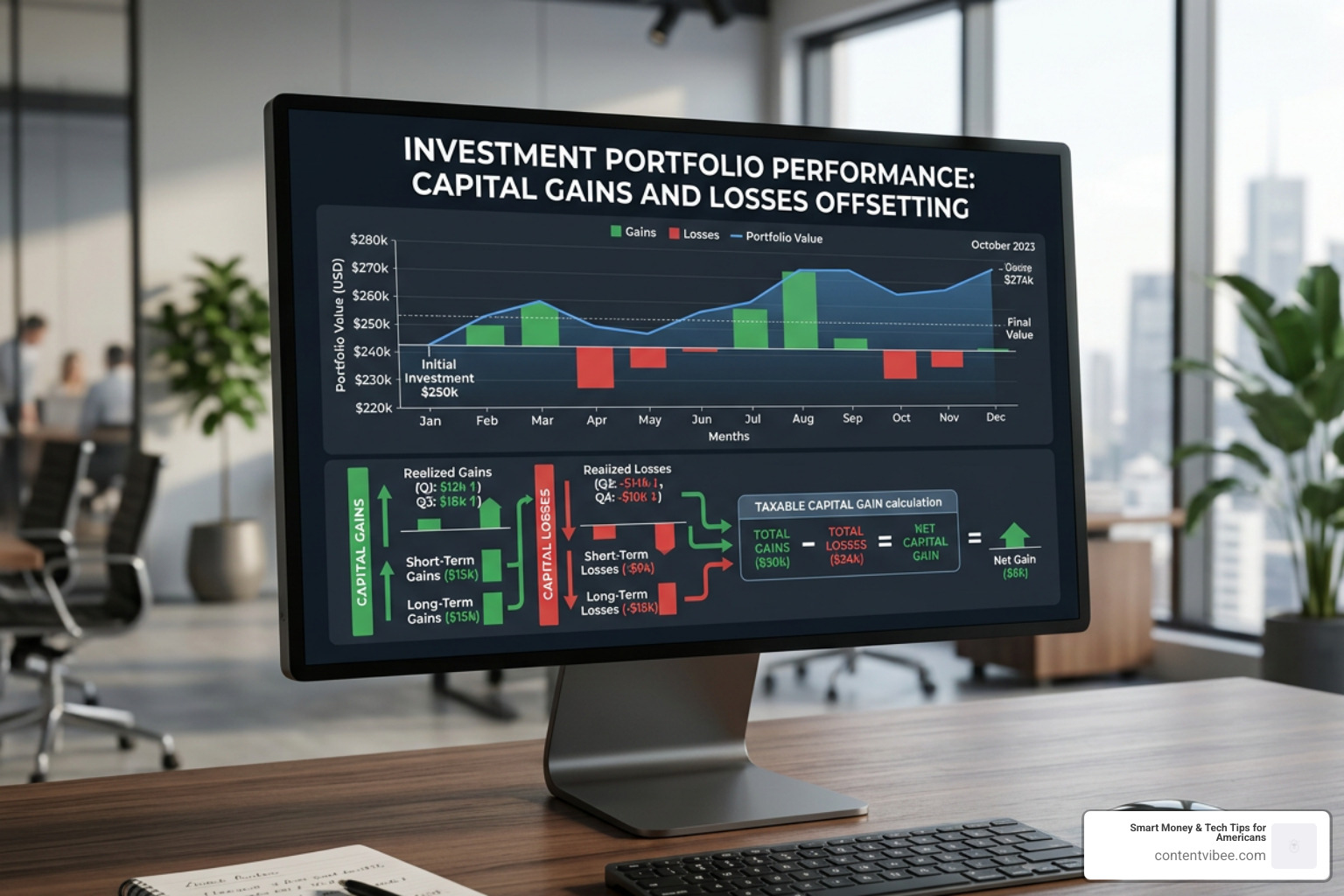
The IRS categorizes capital gains and losses into two buckets based on how long you held the asset:
- Short-term: Assets held for one year or less. These are taxed at your ordinary income tax rates, which can be as high as 37% at the federal level.
- Long-term: Assets held for more than one year. These enjoy preferential tax rates of 0%, 15%, or 20%, depending on your taxable income.
The rules of tax-loss harvesting require you to net your gains and losses in a specific order:
- Short-term losses offset short-term gains.
- Long-term losses offset long-term gains.
- Any excess losses from either category can then be used to offset the other type of gain.
For example, if you realized a $15,000 long-term capital gain from selling a stock, and you harvested a $7,000 loss by selling a declining Exchange-Traded Fund (ETF), your net taxable gain drops to $8,000. If you are in the 20% long-term capital gains bracket, this single move saves you $1,400 in federal taxes ($7,000 x 20%).
The cost basis—the original price you paid for the asset—is the benchmark used to measure these fluctuations.
The $3,000 Ordinary Income Offset Rule
What happens if you have a terrible year in the market and your harvested losses exceed your total capital gains? The IRS provides a soft landing.
You are allowed to use up to $3,000 of excess capital losses ($1,500 if you are married filing separately) to offset your ordinary income—such as your salary or business earnings—in that tax year.
If you still have losses left over after wiping out your capital gains and claiming your $3,000 ordinary income offset, those excess losses do not vanish. They are rolled forward into subsequent tax years indefinitely, waiting to offset future gains or ordinary income.
Evaluating Robo Advisor Tax Loss Harvesting for Your Portfolio
Historically, tax-loss harvesting was a luxury reserved for high-net-worth individuals who could afford expensive wealth managers to manually calculate cost bases, monitor market movements, and execute trades.
Today, robo advisor tax loss harvesting has completely democratized this strategy, putting institutional-grade tax management into the hands of everyday retail investors.

How Robo Advisor Tax Loss Harvesting Works Daily
Robo-advisors utilize sophisticated algorithmic software to monitor your portfolio. Instead of waiting until late December to look for tax savings, these algorithms scan your accounts daily, looking for opportunities to harvest losses.
If a specific asset class or ETF drops below its purchase price by a meaningful threshold (such as 5% or more), the robo-advisor automatically triggers a sale.
To keep your portfolio balanced and ensure you do not miss out on a market recovery, the algorithm immediately reinvests the proceeds from the sale into a highly correlated, but not “substantially identical,” replacement asset.
Because robo-advisors deal in fractional shares and highly liquid ETFs, transaction costs are virtually non-existent or fully covered by your flat wrap fee. You can explore how these advisory fees impact your bottom line in The No-Nonsense Guide to Robo-Advisor Fees.
Robo-Advisors vs. Traditional Financial Advisors
The difference in execution frequency between automated platforms and human advisors is stark:
- Human Financial Advisors: Typically run tax-loss harvesting processes manually once a year, usually in November or December. If the market dips in March and recovers by June, a human advisor will completely miss the opportunity to harvest those temporary losses.
- Robo-Advisors: Perform daily, continuous monitoring. They can capture “micro-losses” during short-term market corrections throughout the year, accumulating substantial tax savings (often referred to as “tax alpha”) over time.
Additionally, human advisors are prone to calculation errors when managing multiple tax lots, whereas algorithms execute wash-sale checks and lot-selection methods (like Highest-In, First-Out, or HIFO) with mathematical precision.
To understand the rules governing these transactions more deeply, check out Understanding Tax-Loss Harvesting Rules.
Navigating the IRS Wash-Sale Rule in Automated Portfolios
The biggest hurdle to successful tax-loss harvesting is the IRS wash-sale rule. The IRS is fully aware that investors might want to claim a tax write-off without actually changing their investment positions.
To prevent this, the wash-sale rule states that if you sell a security at a loss, you cannot claim that loss on your taxes if you buy the same security, or a “substantially identical” one, within a 61-day window: 30 days before the sale, the day of the sale, or 30 days after the sale.
For official details on how the IRS views these transactions, you can reference the IRS Guidance on Capital Gains and Losses.
Identifying Substantially Identical Securities
If you sell an S&P 500 ETF (like SPY) at a loss and immediately buy another S&P 500 ETF (like IVV), the IRS will likely deem those “substantially identical” because they track the exact same index. If that happens, your tax loss is disallowed, and the loss is instead added to the cost basis of your new purchase.
To avoid this, robo-advisors use clever replacement strategies. If they sell a broad market index ETF, they will purchase a different, highly correlated ETF that tracks a slightly different index.
For example, they might replace a Vanguard Total Stock Market ETF (VTI) with an iShares Core S&P Total U.S. Stock Market ETF (ITOT). These funds have a correlation of roughly 0.99, meaning their performance is virtually identical, but because they track different underlying indexes, they do not trigger a wash sale.
This keeps your target asset allocation intact, minimizing tracking error and portfolio drift during the 30-day waiting period.
Managing Wash Sales Across Multiple Brokerage Accounts
A major trap for DIY investors is that the wash-sale rule applies across all of your accounts, including your spouse’s accounts and your tax-advantaged retirement accounts (like Traditional and Roth IRAs). If you sell a stock for a loss in your taxable account, but buy it back inside your IRA within 30 days, you have triggered a wash sale, and that tax loss is permanently lost.
While a single brokerage platform can easily track wash sales within its own walls, it cannot see what you are doing at other financial institutions. This is where specialized multi-brokerage tools like Automated Tax-Loss Harvesting for Every Brokerage | TaxHarvest come in.
These platforms aggregate your holdings across multiple brokerages, monitoring cross-account transactions and sending automated alerts before you accidentally trigger a wash sale.
The Impact of Automated Harvesting on Long-Term Performance
How does tax-loss harvesting affect your portfolio over a multi-decade horizon? When executed correctly, the tax savings generated can be reinvested back into your portfolio, compounding over time to boost your long-term wealth.
How Rebalancing and Tax Savings Work Together
Over time, different assets in your portfolio grow at different rates, causing your portfolio to “drift” away from your target risk profile. If your target allocation is 80% stocks and 20% bonds, a major bull market might push your stock exposure to 90%, exposing you to more risk than you comfortable with.
Robo-advisors solve this by integrating tax-loss harvesting directly with automatic portfolio rebalancing. When the algorithm harvests a loss, it does not just let the cash sit idle. It uses the proceeds from the sale, along with any incoming dividends or new deposits, to purchase underperforming asset classes.
This brings your portfolio back to its target allocation without triggering unnecessary taxable gains. You can learn more about how automated systems manage risk in Robo Advisor Asset Allocation: Can Robots Really Gauge Your Risk Tolerance?.
Potential Drawbacks and Long-Term Tax Risks
While tax-loss harvesting is incredibly beneficial, it is important to understand that it is primarily a tax deferral strategy, not a tax elimination strategy.
When you sell an asset at a loss and buy a replacement asset, you are effectively lowering the cost basis of your new holding. If you hold that replacement asset for decades and eventually sell it in retirement, your taxable capital gains will be larger because of that lower cost basis.
Therefore, the value of tax-loss harvesting relies heavily on the “time value of money”—saving a dollar on taxes today and letting it compound for 20 years is worth far more than paying that extra dollar in taxes down the road.
However, if you expect to be in a much higher tax bracket when you eventually liquidate your portfolio, aggressive tax-loss harvesting today could theoretically work against you.
Who Should Use Automated Tax-Loss Harvesting?
Tax-loss harvesting is a stellar tool, but it is not a one-size-fits-all solution. Its effectiveness depends heavily on your income, your tax bracket, and the types of accounts you hold.
| Investor Profile | Suitability | Primary Benefit | Key Considerations |
|---|---|---|---|
| High-Income Earners | Highly Beneficial | Offsets high marginal rates and capital gains taxes | Maximizes tax alpha; ideal for direct indexing |
| Moderate-Income Earners | Moderately Beneficial | Offsets occasional gains; $3,000 ordinary income write-off | Must watch out for low marginal brackets |
| Low-Income Earners | Low Benefit | Minimal value | Capital gains rate may already be 0% |
| Retirement-Only Investors | Not Applicable | None | IRAs and 401(k)s are already tax-sheltered |
Robo Advisor Tax Loss Harvesting for High-Income Earners
If you find yourself in the upper federal tax brackets (32% to 37%) and live in a high-tax state, automated tax-loss harvesting is an absolute home run.
Because your short-term capital gains and ordinary income are taxed at high rates, every dollar of loss you harvest yields significant, immediate cash savings.
Furthermore, high-net-worth investors can take advantage of advanced features like “direct indexing.” Instead of buying a single S&P 500 ETF, some robo-advisors will buy all 500 individual stocks in the index for you.
This allows the algorithm to harvest losses on individual, volatile stocks (like a tech stock that dipped 20%) even when the broader S&P 500 index is up for the year.
When Automated Harvesting Might Not Be Beneficial
You should generally skip or disable automated tax-loss harvesting if:
- You only invest in retirement accounts: Tax-loss harvesting only works in taxable brokerage accounts. IRAs, 401(k)s, and 529 plans are tax-deferred or tax-free, meaning the IRS does not tax your trades within these accounts anyway.
- You are in a low tax bracket: If your taxable income is low enough that your long-term capital gains tax rate is 0%, harvesting losses does not provide any immediate tax relief.
- You plan to liquidate your entire portfolio soon: If you need to sell all your investments in a year or two for a major purchase (like a home down payment), harvesting losses now will only lower your cost basis and increase your tax bill in the very near future.
Frequently Asked Questions about Automated Tax Harvesting
Can I use tax-loss harvesting in an IRA or 401(k)?
No. Tax-loss harvesting is completely useless inside tax-advantaged accounts like IRAs, Roth IRAs, or 401(k)s. Because these accounts do not trigger capital gains taxes when you sell investments, you cannot use losses generated inside them to offset external taxable gains.
In fact, trading in these accounts can actually complicate your taxable accounts due to cross-account wash-sale rules.
How much can automated tax-loss harvesting increase my annual returns?
For a typical investor with a diversified portfolio, a 10-year horizon, and a moderately high tax bracket, automated tax-loss harvesting can add roughly 0.5% in annualized excess returns (often called tax alpha).
During highly volatile market years, this benefit can be significantly higher, as a larger number of assets will dip temporarily, presenting more harvesting opportunities.
What happens if I trigger a wash sale accidentally?
If you trigger a wash sale, the IRS simply disallows you from claiming that specific capital loss on your current year’s taxes. Instead, the disallowed loss is added to the cost basis of the newly purchased security.
While you do not face any penalties or fines, you do lose the immediate tax break, and you will have to wait until you sell the new security to realize that tax benefit.
Conclusion
At Smart Money & Tech Tips for Americans, we believe that smart investing is not just about choosing the right assets—it is also about keeping as much of your hard-earned return as possible. Automated tax-loss harvesting is the ultimate “set-it-and-forget-it” tool to help you do exactly that.
By leveraging daily algorithmic scans, robo-advisors turn market volatility into a tax advantage, automatically offsetting your capital gains and even lowering your ordinary taxable income.
If you are ready to put your portfolio on autopilot and let technology handle the heavy lifting, take a look at our detailed review: Is the Autopilot Investment App Worth the Cost? to see if an automated investment strategy is the right fit for your financial future.