Shop, Compare, and Save on Covered California Health Plans

What Is the Covered California Estimated Cost in 2026?
Understanding the covered California estimated cost is the first step to finding a plan that fits your budget u2014 especially now that key federal subsidies have changed heading into 2026.
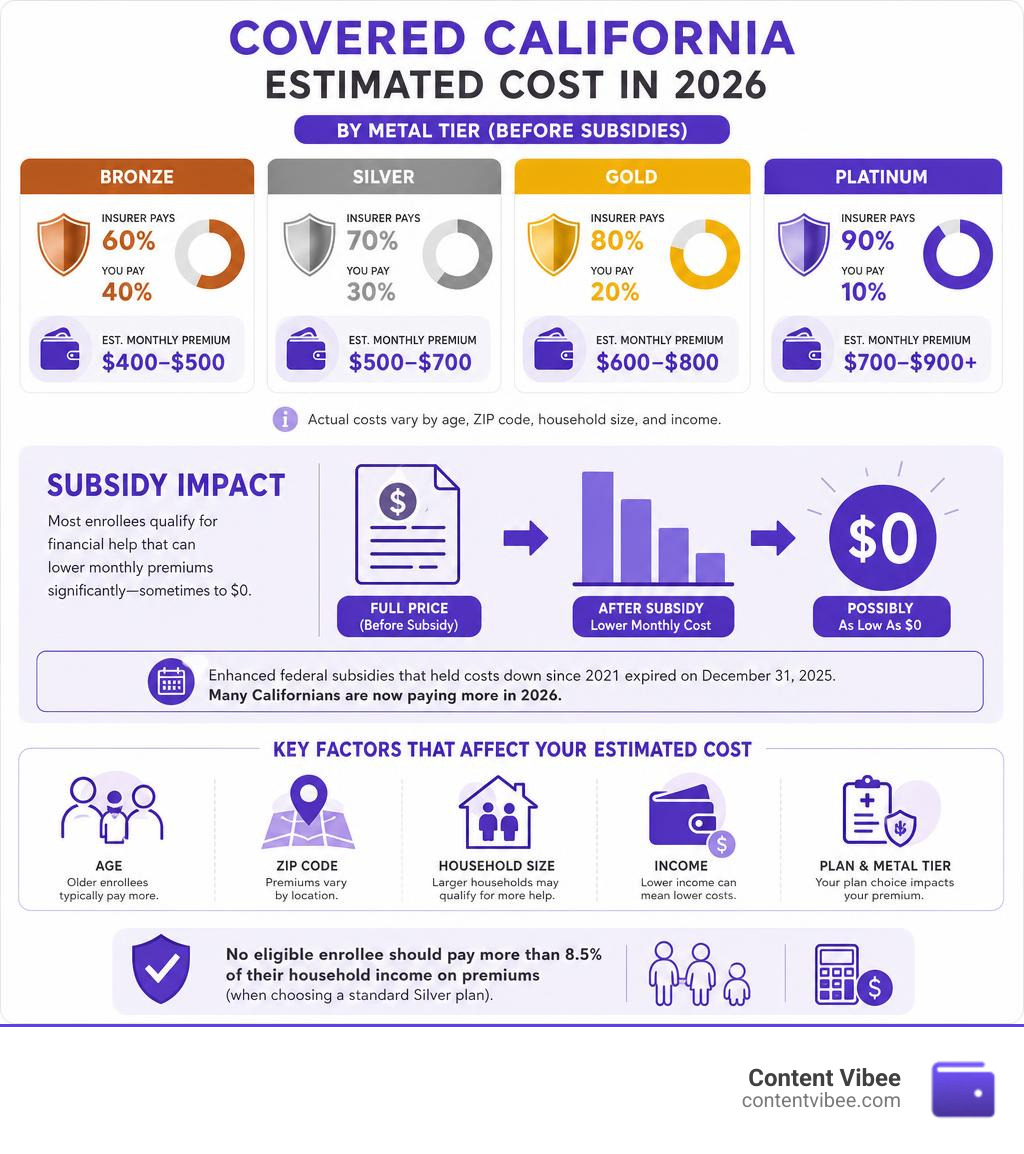
Here’s a quick look at typical monthly premiums by metal tier for a 40-year-old in California (before subsidies):
| Metal Tier | Insurer Pays | You Pay | Est. Monthly Premium |
|---|---|---|---|
| Bronze | 60% | 40% | ~$400u2013$500 |
| Silver | 70% | 30% | ~$500u2013$700 |
| Gold | 80% | 20% | ~$600u2013$800 |
| Platinum | 90% | 10% | ~$700u2013$900+ |
Actual costs vary by age, ZIP code, household size, and income.
The bottom line: Most Covered California enrollees qualify for financial help. For those who do, premiums can drop significantly u2014 sometimes to $0. But the enhanced federal subsidies that held costs down since 2021 expired on December 31, 2025. That means many Californians are now paying more than they did last year.
Close to 2 million Californians get their health coverage through Covered California. Some are seeing sticker shock in 2026. A 25-year-old in Los Angeles earning $32,000 per year, for example, now faces a monthly premium nearly triple what it was under the old subsidy rules u2014 around $172 per month, or 6.6% of their income.
No eligible enrollee should pay more than 8.5% of their household income on premiums (when choosing a standard Silver plan). But knowing how to calculate your actual cost u2014 and which plan to pick u2014 takes a little digging.
That’s exactly what this guide breaks down.
Understanding Your Covered California Estimated Cost in 2026

Navigating the landscape of health insurance can feel a bit like trying to solve a Rubik’s cube in the dark. However, calculating your covered california estimated cost for the 2026 plan year becomes much easier when you understand how the state’s marketplace structures its rates.
Every year, health insurance carriers submit their pricing schedules to state regulators. For 2026, these rates reflect both the rising cost of medical care and structural shifts in federal funding. To get an accurate picture of what you will pay, you have to look at the “sticker price” (the gross premium) and subtract your individual tax credit (the subsidy).
To make sense of these baseline numbers, we can use tools like the California Health Insurance Cost Calculator 2026. This tool integrates the official rating structures with regional cost variations to give you an immediate ballpark figure.
To help put these numbers in perspective, the average unsubsidized marketplace premium in California hovers around $640 per month. But because of California’s massive size and diverse population, very few people actually pay exactly that average. A younger individual in a highly competitive metro area might see baseline rates far below this, while an older resident in a rural county will face higher initial quotes. For a broader overview of how these monthly averages stack up, check out our guide on Everything You Need To Know About Health Insurance Cost Per Month In California.
The Benchmark Plan and the APTC
To understand how your final bill is calculated, you must understand the concept of the benchmark plan. In the health insurance world, the benchmark plan is the second-lowest-cost Silver plan available in your specific geographic rating area.
Covered California uses this benchmark plan to calculate your Advanced Premium Tax Credit (APTC). The federal government determines how much you are reasonably expected to contribute toward your health insurance based on your household income relative to the Federal Poverty Level (FPL). Your APTC is simply the difference between the cost of that benchmark Silver plan and your required contribution.
For example, let’s look at a 40-year-old individual living in Sacramento who earns $31,300 per year (which is approximately 200% of the FPL).
- The benchmark Silver plan premium in their region is $638 per month.
- Based on their income level, their required contribution is calculated at 6.60% of their income, which equates to $172 per month.
- Subtracting the required contribution from the benchmark price ($638 – $172) leaves an APTC of $466 per month.
- When you add in California’s special state-funded credits, this individual receives a total of $467 per month in financial assistance, bringing their out-of-pocket premium for that benchmark Silver plan down to exactly $171 per month.
This system ensures that even when base insurance rates climb, your personal premium remains tied to your actual ability to pay.
How Subsidies and the Expiration of Enhanced Credits Impact Your Covered California Estimated Cost
The biggest story of 2026 is the expiration of the enhanced federal premium subsidies that were originally introduced during the pandemic and extended through 2025 by the Inflation Reduction Act. These enhanced subsidies eliminated the dreaded “subsidy cliff” and ensured that no American had to pay more than 8.5% of their household income for a benchmark health plan.
As of January 1, 2026, those enhanced credits have officially expired, and federal assistance has reverted to pre-pandemic Affordable Care Act (ACA) levels. This shift has massive financial implications for hundreds of thousands of Californians. For a deep dive into the policy changes and localized projections, you can read the analysis on How Much Will Covered California Premiums Cost in 2026?.
Under the pre-pandemic rules, individuals earning more than 400% of the FPL are no longer eligible for any federal APTC. This means middle-income families who previously enjoyed capped premiums are now responsible for the full, unsubsidized cost of their health insurance.
To cushion this blow, the state of California continues to step in with its own general budget funds. Every single Covered California member receives a monthly $1 California Premium Credit, and specialized state-funded subsidies help lower-income residents reduce their costs further. However, for those in the middle-income bracket, these state measures only partially offset the loss of federal support.
Key Factors That Determine Your Covered California Estimated Cost
When you request a quote, your premium isn’t pulled out of thin air. It is determined by five primary personal data points:
- ZIP Code (Geographic Rating Area): California is divided into 19 distinct rating regions. The cost of medical care and the level of competition among hospital systems and insurers vary wildly between these regions. For example, a 40-year-old in Alameda County looking at standard Silver plans will see rates ranging from $649 per month with Kaiser Permanente to $844 per month with Blue Shield of California (PPO).
- Age Rating: Under the ACA, insurers are allowed to charge older enrollees more than younger ones, up to a maximum 3:1 ratio. This means a 64-year-old can be charged three times as much as a 21-year-old for the exact same plan.
- Household Size: Your tax household size determines where your total income falls on the Federal Poverty Level scale, which dictates your subsidy eligibility.
- Annual Household Income: Your estimated modified adjusted gross income (MAGI) for the coverage year is the primary metric used to calculate your premium discounts.
- Tobacco Use: Although California heavily restricts premium surcharges, the ACA does permit a tobacco surcharge of up to 50% in certain circumstances, which does not qualify for subsidy assistance.
For those who run their own businesses and must purchase individual coverage, navigating these variables is critical. We highly recommend reviewing our A Comprehensive Guide To Best Health Insurance For Self Employed California to learn how to optimize your business deductions alongside your marketplace application.
Comparing the Four Standardized Metal Tiers
To make plan comparison straightforward, Covered California organizes plans into four simplified, color-coded “metal tiers”: Bronze, Silver, Gold, and Platinum. Plans within the same tier are standardized. This means that whether you buy a Gold plan from Carrier A or Carrier B, the copays, deductibles, and out-of-pocket maximums are identical. They only differ in their monthly premiums, their network of doctors, and customer service ratings.
To see how these tiers stack up, you can review Covered California Plans: Metallic Plan Benefits. Here is a breakdown of the standard benefit designs for 2026:
| Feature / Metric | Bronze 60 | Silver 70 | Gold 80 | Platinum 90 |
|---|---|---|---|---|
| Actuarial Value | Insurer pays 60% / You pay 40% | Insurer pays 70% / You pay 30% | Insurer pays 80% / You pay 20% | Insurer pays 90% / You pay 10% |
| Individual Deductible | $6,300 | $5,400 | None | None |
| Family Deductible | $12,600 | $10,800 | None | None |
| Individual Out-of-Pocket Max | $9,100 | $9,100 | $8,700 | $4,500 / $5,000* |
| Family Out-of-Pocket Max | $18,200 | $18,200 | $17,400 | $9,000 / $10,000* |
| Primary Care Visit | Copay applies after deductible | Fixed Copay | Fixed Copay | Low Fixed Copay |
| Preventive Care | $0 (No charge) | $0 (No charge) | $0 (No charge) | $0 (No charge) |
*Note: Out-of-pocket limits for Platinum plans differ slightly between individual marketplace plans ($5,000/$10,000) and Covered California for Small Business (CCSB) plans ($4,500/$9,000).
Choosing the Right Tier for Your Needs
- Bronze 60: These plans feature the lowest monthly premiums but the highest out-of-pocket costs when you receive care. They are excellent options for healthy individuals who only want protection against catastrophic medical events. If you are looking to pair your coverage with a tax-advantaged health savings account, a Bronze Health Savings Account (HSA) plan is often the best route.
- Silver 70: This is the most popular tier on the exchange. It offers a balanced mix of moderate monthly premiums and manageable deductibles. Crucially, Silver plans are the only tier that features Cost-Sharing Reductions (CSR). If your income falls below 250% of the FPL, you may qualify for an upgraded Silver plan (Silver 73, 87, or 94) that offers Gold or Platinum-level benefits at the low price of a Silver plan.
- Gold 80 & Platinum 90: These plans have higher monthly premiums but feature no deductibles. From day one, your office visits, specialist consultations, and prescriptions are covered for a predictable, flat copay. These are ideal if you manage chronic medical conditions or expect to utilize your health insurance frequently throughout the year.
If you are still on the fence about which metallic level fits your lifestyle, check out our comprehensive resource, A Comprehensive Guide To Health Insurance Plans Comparison.
How Plan Types and Networks Affect Your Care and Budget

When calculating your covered california estimated cost, the metal tier is only half of the equation. The network typeu2014HMO, PPO, or EPOu2014plays a massive role in both what you pay and how you access care. For a detailed breakdown of how these networks function in the real world, you can read the official guide on How much does it cost to buy insurance through Covered California?.
HMO (Health Maintenance Organization)
HMOs are generally the most affordable network option. With an HMO, you must select a Primary Care Physician (PCP) who acts as the gatekeeper for your healthcare. If you need to see a specialist, you must get a referral from your PCP first. Except in emergencies, HMOs do not cover any care received from out-of-network doctors or hospitals.
PPO (Preferred Provider Organization)
PPOs offer the ultimate level of flexibility, but they come with a premium price tag. You do not need referrals to see specialists, and you are covered if you choose to see an out-of-network provider (though you will pay a higher coinsurance rate). Because PPOs give you access to a larger pool of doctors, their monthly premiums are significantly higher than HMOs.
EPO (Exclusive Provider Organization)
EPOs are a hybrid of HMOs and PPOs. Like an HMO, you receive no coverage for out-of-network care (except for emergencies). However, like a PPO, you generally do not need a referral from a primary care doctor to see an in-network specialist. This makes EPOs a great middle-ground choice for those who want specialist flexibility without paying PPO prices.
Choosing a narrower network (like an HMO) is one of the easiest ways to keep your monthly premium low, but you must ensure your preferred doctors and local hospitals are in-network before signing up.
Frequently Asked Questions about Covered California Costs
Who qualifies for financial help or Cost-Sharing Reductions?
Financial help is primarily based on your household income and size relative to the Federal Poverty Level. If your income is under 400% of the FPL, you will qualify for monthly premium discounts via the APTC.
Furthermore, if your income is at or below 250% of the FPL, you qualify for Cost-Sharing Reductions (CSR). These are automatically applied when you select a Silver plan. This upgrades your plan to a Silver 73, Silver 87, or Silver 94 plan, lowering your deductibles, copays, and out-of-pocket maximums dramatically.
What happens to premiums for people above 400% FPL in 2026?
With the expiration of the enhanced federal subsidies, middle-income enrollees earning above 400% FPL face the full force of the “subsidy cliff.”
For example, a 55-year-old married couple living in Redding with an annual income of $107,000 (roughly 500% FPL) will receive no federal subsidies in 2026. As a result, they will have to pay an additional $2,165 per month out-of-pocket compared to what they paid under the enhanced subsidy rules. This highlights the critical importance of comparing plans to find lower-cost network options.
How can I get a personalized estimate using the Shop & Compare tool?
The easiest way to find your exact pricing is to use the official Shop & Compare Health Insurance Plans tool.
To get an instant, personalized quote, you will need to provide:
- Your home ZIP code (to determine available regional plans).
- Your estimated total household taxable income for the upcoming year.
- The total number of people on your tax return.
- The ages of everyone in your household who needs health coverage.
The tool will immediately calculate your estimated subsidy and show you side-by-side pricing for every plan available in your neighborhood.
Conclusion
Finding the right health insurance plan doesn’t have to be an overwhelming chore. While the expiration of enhanced subsidies in 2026 presents new financial challenges for many California families, there are still plenty of ways to optimize your coverage and keep your out-of-pocket costs manageable.
By carefully choosing the right metal tier, selecting an efficient network type like an HMO or EPO, and taking full advantage of available state-specific tax credits, you can secure high-quality health coverage that protects both your physical wellness and your wallet.
For more practical financial advice and health insurance resources, explore our comprehensive guide on Everything You Need to Know About Health Insurance Cost Per Month in California. Here at Content Vibee, we are dedicated to helping you make smart money decisions so you can navigate life’s biggest expenses with confidence.