San Francisco Personal Injury Lawyers: X Tips for Beginners

When You Need a San Francisco Personal Injury Lawyer: What to Know First
San Francisco personal injury lawyers help injured people recover money for medical bills, lost wages, and pain and suffering caused by someone else’s negligence.
If you just want the quick answer, here it is:
Top things to know about San Francisco personal injury lawyers:
- Cost: Most work on contingency — you pay nothing unless they win
- Deadline: You have 2 years from the date of injury to file (California CCP §335.1)
- Government claims: Only 6 months if the City of San Francisco is at fault
- What you can recover: Medical expenses, lost income, pain and suffering, and sometimes punitive damages
- Fault rules: California’s pure comparative negligence law lets you recover even if you were partly at fault
- First step: See a doctor, then contact a lawyer before speaking to any insurance company
One moment can change everything. A car crash on Market Street. A slip on a wet sidewalk near the Ferry Building. A bicycle collision caused by an unmarked pothole. San Francisco’s dense streets, steep hills, and heavy traffic make serious accidents a daily reality — and when they happen, insurance companies move fast to protect their bottom line, not yours.
That’s why understanding how personal injury law works in San Francisco matters, especially if you also manage a business with vehicles on the road. A gap in knowledge can mean a gap in your recovery.
This guide walks you through 7 practical tips for working with a personal injury lawyer in San Francisco — so you know exactly what to expect and how to protect yourself.
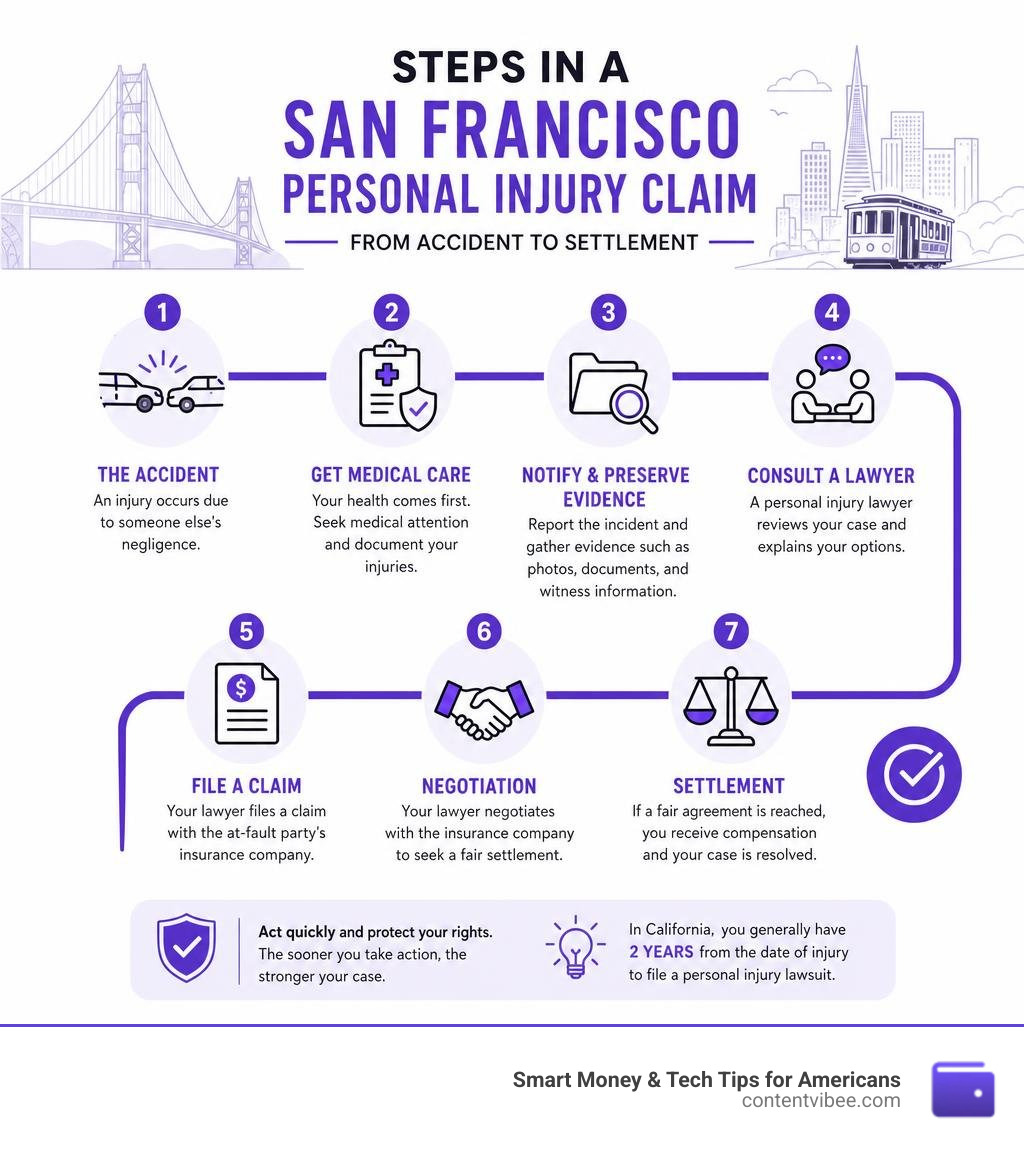
7 Essential Tips for Working with San Francisco Personal Injury Lawyers

Navigating the aftermath of an accident in the Bay Area can feel overwhelming. Between dealing with medical treatments and managing lost wages, trying to understand California’s complex legal landscape is the last thing you want to do alone.
Securing experienced legal representation is the most effective way to establish liability and prove negligence against the at-fault party. Studies in the legal industry show that injured individuals who hire professional representation recover three to four times more on average than those who attempt to handle claims on their own.
When you are ready to explore your options, working with local experts like those at San Francisco Personal Injury Lawyer – Compass Law can help you level the playing field against corporate legal teams and aggressive insurance adjusters.
Here are 7 essential tips to guide you through the process.
Tip 1: Understand the Types of Cases Handled
Personal injury law is broad, but local attorneys typically focus on specific categories of accidents common to the dense, fast-moving Bay Area environment. The most common cases include:
- Car and Rideshare Accidents: With thousands of Uber, Lyft, and private vehicles navigating steep hills and foggy roads, motor vehicle collisions are highly frequent.
- Pedestrian and Bicycle Crashes: San Francisco is a heavily walkable and bike-friendly city. Unfortunately, this means high numbers of crosswalk collisions and “dooring” incidents.
- Slip and Fall Accidents: Wet floors near high-traffic tourist centers, cracked sidewalks in SoMa, or poorly maintained stairwells fall under premises liability.
- Dog Bites: California law holds dog owners strictly liable for bites occurring in public spaces (like Dolores Park) under Civil Code §3342.
- Truck and Commercial Vehicle Collisions: Accidents involving big rigs or delivery trucks often cause catastrophic damage and involve complex commercial insurance policies.
When you file a Personal Injury Claim, your attorney must establish the four core elements of negligence: duty of care, breach of duty, causation, and resulting damages.
Tip 2: Know the California Statute of Limitations
Time is your enemy after an accident. In California, the clock starts ticking the moment the injury occurs.
Under the California Code of Civil Procedure § 335.1, you generally have a two-year deadline from the date of the accident to file a personal injury lawsuit. If you miss this window, the courts will almost certainly dismiss your case, and you will lose your right to seek compensation.
However, if your injury involves a public entity—such as a collision with a MUNI bus, a BART train, or an accident caused by an unmarked pothole on a city-maintained street—the rules are much stricter. Under the California Government Claims Act (Government Code § 911.2), you must file a formal administrative claim within a strict six-month deadline.
Failing to meet these tight municipal timelines can permanently bar your claim. For a detailed breakdown of these critical deadlines and how they apply to your specific situation, consulting with a firm like San Francisco Personal Injury Attorney | Smilove & Rosenblum APC is highly recommended.
Tip 3: Learn How San Francisco Personal Injury Lawyers Charge
Many people hesitate to contact a lawyer because they worry about high hourly legal fees. Fortunately, almost all personal injury attorneys in San Francisco operate on a contingency fee basis.
Under a contingency fee agreement:
- There are no upfront costs or retainers.
- The lawyer advances all case-related expenses (such as filing fees, expert witness costs, and medical record retrieval).
- The attorney only gets paid if they successfully resolve your case through a settlement or court verdict.
- The fee is calculated as a percentage of your total recovery, typically ranging between 33% and 40%.
This structure ensures that legal representation is accessible to everyone, regardless of their financial situation. To dive deeper into how these agreements work and how to evaluate legal expenses, you can read our guides on How Much Does A Personal Injury Lawyer Cost and How Much Does A Personal Injury Lawyer Charge.
Tip 4: What to Look For in San Francisco Personal Injury Lawyers
Not all attorneys are created equal. When searching for the right advocate, you should look for specific qualities that will maximize your chances of a successful outcome:
- Trial Readiness: Many lawyers prefer to settle quickly to avoid the courtroom. However, insurance companies know which attorneys are willing to go to trial. A firm with a proven track record of securing major courtroom verdicts has far more leverage during negotiations.
- Local Court Familiarity: An attorney who regularly practices in the San Francisco County Superior Court understands local judicial tendencies, court procedures, and local defense strategies.
- Active Standing with the State Bar of California: Ensure your prospective attorney is in good standing and has no history of disciplinary actions.
- Bilingual Representation: If Spanish is your primary language, working with a firm that provides direct bilingual services without relying on third-party interpreters can prevent critical details from being lost in translation.
For guidance on choosing the right legal partner, check out our resource on Injury Lawyer Near Me How To Find The Right One. If you require fluent Spanish-speaking advocacy, you can learn more about specialized services at San Francisco Personal Injury Lawyer | Bilingual English/Spanish .
Tip 5: Understand Your Recoverable Damages
If you have been injured due to another party’s negligence, California law allows you to recover compensation designed to make you “whole” again. These damages are split into three main categories:
Economic Damages
These are objective, quantifiable financial losses resulting from your injury. They include:
- Immediate emergency medical bills and ongoing rehabilitation costs.
- Lost wages and lost future earning capacity if you can no longer work.
- Property damage (such as vehicle repair or replacement costs).
Non-Economic Damages
These compensate you for subjective, non-monetary losses that do not have a specific price tag. Examples include:
- Physical pain and suffering.
- Emotional distress and anxiety.
- Loss of enjoyment of life and loss of consortium.
Punitive Damages
In rare cases involving egregious negligence or intentional malice, courts may award punitive damages to punish the wrongdoer and deter similar conduct in the future.
To get an initial estimate of what your claim might be worth, you can utilize our Tools/Settlement Calculators/Personal Injury Settlement Calculator. For comprehensive legal guidance on maximizing the value of these damages, you can reach out to the Personal Injury Lawyer San Francisco, CA – Personal Injury Attorney – Dolan Law Firm .
Tip 6: Prepare for Insurance Company Tactics
It is a common misconception that insurance adjusters are there to help you. In reality, their primary goal is to minimize payouts and protect their company’s profit margins.
Common tactics used by insurance companies include:
- Lowball Offers: Offering a quick, small settlement immediately after the accident before you fully understand the extent of your injuries.
- Recorded Statements: Pressuring you to give a recorded statement, which they will later use to twist your words and shift blame.
- Pre-Existing Condition Disputes: Claiming your pain is the result of a previous injury rather than the recent accident.
To counter these tactics, experienced attorneys utilize specific California legal tools. For example, under California Code of Civil Procedure § 998, a lawyer can issue a formal pre-trial settlement offer. If the defense rejects this offer and the final court judgment is more favorable to you, the defendant may be forced to pay your expert witness fees and pre-judgment interest.
To learn more about navigating these aggressive insurance negotiations, consult the experts at Personal Injury Lawyer San Francisco | Phoong Law .
Tip 7: Follow the Step-by-Step Claim Process
To build the strongest possible case, we recommend following this structured protocol immediately after an accident:
- Seek Immediate Medical Care: Go to a local provider like Zuckerberg San Francisco General Hospital or UCSF Medical Center. This establishes a direct medical record linking your injuries to the accident.
- Preserve Evidence: Take high-quality photos of the accident scene, vehicle damage, skid marks, and your physical injuries. If nearby businesses have security cameras, request the footage within 48 hours before it is overwritten.
- Obtain an SFPD Incident Report: Report the accident immediately to the San Francisco Police Department to secure an official, unbiased report.
- Avoid Social Media: Do not post anything about the accident or your recovery online. Insurance adjusters actively monitor public profiles to find evidence to undermine your claim.
- Consult an Attorney: Do not sign anything or speak to the opposing insurance company until you have secured legal representation.
- Negotiation, Mediation, and Trial: Your lawyer will handle all communications, send a formal demand letter once you reach maximum medical improvement, and represent you through negotiations, mediation, or trial if a fair settlement cannot be reached.
For a detailed walkthrough of this step-by-step framework, you can read the guide provided by San Francisco Personal Injury Lawyer | Impact Attorneys .
How Insurance Companies Respond to Claims

When you file a personal injury claim, the insurance company’s response is highly predictable. They do not look at your claim with empathy; they look at it as a financial liability.
Initially, the insurance company will assign an adjuster to investigate the accident. They will look for any opportunity to deny liability entirely. If liability is undeniable, they will shift to delay tactics—stalling the process in hopes that your growing medical bills and financial strain will force you to accept a much lower settlement.
In complex cases, insurers may even hire private investigators to monitor your daily activities or scour your social media accounts to prove your injuries are not as severe as you claim.
Having a trial-ready attorney who is prepared to walk away from insufficient offers and take your case to court is the most effective way to force insurance companies to negotiate in good faith. When insurers know your legal team has a documented history of securing multimillion-dollar verdicts, they are far more likely to offer a fair settlement.
Frequently Asked Questions About Bay Area Injury Claims
Can I sue the City of San Francisco for an injury?
Yes, you can sue the City and County of San Francisco, but the rules are highly specialized. If you are injured on a MUNI bus, trip on a severely damaged city sidewalk, or get hit by a municipal vehicle, you must file a formal administrative claim directly with the city under the Government Claims Act within six months of the incident. If the city rejects your claim, you then have a limited window to file a formal lawsuit in court.
What happens if I am partially at fault for my accident?
California is a pure comparative negligence state (established under the landmark case Li v. Yellow Cab Co.). This means you can still recover damages even if you were partially—or even mostly—at fault for the accident.
However, your final financial recovery will be reduced by your percentage of fault. For example, if your total damages are valued at $100,000, but a court finds you were 30% at fault for the accident, your final payout will be reduced by 30%, leaving you with $70,000.
How long does a personal injury case take to settle?
There is no single timeline for settling a personal injury case. A simple claim with clear liability and minor injuries may settle within a few months. However, complex cases involving catastrophic injuries, disputed liability, or large commercial policies can take anywhere from one to three years to resolve.
Your attorney should never send a formal demand letter to the insurance company until you have reached Maximum Medical Improvement (MMI)—the point at which your medical condition has stabilized and your future medical costs can be accurately projected.
Conclusion
Recovering from a sudden injury is stressful enough without the added burden of fighting insurance adjusters and navigating complex legal deadlines. By understanding your rights, acting quickly to preserve evidence, and securing experienced representation, you can protect your physical and financial recovery.
At Smart Money & Tech Tips for Americans, we want to make sure you have the practical advice you need to make smart financial decisions during difficult times. If you or your business has been impacted by an accident involving a commercial vehicle, we highly recommend reading our comprehensive Commercial Vehicle Accident Lawyers Guide 2026 to ensure your assets and rights are fully protected.