Convincing Reasons You Need Oilfield Accident Lawyers
Why Oilfield Accident Lawyers Are Essential After a Serious Injury
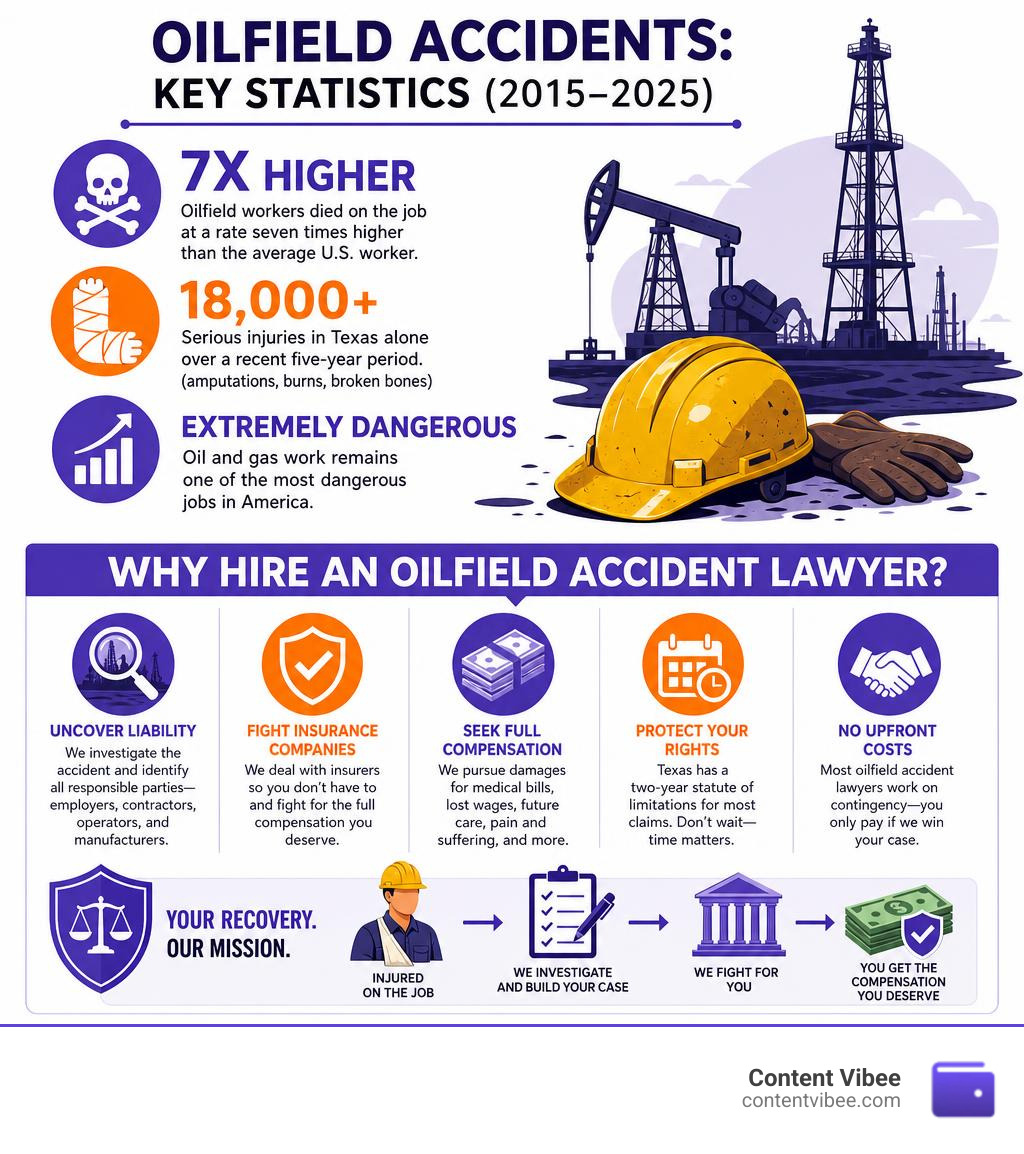
Oilfield accident lawyers help injured workers recover compensation that goes far beyond what employers and insurers typically offer on their own.
If you need a quick answer, here is what you should know:
- Who needs one: Any worker injured on an oil or gas job site — including contractors and independent workers
- What they do: Investigate liability, fight insurance companies, and pursue full compensation including pain and suffering
- When to call: As soon as possible after an accident — Texas has a two-year statute of limitations for most claims
- What it costs: Most work on contingency — no upfront fees, and you only pay if you win
- Who can be sued: Your employer, third-party contractors, equipment manufacturers, and site operators may all share liability
Oil and gas work is one of the most dangerous jobs in America. From 2015 to 2025, oilfield workers died on the job at a rate seven times higher than the average U.S. worker. In Texas alone, workers suffered more than 18,000 serious injuries — including amputations, burns, and broken bones — in just one recent five-year period.
When an accident happens, oil companies and their insurers move fast. They send adjusters to the scene. They push workers toward company doctors. They offer quick settlements that rarely cover the full cost of a serious injury.
That is exactly why having the right legal advocate in your corner matters so much.
The reasons to hire an experienced oilfield injury attorney go well beyond just filing paperwork. Complex liability structures, strict deadlines, and aggressive insurance tactics mean that going it alone can cost you far more than you realize.
Oilfield accident lawyers vocabulary:
1. The High Stakes of Oilfield Injuries and Complex Liability
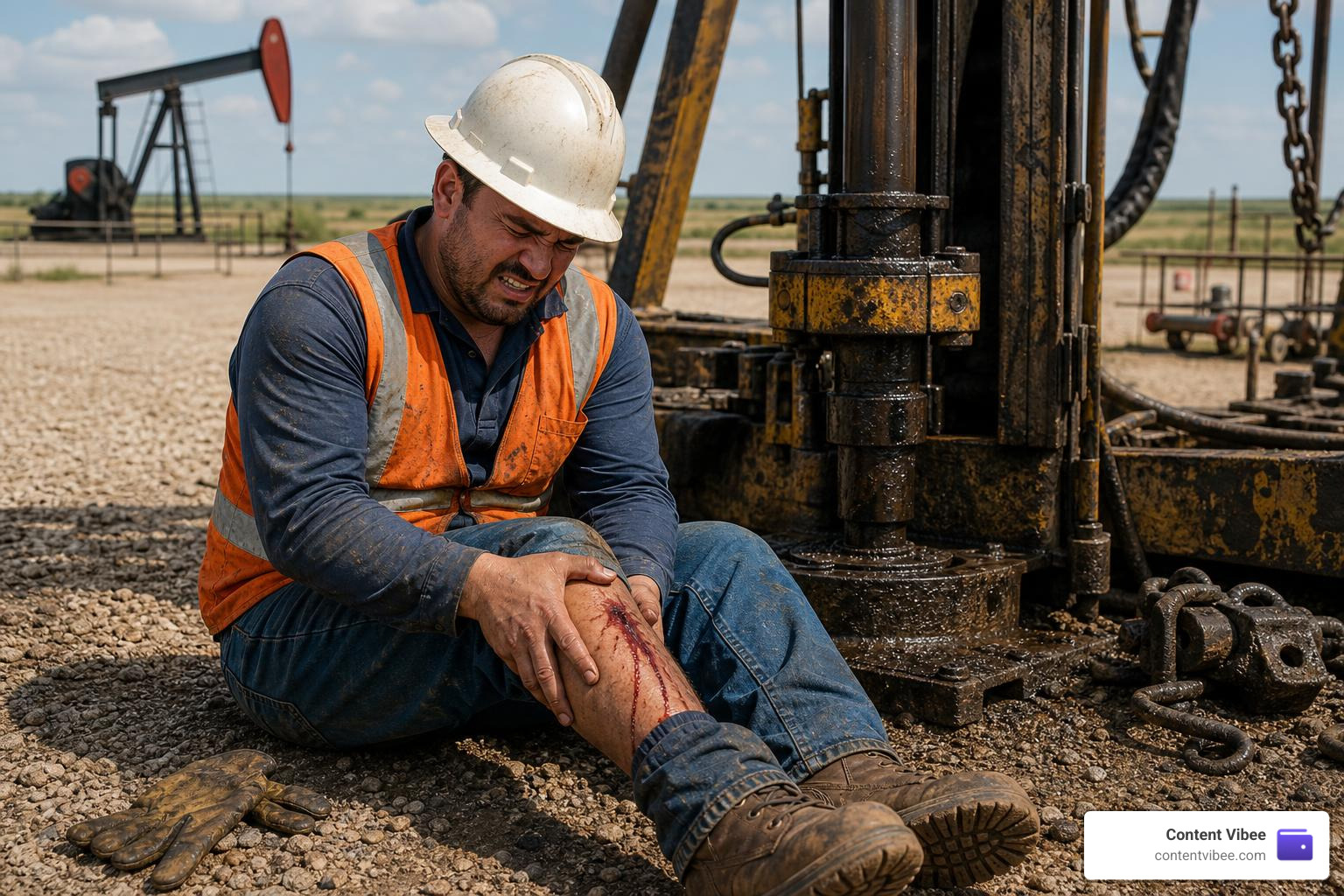
When we look at the sheer scale of the oil and gas industry in Texas, it is easy to see why the stakes are so high. Texas leads the nation in oilfield injuries and fatalities. In fact, almost 40% of all oilfield fatalities in the United States occur in the Permian Basin alone.
Whether workers are operating in the Permian Basin of West Texas or the Eagle Ford Shale of South Texas, they face environments where massive pressure, heavy machinery, and highly volatile chemicals are constantly in play. When safety is compromised, the injuries are rarely minor. Workers routinely face catastrophic, life-altering events including severe burns, crush injuries, amputations, traumatic brain injuries (TBIs), and spinal cord damage.
What makes these situations even more complicated is the legal structure of an oil patch. Unlike a standard office environment where you have one employer and one insurance policy, an oilfield is a sprawling web of operators, subcontractors, service companies, and equipment suppliers. Determining who is actually responsible for a failure requires a deep dive into Master Service Agreements (MSAs), daily logs, and equipment maintenance histories.
To help visualize how these dangers manifest on-site, we have outlined the most common hazards and their primary causes below:
| Oilfield Hazard | Primary Contributing Causes | Typical Resulting Injuries |
|---|---|---|
| Well Blowouts & Explosions | Failure of blowout preventers (BOPs), lack of gas detection, bypassing safety protocols for speed | Severe third-degree burns, blast injuries, wrongful death |
| Heavy Machinery Failures | Lack of regular servicing, mismatched parts (e.g., incorrect wellhead threads), improper training | Crush injuries, traumatic amputations, fractures |
| Struck-By & Caught-Between | Swinging drill pipes, suspended loads without safety precautions, lack of spotters | Traumatic brain injuries, spinal cord damage, internal organ damage |
| Falls from Heights | Inadequate fall protection, lack of guardrails on rigs, slippery walking-working surfaces | Paralysis, severe fractures, death |
Common Hazards and the Need for Specialized Oilfield Accident Lawyers
Beyond mechanical failures, there are human and operational factors that uniquely plague the oil patch. Toxic chemical exposure—such as inhaling lethal Hydrogen Sulfide (H2S) gas—is a constant threat. Furthermore, the modern oilfield workforce faces severe operational pressures that lead directly to accidents.
Consider the “commuter culture” of the industry. Many oilfield workers live in areas like the Rio Grande Valley (RGV) or McAllen but commute two to four hours each way to drill sites in the Eagle Ford Shale or Permian Basin. After working exhausting 12-to-16-hour shifts on rotating schedules, these workers are forced to drive long distances home. This extreme fatigue leads to devastating transportation and heavy truck accidents on rural Texas roads.
Additionally, language barriers and cross-border workforce dynamics frequently impact site safety. When oil companies fail to provide comprehensive, bilingual safety training and manuals in Spanish, crucial instructions are misunderstood. Spanish-speaking workers are often left vulnerable to hazards simply because an operator cut corners on translation and training programs.
Because of these highly technical and region-specific factors, general personal injury attorneys are often out of their depth. You need specialized oilfield accident lawyers who understand OSHA regulations, API standards, and the complex operational realities of drilling rigs. If you have been injured under these complex circumstances, consulting with a specialized firm like the Texas Oilfield Accident Lawyer – McFarlane Law can ensure that the technical details of your accident are properly investigated.
2. Maximizing Compensation Beyond Standard Workers’ Compensation
One of the biggest misconceptions we see is the belief that workers’ compensation is your only option after an on-the-job injury. While workers’ comp provides a basic safety net, it is rarely enough to cover the true, long-term costs of a catastrophic oilfield injury.
In Texas, workers’ compensation benefits are strictly capped. They will cover your immediate medical bills (with doctors chosen or approved by the insurance company) and a portion of your lost wages. However, workers’ comp does not provide any compensation for:
- Physical pain and suffering
- Mental anguish and emotional distress
- Physical disfigurement or scarring
- Loss of enjoyment of life
- The full value of your future lost earning capacity
Furthermore, Texas is unique because it is the only state in the country that does not require employers to carry workers’ compensation insurance. Employers who opt out are known as “non-subscribers.” If your employer is a non-subscriber, you are not limited by workers’ comp laws. Instead, you have the right to file a direct negligence lawsuit against them. In a non-subscriber lawsuit, the employer loses key legal defenses—such as claiming the accident was partially your fault—making it much easier to hold them fully accountable for your medical bills and human suffering.
Navigating these options is critical to securing your family’s financial future. If you want to understand the full scope of what a civil claim entails, you can read more about how a Personal Injury Claim works to recover both economic and non-economic damages.
Navigating Third-Party Claims and Non-Subscriber Lawsuits
Even if your direct employer does carry workers’ compensation, you are not necessarily barred from seeking full civil damages. If a company other than your direct employer contributed to your injury, you can file a third-party liability claim.
Because oilfields are crowded with different companies, third-party claims are incredibly common. Potential third-party defendants include:
- The Site Operator: The company that controls the entire lease and sets the safety standards.
- Subcontractors: Other service companies on-site (e.g., casing crews, mud logging companies, or transport providers) whose employees acted negligently.
- Equipment Manufacturers: If a pipe, valve, blowout preventer, or crane failed due to a manufacturing or design defect, you can file a product liability lawsuit.
- Trucking Companies: Third-party transport companies that cause collisions on or near the job site.
By pursuing a third-party claim, you can recover the full spectrum of damages, including punitive damages if gross negligence was involved. In the tragic event that an accident results in a loss of life, families have the right to pursue justice through specialized legal channels. To learn more about the legal rights of surviving family members, you can read about the options provided by an Oilfield Wrongful Death Lawyer Texas | Trey Barton Law.
3. Why You Cannot Rely on the Oil Company or Insurers
It is a hard truth to accept, but the oil company is not your friend after an accident. No matter how long you have worked for them or how close you are with your supervisor, the corporate machinery will immediately pivot to protect its profits.
Oil companies and their insurance adjusters are trained to minimize payouts. They use several common tactics to undermine your claim:
- The “Blame the Worker” Strategy: They will attempt to argue that you bypassed a safety protocol, failed to wear proper PPE, or simply acted carelessly.
- Recorded Statements: Adjusters will call you shortly after the accident, acting friendly and sympathetic, to get you to make a recorded statement. They will use any slip of the tongue to argue your injuries are not as severe as you claim or that you admitted fault.
- Company-Controlled Doctors: They will send you to a doctor who relies on the oil company for steady business. These doctors frequently downplay injuries, clear workers to return to work prematurely, and claim that severe pain is just a “pre-existing condition.”
- Quick, Lowball Settlements: They may offer you a fast check for a few thousand dollars while you are stressed about bills. In exchange, you must sign a release waiving your right to sue—long before you know the true cost of your future medical care.
To protect yourself from these predatory tactics, it is vital to understand how liability and evidence are handled on these industrial sites. For a deeper look into how companies attempt to shift blame, check out the resources on Oilfield Accidents | Adley Law Firm.
How Experienced Oilfield Accident Lawyers Protect Your Rights
Experienced oilfield accident lawyers act as an impenetrable shield between you and the oil company’s legal team. They immediately take over all communication, meaning you never have to speak to an aggressive insurance adjuster again.
Here is how a dedicated legal team builds an undeniable case on your behalf:
- Bilingual Representation: They provide fluent, native Spanish-speaking staff and attorneys to ensure that RGV and cross-border workers can tell their stories comfortably and clearly, without anything getting lost in translation.
- Evidence Preservation (Temporary Restraining Orders): Oilfields change rapidly. Physical evidence can be repaired, replaced, or swept away within hours. A lawyer can immediately file a Temporary Restraining Order (TRO) to halt operations on the rig, forcing the company to preserve the scene, the machinery, and all electronic data logs for independent inspection.
- Expert Witnesses: They collaborate with process safety management experts, accident reconstructionists, OSHA consultants, and engineering experts to prove exactly how safety standards were violated.
- Independent Medical Networks: They connect you with top-tier, independent medical specialists who prioritize your recovery, not the oil company’s bottom line.
If you are worried about how you will afford this level of representation, you should know that personal injury lawyers operate on a contingency fee basis. To understand how these fees work and why there are no upfront costs, read our detailed guide on How Much Does A Personal Injury Lawyer Cost. Additionally, you can explore the nuances of legal pricing in our breakdown of How Much Does A Personal Injury Lawyer Charge.
4. Crucial Steps to Take Immediately After an Oilfield Accident
What you do in the hours and days following an oilfield injury can make or break your legal claim. If you are physically able, we highly recommend taking the following steps to protect your health and your right to full compensation:
- Seek Independent Medical Treatment: Do not rely solely on the company medic or a doctor chosen by your supervisor. Go to an emergency room or a specialist of your own choosing immediately. Clearly explain to the medical staff exactly how the accident happened so it is documented in your official medical records.
- Report the Injury in Writing: Notify your supervisor of the injury as soon as possible. Ensure the report is submitted in writing, and keep a physical or digital copy for your own records. Guard your words—do not apologize, do not downplay your pain, and do not admit any fault.
- Gather Evidence at the Scene: If possible, take high-quality photos and videos of the accident scene, the defective equipment, the lack of safety guards, and your visible injuries.
- Collect Witness Contact Information: Write down the names, phone numbers, and job titles of everyone who saw the accident or worked on the rig floor with you that day.
- Do Not Sign Anything: Do not sign any incident reports, medical releases, or settlement offers from the oil company or their insurer without a lawyer reviewing them first.
- Consult an Attorney Early: The oil company’s investigators are already building a case against you. You need a team building a case for you.
Time is of the essence. While the legal statute of limitations for a personal injury lawsuit in Texas is generally two years from the date of the accident, waiting that long is a massive mistake. Evidence disappears, witnesses move to different states, and memories fade.
If you are curious about what your potential recovery might look like based on your medical bills and lost wages, you can use our interactive Tools/Settlement Calculators/Personal Injury Settlement Calculator to get an estimate of your claim’s value.
Frequently Asked Questions About Oilfield Accident Lawyers
What is the statute of limitations for an oilfield injury claim in Texas?
In Texas, the statute of limitations for filing a personal injury lawsuit or a third-party negligence claim is two years from the date the accident occurred. If you fail to file a lawsuit within this two-year window, you will lose your right to seek compensation forever.
However, if you are filing a workers’ compensation claim, the timeline is much tighter: you must report your injury to your employer within 30 days and file the official claim form within one year. Because these deadlines are strict and evidence can be lost in a matter of days, we strongly advise speaking to an attorney immediately. For a free, confidential case review to discuss your timeline, you can reach out to the Award-Winning Houston Oilfield Injury Lawyer – Free Consult.
Can I sue a third party if I am already receiving workers’ compensation?
Yes, absolutely. Accepting workers’ compensation benefits does not prevent you from filing a civil lawsuit against a negligent third party, such as a subcontractor, equipment manufacturer, or site owner.
In fact, this dual-recovery strategy is often the only way for severely injured workers to secure enough money to cover their long-term medical care and make up for lost future earnings. If you win a third-party lawsuit, you may have to subrogate (repay) your workers’ comp insurer for the medical bills they covered, but you keep the remaining recovery, including all damages for pain, suffering, and disfigurement. To learn more about how third-party liability works on complex energy sites, visit the Oil and Gas Field Injury Lawyer in Houston – Kherkher Garcia.
How much does it cost to hire an oilfield injury attorney?
It costs nothing upfront. Reputable oilfield accident lawyers work on a contingency fee basis. This means:
- Your initial consultation is 100% free and confidential.
- The law firm covers all upfront expenses, including filing fees, expert witness costs, and accident reconstruction services.
- You pay absolutely nothing out of pocket.
- The attorney only gets paid if they successfully recover money for you through a settlement or a jury verdict. Their fee is a pre-agreed percentage of your total recovery.
This system levels the playing field, allowing injured workers to go toe-to-toe with multi-billion-dollar energy corporations without financial risk. For a detailed breakdown of how these fees are structured, you can read our guide on How Much Do Lawyers Charge For Accident Claims.
Conclusion
At Content Vibee, we believe that hard-working oilfield crews deserve the absolute best protection when things go wrong. The oil patch is a place of immense economic opportunity, but it is also an unforgiving environment where safety is too often sacrificed for speed and corporate profit.
If you or a loved one has suffered a severe injury on a Texas job site, do not let an insurance adjuster dictate your future. Relying on the company’s promises or a limited workers’ comp check can leave you facing a lifetime of medical debt and lost income. By partnering with dedicated oilfield accident lawyers, you gain a powerful ally who understands the industry, knows how to preserve critical evidence, and will fight relentlessly for the maximum compensation you deserve.
If you are dealing with the aftermath of a different type of roadway or work incident, we also provide comprehensive guides to help you find the right legal match. Take a look at our expert tips on How to Find a Good Car Accident Lawyer to ensure your rights are protected no matter where an accident occurs.