Set and Forget Your Way to Wealth with Automated Investing
Your Money, Working While You Sleep: The Truth About Investing on Autopilot
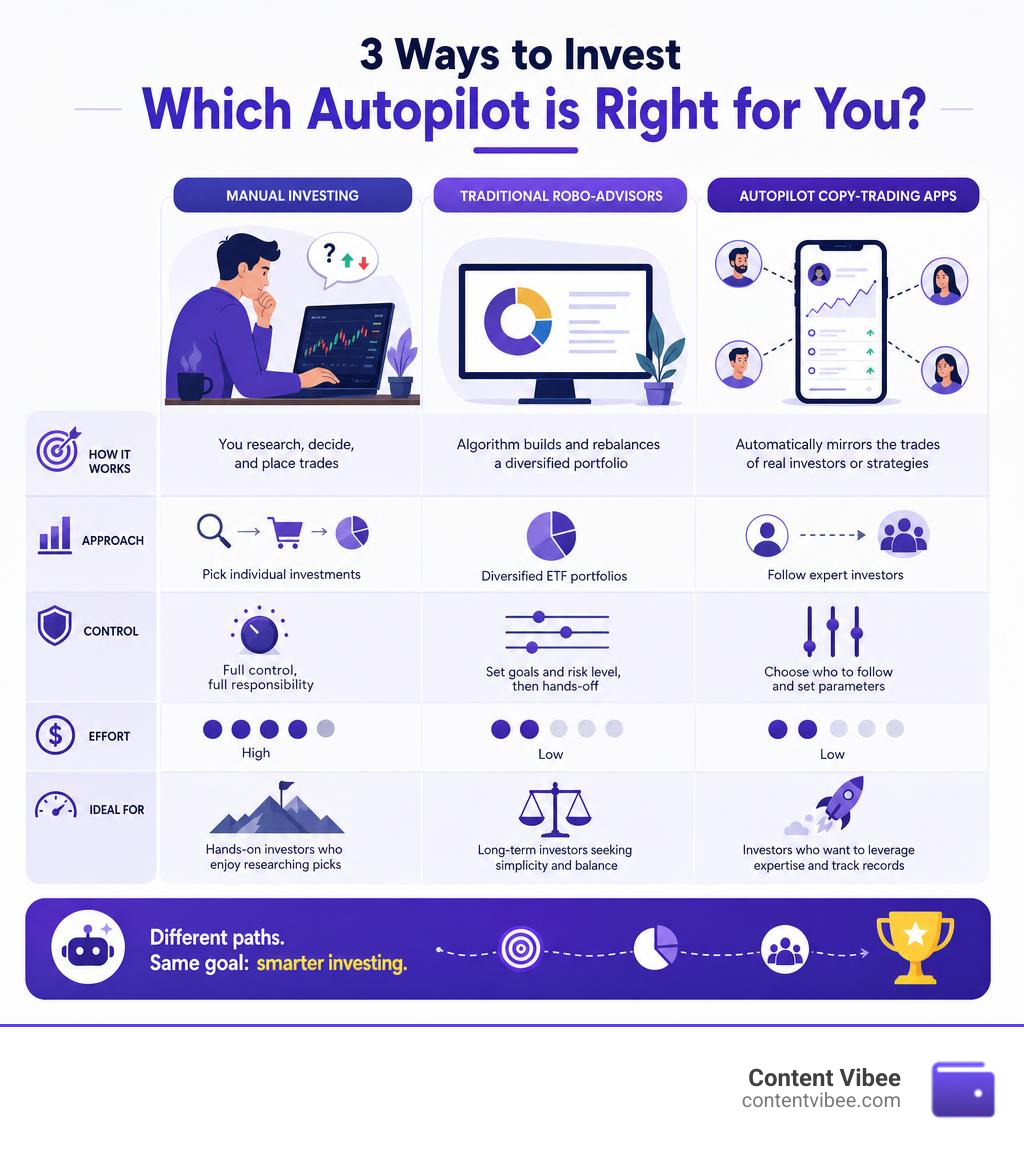
Investing on autopilot means setting up a system that buys, rebalances, and manages your portfolio automatically — so you don’t have to watch the market every day.
Here’s what that looks like in practice:
- Robo-advisors (like Fidelity Go or Schwab Intelligent Portfolios) build a diversified ETF portfolio based on your goals and rebalance it automatically
- Autopilot apps (like the Autopilot app) connect to your existing brokerage and mirror trades from real investors — including hedge funds, AI strategies, or even politicians
- Automated ETF tools let you schedule regular investments (dollar-cost averaging) across multiple funds without lifting a finger
The core idea is simple: remove the emotion, reduce the manual work, and let a system do the investing for you.
This approach has gone mainstream fast. Hundreds of thousands of investors now use some form of automated investing, with billions of dollars managed across platforms of all types.
But not all autopilot investing works the same way. A robo-advisor and a copy-trading app are very different tools — with different risks, costs, and results.
This guide breaks it all down so you can choose what actually fits your situation.
What is Investing on Autopilot?
At its core, investing on autopilot is the practice of delegating the daily decision-making, trading, and monitoring of your investment portfolio to automated systems. Instead of logging into your brokerage account every week, agonizing over which stock to buy, or manually calculating how to rebalance your assets, you set predefined rules. The technology takes care of the rest.
But automation is not a one-size-fits-all concept. It spans a wide spectrum, from conservative, algorithm-driven retirement portfolios to high-octane apps that clone the moves of Wall Street executives or politicians in real time.
When you decide to automate, you are essentially choosing how much control you want to hand over to software. To understand if this modern approach fits your financial journey, ask yourself: Is Automated Portfolio Management Right for You?
Traditional Passive Strategies vs. Investing on Autopilot
Historically, “passive investing” meant a classic buy-and-hold strategy. You would buy a handful of broad-market index funds, perhaps a total stock market fund and a bond fund, and let them sit for decades.
While passive investing is highly effective, traditional execution still required manual effort. You had to physically transfer money, purchase shares, and periodically rebalance your portfolio when market swings threw your target asset allocation out of whack.
Modern automation changes this dynamic entirely. Today, putting your money on autopilot means the system handles:
- Dollar-Cost Averaging (DCA): Automatically pulling a set amount of cash from your checking account on payday and investing it immediately.
- Automated Rebalancing: Adjusting your holdings without tax consequences or manual math when one asset class grows faster than another.
- Fractional Share Investing: Ensuring every single dollar is put to work, even if you do not have enough cash to buy a full share of an expensive stock or ETF.
For those curious about the various methods of setting up these hands-off systems, exploring 6 ways to put your investments on auto-pilot can provide a great baseline. Furthermore, corporate programs like those outlined in Investing on Autopilot – The Schwab Equity Award Center show how automation is even being integrated into employee stock compensation plans to build long-term wealth seamlessly.
The Rise of Automated Copy Trading and Mirror Portfolios
In recent years, a new branch of automated investing has exploded in popularity: mirror trading (or copy trading).
Instead of matching you with a static basket of index funds, these modern autopilot platforms connect directly to your personal brokerage account and automatically execute trades to copy a specific “pilot.”
These pilots can be:
- Politicians: Tracking the public financial disclosures of members of Congress.
- Hedge Funds: Mirroring the quarterly 13F regulatory filings of legendary institutional investors.
- AI Algorithms: Operating on predictive models and automated market signals.
When the pilot buys or sells a security, the app detects the move and instantly places a matching order in your linked brokerage account. This gives everyday retail investors access to active, high-conviction strategies without having to spend hours reading financial statements or watching the news.
How Autopilot Investing Apps Work in 2026
The technology powering automated investing has evolved rapidly. In May 2026, you no longer need to transfer your life savings to a shady, unverified platform to access advanced strategies. Instead, modern autopilot apps act as an intelligent software layer sitting on top of the established, heavily regulated brokerage accounts you already own and trust.
To understand how these platforms execute trades behind the scenes without manual intervention, it can be helpful to read The Ultimate Guide to Trading Bots for Beginners, which explains the fundamentals of automated financial software.
Connecting Your Existing Brokerage Accounts
The magic of modern autopilot apps lies in their ability to integrate with major brokerage platforms like Robinhood, Charles Schwab, Fidelity, and Public.
Rather than acting as a custodian that holds your cash, the autopilot app uses secure, bank-level API integrations (often facilitated by third-party data networks like Plaid) to establish a bridge.
Here is how the secure authentication process works:
- Secure Handshake: You log into your brokerage account through an encrypted portal within the autopilot app. The app never sees or stores your raw login credentials.
- Read-Write Permissions: You grant the app permission to view your portfolio balance (read access) and execute trades on your behalf (write access).
- Keep Your Capital Safe: The app is strictly blocked from ever withdrawing or transferring money out of your brokerage account. Your funds remain safely housed with your SIPC-insured broker.
Choosing Your Pilot: Politician Trackers, Hedge Funds, and AI
Once your brokerage account is connected, you enter a marketplace of different investment strategies. You choose a “pilot” that matches your risk tolerance and financial outlook, set the amount of capital you want to allocate to that strategy, and let the software take over.
Platforms like the Autopilot – Invest alongside politicians & real-time traders app have built massive followings by offering highly unique, thematic trackers. You can find these apps across major platforms, including the Autopilot: Automated Investing – App Store for iOS and the Autopilot – Investment App – Apps on Google Play for Android.
Some of the most popular automated portfolios available in 2026 include:
- Politician Trackers: These portfolios automatically mirror the trades of active politicians. Because of public disclosure laws, when a politician buys a stock, the app tracks the filing and replicates the trade in your account.
- Hedge Fund Mirrors: Want to invest like Warren Buffett or Bill Ackman? These trackers monitor regulatory filings and adjust your portfolio to mirror the holdings of top-performing hedge funds.
- AI-Driven Funds: Algorithmic portfolios that dynamically trade based on sentiment analysis, market momentum, or macroeconomic indicators.
Autopilot Apps vs. Traditional Robo-Advisors
While both approaches aim to make investing easier, autopilot apps and traditional robo-advisors serve completely different types of investors. Understanding these differences is crucial, and looking into a Why Robo Advisor Fees Comparison Matters can help you weigh the financial impact of each path.
| Feature | Traditional Robo-Advisors | Autopilot Copy-Trading Apps |
|---|---|---|
| Primary Investments | Low-cost, diversified ETFs (Stocks & Bonds) | Individual stocks, options, and thematic assets |
| Strategy Type | Passive, long-term asset allocation | Active, dynamic trade mirroring and copy trading |
| Rebalancing | Algorithmic, based on asset drift thresholds | Event-driven, matching the “pilot’s” active trades |
| Account Ownership | Held directly with the robo-advisor custodian | Held in your own pre-existing brokerage account |
| Tax Features | Tax-loss harvesting often included | Tax-loss harvesting is rare; higher turnover |
| Ideal For | Retirement, long-term wealth, risk-averse | Active market exposure, trend-following, higher risk |
Traditional Robo-Advisors: Steady and Structured
Traditional robo-advisors are built on Modern Portfolio Theory. They focus on minimizing risk through broad diversification. When you sign up for a service like Fidelity Go | Invest With Our Robo Advisor | Fidelity Investments or Charles Schwab , you answer a series of questions about your timeline and risk comfort.
The algorithm then constructs a portfolio utilizing low-cost ETFs. For investors looking for a balance of automated software and human touch, hybrid options like TD Automated Investing and Robo Advising | TD Wealth Investing and Robo/Hybrid Advisor | TD Automated Investing Plus offer access to professional human advisors alongside automated tracking. Even international options, such as Canada’s SmartFolio: Online Investing – BMO Canada , follow this structured, risk-managed philosophy.
These platforms continuously monitor your account. If your target allocation is 80% stocks and 20% bonds, and a stock market rally pushes your equities to 85%, the robo-advisor automatically sells some stock and buys bonds to bring you back to your target.
Autopilot Apps: Dynamic and Active
In contrast, autopilot copy-trading apps are highly dynamic. They do not care about keeping a steady 80/20 balance of stocks and bonds. Instead, they focus on alpha—beating the market by copying high-conviction, concentrated moves.
If your selected pilot decides to put 15% of their capital into a single tech stock, your linked brokerage account will execute trades to match that high-conviction allocation. This can lead to market-beating returns during bull runs, but it also exposes you to significantly higher volatility and drawdown risks if the pilot’s trades turn sour.
The Risks and Rewards of Automated Portfolios
No investment strategy is free of risk, and putting your portfolio on autopilot introduces unique technical and financial challenges that every investor must understand.
Understanding the Hidden Costs of Investing on Autopilot
While automating your finances sounds incredibly efficient, the costs can sneak up on you if you aren’t paying attention. To see how even small fees compound over time, you can run the numbers using an Expense Ratio Impact Calculator.
When investing on autopilot, you must watch out for:
- Subscription Fees: Many copy-trading apps charge a flat monthly or annual subscription fee (e.g., $10 to $30 a month). While this sounds small, if you only have $1,000 invested, a $120 annual fee represents a massive 12% drag on your performance.
- Wrap Fees and Advisory Costs: Traditional robo-advisors often charge an asset-based fee. For example, some platforms charge a 0.30% to 0.60% annual advisory fee.
- Slippage and Transaction Costs: When an autopilot app mirrors a trade, there is a delay between when the pilot executes the trade and when your app places the matching order in your account. During highly volatile market hours, the price of the stock can move against you in those few seconds or minutes, resulting in “slippage” that eats into your profits.
- Tax Inefficiency: Active copy trading leads to high portfolio turnover. This means you will likely rack up short-term capital gains, which are taxed at a higher rate than long-term capital gains.
Technical Limitations and Execution Delays
Because copy-trading apps rely on API connections to external brokerages, they are vulnerable to technical glitches.
User reviews of various autopilot apps frequently highlight a few common operational pain points:
- Brokerage Disconnects: Due to security updates or token expirations, the link between the autopilot app and your brokerage (like Robinhood or Schwab) can disconnect. If this happens, the app cannot execute trades, and you might miss critical buying or selling opportunities until you manually re-authorize the connection.
- Delayed Execution: If a politician or hedge fund trade is reported after the market closes, your app cannot execute the trade until the following morning, potentially missing out on the optimal entry price.
- Customer Support Hurdles: Unlike major financial institutions with 24/7 phone lines, many newer fintech startups rely primarily on email or in-app chat support, which can be frustrating if you are experiencing a technical issue during a major market selloff.
Who is Autopilot Investing Best For?
Automating your investments is a fantastic way to build wealth, but the specific tool you choose should align with your personal financial goals, timeline, and stomach for volatility.
The Hands-Off Long-Term Accumulator
If your primary goal is to build a nest egg for retirement, buy a house in ten years, or steadily grow your wealth without stress, traditional automated ETF strategies are your best bet.
By setting up a system that automatically dollar-cost averages your funds into broad-market index ETFs, you ensure consistent progress. You can easily visualize how consistent, automated contributions grow over time by plugging your numbers into A Compound Interest Calculator for Retirement.
For those who want to build a highly customized, set-and-forget ETF portfolio across multiple brokerages, utilizing tools like Passive ETF Automation can help you maintain your target allocations automatically without manual spreadsheet calculations.
The Active Mirror Trader
If you already have a solid financial foundation—such as an emergency fund and a healthy retirement account—and you want to allocate a portion of your “fun money” or risk capital to active strategies, autopilot copy-trading apps can be highly engaging and potentially lucrative.
This approach is ideal for investors who want thematic exposure to market trends but do not have the time to perform deep fundamental research on individual companies. Before diving into active copy trading, it is highly recommended to read through these foundational guides on portfolio control:
- To Manage or Not to Manage Taking the Reins of Your Investments
- Why Choosing the Right Portfolio Management
- Why Managing Your Portfolio Manually
Frequently Asked Questions About Automated Investing
Is investing on autopilot safe for beginners?
Yes, but it depends entirely on the strategy you choose. Using a traditional robo-advisor to invest in highly diversified, low-cost index ETFs is incredibly safe and one of the best ways for a beginner to start. However, using copy-trading apps to mirror active traders or politicians carries significantly higher risk, as those portfolios often hold highly concentrated positions in volatile individual stocks. You should only use risk capital—money you can afford to lose—for active copy-trading strategies.
How do autopilot apps connect to my brokerage?
Most modern autopilot apps use highly secure APIs or third-party data networks like Plaid to connect to your brokerage account. This connection gives the app “read” access to view your balance and “write” access to execute trades. Crucially, the app is blocked from ever withdrawing or transferring cash out of your account, meaning your capital remains safely secured with your primary broker.
What is the difference between a robo-advisor and a copy-trading app?
A robo-advisor uses mathematical algorithms to build and maintain a diversified portfolio of ETFs based on your risk profile, automatically rebalancing when your asset allocation drifts. A copy-trading app, on the other hand, actively mirrors the real-time trades of specific individuals, hedge funds, or AI models, often trading individual stocks and holding highly concentrated, active positions.
To ensure your financial projections and automated calculators are set up correctly, we recommend learning Why Investment Calculator Accuracy and Financial planning tools are vital to keeping your automated wealth-building plan on track.
Conclusion
Putting your investing on autopilot is one of the most powerful steps you can take toward securing your financial freedom. By removing emotional decision-making, eliminating manual chores, and establishing consistent, systematic contributions, you allow the magic of compound interest to work in your favor.
Whether you choose the steady, time-tested path of a traditional robo-advisor or decide to explore the dynamic, world of copy trading, the key is to understand the underlying mechanics, keep an eye on hidden fees, and choose a strategy that matches your personal risk tolerance.
Ready to take the next step and see if a copy-trading platform makes sense for your financial goals? Read our deep-dive analysis: Is the Autopilot Investment App Worth the Cost? to find out if it’s the right fit for your wallet.