Stop Manual Investing with These Top Automated Investing Tools

The Best Automated Investment Platforms at a Glance (June 2026)
Automated investment platforms — also called robo-advisors — let software manage your money for you, hands-free. If you want the quick answer, here are the top platforms worth considering right now:
| Platform | Advisory Fee | Account Minimum | Best For |
|---|---|---|---|
| Betterment | 0.25%/yr or $5/mo | $0 | Tax-loss harvesting, beginners |
| Wealthfront | 0.25%/yr | $500 | Broad asset class exposure |
| Schwab Intelligent Portfolios | $0 | $5,000 | Fee-conscious investors |
| Fidelity Go | $0 under $25k | $0 | Low-balance accounts |
| Vanguard Digital Advisor | ~0.20%/yr | $100 | Low-cost index investing |
| E*TRADE Core Portfolios | 0.30%/yr | $500 | Daily rebalancing |
| Ally Invest Robo | 0.30%/yr | $100 | Flexible cash options |
| M1 Finance | $0 | $100 | Customizable portfolios |
Let’s be honest — watching the market, rebalancing your portfolio, and figuring out when to harvest tax losses is exhausting. Most people don’t have time for it. And for retirees or those approaching retirement, the stakes feel even higher.
That’s exactly why automated investment platforms have exploded in popularity. They use algorithms to do the heavy lifting — building a diversified portfolio, rebalancing it automatically, and even optimizing for taxes — all without you lifting a finger.
Betterment alone now manages over $70 billion for more than 1 million customers. That’s not a niche trend. That’s a fundamental shift in how Americans invest.
But not every platform is built the same. Fees vary. Account minimums differ. Some platforms are better for retirement accounts. Others shine for taxable investing or tax savings.
In this guide, we compare the top automated investment platforms side by side — so you can stop second-guessing and start putting your money to work.
Know your automated investment platforms terms:
What is Automated Investing and How Does It Work?
At its core, automated investing is a technology-driven method of managing your money. Instead of paying a human advisor thousands of dollars to pick stocks or manually buying mutual funds yourself, you hand the steering wheel over to a smart algorithm.
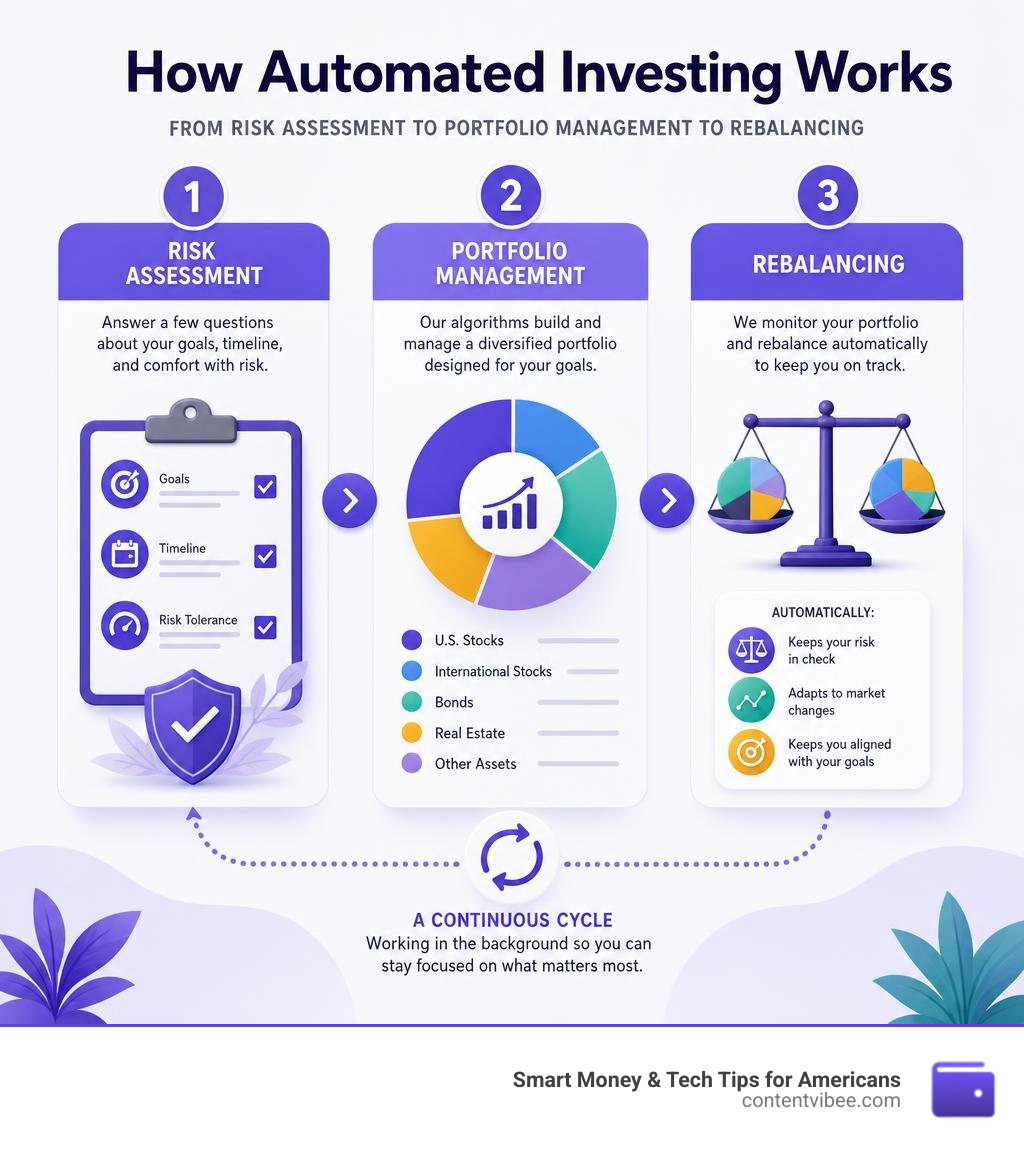
If you have ever wondered what is a Robo Advisor?, think of it as a digital co-pilot for your money. When you sign up, the platform asks you a series of questions about your financial goals, your age, when you plan to retire, and how much market volatility makes your stomach churn.
Using your answers, the platform relies on Modern Portfolio Theory (MPT) to build a diversified portfolio. MPT is a Nobel Prize-winning framework designed to maximize your returns for a specific level of risk. The platform executes this strategy by automatically spreading your money across various asset classes—like domestic stocks, international equities, and municipal bonds—using low-cost exchange-traded funds (ETFs).
Once your money is in the market, the automation doesn’t stop. The platform continuously monitors your account. If market swings push your portfolio out of alignment, the software automatically executes trades to bring you back to your target asset allocation. It is a continuous loop of optimized wealth building that works quietly in the background while you sleep.
Robo-Advisors vs. Traditional Financial Advisors
The debate between going digital or hiring a human is one we hear often at Suppremo. While traditional financial advisors offer high-touch, deeply personalized planning, they also come with a heavy price tag.
Most traditional wealth managers charge an Assets Under Management (AUM) fee of around 1.00% per year. On a $500,000 retirement nest egg, that is $5,000 out of your pocket every single year! In contrast, automated platforms typically charge a fraction of that cost—often between 0.20% and 0.35%—and some even charge no advisory fee at all.
Here is a quick look at how the two models stack up:
| Feature | Automated Platforms (Robo-Advisors) | Traditional Financial Advisors |
|---|---|---|
| Average Cost | 0.00% to 0.35% AUM | 1.00% AUM or hourly fees |
| Account Minimums | $0 to $5,000 | Often $100,000 to $250,000+ |
| Portfolio Management | Algorithmic, daily automated monitoring | Manual reviews, periodic adjustments |
| Human Contact | Limited (or fee-based hybrid access) | Unlimited face-to-face or phone meetings |
| Best For | Hands-off wealth building, lower costs | Complex estate planning, high-net-worth needs |
If you are trying to decide which path is right for your cash, check out our guide on to manage or not to manage: taking the reins of your investments to weigh your options.
How Automated Investment Platforms Construct Portfolios
So, how do these digital wizards actually build your portfolio? It all starts with your personal risk tolerance and investment timeline.
When you use a platform like Schwab Intelligent Portfolios, the algorithm uses your profile to select a customized blend of investments. Instead of picking individual stocks like Apple or Tesla—which can be incredibly risky—the platform builds your foundation using highly diversified exchange-traded funds (ETFs).
These ETFs track entire indexes, giving you instant exposure to thousands of companies across global markets. Schwab’s robo-advisor, for instance, evaluates approximately 50 ETFs across 20 different asset classes to construct up to 80 portfolio variations. This high level of diversification ensures that if one sector of the economy takes a hit, your entire financial future doesn’t go down with it.
To understand why this structure is so critical, we highly recommend reading about investment asset allocation strategy & risk management to see how different asset classes protect your wealth.
Choosing the Right Automated Investment Platforms for Your Goals
With so many excellent choices available in June 2026, finding the perfect match depends on what you are saving for and how much money you have to start.
If you are just starting out with a couple of hundred dollars, platforms like Betterment or Vanguard Digital Advisor are fantastic because of their incredibly low account minimums ($0 and $100, respectively). Betterment is widely loved for its incredibly clean mobile app and automated tools that let you “build wealth in the background.” In fact, investors in Betterment’s Core portfolio have earned an impressive 10% average annual return since its launch date.
On the other hand, if you want a reliable cash buffer alongside your market investments, the Ally Invest® Robo Portfolios offer a “cash-enhanced” portfolio option. This structure keeps 30% of your portfolio in high-yield cash earning a variable interest rate (currently 3.00% APY) to protect against market downturns, all with a low $100 minimum deposit and $0 advisory fees.
Before you make a final decision, it is smart to ask yourself: is automated portfolio management right for you? to ensure your expectations align with a hands-off approach.
Pure Robo-Advisors vs. Hybrid Models
As you shop around, you will notice that automated platforms generally fall into two categories: pure robo-advisors and hybrid models.
- Pure Robo-Advisors: These are 100% automated. Algorithms handle everything from asset allocation to rebalancing. There is no human advisor to call when the market dips. This model is incredibly cost-effective and perfect for disciplined, hands-off investors.
- Hybrid Robo-Advisors: These platforms combine automated algorithmic management with access to real, certified human financial planners. If you have complex questions about buying a home, planning for Social Security, or managing an inheritance, you can book a call with a professional.
To dive deeper into how these models blend technology with human empathy, read our breakdown of hybrid robo advisors.
Key Fees Associated with Automated Investment Platforms
While automated platforms are substantially cheaper than traditional advisors, they are not completely free. There are three main layers of fees you need to watch out for:
- Advisory/Management Fees: This is what you pay the platform to manage your money. It is usually charged as a percentage of your assets (Assets Under Management, or AUM). For example, Wealthfront charges a flat 0.25% annual fee. If you invest $10,000, you pay just $25 a year.
- Expense Ratios: These are fees charged directly by the managers of the ETFs inside your portfolio. Even if a robo-advisor charges a 0% advisory fee, the underlying funds still have expense ratios (typically ranging from 0.05% to 0.20%). Fidelity Go is a unique exception here—they use proprietary funds with 0% expense ratios, making it incredibly cheap for smaller accounts.
- Indirect Costs (Cash Drag): Some “free” platforms, like Schwab Intelligent Portfolios, make their money by keeping a portion of your portfolio in cash swept to their affiliated bank. While this cash earns interest, it can cause “cash drag,” meaning your money might grow slower than if it were fully invested in the stock market.
To avoid getting caught off guard by hidden costs, check out the ultimate guide to robo advisor fees and learn how to find free robo advisors that actually save you money.
Key Benefits and Drawbacks of Autopilot Portfolios

Like any financial tool, automated investing has its bright spots and its limitations. Understanding both sides of the coin will help you decide if an autopilot portfolio fits your wealth-building strategy.
The Benefits:
- Incredible Cost-Effectiveness: By replacing human labor with smart code, these platforms save you thousands of dollars in fees over your investing lifetime. To see how much you can save, read our guide on how to use an AUM fee calculator to save your retirement.
- Ultimate Convenience (Set-and-Forget): You don’t have to spend your weekends analyzing balance sheets. You simply set up a recurring deposit and let the software handle the rest.
- Emotion-Free Investing: Human beings are notorious for panic-selling when the market drops and buying when prices are unsustainably high. Algorithms don’t have feelings; they buy and sell based on logic, keeping your long-term strategy intact.
- Advanced Tax Strategies: Features like automatic tax-loss harvesting, which used to be reserved exclusively for multi-millionaires, are now available to everyday investors.
The Drawbacks:
- Lack of Personal Control: If you love picking individual stocks or want to tilt your portfolio heavily toward a specific company you believe in, pure robo-advisors will frustrate you. They generally do not allow you to customize individual holdings.
- Limited Complexity: If you have a highly complex financial situation—such as navigating complicated business taxes, estate planning, or trust funds—an algorithm might be too simple for your needs.
- Technology & Platform Risks: While rare, software glitches or platform downtime can occur, potentially limiting your ability to access your account during periods of extreme market volatility.
To help you decide if the pros outweigh the cons for your specific situation, take a look at our article on why choosing the right portfolio management strategy is so vital to your long-term success.
Frequently Asked Questions About Automated Investing
Let’s explore some of the most common questions we receive from readers looking to make the switch to automated platforms.
How is my money protected on automated platforms?
This is a massive concern for many investors, especially those approaching retirement. Fortunately, your money is highly protected on reputable automated platforms.
First, almost all major robo-advisors are members of the Securities Investor Protection Corporation (SIPC). SIPC protects your brokerage account up to $500,000 (including a limit of $250,000 for cash claims) if the brokerage firm fails.
Second, for cash accounts, many platforms partner with multiple banks to offer sweep programs with massive FDIC insurance limits. For example, Betterment offers up to $4 million in FDIC insurance for individual cash accounts through its partner banks, while M1 Finance offers up to $4.75 million in aggregate FDIC coverage.
Even innovative modern business platforms like Altruist, which powers independent human financial advisors with cutting-edge automated custodial software, carry excess SIPC policies to keep client assets incredibly secure.
Can automated investing help me save on taxes?

Yes, absolutely! In fact, this is one of the most powerful features of automated investing. The primary tool used here is called Tax-Loss Harvesting (TLH).
When an investment in your taxable portfolio loses value, the automated platform can automatically sell that ETF at a loss and immediately replace it with a highly similar ETF to maintain your portfolio’s asset allocation.
Under U.S. tax law, you can use those realized losses to offset capital gains from other investments, and even offset up to $3,000 of your ordinary income. Nearly 70% of Betterment customers who utilized their automated tax-loss harvesting feature found that their estimated tax savings completely covered their annual advisory fees!
To learn how to unleash this financial superpower in your own accounts, read our deep dive into Tax-Loss Harvesting: The Secret Weapon of Robo Advisors.
Is automated investing suitable for retirement planning?
Yes, automated platforms are spectacular for retirement planning. Whether you want to open a Traditional IRA, a Roth IRA, a SEP IRA for self-employed individuals, or execute a direct 401(k) rollover, robo-advisors make the process incredibly simple.
For instance, E*TRADE Core Portfolios allows you to set up automated retirement accounts with a low $500 minimum investment. The system automatically selects tax-efficient municipal bond ETFs for taxable accounts while keeping higher-yield, tax-heavy investments inside your tax-advantaged retirement accounts.
If you are looking to maximize your retirement growth while avoiding platform fees that eat away at your compounding interest, read our guide on stop paying platform fees: top tax-free investment accounts.
Conclusion
At Suppremo, we believe that achieving financial freedom shouldn’t require a degree in advanced mathematics or hours of stressful manual trading every week.
Automated investment platforms have democratized wealth building. They allow you to take advantage of institutional-grade portfolios, automatic rebalancing, and sophisticated tax-loss harvesting for a fraction of the cost of a traditional advisor. By setting your investments on autopilot, you remove the emotional stress of market volatility and give your money the consistent, disciplined environment it needs to compound over time.
Ready to take the first step toward hands-off wealth building? Check out our ultimate guide on the Best Autopilot Investing Strategies for Beginners Who Hate Math to launch your automated portfolio with confidence today!