Alternative Ways to Save for Retirement That Actually Work

Why Most Americans Need to Rethink Their Retirement Strategy
If you’re looking for alternative ways to save for retirement, here are the most effective options available in 2026:
- Traditional or Roth IRA – Up to $7,500/year ($8,600 if 50+), with tax-deferred or tax-free growth
- Health Savings Account (HSA) – Triple tax advantage; $4,400 individual / $8,750 family limit in 2026
- SEP IRA – Up to 25% of compensation for self-employed individuals
- Solo 401(k) – Up to $72,000/year for self-employed, with Roth option
- Annuities – Guaranteed income stream you can’t outlive
- Real estate / Self-directed IRA – Tangible assets with tax-sheltered growth
- CDs and high-yield savings – Low-risk, FDIC-insured growth
- Taxable brokerage accounts – No contribution limits, flexible withdrawals
Financial security in retirement doesn’t just happen. It takes planning, commitment, and the right tools.
Here’s the problem: most people only know about one tool — the 401(k). But more than a quarter of workers with access to a 401(k) didn’t even use it in 2022. And for the millions who are self-employed, change jobs frequently, or simply want more options, relying on a single employer-sponsored plan is a risky strategy.
The numbers make this urgent. The average American spends roughly 20 years in retirement. Experts estimate you’ll need 70 to 90 percent of your pre-retirement income to maintain your standard of living. Social Security covers only about 40 percent of that on average — leaving a significant gap you need to fill yourself.
The good news? There are more tools available than most people realize — and several of them offer tax advantages that rival or even beat a traditional 401(k).
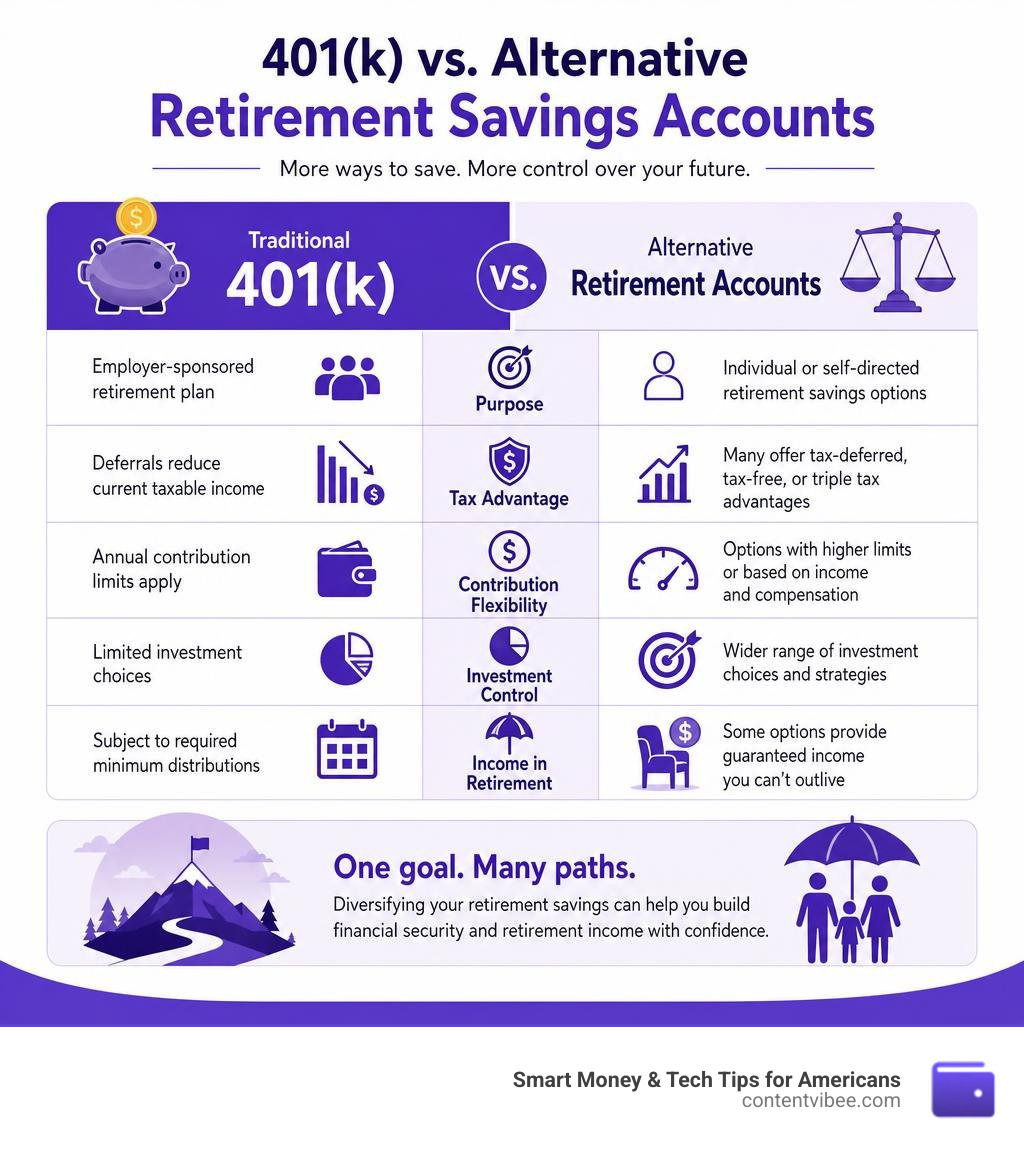
Alternative ways to save for retirement terms to learn:
Why Look Beyond the Traditional 401(k)?

Defined contribution plans like the standard 401(k) have become the default retirement vehicle for millions of workers. However, relying solely on them can leave you with significant blind spots. If your employer doesn’t offer a matching contribution, or if the investment choices within your plan are limited and burdened by high administrative fees, you might be leaving money on the table.
Furthermore, historical retirement statistics paint a sobering picture: a Federal Reserve Board study found that the median retirement account balance among households ages 55 to 64 was exceptionally low, and many workers miss out on compounding growth simply because they do not participate in their workplace plans.
If you are looking to build a robust nest egg, stepping outside the 401(k) boundary allows you to customize your investment portfolio, lower your fee exposure, and target better returns. To figure out where you stand with your current workplace savings, you can utilize helpful tools like a Retirement Math Made Easy With A 401K Balance Calculator. Taking control of your financial destiny also means adopting solid habits early on, which is why we recommend checking out these 10 Tips on How to Save for Retirement – California Credit Union to build a firm foundation.
Tax-Advantaged Alternative Ways to Save for Retirement
To build a truly resilient retirement portfolio, you need to understand tax diversification. Spreading your savings across different “tax buckets” (pre-tax, tax-free, and taxable) protects you from future tax hikes and gives you flexibility when it’s time to withdraw your funds.
Here is how the top tax-advantaged alternatives compare in 2026:
| Account Type | 2026 Contribution Limit | Tax Advantage | Withdrawal Rules |
|---|---|---|---|
| Traditional IRA | $7,500 ($8,600 if age 50+) | Tax-deductible contributions; tax-deferred growth | Withdrawals taxed as ordinary income; RMDs apply |
| Roth IRA | $7,500 ($8,600 if age 50+) | Tax-free growth; tax-free qualified withdrawals | No tax on qualified withdrawals; no RMDs |
| Health Savings Account (HSA) | $4,400 (Individual) / $8,750 (Family) | Triple tax advantage (pre-tax, tax-free growth, tax-free withdrawals) | Tax-free for medical; taxed as ordinary income after age 65 for non-medical |
Traditional and Roth IRAs as Alternative Ways to Save for Retirement
Individual Retirement Accounts (IRAs) are the most popular alternative ways to save for retirement outside of workplace plans.
- Traditional IRAs allow you to make pre-tax contributions, which can reduce your taxable income today. Your investments grow tax-deferred, and you only pay taxes when you withdraw the money in retirement.
- Roth IRAs flip this formula. You contribute post-tax dollars, meaning there is no immediate tax break. However, your money grows completely tax-free, and qualified withdrawals in retirement are also 100% tax-free.
In 2026, the contribution limit for both Traditional and Roth IRAs is $7,500 for those under 50, and $8,600 for those age 50 and older (which includes a $1,100 catch-up contribution).
If your income is too high to contribute directly to a Roth IRA, you can use the “backdoor Roth” strategy. This involves making a non-deductible contribution to a Traditional IRA and immediately converting it to a Roth IRA. To keep your administrative costs low while managing these accounts, explore the Stop Paying Platform Fees Top Tax Free Investment Accounts to maximize your savings.
Health Savings Accounts as Alternative Ways to Save for Retirement
Often marketed as a way to pay for current medical bills, the Health Savings Account (HSA) is actually a premier retirement tool. If you are enrolled in a High-Deductible Health Plan (HDHP), you are eligible to contribute to an HSA and unlock what financial planners call the triple tax advantage:
- Contributions are 100% tax-deductible (and exempt from FICA taxes if made via payroll deduction).
- The balance grows tax-free inside the account.
- Withdrawals are completely tax-free when used for qualified medical expenses.
In 2026, you can contribute up to $4,400 for individual coverage and $8,750 for family coverage, with an additional $1,000 catch-up contribution allowed if you are age 55 or older.
The ultimate retirement strategy here is the “stealth IRA” approach. Instead of spending your HSA funds on medical bills today, pay those bills out of pocket, keep the receipts, and let your HSA balance compound in low-cost index funds. There is no statute of limitations on when you must reimburse yourself. You can let the money grow for 20 years, then withdraw it tax-free by matching it against those old receipts.
Even if you run out of medical receipts, once you turn 65, the HSA functions exactly like a Traditional IRA—you can withdraw funds for any purpose and only pay ordinary income tax, with zero penalties. Learn more about optimizing your post-tax strategies with this guide on After Tax Contributions How To Maximize Your Retirement Nest Egg.
Self-Employed Plans: SEP, SIMPLE, and Solo 401(k)
If you work for yourself, run a small business, or earn side-hustle income in California, you are not locked out of high-limit retirement accounts. In fact, self-employed plans offer some of the most generous savings limits available:
- SEP IRA (Simplified Employee Pension): This plan allows you to contribute up to 25% of your net self-employment earnings, up to a maximum cap. It is incredibly easy to set up and maintain, with no annual IRS reporting required.
- SIMPLE IRA: Designed for small businesses with fewer than 100 employees, this plan allows salary reduction contributions and requires an employer match.
- Solo 401(k): If you have no employees (other than a spouse), the Solo 401(k) is often the gold standard. In 2026, the combined employee and employer contribution limit is a staggering $72,000 (plus a $7,500 catch-up contribution for those 50 and older). It also allows you to make Roth contributions, which SEP IRAs traditionally make more difficult.
For Californians seeking state-sponsored alternatives, the CalSavers | A simple, trusted way to save for retirement program offers an easy, portable way to build savings if your employer doesn’t offer a private plan. Additionally, if you work in the public sector or for certain non-profits, you may want to compare these to alternative structures by Demystifying The 457 Deferred Compensation Plan Your Golden Ticket To Early Retirement.
Non-Traditional and Investment-Based Strategies
A truly diversified retirement plan extends beyond standard mutual funds. Incorporating tangible assets and alternative investment vehicles can hedge against inflation and market volatility, provided you align them with your personal risk tolerance.
Self-Directed IRAs for Real Estate and Alternative Assets
A Self-Directed IRA (SDIRA) is a unique type of Traditional or Roth IRA that allows you to invest in alternative assets that standard custodians don’t support. This includes:
- Residential or commercial real estate
- Precious metals (like physical gold and silver)
- Private equity and start-up businesses
- Promissory notes
While SDIRAs unlock incredible investment flexibility, they require strict compliance. Under Internal Revenue Code Section 4975 (IRC §4975), you must avoid “prohibited transactions.” This means you cannot buy a rental property and live in it, rent it to a “disqualified person” (such as your parents, children, or spouse), or perform personal maintenance on the property. All expenses and revenues must flow directly through the IRA custodian.
If you violate these rules, the IRS can disqualify the entire account, treating it as fully distributed and subjecting it to massive tax bills. For those considering early retirement through alternative real estate holdings, timing is everything. Read our breakdown on When Can You Stop Working And Retire In California to plan your exit strategy.
Automated Investing and Robo-Advisors
For those who want to build wealth on autopilot without dealing with complex calculations, automated investing is a game-changer. Robo-advisors use algorithms to manage your asset allocation, automatically rebalancing your portfolio as market conditions change.
One of the greatest benefits of robo-advisors is automated tax-loss harvesting. This strategy involves selling losing investments to offset capital gains taxes, keeping more money compounding in your account.
To determine if this path fits your style, check out our resources:
- Learn the basics: What Is Robo Advisor
- Evaluate the pros and cons: Is Automated Portfolio Management Right For You
- Simple strategies: Best Autopilot Investing Strategies For Beginners Who Hate Math
- Set up a wealth system: Set And Forget Your Way To Wealth With Automated Investing
- Find budget-friendly options: How To Find Free Robo Advisors That Actually Save You Money
- Compare costs: The Ultimate Guide To Robo Advisor Fees and The No Nonsense Guide To Fidelity Robo Advisor Fees
- Discover human-algorithm blends: Hybrid Robo Advisors
- Read head-to-head reviews: Robo Advisor Reviews Which Automated Investing Platform Wins
- Understand risk metrics: Robo Advisor Asset Allocation Can Robots Really Gauge Your Risk Tolerance
- Unlock tax efficiency: Tax Loss Harvesting The Secret Weapon Of Robo Advisors
Annuities and Cash-Value Life Insurance
Annuities are contracts with insurance companies designed to provide a steady, guaranteed income stream during your retirement years. They can be structured to pay out immediately or defer payments to a later date.
- Pros: They mitigate the risk of outliving your money and provide predictable returns.
- Cons: They often come with high administrative fees, complex terms, and a “surrender period”—a multi-year window during which withdrawing your principal results in heavy financial penalties.
Cash-value life insurance policies (such as Whole Life) also serve as alternative retirement vehicles. These policies build cash reserves over time that you can borrow against tax-free. However, they are generally more expensive than term life insurance and require careful management to avoid policy lapses. If you are aiming for an early exit from the workforce, take a look at this list of factors: Think you can retire at 50? Here are 8 things to consider .
Low-Risk Vehicles: CDs, High-Yield Savings, and Money Market Accounts
If you are close to retirement or have a low risk tolerance, preserving your capital is just as important as growing it. Low-risk vehicles backed by FDIC or NCUA insurance (up to $250,000 per depositor, per institution) provide safety and liquidity:
- High-Yield Savings Accounts (HYSAs): Offer much higher interest rates than traditional checking or savings accounts while keeping your cash fully liquid.
- Money Market Accounts (MMAs): Combine the competitive interest rates of HYSAs with check-writing privileges or debit card access.
- Certificates of Deposit (CDs): Lock your money in for a set period (ranging from months to years) in exchange for a fixed interest rate. To maintain access to cash while securing high yields, you can build a “CD ladder” by purchasing multiple CDs that mature at staggered intervals.
Frequently Asked Questions About Alternative Retirement Strategies
How much should I save annually for retirement?
As a general rule of thumb, financial experts recommend aiming to save 15% of your pre-tax income annually for retirement (including any employer matching contributions).
Because you will likely need 70% to 90% of your pre-retirement income to maintain your standard of living, and Social Security only replaces about 40% of average earnings, your personal savings must bridge the remaining 30% to 50% gap.
What strategies can help maximize my retirement savings?
- Automate Your Savings: Set up automatic transfers to your IRAs, HSAs, or brokerage accounts on payday so you never have the chance to spend that money.
- Utilize Catch-Up Contributions: If you are age 50 or older, take advantage of the higher annual limits allowed for IRAs and workplace plans.
- Delay Social Security: While you can claim benefits starting at age 62, delaying your claim past your Full Retirement Age (until age 70) increases your monthly benefit by up to 8% for every year you wait.
- Let Compound Interest Work: Start as early as possible. Even small, consistent contributions made in your 20s or 30s will vastly outperform larger amounts started in your 40s or 50s.
How can I make my retirement savings last?
To prevent running out of money, establish a sustainable withdrawal strategy. The historical benchmark is the 4% rule, which suggests withdrawing 4% of your portfolio in your first year of retirement and adjusting that dollar amount for inflation each year after.
Additionally, perform annual portfolio rebalancing to keep your asset allocation aligned with your risk tolerance, and maintain a cash cushion (such as 1 to 2 years of living expenses in an HYSA) to protect against sequence of returns risk—the danger of having to sell stock market investments during a market downturn.
Conclusion
There is no single “correct” path to financial security. Whether you choose to leverage the triple tax advantages of an HSA, build a real estate portfolio inside a self-directed IRA, or automate your stock market investments with a robo-advisor, the key is to build a customized retirement roadmap that works for you.
At Suppremo, we are dedicated to helping you navigate these complex choices with clear, actionable advice. Securing your financial independence means looking at the big picture—including how government benefits fit into your plan. To optimize your retirement strategy, read our A Comprehensive Guide to Social Security Benefits and start taking control of your financial future today!