7 Best Motorcycle Personal Injury Attorneys
When Every Second Counts: Finding the Right Motorcycle Personal Injury Attorney
If you need a motorcycle personal injury attorney right now, here are the most important things to know:
Quick Answer: Top things a motorcycle personal injury attorney does for you:
- Fights insurance bias — Insurers often assume riders are reckless. An attorney pushes back.
- Builds your case — Gathers police reports, witness statements, dashcam footage, and expert testimony.
- Calculates full damages — Medical bills, lost wages, pain and suffering, and property damage.
- Negotiates on your behalf — So you don’t have to deal with adjusters while recovering.
- Works on contingency — No upfront costs. You pay nothing unless you win.
Motorcycle accidents are not like car accidents. According to the National Highway Traffic Safety Administration (NHTSA), motorcyclists are 35 times more likely to suffer fatal injuries than people in passenger vehicles. And in nearly 98% of collisions between a car and a motorcycle, the rider gets hurt.
If you’ve been injured, you’re likely dealing with medical bills stacking up, lost income, and an insurance company that isn’t on your side. That’s a lot to handle while trying to heal.
The right attorney can change the outcome of your case — dramatically.
Handy motorcycle personal injury attorney terms:
Why You Need a Specialized Motorcycle Personal Injury Attorney
When you are involved in a motorcycle collision, hiring a general personal injury lawyer is like asking a dentist to perform heart surgery. They are both in the medical field, but the specialization is entirely different.
Motorcycles operate on completely different physics than passenger cars. Understanding the nuances of countersteering, lane positioning, and how rider experience influences split-second decisions is critical when building a legal case.
For instance, an inexperienced driver in a sedan might see a motorcyclist swerve and assume they were riding recklessly. In reality, a rider knows that swerving is often the only way to avoid a deadly road hazard or a sudden car door opening. A specialized attorney understands these dynamics and knows how to explain them to a jury or an insurance adjuster.
If you are currently trying to navigate the complex legal waters after a crash, knowing How to find the right legal help is your very first step toward physical and financial recovery.
How a Motorcycle Personal Injury Attorney Overcomes Insurance Bias
Let’s address the elephant in the courtroom: rider bias. There is a persistent, unfair cultural assumption that anyone who rides a motorcycle is a reckless daredevil looking for trouble.
Insurance adjusters love this stereotype. They rely on it to devalue your claim, arguing that you must have been speeding, lane splitting unsafely, or failing to react in time. They use complex mathematical algorithms and assumptions about human reaction times to shift the blame onto you.
An experienced lawyer knows how to dismantle this prejudice. Attorneys who specialize in this field—especially Attorneys who ride—understand the daily threats bikers face from distracted or impaired motorists. They can anticipate the insurer’s tricks, present concrete evidence to prove you were riding defensively, and ensure that jury prejudice does not get in the way of your right to fair compensation.
Understanding Motorcycle Dynamics and Crash Physics
To win a motorcycle accident lawsuit, your legal team must understand the science of the ride. This includes:
- Braking Distance: Motorcycles require different braking techniques and distances compared to cars, especially on wet or uneven pavement.
- Road Hazards: A minor pothole, loose gravel, or a metal construction plate that a car would roll right over can cause a motorcycle to lose traction and crash.
- Accident Reconstruction: Specialized attorneys work closely with accident reconstruction experts who can analyze skid marks, vehicle damage, and road conditions to prove exactly how the crash occurred.
Without this specialized knowledge, crucial details can get lost in translation. If your accident occurred on the West Coast, securing specialized California motorcycle accident representation ensures your legal team understands how local road designs and traffic patterns contribute to these unique physics.
7 Best Qualities of a Top Motorcycle Accident Lawyer
Finding the right legal advocate can feel overwhelming when you are trying to recover from severe injuries. To help you narrow down your search, look for these seven essential qualities in a top-tier attorney:
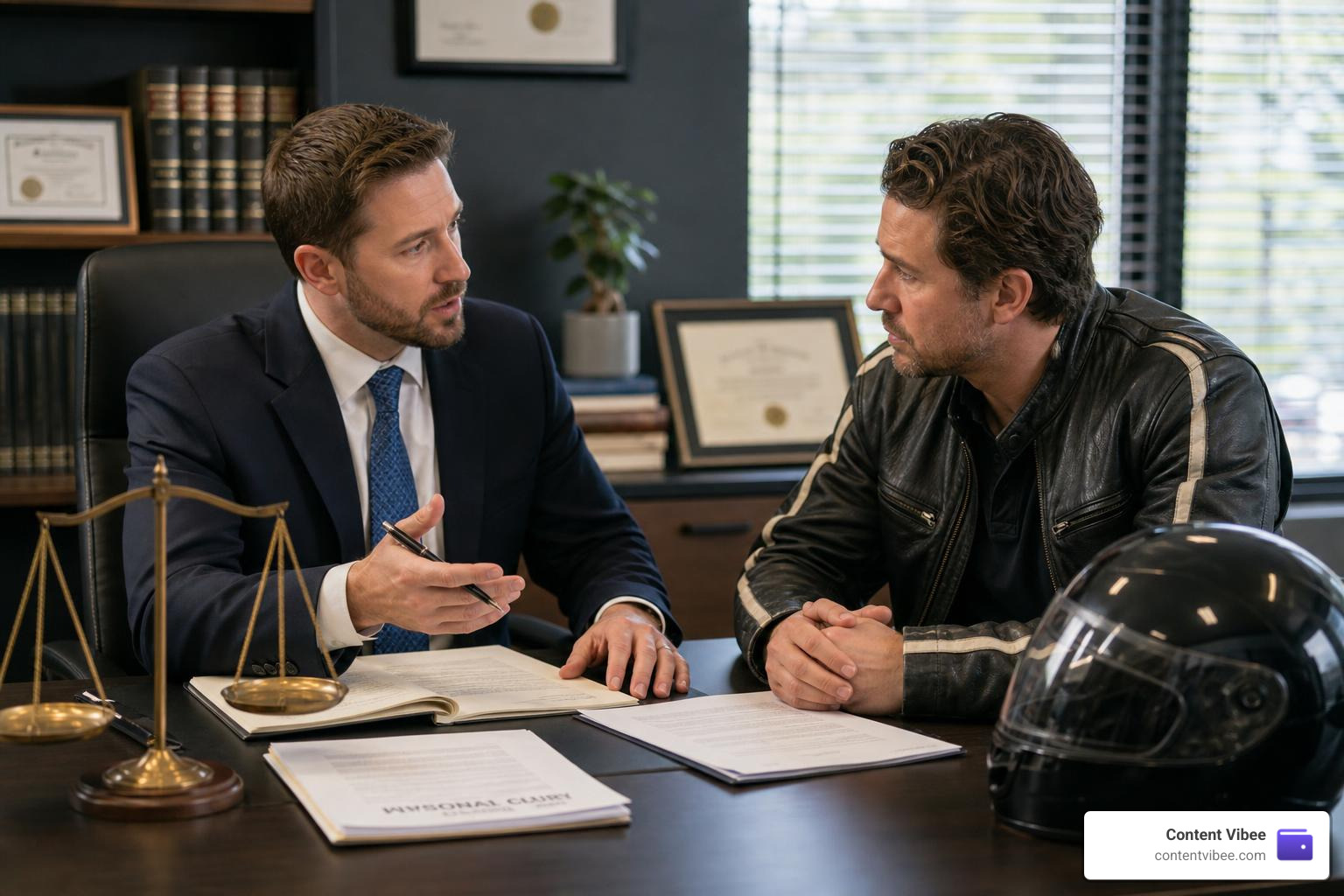
- Direct Riding Experience: An attorney who rides personally understands road hazards, countersteering, and the vulnerability of being on two wheels.
- Deep Knowledge of Crash Physics: They can easily explain the mechanics of a motorcycle collision to an insurance adjuster or jury.
- Willingness to Go to Trial: Some law firms are “settlement mills” that take the first lowball offer. You want an attorney who is fully prepared to take your case to court to maximize your recovery.
- Access to Top Reconstruction Experts: They have a network of medical professionals, life-care planners, and accident reconstructionists ready to build your case.
- No Fee Unless You Win (Contingency): They operate on a clear contingency fee structure, meaning you pay nothing upfront and nothing at all unless they secure a settlement or verdict.
- Transparent Communication: They keep you updated regularly and explain complex legal terms in plain English.
- A Proven Track Record with Catastrophic Claims: They have successfully recovered millions of dollars specifically for motorcycle crash victims.
To see how top-rated legal professionals measure up across the country, check out our guide on the Top 10 reviewed attorneys to find the best advocate for your specific situation.
Key Differences Between Motorcycle and Car Accident Claims
While both fall under the umbrella of personal injury law, motorcycle claims are vastly different from standard passenger vehicle claims. The stakes are much higher, the injuries are far more severe, and the legal hurdles are significantly more complex.
Here is a quick look at how these two types of claims compare:
| Feature | Car Accident Claims | Motorcycle Accident Claims |
|---|---|---|
| Fatality Risk | Baseline | 35x higher risk of death |
| Injury Rate | Lower (protected by steel frame/airbags) | 98% of collisions result in rider injury |
| Insurance Bias | Generally neutral | High (assumption of rider recklessness) |
| No-Fault Exclusions | Covered in most no-fault states | Often excluded from standard no-fault coverage |
| Road Hazard Impact | Minor inconvenience | Can easily cause catastrophic crashes |
Because of these stark differences, relying on standard auto insurance routes can leave you holding the bag for hundreds of thousands of dollars in medical debt. To learn more about how standard auto claims differ, read up on Car accident legal differences.
Severe Injuries and Long-Term Impacts
Because motorcycles offer virtually no physical protection, even a low-speed collision can result in life-altering physical trauma. Some of the most common injuries sustained by riders include:
- Traumatic Brain Injuries (TBI): Even with a high-quality helmet, the sudden impact of a crash can cause severe brain trauma.
- Road Rash: This is not just a bad scrape. Severe road rash can strip away skin down to the muscle, requiring painful skin grafts and leading to permanent scarring or infections.
- Spinal Cord Damage: Severe impacts can cause partial or complete paralysis, requiring lifelong medical care and home modifications.
- Biker’s Arm / Hand Injuries: When a rider is thrown from their bike, their natural instinct is to draw their arms out to break the fall. This often results in severe nerve damage, broken wrists, and torn ligaments.
The statistics are sobering. For example, in Florida, over 500 motorcyclists lose their lives every single year. In a recent study of the St. Petersburg and Tampa Bay area, there were nearly 1,700 motorcycle accidents in a single year, and over 80% of them resulted in serious personal injury.
If you or a loved one has been injured in this region, consulting a specialized St. Petersburg motorcycle injury lawyer is vital to securing the compensation needed for long-term medical care and rehabilitation.
State Laws, Statutes of Limitations, and Contributory Negligence
Where your accident occurs plays a massive role in how your case is handled. Every state has its own rules regarding how long you have to file a claim (the statute of limitations) and how fault is distributed.
- Arkansas: The state has seen a worrying 23% increase in deadly motorcycle wrecks in recent years, ranking third highest nationally for fatalities. Arkansas generally gives you a three-year window to file a personal injury claim.
- North Carolina: This state enforces a strict contributory negligence rule. Under this law, if you are found to be even 1% at fault for the accident, you can be completely barred from recovering any compensation. This is why having a strong defense against insurer blame is so critical here. Learn more about navigating these strict rules with North Carolina motorcycle accident claims.
- California: California operates under pure comparative negligence. This means you can still recover damages even if you were partially at fault, though your payout will be reduced by your percentage of blame. California also uniquely permits legal lane splitting, which requires a specialized legal eye to evaluate properly in accident reports.
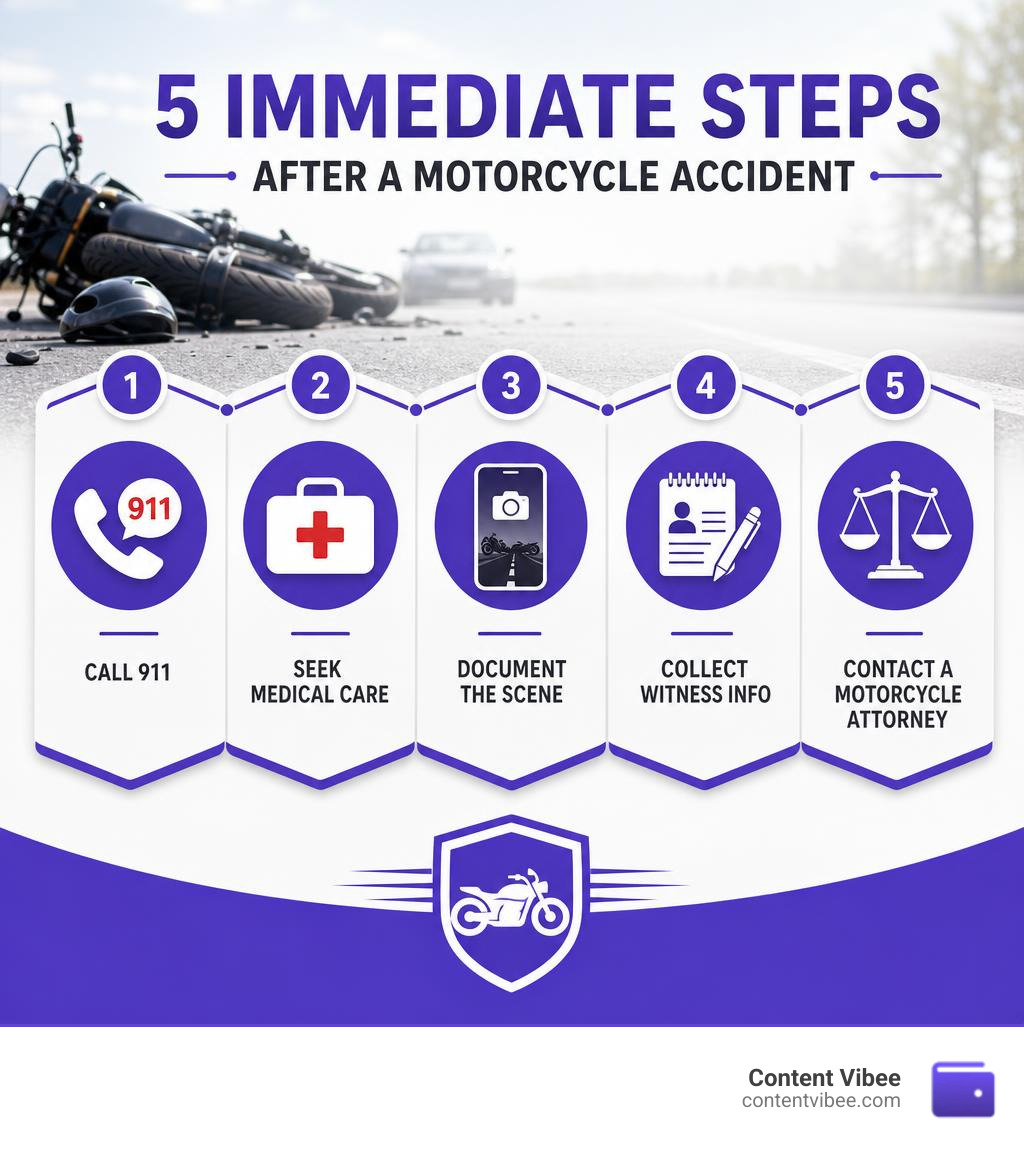
What to Do Immediately After a Motorcycle Crash to Protect Your Rights
The moments directly following a motorcycle crash are chaotic, but the actions you take can make or break your future legal claim.
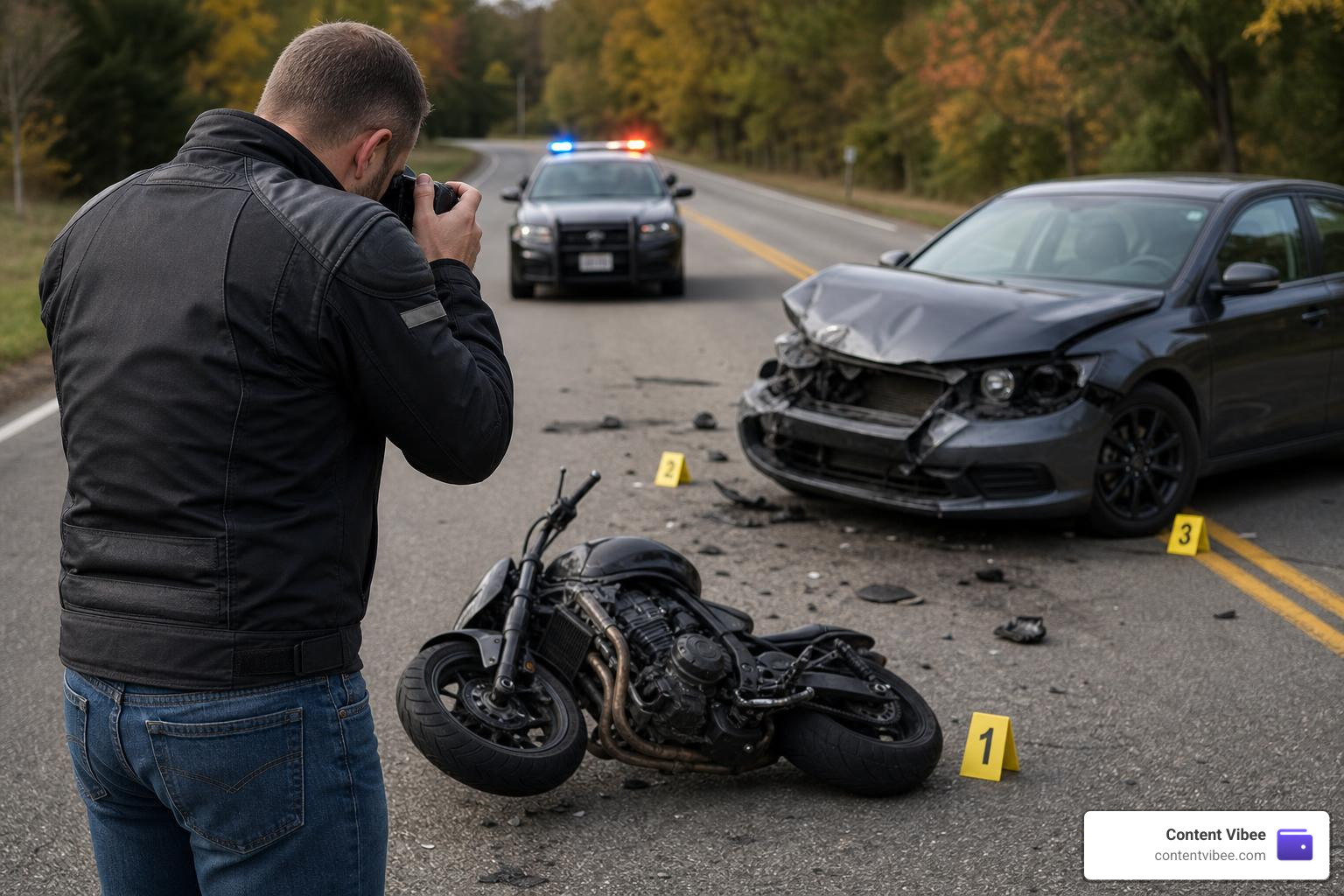
- Call 911 Immediately: Ensure that police and medical responders are dispatched to the scene. A formal police report is a cornerstone of evidence.
- Seek Immediate Medical Attention: Even if you feel “fine” or just shaken up, adrenaline can mask severe internal injuries or brain trauma. Always get checked out by a doctor.
- Document the Scene: If you are physically able, take photos of your motorcycle, the other vehicle, skid marks, road hazards, your riding gear, and your visible injuries.
- Gather Witness Information: Collect names, phone numbers, and statements from anyone who saw the crash occur.
- Never Admit Fault or Give Recorded Statements: Do not apologize to the other driver (which can be twisted as an admission of guilt) and do not agree to give a recorded statement to the insurance adjuster until you have spoken with a lawyer.
The Critical Role of Evidence in Your Claim
In personal injury law, claims are won on evidence, not emotions. To overcome insurance company bias, your attorney will need a robust treasure trove of proof. This includes:
- Official police reports and citations issued to the other driver.
- Dashcam footage from nearby vehicles or traffic camera recordings before they are overwritten.
- Comprehensive medical records documenting your injuries immediately after the crash and throughout your recovery.
- Expert accident reconstruction diagrams showing vehicle speeds and impact angles.
Understanding how to preserve this evidence is key to successfully Filing a personal injury claim that can stand up to aggressive insurance defense tactics.
What to Expect During a Free Consultation with a Motorcycle Personal Injury Attorney
Most reputable motorcycle accident lawyers offer a free, no-obligation initial consultation. This is your chance to interview them and see if they are a good fit for your case.
During this meeting, the attorney will:
- Evaluate the facts of your accident and assess liability.
- Review your medical bills, property damage, and insurance policies.
- Explain your legal rights under your state’s specific personal injury laws.
- Outline your legal options and describe how they plan to pursue compensation.
Frequently Asked Questions about Motorcycle Accident Claims
What compensation can I recover in a motorcycle accident claim?
If your accident was caused by another driver’s negligence, you may be entitled to recover both economic and non-economic damages, including:
- Medical Expenses: Coverage for emergency room visits, surgeries, hospital stays, physical therapy, and future medical care.
- Lost Wages: Compensation for the income you lost while recovering, as well as loss of future earning capacity if you suffer a permanent disability.
- Pain and Suffering: Damages for physical pain, emotional distress, anxiety, and loss of enjoyment of life.
- Property Damage: The cost to repair or replace your motorcycle, helmet, and protective riding gear.
How do contingency fee arrangements work for injured riders?
Most motorcycle personal injury attorneys work on a contingency fee basis. This means there are absolutely no upfront, out-of-pocket costs for you.
The law firm covers all the expenses of investigating your crash, hiring experts, and filing paperwork. They only get paid if they successfully resolve your case through a settlement or court verdict. Their fee is a pre-agreed percentage of your final recovery—meaning if you don’t get paid, they don’t get paid.
What if I was partially at fault for the motorcycle accident?
Being partially at fault does not automatically mean you cannot recover compensation. In states that use comparative negligence (like California), your compensation will simply be reduced by your percentage of fault. For example, if you are awarded $100,000 but found to be 20% at fault, you will receive $80,000.
However, in contributory negligence states (like North Carolina), even minor fault can bar recovery. This is why having an experienced attorney is vital to defend you against unfair allegations of blame.
Conclusion
At Content Vibee, we believe that making smart financial and legal decisions after a life-altering event like a motorcycle accident is crucial to your physical and financial recovery. Navigating insurance claims, medical bills, and complex state laws on your own is an uphill battle—especially when fighting systemic bias against riders.
Partnering with a specialized legal advocate allows you to focus on what matters most: healing and getting back on the road. If you are also dealing with a passenger vehicle collision or want to compare your options, take a look at our guide on How to find a good car accident lawyer to protect your rights on every front.